Internet Browsers Market Size, Share & Trends Analysis Report By Browser Type (Desktop Browsers, Mobile Browsers, Tablet Browsers), By Platform (Windows, macOS, Android, iOS, Linux, Other Platforms), By Distribution Model (Pre-installed, Downloadable), By Application (Personal Use, Enterprise Use, Education & Research, Government & Public Sector) and By Region (North America, Europe, Asia-Pacific, Middle East and Africa, Latin America) Forecasts, 2026–2034
USD 3950
Internet Browsers Market Size
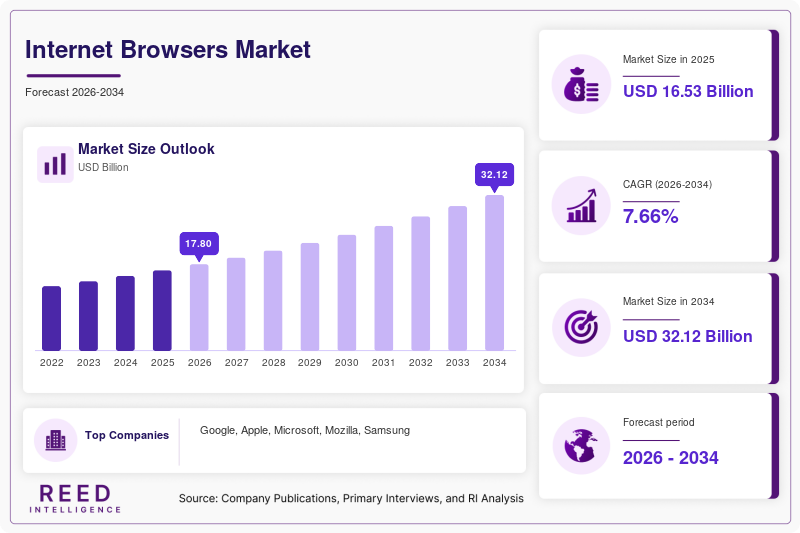
The internet browsers market was valued at USD 16.53 billion in 2025 and is estimated to reach USD 17.80 billion in 2026. The market is projected to reach USD 32.11 billion by 2034, registering a 7.66% CAGR during 2026–2034.
The internet browsers market is being shaped by the continued migration of web activity across smartphones, PCs and other connected devices, while competition between browser providers increasingly centers on privacy, security, AI-assisted browsing, synchronization and platform integration. Browser usage remains highly concentrated: StatCounter reported Chrome at 69.39% of worldwide browser usage in August 2026, followed by Safari at 15.83%, Edge at 5.36%, Firefox at 2.98%, Samsung Internet at 2.01% and Opera at 1.94%.
The commercial mechanism is broader than browser downloads. Browsers function as gateways to search, advertising, cloud applications, e-commerce, streaming, enterprise software and other online services. Consequently, browser providers compete for user engagement and ecosystem participation, while enterprises increasingly evaluate browsers through security, manageability and compatibility requirements.
Internet Browsers Market Drivers
AI Integration Is Expanding the Browser's Role from Web Access to an Intelligent Interface
Browser providers are increasingly integrating AI-assisted capabilities into the browsing experience, changing the browser from a relatively passive page-rendering application into an interface for search, information retrieval and productivity.
The market mechanism is linked to engagement and differentiation. AI functions can encourage users to perform research, summarization, comparison and content-generation tasks within the browser rather than moving between separate applications. This gives browser vendors additional opportunities to strengthen ecosystem usage and differentiate products.
The impact is particularly relevant to desktop and mobile users with frequent information-intensive workflows. However, AI features also introduce higher infrastructure, privacy and accuracy requirements, and vendors must balance functionality with user trust.
Privacy and Security Features Are Becoming Product Differentiators
Privacy has become an increasingly visible component of browser competition. Google has developed Privacy Sandbox technologies intended to reduce cross-site tracking while supporting advertising and web functionality, while Chrome has also introduced mechanisms to restrict third-party cookies in its privacy initiative.
The commercial mechanism is a shift in browser value toward privacy controls, tracking protection, permission management and secure browsing. These capabilities can influence browser selection among privacy-conscious consumers and organizations.
Apple similarly positions Safari around privacy features, including Private Browsing and protections concerning website data.
The counterbalance is that privacy implementations can affect advertising, analytics and website compatibility, requiring browser providers to balance user protection with ecosystem functionality.
Growth of Mobile Internet Usage Expands Browser Consumption Across Connected Devices
Mobile devices have become a major access point for internet services, increasing the importance of browsers optimized for smartphones and tablets. Current browser market data shows Chrome and Safari holding substantial global positions, with platform ecosystems strongly influencing browser usage.
The market mechanism is primarily device penetration and embedded software distribution. Android devices provide Chrome with broad distribution, while Apple's device ecosystem supports Safari adoption. This creates a recurring installed-user base and reduces the need for users to actively download a browser.
The opportunity is strongest in emerging digital markets where smartphone-based internet usage continues to expand. However, default-browser positioning and operating-system policies can make competitive entry difficult.
Internet Browsers Market Restraints
Strong Default-Browser Positions Increase Switching Barriers
Browser usage is highly concentrated among a small number of providers. StatCounter's August 2026 worldwide data shows Chrome, Safari and Edge collectively accounting for more than 90% of measured browser usage.
The mechanism is network and distribution driven. Users frequently retain the browser supplied with their operating system or device, reducing the incentive to download alternatives.
This makes customer acquisition more difficult for smaller browser vendors and increases the importance of differentiation through privacy, performance, customization, security or specialized functionality.
Browser Compatibility and Privacy Changes Increase Development Costs
Browser providers must maintain compatibility with evolving web standards, security requirements and websites. Changes to tracking technologies can also require developers, publishers and advertisers to modify existing implementations.
Google's Privacy Sandbox development illustrates the complexity of changing browser-level web technologies while coordinating with publishers, advertisers, developers and regulators.
For browser vendors, maintaining compatibility while introducing new privacy and AI capabilities increases engineering requirements and testing costs.
Internet Browsers Market Opportunities
AI-Powered Browsing Creates a New Differentiation Layer
AI can expand browsers into research, productivity and decision-support interfaces. Instead of limiting the browser to navigation and content rendering, providers can integrate summarization, contextual search, writing assistance and task-oriented workflows.
This creates an opportunity for vendors to differentiate products without relying solely on page-loading performance. The opportunity is particularly relevant on desktops, where users frequently perform research, document work and enterprise tasks.
Adoption will depend on the quality of AI outputs, latency, privacy controls and integration with existing services.
Enterprise Browser Management Creates Demand Beyond Consumer Browsing
Organizations increasingly require browsers to operate as managed endpoints rather than purely consumer applications. Enterprise requirements include security policies, identity integration, extension management, data protection and centralized administration.
This creates an opportunity for browser vendors to monetize enterprise features and compete on security and manageability. The addressable opportunity is particularly relevant for organizations with large distributed workforces.
The main constraint is competition from established browsers that already have strong operating-system and enterprise-software integrations.
Internet Browsers Market Browser Type Segment Analysis
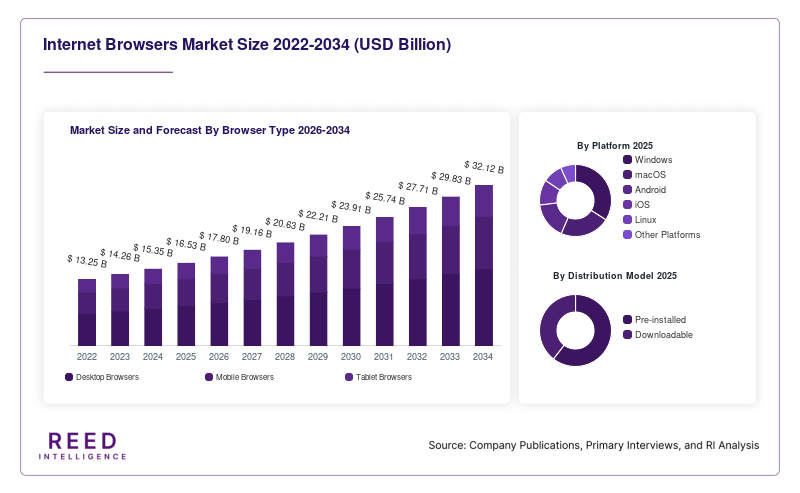
Mobile Browsers are internally modeled as the largest browser-type segment, accounting for approximately 52% of the 2025 market, equivalent to USD 8.60 billion. Their position reflects the large installed base of smartphones and the integration of browsers into mobile operating systems.
The segment is modeled to reach approximately USD 17.15 billion by 2034, increasing its share to approximately 53.4%, representing a modeled 7.97% CAGR.
Mobile browser demand is strongly linked to smartphone usage, app-to-web interactions, mobile commerce and social-media activity. Distribution through Android and iOS ecosystems also reduces user acquisition friction.
The principal limitation is platform dependence. Browser vendors operating outside the dominant mobile ecosystems can face restrictions in distribution, default-browser positioning and system-level integration.
Tablet Browsers account for approximately 11% of the 2025 market, equivalent to USD 1.82 billion. Tablets occupy an intermediate position between smartphones and PCs, with demand concentrated among users seeking larger screens for browsing, entertainment, education and productivity.
The segment is modeled to reach approximately USD 3.33 billion by 2034, representing around 10.4% share and a modeled 6.80% CAGR.
Its development depends on tablet adoption and the increasing use of larger-screen mobile devices. However, tablets compete directly with smartphones for casual browsing and with laptops for productivity-oriented use.
Internet Browsers Market Platform Analysis
Windows accounts for approximately 34% of the 2025 market, equivalent to USD 5.62 billion. Its large PC installed base supports substantial desktop browser usage, particularly across enterprise and professional environments.
Android represents approximately 31% of the 2025 market, or USD 5.12 billion. Its broad global smartphone footprint makes it a major browser distribution environment and supports large-scale mobile web usage.
iOS accounts for approximately 20% of the 2025 market, equivalent to USD 3.31 billion. Safari's integration into Apple's device ecosystem provides a substantial installed-user base.
macOS represents approximately 8% of the 2025 market, or USD 1.32 billion. The platform supports browser usage among consumers, creative professionals and enterprise users.
Linux accounts for approximately 4% of the 2025 market, equivalent to USD 661 million. Usage is concentrated among technical users, developers, researchers and specialized enterprise environments.
Other platforms collectively represent approximately 3% of 2025 revenue, or USD 496 million. These include specialized and less widely deployed operating environments.
Internet Browsers Market Distribution Model Analysis
Pre-installed browsers account for approximately 71% of the 2025 market, equivalent to USD 11.74 billion. Operating-system and device integration provides vendors with a major distribution advantage because users can access the browser without installing additional software.
Downloadable browsers represent approximately 29% of the 2025 market, or USD 4.79 billion. This category includes users who actively select an alternative browser based on privacy, performance, features, enterprise requirements or ecosystem preferences.
Internet Browsers Market Application Analysis
Personal use accounts for approximately 58% of the 2025 market, equivalent to USD 9.59 billion. Browsers remain a primary interface for search, entertainment, social media, shopping and general web access.
Enterprise use represents approximately 25% of the 2025 market, or USD 4.13 billion. Organizations increasingly evaluate browsers based on security, identity, compatibility, centralized administration and employee productivity.
Education and research contribute approximately 11% of 2025 revenue, equivalent to USD 1.82 billion. Browser usage is closely connected with digital learning platforms, online research and cloud-based educational tools.
Government and public-sector applications represent approximately 6% of the 2025 market, or USD 992 million. Demand is influenced by secure access requirements, compatibility and centralized device management.
Internet Browsers Market Regional Analysis
North America Represents a Mature Browser Market Supported by High Digital Service Usage and Enterprise Adoption
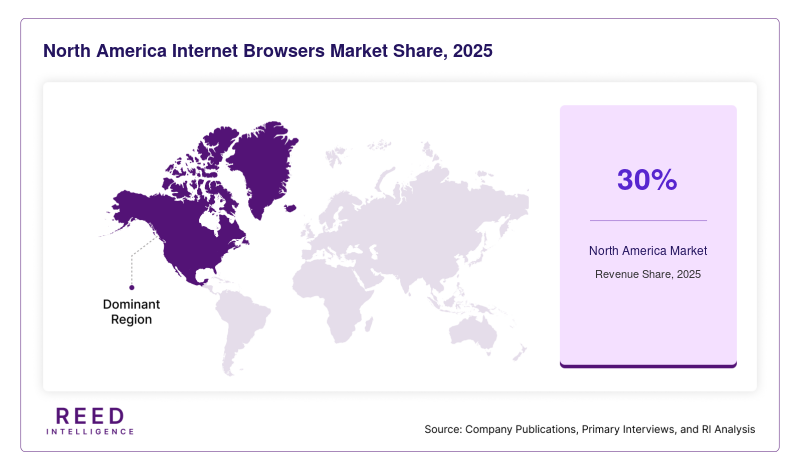
North America accounts for approximately 30% of the 2025 market, equivalent to USD 4.96 billion. Its share is internally modeled at 28.5% by 2034, with market value reaching approximately USD 9.15 billion and a modeled 7.04% CAGR.
The region has high adoption of cloud applications, digital commerce, streaming services and enterprise software, creating sustained browser usage across consumer and business environments.
The commercial mechanism is increasingly shifting from basic browser adoption toward enterprise security, AI functionality, privacy controls and integration with productivity ecosystems.
The U.S. remains particularly important. Statista's June 2026 data placed Chrome at 52.1% of U.S. browser usage, Safari at 25.9% and Edge at 7.5%, illustrating the concentration of usage among established platforms.
Europe Maintains Demand Through Privacy, Security and Digital-Regulation Considerations
Europe represents approximately 25% of the 2025 market, equivalent to USD 4.13 billion. Its share is modeled at 24% by 2034, with market value reaching approximately USD 7.71 billion and a modeled 7.17% CAGR.
Privacy and data governance are particularly relevant to browser competition because browser-level tracking technologies influence the digital advertising ecosystem. Google's Privacy Sandbox development has involved engagement with European regulatory stakeholders, illustrating the connection between browser technology and digital-market governance.
Demand therefore extends beyond performance to privacy controls, enterprise security and compatibility.
Asia-Pacific Represents the Fastest-Growing Region as Internet Access Continues to Expand Across Mobile Devices
Asia-Pacific accounts for approximately 29% of the 2025 market, equivalent to USD 4.79 billion. Its share is internally modeled to reach 32% by 2034, with market value reaching approximately USD 10.27 billion and a modeled 8.81% CAGR.
The region's large smartphone population, expanding digital commerce and increasing online service usage provide the underlying demand base. Mobile browsers are particularly important because smartphones provide internet access to users who may have limited reliance on traditional PCs.
The competitive environment remains highly platform-dependent, with Android and iOS ecosystems influencing browser distribution and usage.
Middle East and Africa Represents a Developing Market Driven by Mobile-First Internet Usage
Middle East and Africa account for approximately 8% of the 2025 market, equivalent to USD 1.32 billion. The regional share is modeled at 8.5% by 2034, with market value reaching approximately USD 2.73 billion and a modeled 8.44% CAGR.
Mobile connectivity provides an important demand mechanism, particularly in markets where smartphones are a primary gateway to online services. Browser demand also benefits from expanding digital payments, government services, education platforms and online commerce.
Constraints include differences in connectivity quality, device affordability and digital infrastructure across countries.
Latin America Represents a Growing Market Closely Connected to Smartphone-Based Internet Access
Latin America represents approximately 8% of the 2025 market, equivalent to USD 1.32 billion. Its share is modeled at 7% by 2034, with market value reaching approximately USD 2.25 billion and a modeled 6.08% CAGR.
Browser usage is supported by smartphone penetration, social-media activity, digital commerce and online financial services. Mobile browsing remains particularly relevant because smartphones provide a relatively accessible gateway to online services.
Economic volatility and differences in connectivity infrastructure can affect device upgrades and overall digital-service consumption.
Internet Browsers Market Competitive Landscape
The internet browsers market is highly concentrated and competition is influenced by operating-system integration, search ecosystems, privacy architecture, security, AI capabilities, extension ecosystems and cross-device synchronization.
Google competes through Chrome's integration with Android, Google Search, Google Account services and a large extension ecosystem. StatCounter's August 2026 data places Chrome at 69.39% of worldwide browser usage, making ecosystem integration a major competitive asset.
Apple uses Safari's integration across iOS, macOS and iPadOS to maintain distribution through its hardware ecosystem. Its competitive positioning also includes privacy features and system-level integration.
Key Market Players
- Apple
- Microsoft
- Mozilla
- Samsung
- Opera
- Brave Software
- Vivaldi Technologies
- DuckDuckGo
- Yandex
Internet Browsers Market Recent Developments
- Google has continued developing Chrome privacy technologies designed to reduce reliance on third-party cookies and other cross-site tracking mechanisms. Its Privacy Sandbox initiative has involved technical testing and engagement with developers, publishers, advertisers and regulators. The market implication is broader than cookie management: changes to browser privacy architecture affect digital advertising, analytics, attribution and website functionality, increasing the strategic importance of browser technology for the wider internet economy.
- Apple's current Safari privacy documentation highlights Private Browsing and other mechanisms governing website data and processing. The continued emphasis on privacy means browser competition is increasingly connected to how providers handle tracking, website permissions, browsing information and user controls.
Internet Browsers Market Segments
By Browser Type
- Desktop Browsers
- Mobile Browsers
- Tablet Browsers
By Platform
- Windows
- macOS
- Android
- iOS
- Linux
- Other Platforms
By Distribution Model
- Pre-installed
- Downloadable
By Application
- Personal Use
- Enterprise Use
- Education & Research
- Government & Public Sector
By Region
- North America
- Europe
- APAC
- Middle East and Africa
- LATAM