Lab Grown Diamond Market Size, Share, Demand Report By Type (CVD Diamonds, HPHT Diamonds), By Application (Jewelry Manufacturing, Industrial Applications, Electronics & Semiconductor Applications, Optical Components), By End-Use (Jewelry Retail, Industrial Manufacturing, Aerospace & Defense, Electronics Industry) & Regional Forecasts, 2026–2034
USD 3950
Market Overview
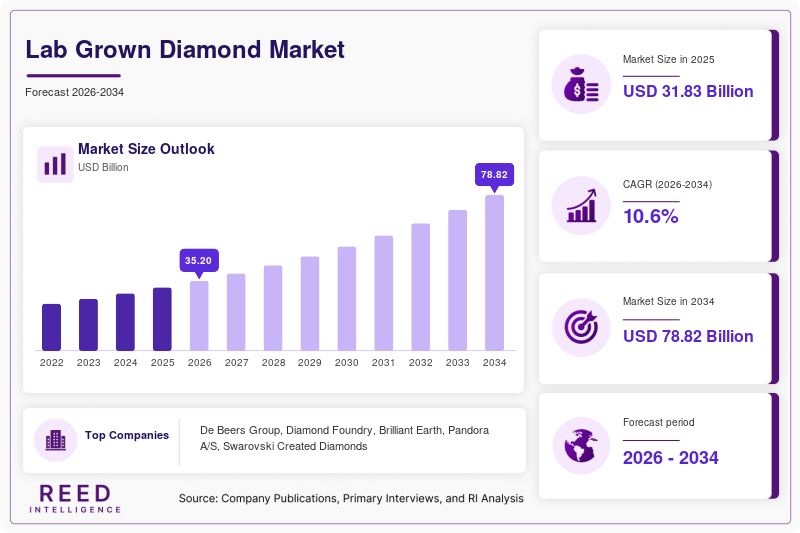
The Lab Grown Diamond Market size is projected to witness substantial expansion, with the global market size estimated at USD 35.2 billion in 2026 and expected to reach USD 78.5 billion by 2034, registering a CAGR of 10.6% during 2026–2034. The market growth is primarily driven by increasing consumer preference for ethically sourced gemstones, rising adoption of sustainable luxury products, and technological advancements in chemical vapor deposition (CVD) and high-pressure high-temperature (HPHT) manufacturing processes. A key global factor supporting market expansion is the shift in consumer purchasing behavior toward environmentally responsible and conflict-free alternatives in the jewelry industry, particularly among millennials and Gen Z populations.
Growing integration of lab grown diamonds in fashion jewelry, engagement rings, and industrial applications has strengthened market penetration across multiple end-use industries. The increasing affordability of lab created diamonds compared to mined diamonds has further enhanced demand across price-sensitive markets. Additionally, advancements in precision cutting and polishing technologies have improved product quality, making lab grown diamonds visually and chemically identical to natural diamonds, thereby increasing consumer acceptance across global markets.
Key Highlights
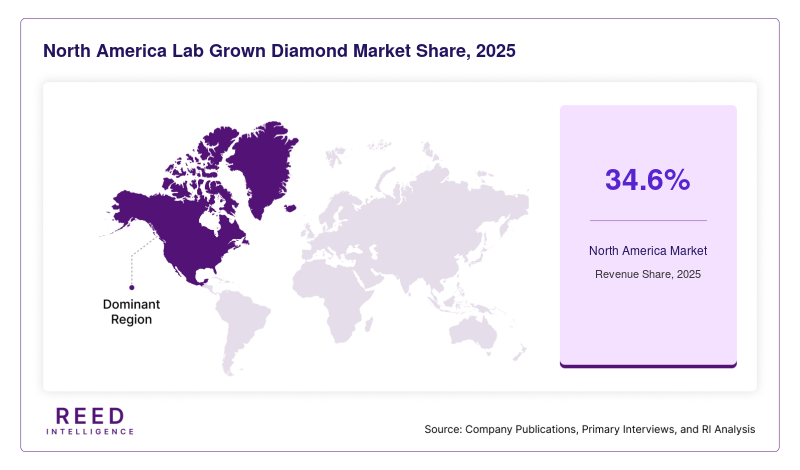
- North America dominated the market with a 34.6% share in 2025.
- Asia Pacific is expected to grow at the fastest CAGR of 11.4% during 2026–2034.
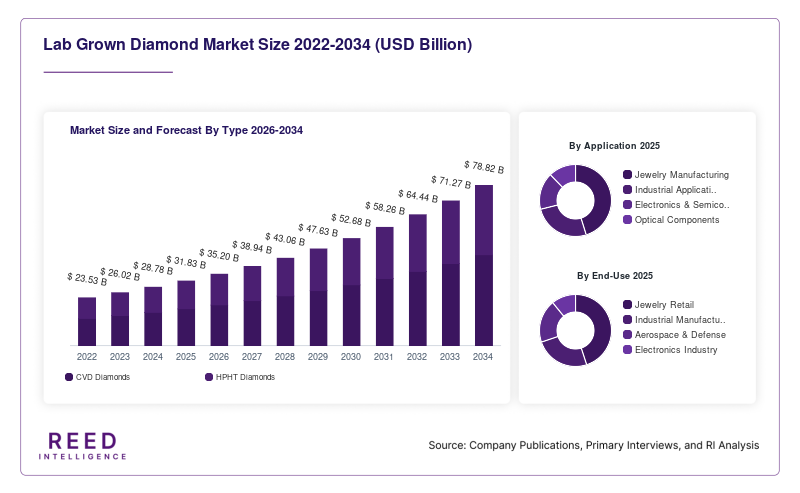
- By type, CVD diamonds accounted for the largest share of 52.1%, while HPHT diamonds are projected to grow at a CAGR of 11.9%.
- By application, jewelry manufacturing led with a 58.3% share, whereas industrial applications are expected to expand at a CAGR of 10.8%.
- The United States remained the dominant country, with market values of USD 6.8 billion in 2024 and USD 7.5 billion in 2025.
Market Trends
Rising Adoption of Sustainable Luxury and Ethical Jewelry
The lab grown diamond industry is increasingly shaped by a global transition toward sustainable luxury consumption. Consumers are showing a strong preference for gemstones that are conflict-free, environmentally responsible, and traceable throughout the supply chain. This shift is particularly evident among younger demographics who prioritize ethical sourcing and carbon footprint reduction. Jewelry brands are responding by expanding collections that exclusively feature lab grown diamonds, integrating sustainability narratives into marketing strategies. Retailers are also investing in transparent certification systems that validate origin and production methods. This trend is further supported by corporate sustainability commitments across the luxury sector, where brands are aligning with ESG frameworks. As awareness grows, lab grown diamonds are becoming a mainstream alternative rather than a niche category.
Technological Advancements in Diamond Production Methods
Technological innovation in CVD and HPHT processes continues to transform production efficiency and quality standards in the lab grown diamond market. Manufacturers are increasingly leveraging automation, AI-driven growth monitoring systems, and plasma-enhanced deposition techniques to improve crystal consistency and reduce production time. These advancements have significantly lowered operational costs, enabling competitive pricing compared to mined diamonds. Furthermore, improvements in defect control and color enhancement techniques have expanded the application scope of lab grown diamonds in both jewelry and industrial sectors. The integration of advanced analytics in production facilities has also improved yield optimization and resource utilization. As a result, manufacturers are scaling operations to meet growing global demand while maintaining high-quality standards.
Market Drivers
Increasing Consumer Demand for Affordable Luxury Products
One of the primary drivers of the lab grown diamond market is the growing demand for affordable luxury alternatives. Consumers are increasingly seeking high-quality gemstones that offer the same physical and optical properties as natural diamonds but at significantly lower prices. This affordability factor has widened the customer base, particularly in emerging economies where purchasing power remains moderate. The availability of customizable designs and larger carat options at lower price points has also contributed to rising adoption. Additionally, e-commerce platforms have expanded accessibility, allowing consumers to compare pricing and quality more efficiently. Jewelry brands are capitalizing on this demand by offering flexible pricing models and direct-to-consumer sales channels, further accelerating market growth.
Expansion of Industrial Applications Across High-Tech Sectors
Lab grown diamonds are witnessing increasing adoption beyond jewelry, particularly in industrial applications such as cutting tools, semiconductors, heat sinks, and optical components. Their exceptional hardness, thermal conductivity, and electrical insulation properties make them suitable for high-performance engineering environments. Industries such as electronics, aerospace, and automotive manufacturing are integrating lab grown diamonds into advanced systems requiring durability and precision. The growing demand for miniaturized electronic components has further increased reliance on diamond-based substrates for thermal management solutions. Research institutions are also exploring their use in quantum computing and photonics. This expanding industrial application base is significantly contributing to long-term market growth and diversification.
Market Restraint
Price Volatility and Perception Challenges in Luxury Segments
Despite strong growth potential, the lab grown diamond market faces restraint due to fluctuating pricing structures and perception-related challenges in premium luxury segments. While lab created diamonds are more affordable, frequent price reductions driven by increased production capacity can create concerns regarding long-term value retention. Some consumers still associate mined diamonds with higher prestige and emotional value, particularly in traditional markets. This perception gap affects adoption rates in high-end jewelry segments where exclusivity plays a significant role. Additionally, inconsistent branding and lack of unified global certification standards can create confusion among buyers. Luxury retailers often face challenges in positioning lab grown diamonds as equivalent status symbols compared to natural diamonds.
Market Opportunities
Expansion of E-Commerce and Direct-to-Consumer Jewelry Platforms
The rise of digital retail channels presents a significant opportunity for the lab grown diamond market. E-commerce platforms enable manufacturers and brands to reach global consumers without relying heavily on traditional retail networks. This shift reduces distribution costs and enhances price competitiveness. Direct-to-consumer models also allow companies to provide detailed product transparency, including origin, grading, and sustainability metrics. Virtual try-on technologies and augmented reality tools are further improving online purchasing experiences. As digital adoption increases, particularly in emerging markets, online jewelry sales are expected to become a key growth driver. Companies investing in digital branding and personalized marketing strategies are likely to gain a competitive advantage.
Growing Demand from Emerging Economies and Middle-Class Expansion
Emerging economies present strong growth opportunities due to rising disposable incomes and expanding middle-class populations. Countries in Asia, Latin America, and parts of the Middle East are witnessing increased demand for affordable luxury goods, including lab grown diamond jewelry. Urbanization and changing lifestyle preferences are influencing purchasing behavior, especially among younger consumers. Local jewelry retailers are expanding their product offerings to include lab grown diamonds to meet this demand. Additionally, favorable government policies supporting manufacturing and export-oriented industries are encouraging production investments in these regions. This geographic expansion is expected to significantly contribute to long-term market growth.
Segmental Analysis
Type Segment
The type segment of the Lab Grown Diamond Market is primarily categorized into CVD diamonds and HPHT diamonds, with CVD diamonds holding the dominant position at approximately 52.1% share in 2024. This dominance is attributed to the scalability of chemical vapor deposition technology, which allows manufacturers to produce high-quality diamonds with consistent clarity and fewer structural defects. CVD diamonds are widely used in both jewelry and industrial applications due to their superior control over color grading and crystal formation. The increasing number of production facilities adopting CVD technology has further strengthened its market leadership across global regions, especially in North America and Asia Pacific.
HPHT diamonds are emerging as the fastest-growing subsegment, projected to register a CAGR of 11.9% during 2026–2034. Growth in this segment is driven by advancements in high-pressure high-temperature synthesis techniques that enable the production of gem-quality diamonds with enhanced brilliance and durability. HPHT diamonds are increasingly preferred in premium jewelry applications where traditional diamond aesthetics are highly valued. Continuous improvements in pressure calibration systems and thermal stability control are enhancing production efficiency, making HPHT technology more competitive in large-scale manufacturing environments.
Application Segment
Within the application segment, jewelry manufacturing remains the dominant category, accounting for approximately 58.3% share in 2024. The strong dominance of this segment is driven by rising consumer preference for ethical and affordable luxury jewelry, particularly in engagement rings, earrings, and customized ornaments. Jewelry brands are increasingly integrating lab grown diamonds into their core product lines, supported by marketing strategies focused on sustainability, transparency, and affordability. The expansion of retail channels, both offline and online, has significantly improved accessibility, allowing consumers to explore a wide range of designs and price points.
Industrial applications represent the fastest-growing subsegment, expected to expand at a CAGR of 10.8% during 2026–2034. This growth is driven by the unique physical properties of lab grown diamonds, including extreme hardness, thermal conductivity, and chemical stability, making them suitable for use in cutting tools, heat sinks, semiconductor devices, and optical systems. The increasing demand for high-performance materials in electronics, aerospace, and defense sectors is further accelerating adoption. Ongoing research in quantum computing and photonics is also opening new opportunities for lab grown diamonds in advanced technological applications.
End-Use Segment
The end-use segmentation is led by the jewelry sector, which accounted for approximately 61.4% share in 2024. The dominance of this segment is supported by strong consumer adoption, expanding luxury retail networks, and increasing acceptance of lab grown diamonds as a mainstream alternative to mined diamonds. Jewelry retailers are actively promoting lab grown diamond collections through sustainability-focused branding campaigns, further enhancing market penetration across developed and emerging economies.
The industrial end-use segment is witnessing rapid growth, projected at a CAGR of 10.5% during 2026–2034. Growth is driven by increasing utilization of lab grown diamonds in advanced engineering applications such as precision machining, thermal management systems, and high-performance electronics. The rising demand for durable and cost-efficient materials in manufacturing industries is significantly contributing to the expansion of this segment. Continuous innovation in synthetic diamond engineering is expected to further broaden industrial applications over the forecast period.
Regional Analysis
North America
North America accounted for approximately 34.6% share in 2025 of the global Lab Grown Diamond Market and is projected to expand at a CAGR of 10.1% during 2026–2034. The region continues to dominate due to high consumer awareness regarding sustainable luxury products, strong purchasing power, and rapid adoption of lab grown diamonds in engagement rings and fine jewelry categories. The presence of established jewelry retail chains and direct-to-consumer brands has further strengthened market penetration. Additionally, increasing acceptance of lab created diamonds among millennials and Gen Z consumers is reshaping traditional jewelry buying behavior and accelerating demand growth across the region.
The United States remains the leading country in North America, supported by robust e-commerce infrastructure and aggressive branding strategies by key jewelry companies. A major growth factor driving the market in the country is the expansion of digitally native jewelry startups that focus exclusively on lab grown diamond collections, offering customization, transparency, and competitive pricing. Canada is also witnessing steady growth due to rising awareness of ethical sourcing practices and increasing preference for conflict-free gemstones among urban consumers.
Europe
Europe held a 27.3% share in 2025 and is anticipated to grow at a CAGR of 9.8% during 2026–2034. The regional market is strongly influenced by sustainability-driven consumer behavior and stringent regulations promoting ethical sourcing in luxury goods. Demand is particularly strong in countries with established luxury fashion industries, where consumers are increasingly shifting toward environmentally responsible alternatives to mined diamonds. The growing presence of lab grown diamond collections in high-end jewelry boutiques has further enhanced market visibility across Europe.
The United Kingdom leads the European market, driven by strong demand for sustainable luxury jewelry and increasing adoption of lab grown diamonds in engagement and bridal collections. A key growth factor in the region is the expansion of luxury jewelry houses incorporating lab created diamonds into mainstream product portfolios. Germany and France are also emerging as important markets, supported by rising awareness of carbon-neutral products and increasing investment in sustainable retail practices.
Asia Pacific
Asia Pacific accounted for 22.1% market share in 2025 and is expected to register the fastest CAGR of 11.4% during 2026–2034. The region’s rapid growth is driven by expanding middle-class populations, increasing disposable income, and strong manufacturing capabilities in lab grown diamond production. Countries such as China and India are emerging as global hubs for diamond synthesis and cutting, supported by advanced production infrastructure and skilled labor availability. Rising urbanization and changing lifestyle preferences are also contributing to increased adoption of lab grown diamonds in fashion and bridal jewelry segments.
China dominates the regional market due to its strong domestic production ecosystem and growing acceptance of lab created diamonds among younger consumers. A key growth factor in China is the rapid expansion of CVD diamond manufacturing clusters, which are enhancing supply chain efficiency and reducing production costs. India is also witnessing strong growth driven by its established diamond cutting and polishing industry, which is increasingly integrating lab grown diamond processing into existing operations.
Middle East & Africa
The Middle East & Africa region held a 9.2% share in 2025 and is projected to grow at a CAGR of 10.3% during 2026–2034. Growth in this region is primarily driven by high demand for luxury jewelry in Gulf Cooperation Council (GCC) countries, where consumers show strong preference for premium and high-quality gemstones. Increasing awareness of sustainable and ethically sourced diamonds is also influencing purchasing decisions among affluent consumers. Retail expansion in luxury malls and tourism-driven jewelry sales further support market growth.
The United Arab Emirates leads the regional market due to its strong luxury retail infrastructure and high concentration of high-net-worth individuals. A key growth factor in the UAE is the rising demand for certified sustainable jewelry among international tourists and residents. Saudi Arabia is also emerging as a key market supported by economic diversification initiatives and increasing investments in luxury retail development under national transformation programs.
Latin America
Latin America accounted for 6.8% share in 2025 and is expected to grow at a CAGR of 9.9% during 2026–2034. The market is gradually expanding due to increasing urbanization, rising middle-class income levels, and growing awareness of affordable luxury products. The region is witnessing a shift in consumer preferences toward lab grown diamonds as a cost-effective alternative to mined diamonds, particularly in urban centers where fashion trends are evolving rapidly.
Brazil dominates the Latin American market, supported by a large consumer base and expanding jewelry retail networks. A key growth factor in Brazil is the increasing penetration of online jewelry platforms offering customized lab grown diamond products. Mexico is also emerging as a significant market due to rising disposable income and growing adoption of modern jewelry designs among younger consumers.
Competitive Landscape
The lab grown diamond market is moderately consolidated with key players focusing on production expansion, technological innovation, and strategic partnerships. Leading companies include De Beers Group, Element Six, Pandora, Brilliant Earth, and Diamond Foundry. De Beers Group maintains a strong position through its Lightbox Jewelry brand, which focuses on accessible lab grown diamond jewelry. Pandora has expanded its sustainable jewelry portfolio by integrating lab created diamonds into mainstream collections. Brilliant Earth continues to strengthen its direct-to-consumer model with strong sustainability positioning. Diamond Foundry focuses on large-scale CVD diamond production for both jewelry and industrial use. Recent development includes expansion of production facilities by Diamond Foundry to increase global supply capacity.
Key Players
- De Beers Group
- Diamond Foundry
- Brilliant Earth
- Pandora A/S
- Swarovski Created Diamonds
- ALTR Created Diamonds
- VRAI (Diamond Foundry Brand)
- Clean Origin
- LUSIX Ltd.
- WD Lab Grown Diamonds
- New Age Diamonds
- Greenlab Diamonds
- MiaDonna
- Henan Huanghe Whirlwind Co. Ltd.
- Pure Grown Diamonds
Recent Developments
- In 2025, Diamond Foundry expanded its production capacity by scaling advanced CVD-based diamond manufacturing facilities to meet rising global demand for lab grown diamonds across jewelry and industrial applications.
- In 2025, De Beers Group enhanced its Lightbox brand portfolio by introducing new lab grown diamond jewelry collections targeting mid-range consumers in North America and Europe.
- In 2024, Pandora A/S strengthened its sustainability strategy by increasing the use of lab grown diamonds in core product lines and integrating transparent sourcing certifications across its retail operations.
- In 2024, Brilliant Earth expanded its omnichannel retail strategy by opening new experiential showrooms and improving its digital customization platform for lab grown diamond engagement jewelry.
Lab Grown Diamond Market Segments
By Type
- CVD Diamonds
- HPHT Diamonds
By Application
- Jewelry Manufacturing
- Industrial Applications
- Electronics & Semiconductor Applications
- Optical Components
By End-Use
- Jewelry Retail
- Industrial Manufacturing
- Aerospace & Defense
- Electronics Industry
By Region
- North America
- Europe
- APAC
- Middle East and Africa
- LATAM