Laser L& Levelers Market Size, Share, Demand Report By Type (Rotary Laser Levelers, Line Laser Levelers, Self-Leveling Laser Systems), By Application (Construction, Industrial Alignment, Surveying, Interior Design), By End-Use (Residential, Commercial, Industrial, Infrastructure Development) & Regional Forecasts, 2026–2034
USD 3950
Market Overview
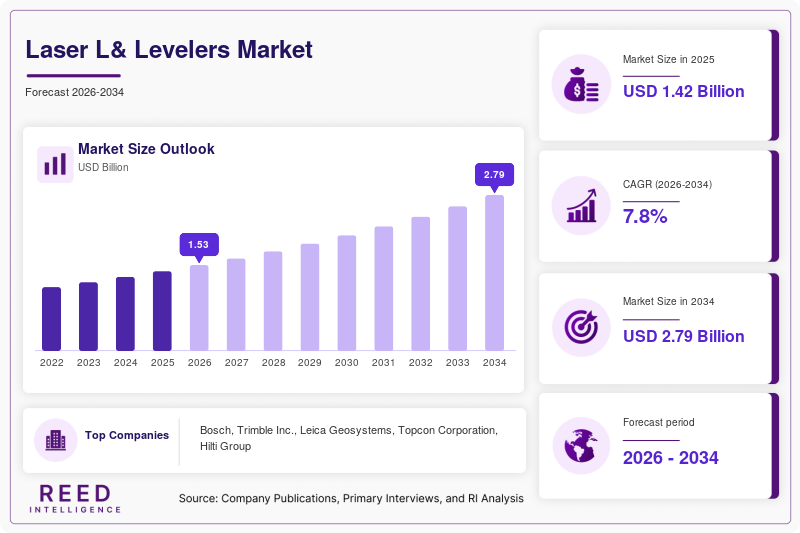
The Laser L& Levelers Market size is projected to be valued at USD 1.42 billion in 2026 and is anticipated to reach approximately USD 2.61 billion by 2034, expanding at a CAGR of 7.8% during 2026–2034. The market is experiencing steady growth due to rising demand for high-precision leveling solutions across construction, manufacturing, and industrial automation applications. Laser-based leveling systems are increasingly replacing traditional mechanical tools due to their higher accuracy, reduced human error, and compatibility with digital construction workflows.
A key global factor supporting market expansion is the rapid adoption of smart construction technologies and Industry 4.0 integration. As infrastructure projects become more complex, contractors and engineers are relying on laser leveling systems integrated with IoT-enabled sensors and automated calibration software. This shift is enhancing operational efficiency, reducing project delays, and improving quality assurance in large-scale construction and industrial projects. Additionally, the growing emphasis on sustainable construction practices has further increased the adoption of precision tools that minimize material wastage.
Key Highlights
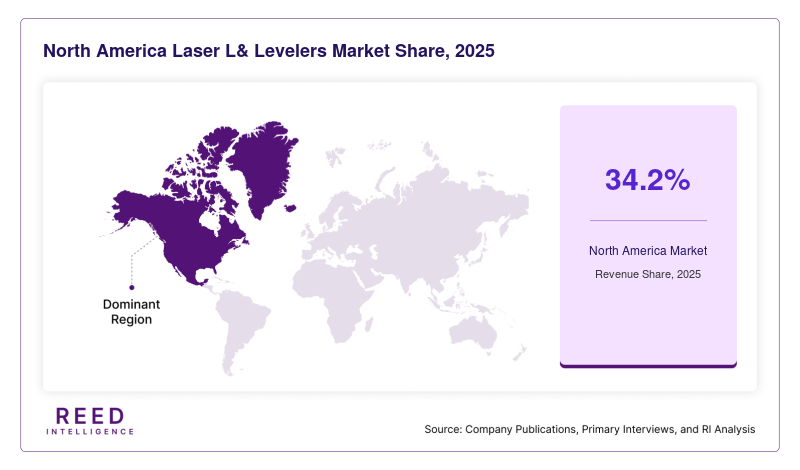
- North America dominated the market with a 34.2% share in 2025.
- Asia Pacific is expected to grow at the fastest CAGR of 11.2% during 2026–2034.
- By equipment type, sensors accounted for the largest share of 38.5%, while software solutions are projected to grow at a CAGR of 12.4%.
- By application, structural alignment projects led with a 41.7% share, whereas automated industrial leveling is expected to expand at a CAGR of 11.8%.
- The United States remained the dominant country, with market values of USD 510 million in 2024 and USD 560 million in 2025.
Market Trends
Integration of Digital Construction and IoT-Based Leveling Systems
The Laser L& Levelers Market is witnessing a strong shift toward digital construction ecosystems where laser leveling systems are integrated with IoT-enabled devices and cloud-based project management platforms. These advanced systems allow real-time data collection, remote monitoring, and automated calibration, significantly improving operational accuracy. Construction firms are increasingly adopting connected leveling tools that can communicate with BIM (Building Information Modeling) software to ensure precision during design and execution phases. This integration reduces manual intervention and enhances productivity across large infrastructure projects. The trend is particularly strong in smart city developments and high-rise construction projects, where accuracy and time efficiency are critical success factors.
Rising Adoption of Portable and Automated Laser Levelers
Another key trend shaping the Laser L& Levelers Market is the growing demand for portable, battery-operated, and automated leveling devices. Contractors and field engineers prefer lightweight systems that offer easy deployment and minimal setup time. Manufacturers are focusing on developing self-leveling laser systems equipped with AI-based correction mechanisms that automatically adjust alignment in real time. These devices are increasingly used in road construction, interior design, and industrial machinery installation. The shift toward automation is reducing dependency on skilled labor while improving consistency in measurement accuracy, thereby enhancing project outcomes across multiple industries.
Market Drivers
Expansion of Global Infrastructure Development Projects
One of the primary drivers of the Laser L& Levelers Market is the rapid expansion of infrastructure development projects worldwide. Governments and private investors are heavily investing in highways, railways, airports, and smart city initiatives, all of which require highly precise leveling and alignment tools. Laser leveling systems ensure accurate grading and structural alignment, reducing construction errors and material wastage. Emerging economies in Asia Pacific and Latin America are particularly contributing to demand growth due to large-scale urbanization and industrialization. The increasing complexity of infrastructure designs is further pushing contractors to adopt advanced laser-based solutions over traditional optical or manual methods.
Technological Advancements in Laser Measurement Systems
Continuous advancements in laser measurement technologies are significantly driving market growth. Modern laser levelers are equipped with high-resolution sensors, extended range capabilities, and enhanced durability for harsh construction environments. The integration of AI and machine learning allows predictive calibration and automated error correction, improving precision levels across applications. Additionally, the development of green laser technology, which offers better visibility in outdoor conditions, is boosting adoption in large construction sites. These innovations are making laser leveling systems more reliable, cost-effective, and suitable for a wider range of industrial applications, thereby accelerating market penetration globally.
Market Restraint
High Initial Cost and Maintenance Complexity
A key restraint affecting the Laser L& Levelers Market is the relatively high initial investment required for advanced laser leveling systems. Small and medium-sized construction firms often face budget constraints that limit their ability to adopt high-end laser equipment. In addition to purchase costs, maintenance and calibration expenses further increase the total cost of ownership. Complex system components, including sensors and software integration modules, require specialized technical expertise for servicing. This creates operational challenges, particularly in developing regions where access to skilled technicians is limited. As a result, many companies continue to rely on conventional leveling tools despite lower accuracy and efficiency, thereby slowing widespread adoption.
Market Opportunities
Growth of Smart Cities and Automated Construction Projects
The development of smart cities presents a significant opportunity for the Laser L& Levelers Market. Smart city projects require highly precise construction standards to support interconnected infrastructure systems such as smart roads, automated buildings, and intelligent transportation networks. Laser leveling systems play a critical role in ensuring structural accuracy and alignment in such projects. Governments across Asia Pacific, the Middle East, and Europe are heavily investing in urban modernization initiatives. This is driving demand for advanced laser-based tools that can integrate with digital construction platforms. As automation in construction increases, laser levelers are expected to become essential components in project execution.
Rising Adoption in Industrial Manufacturing and Robotics
Another major opportunity lies in the expanding use of laser leveling systems in industrial manufacturing and robotics. Manufacturing facilities require precise alignment of machinery, conveyor systems, and robotic arms to ensure operational efficiency. Laser levelers are increasingly being used for equipment installation, calibration, and quality assurance processes. The growth of automated production lines and smart factories is further boosting demand for high-precision alignment tools. Industries such as automotive, aerospace, and electronics manufacturing are adopting laser leveling systems to maintain tight tolerances and improve production accuracy, thereby creating strong growth potential for market players.
Segmental Analysis
By Type
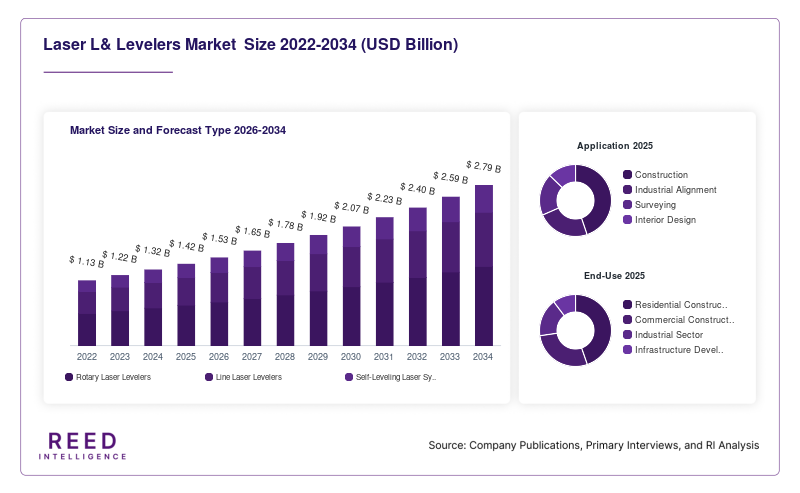
Rotary laser levelers dominated the market with approximately 42.3% share in 2024, owing to their wide applicability in large-scale infrastructure projects, road construction, and land surveying activities. These systems are highly preferred for outdoor applications because they provide long-range accuracy and 360-degree coverage, making them essential for leveling large construction sites. Their durability and ability to operate under harsh environmental conditions further strengthen their dominance in the Laser L& Levelers Market. Additionally, continuous improvements in beam visibility, battery efficiency, and remote operation features are enhancing their usability in complex construction environments, contributing to sustained demand across both developed and emerging economies.
Self-leveling laser systems represent the fastest-growing subsegment with a CAGR of 10.9%, driven by increasing demand for automation, ease of use, and reduced dependency on skilled labor. These systems automatically adjust alignment, minimizing manual calibration errors and improving productivity on construction sites. Their adoption is rising in residential construction, interior design, and small-to-medium infrastructure projects due to their compact size and user-friendly design. Technological advancements such as AI-based calibration, vibration compensation, and wireless connectivity are further enhancing their efficiency. As construction activities become more time-sensitive and precision-driven, self-leveling systems are expected to gain stronger market penetration globally.
By Application
Construction applications accounted for the largest share of approximately 45.6% in 2024, as laser levelers are widely used in foundation laying, structural alignment, road grading, and building layout tasks. Their ability to ensure precise leveling significantly reduces structural errors and material wastage, making them indispensable in modern construction workflows. The increasing complexity of infrastructure projects, including high-rise buildings and transportation networks, is further driving adoption. Contractors are increasingly integrating laser leveling tools with digital surveying systems to enhance project accuracy and reduce completion timelines, thereby reinforcing their dominant position in the Laser L& Levelers Market.
Industrial alignment applications are emerging as the fastest-growing segment with a CAGR of 11.3%, driven by rapid automation in manufacturing facilities, robotics integration, and precision machinery installation. Industries such as automotive, aerospace, and electronics manufacturing require highly accurate alignment systems to ensure operational efficiency and product quality. Laser levelers are being widely adopted for equipment installation, calibration of production lines, and maintenance of automated systems. The growing shift toward smart factories and Industry 4.0 ecosystems is further accelerating demand, as manufacturers prioritize precision tools that support continuous production optimization.
By End-Use
Commercial construction dominated the market with approximately 40.8% share in 2024, supported by extensive development of office spaces, retail complexes, hospitality infrastructure, and public buildings. Laser levelers are extensively used in commercial projects to ensure structural accuracy, optimize material usage, and improve construction efficiency. Large-scale contractors prefer advanced laser systems to maintain consistency across multi-phase projects, particularly in urban development zones. Increasing investments in commercial real estate across developed and emerging economies continue to strengthen this segment’s dominance in the Laser L& Levelers Market.
Residential construction is the fastest-growing end-use segment with a CAGR of 9.8%, driven by rising urban housing demand, renovation activities, and growing awareness of precision construction tools among small contractors and DIY users. The availability of affordable, compact, and user-friendly laser levelers is significantly boosting adoption in home improvement projects. Additionally, government-led affordable housing schemes and suburban expansion projects are increasing residential construction activity globally. As homeowners and small builders increasingly prioritize accuracy and efficiency, the residential segment is expected to witness sustained growth throughout the forecast period.
Regional Analysis
North America
North America accounted for approximately 34.2% share in 2025, and the region is projected to expand at a CAGR of 7.2% during 2026–2034, supported by strong technological adoption in construction automation and precision engineering tools. The Laser L& Levelers Market in this region is highly mature, with widespread use across commercial construction, infrastructure maintenance, and industrial alignment applications. Demand is further strengthened by the rising integration of digital surveying systems and laser-based measurement tools in large-scale urban redevelopment projects across major metropolitan areas.
The United States remains the dominant country in the region, driven by strong investments in smart infrastructure, highway modernization, and commercial real estate expansion. The adoption of laser levelers is also increasing in residential renovation projects due to growing DIY construction trends and improved availability of user-friendly, compact devices. Additionally, the presence of leading manufacturers and advanced distribution networks ensures rapid adoption of innovative laser leveling technologies across the country, further reinforcing its leadership position in the global market.
Europe
Europe held approximately 27.5% market share in 2025, with a projected CAGR of 6.9% during 2026–2034, driven by stringent construction accuracy regulations and increasing refurbishment of aging infrastructure. The Laser L& Levelers Market in Europe benefits significantly from strong engineering standards, particularly in countries with advanced industrial and architectural ecosystems. The demand is also influenced by the growing need for energy-efficient building practices, where precise leveling plays a critical role in structural optimization and material efficiency.
Germany leads the European market due to its strong manufacturing base, advanced automotive production facilities, and high adoption of industrial automation technologies. The country’s focus on precision engineering and Industry 4.0 integration has significantly increased the use of laser leveling systems in factory installations and infrastructure projects. Additionally, ongoing smart building initiatives across France, the United Kingdom, and the Nordic countries are further contributing to regional demand expansion.
Asia Pacific
Asia Pacific accounted for approximately 23.8% share in 2025, and it is expected to register the fastest growth with a CAGR of 11.2% during 2026–2034, driven by rapid urbanization, large-scale infrastructure investments, and expanding construction activity. The Laser L& Levelers Market in this region is witnessing strong momentum due to increasing government spending on smart cities, transportation networks, and industrial parks. The rising demand for affordable yet high-precision construction tools is also accelerating market penetration.
China dominates the Asia Pacific region due to massive infrastructure expansion, rapid urban development, and strong government-backed construction programs. The country’s emphasis on smart city development and high-speed rail projects significantly increases the adoption of advanced laser leveling systems. India is another high-growth country, supported by affordable housing initiatives, highway development projects, and increasing mechanization in the construction sector, further boosting demand for precision leveling tools.
Middle East & Africa
Middle East & Africa held approximately 8.1% market share in 2025, with a projected CAGR of 8.4% during 2026–2034, supported by large-scale infrastructure megaprojects and diversification away from oil-dependent economies. The Laser L& Levelers Market in this region is gaining traction due to increasing investments in smart cities, airports, hospitality infrastructure, and transportation networks. The demand for precision construction tools is rising as governments focus on world-class urban development standards.
The United Arab Emirates leads the regional market due to ambitious projects such as smart city developments, luxury real estate expansion, and tourism infrastructure growth. Saudi Arabia is also emerging as a key contributor, driven by mega-projects under national transformation programs. These initiatives require advanced construction technologies, including laser leveling systems, to ensure accuracy, efficiency, and compliance with international construction standards.
Latin America
Latin America accounted for approximately 6.4% share in 2025, and the region is projected to grow at a CAGR of 7.6% during 2026–2034, supported by rising urbanization and industrial development. The Laser L& Levelers Market in this region is expanding steadily due to increasing investments in housing projects, commercial infrastructure, and public transportation systems. Growing awareness about precision construction tools is also contributing to higher adoption rates across mid-sized contractors and construction firms.
Brazil dominates the regional market due to strong urban infrastructure development, industrial expansion, and government-backed housing initiatives. The country’s construction sector is increasingly adopting laser leveling systems to improve efficiency and reduce project delays. Mexico also plays a significant role, driven by manufacturing sector growth and cross-border industrial investments, which are boosting demand for precise alignment and leveling solutions in industrial applications.
Competitive Landscape
The Laser L& Levelers Market is moderately consolidated with leading players focusing on product innovation, digital integration, and geographic expansion. Key companies include Bosch, Leica Geosystems, Trimble Inc., Topcon Corporation, and Hilti Group. Among these, Trimble Inc. holds a leading position due to its strong portfolio of advanced positioning solutions and integrated construction technologies. Recently, the company expanded its laser measurement division with AI-enabled calibration systems to enhance construction automation capabilities.
Key Players
- Bosch
- Leica Geosystems
- Trimble Inc.
- Topcon Corporation
- Hilti Group
- Stabila
- Johnson Level & Tool
- DeWalt
- Spectra Precision
- Sokkia
- South Surveying & Mapping Instruments
- Makita Corporation
- Stanley Black & Decker
- CST/Berger
- Nikon Metrology
Recent Developments
- In 2025, Trimble Inc. enhanced its construction technology portfolio by integrating AI-based calibration features into its laser leveling systems, enabling higher accuracy in automated site alignment and reducing manual adjustment requirements on large infrastructure projects.
- In 2025, Leica Geosystems introduced next-generation green beam laser levelers designed to improve visibility in outdoor construction environments, particularly for long-range surveying and large-scale civil engineering applications.
- In 2024, Topcon Corporation expanded its cloud-connected laser measurement solutions, allowing real-time data synchronization between construction sites and project management platforms to improve workflow efficiency and reduce project delays.
- In 2024, Bosch upgraded its professional laser leveling product line with improved battery efficiency and enhanced self-leveling stability, targeting increased adoption among residential contractors and small construction firms.
Laser L& Levelers Market Segments
Type
- Rotary Laser Levelers
- Line Laser Levelers
- Self-Leveling Laser Systems
Application
- Construction
- Industrial Alignment
- Surveying
- Interior Design
End-Use
- Residential Construction
- Commercial Construction
- Industrial Sector
- Infrastructure Development
By Region
- North America
- Europe
- APAC
- Middle East and Africa
- LATAM