Logistics Consulting Services Market Size, Share & Trends Analysis Report By Service Type, By Organization Size, By Application, By End User and By Region, Forecasts 2026–2034
USD 3950
Logistics Consulting Services Market Size
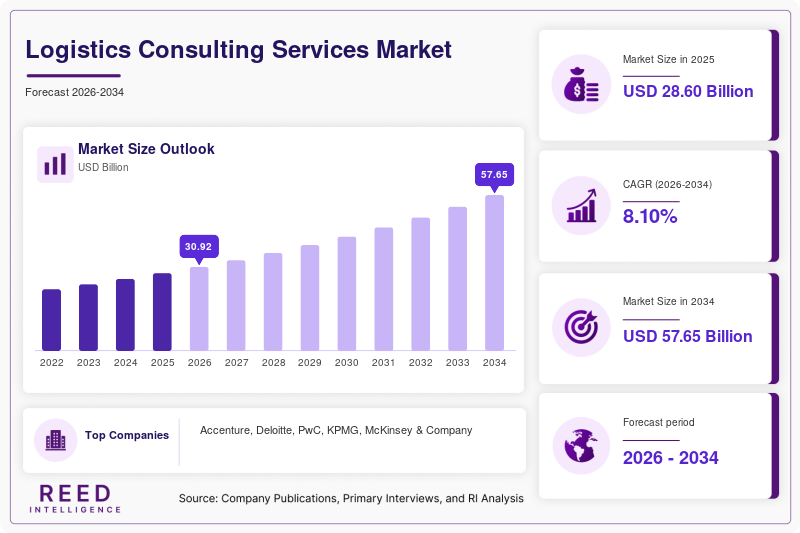
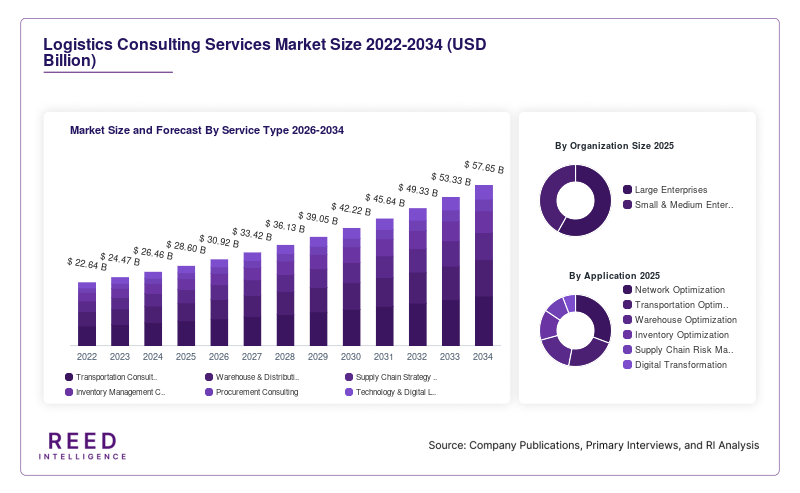
The global logistics consulting services market was valued at USD 28.60 billion in 2025 and is projected to grow from USD 30.92 billion in 2026 to USD 57.65 billion by 2034, registering a CAGR of 8.10% during the forecast period from 2026 to 2034.
Logistics consulting services help organizations design, optimize and transform their logistics and supply-chain operations. These services can cover transportation management, warehouse optimization, distribution-network design, inventory planning, procurement, supply-chain technology, logistics strategy and operational improvement.
The market is benefiting from increasingly complex global supply chains, rising transportation costs, e-commerce expansion, omnichannel distribution and growing demand for real-time supply-chain visibility. Companies are increasingly engaging specialized consultants to redesign logistics networks, improve asset utilization and identify opportunities for cost reduction.
Logistics Consulting Services Market Drivers
Increasing Supply Chain Complexity
Global businesses increasingly operate across multiple suppliers, manufacturing locations, distribution centers and transportation networks.
This complexity is increasing demand for consulting expertise in network design, supplier coordination, transportation optimization and risk management.
Growth of E-commerce and Omnichannel Distribution
E-commerce has increased the need for flexible fulfillment networks and faster delivery.
Retailers and manufacturers are redesigning warehouses and distribution networks to support direct-to-consumer fulfillment, store-based fulfillment and multiple delivery options.
Rising Logistics Costs
Fuel, labor, warehousing, transportation and inventory costs continue to influence logistics strategies.
Consulting services help organizations identify cost-reduction opportunities through network optimization, route planning, warehouse redesign and improved inventory management.
Increasing Adoption of Digital Logistics Technologies
Organizations are investing in transportation management systems, warehouse management systems, IoT, artificial intelligence and advanced analytics.
Consultants increasingly support technology selection, implementation, integration and operational transformation.
Growing Focus on Supply Chain Resilience
Disruptions caused by geopolitical developments, extreme weather, transportation bottlenecks and supplier issues have increased attention toward supply-chain resilience.
Companies are engaging consultants to diversify supply networks, redesign logistics footprints and establish contingency strategies.
Logistics Consulting Services Market Restraints
High Consulting Costs
Large-scale logistics transformation projects can require significant investment.
Small and medium-sized organizations may limit consulting engagements because of budget constraints.
Shortage of Specialized Expertise
Advanced logistics transformation requires knowledge of transportation, warehousing, analytics, automation, enterprise software and supply-chain strategy.
The limited availability of professionals combining these capabilities can constrain project execution.
Implementation Complexity
Consulting recommendations frequently require changes to technology, processes, facilities and organizational structures.
Complex implementation can extend project timelines and increase transformation costs.
Data Quality Challenges
Advanced logistics analysis depends on accurate information about transportation, inventory, customers, suppliers and warehouse operations.
Inconsistent or fragmented data can reduce the effectiveness of analytics-based consulting projects.
Logistics Consulting Services Market Opportunities
AI-Enabled Logistics Optimization
Artificial intelligence and machine learning provide opportunities to optimize transportation routes, forecast demand, identify logistics bottlenecks and improve warehouse operations.
Consulting firms can combine these technologies with operational expertise to provide data-driven transformation services.
Digital Twin-Based Network Design
Digital twins allow companies to simulate logistics networks before implementing major changes.
Consultants can use simulation to evaluate distribution-center locations, transportation flows, inventory policies and capacity requirements.
Sustainable Logistics Consulting
Organizations are increasingly seeking to reduce transportation emissions, optimize fleet utilization and adopt lower-carbon logistics models.
This creates opportunities for consultants specializing in green logistics, alternative fuels, electric fleets and sustainable network design.
Warehouse Automation
Increasing adoption of robotics, automated storage and retrieval systems and autonomous mobile robots is creating demand for consulting services covering warehouse design, technology selection and implementation.
Growth in Emerging Markets
Rapid industrialization, e-commerce expansion and infrastructure development in Asia-Pacific, Latin America and the Middle East create opportunities for logistics consulting firms.
Service Type Segment Analysis
Transportation Consulting Holds the Largest Share
Transportation consulting accounted for approximately 27% of the logistics consulting services market in 2025, making it the largest service segment. Transportation optimization remains a priority as companies seek to reduce freight costs, improve fleet utilization and optimize delivery networks.
Technology & digital logistics consulting accounted for approximately 18% and is projected to grow at approximately 10.5% CAGR, making it the fastest-growing major service segment. Increasing investments in AI, logistics software, automation, IoT and cloud platforms are supporting demand.
Warehouse & distribution consulting represented approximately 23%, supply-chain strategy consulting 17%, inventory management consulting 9%, and procurement consulting approximately 6%.
Organization Size Segment Analysis
Large Enterprises Hold the Largest Share
Large enterprises accounted for approximately 72% of the market in 2025, reflecting their complex logistics networks, larger transformation budgets and extensive international operations.
Small and medium enterprises accounted for approximately 28% and are projected to grow at approximately 10.1% CAGR, making them the faster-growing segment. Cloud logistics technologies and standardized consulting solutions are making specialized expertise increasingly accessible to smaller organizations.
Application Segment Analysis
Network Optimization Holds the Largest Share
Network optimization accounted for approximately 26% of the market in 2025, making it the largest application segment. Companies use network analysis to optimize warehouses, distribution centers, transportation routes and inventory positioning.
Digital transformation accounted for approximately 19% and is projected to grow at approximately 11.2% CAGR, making it the fastest-growing major application segment. Increasing adoption of AI, cloud platforms, automation and real-time visibility technologies is supporting growth.
Transportation optimization represented approximately 22%, warehouse optimization 17%, inventory optimization 10%, and supply-chain risk management approximately 6%.
End-User Segment Analysis
Manufacturing Holds the Largest Share
Manufacturing accounted for approximately 28% of the market in 2025, making it the largest end-user segment. Manufacturers require complex inbound logistics, production-related transportation, warehousing and outbound distribution networks.
Retail & e-commerce accounted for approximately 23% and is projected to grow at approximately 10.4% CAGR, making it the fastest-growing major end-user segment. Omnichannel fulfillment, faster delivery requirements and increasing online retail volumes are supporting demand.
Automotive represented approximately 14%, healthcare 10%, food & beverage 9%, consumer goods 11%, and other industries approximately 5%.
Logistics Consulting Services Market Regional Analysis
North America Holds the Largest Share
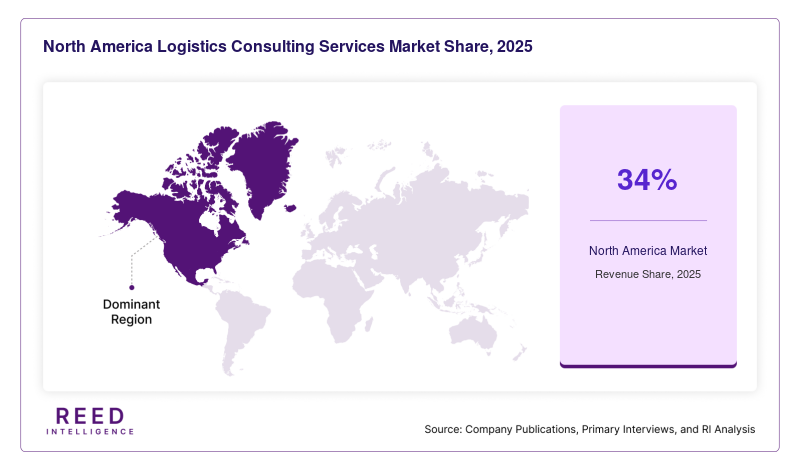
North America accounted for approximately 34% of the global logistics consulting services market in 2025, making it the largest regional market. The region benefits from sophisticated logistics infrastructure, extensive e-commerce activity, advanced technology adoption and strong demand for supply-chain optimization.
Asia-Pacific accounted for approximately 28% and is projected to grow at approximately 9.8% CAGR, making it the fastest-growing major region. Manufacturing expansion, e-commerce growth, infrastructure development and supply-chain digitalization are supporting regional demand.
Europe Maintains Strong Demand
Europe accounted for approximately 25% of the market in 2025 and is projected to grow at approximately 7.2% CAGR.
Demand is supported by cross-border trade, advanced manufacturing, sustainability initiatives and increasing investments in logistics technology.
Latin America Shows Increasing Adoption
Latin America accounted for approximately 7% of the market in 2025 and is projected to grow at approximately 8.4% CAGR.
E-commerce expansion, manufacturing investment and logistics infrastructure development are creating opportunities for consulting firms.
Middle East & Africa Represents an Emerging Opportunity
Middle East & Africa accounted for approximately 6% of the market in 2025 and is projected to grow at approximately 8.7% CAGR.
Infrastructure investments, logistics-hub development, diversification of regional economies and growing e-commerce activity are supporting market expansion.
Logistics Consulting Services Market Competitive Landscape
Competition in the logistics consulting services market is based on industry expertise, geographic coverage, digital capabilities, analytics capabilities, implementation experience, technology partnerships and the ability to deliver end-to-end transformation programs.
Key Market Players
Logistics Consulting Services Market Recent Developments
- Major consulting firms are expanding AI capabilities across supply-chain planning, transportation optimization, inventory management and demand forecasting. AI is increasingly being incorporated into consulting projects to identify operational inefficiencies and support scenario-based decision-making.
- Digital-twin technologies are increasingly being used to simulate distribution networks, warehouses and transportation flows. These tools allow organizations to test operational changes before implementing them in physical logistics environments.
Logistics Consulting Services Market Segments
By Service Type
- Transportation Consulting
- Warehouse & Distribution Consulting
- Supply Chain Strategy Consulting
- Inventory Management Consulting
- Procurement Consulting
- Technology & Digital Logistics Consulting
By Organization Size
- Large Enterprises
- Small & Medium Enterprises
By Application
- Network Optimization
- Transportation Optimization
- Warehouse Optimization
- Inventory Optimization
- Supply Chain Risk Management
- Digital Transformation
By End User
- Manufacturing
- Retail & E-commerce
- AutomotiveG
- Healthcare
- Food & Beverage
- Consumer Goods
- Others
By Region
- North America
- Europe
- APAC
- Middle East and Africa
- LATAM