Medical Education Market Size, Share & Trends Analysis Report By Type, By Learning Mode, By End User and By Region, Forecasts 2026–2034
USD 3950
Medical Education Market Size
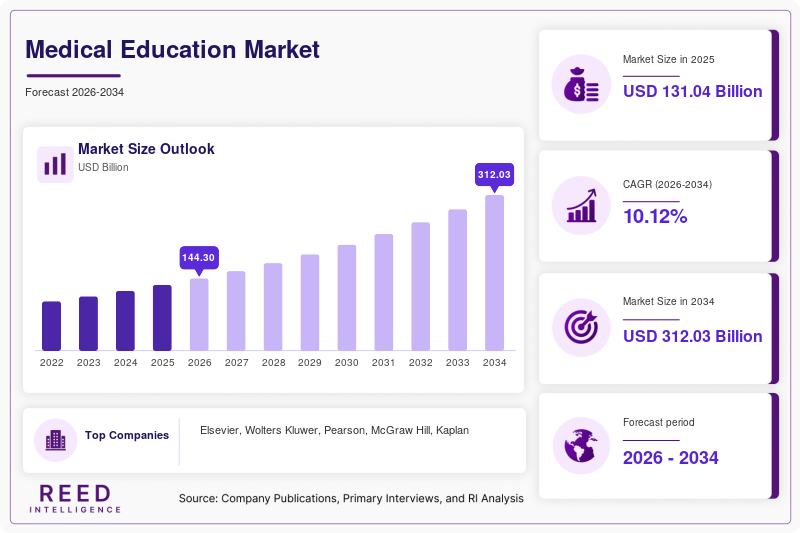
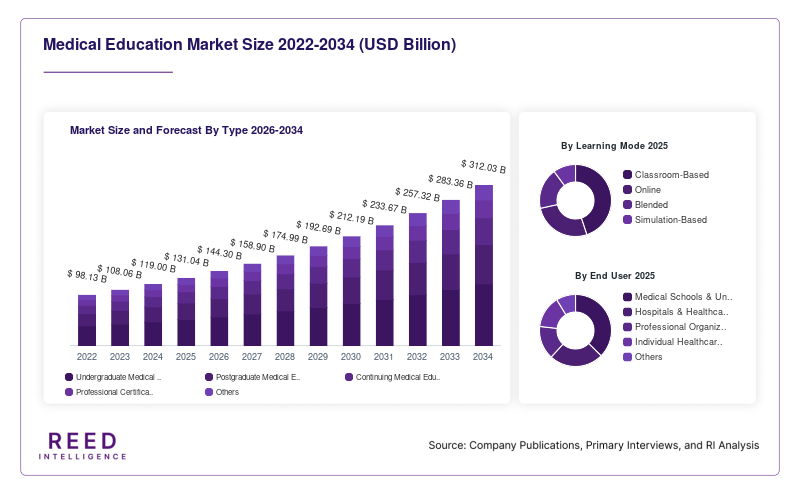
The global medical education market was valued at USD 131.04 billion in 2025 and is projected to grow from USD 144.30 billion in 2026 to USD 312.03 billion by 2034, registering a CAGR of 10.12% during the forecast period from 2026 to 2034.
Medical education encompasses undergraduate medical education, postgraduate training, continuing medical education, professional development, clinical training and digital learning solutions for healthcare professionals and students. The market includes universities, medical schools, hospitals, training institutions, professional organizations and technology-enabled education providers.
The market is experiencing a significant shift toward blended and technology-enabled learning. Medical institutions increasingly combine classroom instruction and clinical training with virtual simulations, online courses, learning-management systems, digital libraries and interactive educational content.
Medical Education Market Drivers
Growing Healthcare Workforce Requirements
Increasing demand for physicians, nurses, allied healthcare professionals and other medical specialists is creating a need for expanded education and training capacity.
Healthcare systems in emerging economies are particularly investing in medical education infrastructure to address workforce shortages and improve access to qualified professionals.
Increasing Need for Continuous Medical Education
Medical knowledge, clinical guidelines and treatment technologies continue to evolve.
Healthcare professionals therefore require ongoing education to maintain professional competence and remain familiar with new procedures, therapies, devices and clinical practices.
Expansion of Digital Learning
Online courses, virtual classrooms, mobile learning and learning-management systems are becoming increasingly integrated into medical education.
Digital learning enables students and professionals to access educational materials at flexible times and locations.
Growth of Simulation-Based Training
Medical simulation allows students and healthcare professionals to practice clinical procedures in controlled environments.
Virtual patients, simulation laboratories, augmented reality and virtual reality technologies are expanding opportunities for practical training without requiring direct exposure to patients during early learning stages.
Increasing Healthcare Specialization
The expansion of specialized medical fields is increasing demand for advanced training programs.
Specialties such as oncology, cardiology, neurology, radiology, emergency medicine and minimally invasive procedures require continuous development of specialized knowledge and technical skills.
Medical Education Market Restraints
High Cost of Medical Education
Medical education often requires significant investment in faculty, clinical facilities, simulation laboratories, equipment and educational infrastructure.
High tuition and training costs can restrict access for students and professionals, particularly in developing healthcare systems.
Shortage of Qualified Faculty
Medical education requires experienced clinicians and educators who can combine academic knowledge with practical clinical expertise.
Shortages of qualified teaching professionals can limit institutional capacity and affect the expansion of training programs.
Limited Access to Advanced Simulation Infrastructure
Advanced simulation centers, virtual reality systems and specialized training equipment can require substantial investment.
Institutions with limited budgets may continue relying on conventional training methods.
Regulatory and Accreditation Requirements
Medical education programs must meet professional, institutional and accreditation requirements.
Changes in curriculum standards and licensing requirements can increase administrative and operational demands for education providers.
Medical Education Market Opportunities
Artificial Intelligence in Medical Education
AI can support personalized learning, clinical case generation, automated assessment and adaptive educational content.
Education providers are increasingly exploring AI-enabled tools to complement conventional teaching and improve learning experiences.
Virtual Reality and Augmented Reality
VR and AR technologies provide opportunities for immersive anatomy education, procedural training and clinical simulation.
These technologies can allow learners to practice complex procedures repeatedly in controlled environments.
Expansion of Online Medical Courses
Online education platforms provide opportunities to deliver medical courses to geographically distributed learners.
Professional certification, continuing education and specialized medical training are particularly suitable for digital delivery.
Personalized Learning
Data analytics and adaptive learning technologies can identify knowledge gaps and adjust educational content to individual learners.
Personalized education can support more targeted training for medical students and practicing professionals.
Emerging-Market Medical Education
Growing healthcare infrastructure and medical workforce requirements across Asia-Pacific, Latin America, the Middle East and Africa create opportunities for universities, hospitals and digital education providers.
Type Segment Analysis
By Type
Undergraduate medical education accounted for approximately 38% of the medical education market in 2025, making it the largest type segment. Medical schools and universities continue to represent a substantial portion of medical education demand as healthcare systems require a steady pipeline of newly trained professionals.
Continuing medical education accounted for approximately 23% and is projected to grow at approximately 11.8% CAGR, making it the fastest-growing major type segment. The need for healthcare professionals to continuously update clinical knowledge, technologies and treatment practices is supporting expansion.
Postgraduate medical education represented approximately 25%, professional certification and training 9%, and other education programs approximately 5%.
Learning Mode Segment Analysis
By Learning Mode
Classroom-based learning accounted for approximately 42% of the market in 2025, supported by established medical education institutions, direct faculty interaction and conventional academic structures.
Online learning accounted for approximately 24% and is projected to grow at approximately 13.2% CAGR, making it the fastest-growing major learning mode. Greater adoption of digital platforms, remote access and flexible professional education is supporting growth.
Blended learning represented approximately 22%, while simulation-based learning accounted for approximately 12%.
End-User Segment Analysis
By End User
Medical schools and universities accounted for approximately 46% of the market in 2025, making them the largest end-user segment. These institutions provide undergraduate and postgraduate education and maintain substantial demand for faculty, educational content, clinical training and simulation infrastructure.
Individual healthcare professionals accounted for approximately 19% and are projected to grow at approximately 12.4% CAGR, making them the fastest-growing major end-user segment. Increasing demand for continuing education, professional certification and flexible online training is supporting growth.
Hospitals and healthcare institutions represented approximately 25%, professional organizations 7%, and other end users approximately 3%.
Medical Education Market Regional Analysis
North America Holds the Largest Share
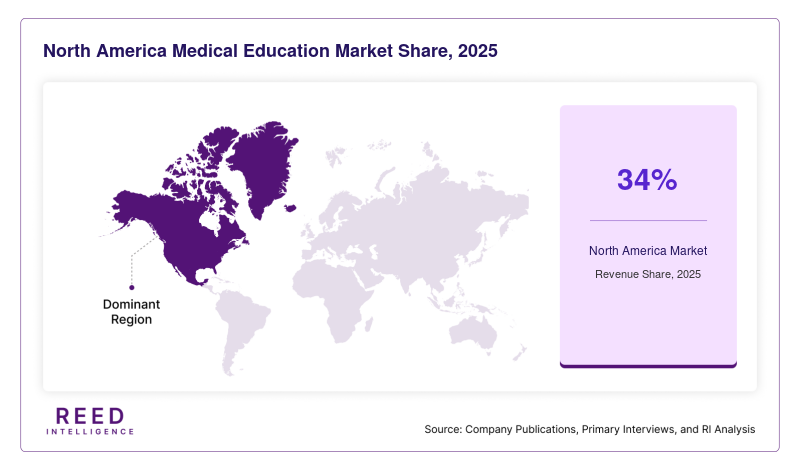
North America accounted for approximately 34% of the global medical education market in 2025, making it the largest regional market. The region benefits from established medical schools, advanced healthcare infrastructure, significant spending on professional education and extensive adoption of digital learning technologies.
Asia-Pacific accounted for approximately 30% and is projected to grow at approximately 12.1% CAGR, making it the fastest-growing major region. Increasing healthcare workforce requirements, expansion of medical schools, healthcare infrastructure development and adoption of online medical education are supporting regional growth.
Europe Maintains Strong Demand
Europe accounted for approximately 25% of the market in 2025 and is projected to grow at approximately 8.8% CAGR.
The region benefits from established medical education systems, strong professional development requirements and increasing adoption of digital and simulation-based learning.
Latin America Shows Increasing Adoption
Latin America accounted for approximately 6% of the market in 2025 and is projected to grow at approximately 9.6% CAGR.
Expansion of healthcare infrastructure, increasing medical workforce requirements and growing availability of online education platforms are supporting market development.
Middle East & Africa Represents an Emerging Market
Middle East & Africa accounted for approximately 5% of the market in 2025 and is projected to grow at approximately 10.2% CAGR.
Healthcare infrastructure investments, medical workforce development programs and increasing demand for specialized healthcare professionals are supporting regional growth.
Medical Education Market Competitive Landscape
Competition in the medical education market is based on educational quality, accreditation, faculty expertise, course content, clinical training capabilities, technology integration, accessibility and institutional reputation.
Education providers are increasingly investing in online learning platforms, virtual simulation, AI-enabled education tools and interactive digital content.
Key Market Players
Medical Education Market Recent Developments
- Medical education providers are increasingly incorporating artificial intelligence into learning platforms, clinical case generation, assessment and personalized education. AI-based tools can help learners identify knowledge gaps and provide adaptive educational content.
- Medical schools and healthcare institutions are expanding the use of virtual simulation to provide safe environments for practicing clinical procedures. Simulation technologies can complement hands-on training and provide learners with repeatable clinical scenarios.
Medical Education Market Segments
By Type
- Undergraduate Medical Education
- Postgraduate Medical Education
- Continuing Medical Education
- Professional Certification & Training
- Others
By Learning Mode
- Classroom-Based
- Online
- Blended
- Simulation-Based
By End User
- Medical Schools & Universities
- Hospitals & Healthcare Institutions
- Professional Organizations
- Individual Healthcare Professionals
- Others
By Region
- North America
- Europe
- APAC
- Middle East and Africa
- LATAM