On-Demand Home Services Market Size, Share & Trends Analysis Report By Service Type (Home Cleaning, Home Repair & Maintenance, Home Improvement, Moving & Delivery, Beauty & Personal Care, Others), By Booking Channel (Mobile Applications, Websites, Phone & Offline), By End User (Individual Households, Property Managers & Landlords, Residential Communities & Real Estate Operators) and By Region (North America, Europe, APAC, Middle East and Africa, LATAM) Forecasts, 2026–2034
USD 3950
On-Demand Home Services Market Size
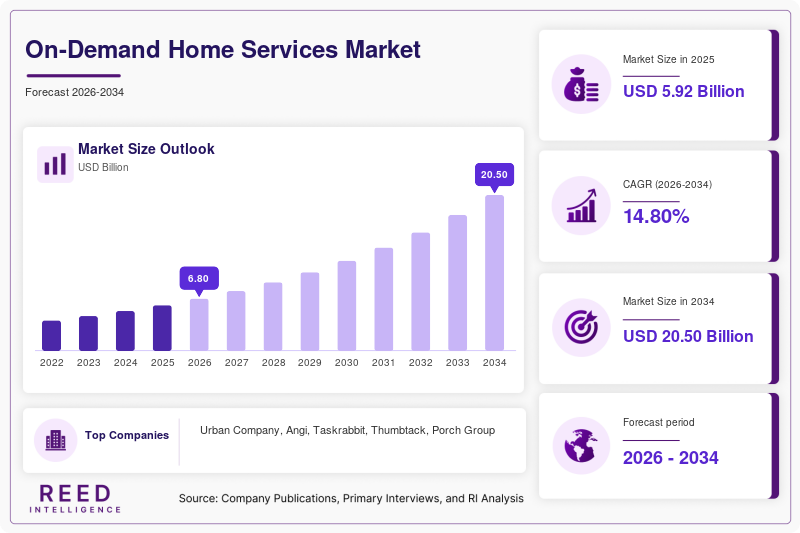
The global on-demand home services market is valued at USD 5.92 Billion in 2025 and USD 6.80 Billion in 2026. The market is projected to reach USD 20.50 Billion by 2034, registering a 14.80% CAGR during the forecast period.
The on-demand home services market is evolving from traditional local service arrangements toward digitally managed platforms that allow consumers to discover, schedule, pay for and review professionals through mobile applications and online marketplaces. The service ecosystem includes cleaning, plumbing, electrical work, appliance repair, handyman services, beauty treatments, moving, furniture assembly, lawn care and other household tasks. Urban Company operates a full-stack home-services model spanning beauty and wellness, home repairs and maintenance, while Taskrabbit connects consumers with independent Taskers across furniture assembly, moving, cleaning, mounting and repairs.
The strongest structural change is the increasing use of instant or near-instant booking. Urban Company's InstaHelp service, launched initially as Insta Maids in March 2025, was designed around short-notice household assistance covering cleaning, dishwashing, laundry and meal preparation. By February 2026, the company reported more than 50,000 bookings on a single day across selected Indian metropolitan markets.
On-Demand Home Services Market Drivers
Consumers are shifting home-service discovery and booking toward digital marketplaces
Digital marketplaces reduce the effort involved in finding local professionals by combining search, availability, customer reviews, price information, service descriptions and booking functionality in a single interface. Taskrabbit's nationwide expansion illustrates how marketplace operators are continuing to increase geographic coverage and bring additional categories such as cleaning, moving, mounting, furniture assembly and repairs into a common digital environment.
The expansion of platform availability increases the number of transactions that can be completed without traditional phone-based sourcing. Taskrabbit's integration with IKEA also demonstrates how home-service booking can be embedded into the purchase journey itself, allowing consumers to arrange furniture assembly while completing their retail transaction.
This changes the market mechanism from consumers independently searching for contractors toward platforms controlling discovery, matching and fulfillment. As more services become bookable through standardized interfaces, the addressable customer pool expands beyond consumers who already have established relationships with local providers.
Instant and scheduled household services are expanding the frequency of platform use
On-demand home services are increasingly extending beyond occasional repairs toward recurring and short-notice household assistance. Urban Company's InstaHelp provides cleaning, dishwashing, laundry and meal-preparation assistance through a rapid booking model, while its reported peak of more than 50,000 daily bookings in February 2026 demonstrates the potential for high-frequency household services once sufficient professional availability is established.
The commercial importance of this model is that routine services create more frequent transactions than one-time home improvement projects. A consumer who books recurring cleaning or household support can generate multiple annual transactions, increasing customer lifetime value and allowing platforms to spread customer-acquisition costs across more bookings.
The model also creates opportunities for professionals to maintain denser schedules across geographically concentrated service areas. Higher booking density can reduce travel time between assignments and improve utilization when platforms use location, availability and service-category data to coordinate supply.
AI is becoming an additional customer-acquisition and service-matching channel
Home-service companies are increasingly moving discovery outside conventional search engines and marketplace interfaces. Angi launched its ChatGPT app in March 2026 and subsequently introduced its marketplace through Gemini as a connected app in August 2026, creating pathways for consumers to progress from natural-language questions toward professional matching.
Thumbtack has taken a comparable approach by introducing an AI-powered experience that allows consumers to describe home problems through text, photographs or voice rather than relying on conventional keyword searches.
The shift creates a new market mechanism because consumers can begin with a problem rather than knowing the exact service category. A homeowner describing a leaking fixture, damaged wall or unusual appliance noise can potentially be guided toward the relevant service type before being matched with a provider. This reduces search friction and increases the number of household problems that can enter a digital marketplace.
On-Demand Home Services Market Restraints
Service quality and professional availability vary across local markets
Home services are inherently localized. A platform may have strong customer demand in an urban area but insufficient professionals with the required skills, availability or geographic coverage. The problem becomes more pronounced for urgent services because customers expect short response times while professionals must account for travel and existing appointments.
Urban Company's rapid-service model illustrates the operational requirement: InstaHelp has been scaled selectively across micro-markets rather than deployed uniformly across every location. The company reported the service across five major metropolitan markets during its early expansion.
Platforms therefore need to balance customer acquisition with professional recruitment, training, verification and retention. Poor availability can create cancellations, longer response times and inconsistent customer experiences, limiting repeat usage.
Labor economics and trust requirements complicate platform scaling
Home services depend heavily on individual service professionals, making compensation, scheduling, training, insurance, worker protections and classification important operating considerations. Urban Company's InstaHelp launch included stated earnings and insurance-related benefits for service partners, illustrating the extent to which platforms need structured supply-side programs when building high-frequency service categories.
Trust is equally important because professionals enter private homes. Customers assess providers through identity verification, ratings, reviews, service guarantees and platform policies. The cost of maintaining these controls can increase as a marketplace expands across multiple countries and service categories.
On-Demand Home Services Market Opportunities
AI-enabled home-service interfaces create an opportunity to capture consumers at an earlier stage of the purchase journey. Rather than waiting for consumers to search for "plumber" or "electrician," platforms can interpret descriptions, images or voice inputs and recommend the relevant service category.
The opportunity extends to automated project scoping, estimated service requirements, question generation for professionals, appointment scheduling and post-service follow-up. These features can increase conversion by reducing uncertainty before a consumer commits to booking.
Recurring cleaning, maintenance, lawn care, pest control, appliance servicing and personal-care services can create more predictable booking patterns than one-time home improvement projects. Urban Company's InstaHelp provides an example of a platform extending into high-frequency household services rather than relying exclusively on traditional beauty and repair bookings.
Subscription and membership models can further support recurring demand by combining scheduled services, priority access, discounted fees or maintenance plans. These models also provide platforms with better demand visibility, allowing professional capacity to be planned around recurring appointments.
Service Type Segment Analysis
Home Repair & Maintenance represents the largest service segment
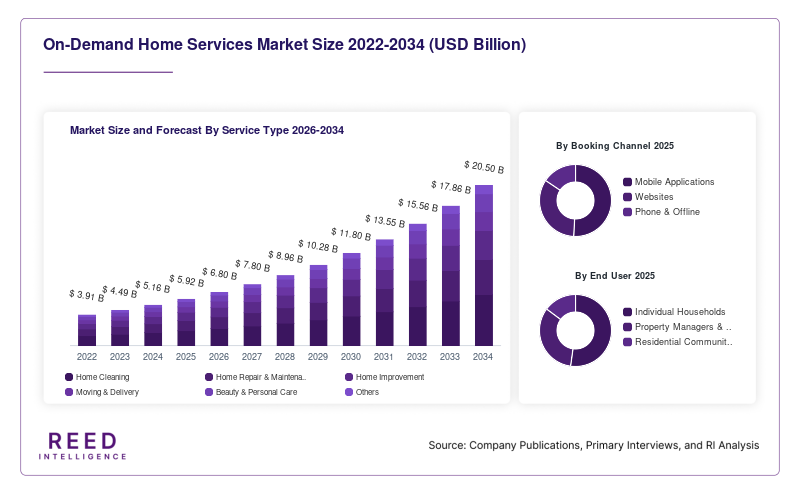
The Home Repair & Maintenance segment accounts for 27% of the 2026 market, equivalent to USD 1.84 Billion, and is projected to reach 26% by 2034, equivalent to USD 5.33 Billion. The segment is expected to register a 14.24% CAGR during the forecast period.
Home repair and maintenance covers plumbing, electrical work, HVAC, appliance repair, handyman services, pest control and other recurring property-maintenance requirements. These services are highly suitable for digital marketplaces because consumers frequently require professional skills but may not have established relationships with individual contractors.
Home Cleaning maintains strong recurring demand
The Home Cleaning segment represents 24% of the 2026 market, equivalent to USD 1.63 Billion, and reaches 22% by 2034, equivalent to USD 4.51 Billion. The segment is projected to grow at a 13.54% CAGR.
Cleaning includes standard residential cleaning, deep cleaning, laundry support, dishwashing and other household assistance. Its frequency of use gives it an important position within on-demand services because customers can book the same category repeatedly rather than only during major household projects.
User Analysis
Individual households represent the largest customer group
The Individual Households segment represents 68% of the 2026 market, equivalent to USD 4.62 Billion, and reaches 65% by 2034, equivalent to USD 13.33 Billion. The segment is projected to grow at a 14.13% CAGR.
Individual households constitute the primary customer base because the majority of on-demand services are purchased directly for residential cleaning, repairs, personal care, maintenance, installation and moving requirements. Taskrabbit and Urban Company both explicitly position their platforms around household consumers and professional service providers.
Property Managers & Landlords are increasing platform-based procurement
The Property Managers & Landlords segment accounts for 17% of the 2026 market, equivalent to USD 1.16 Billion, and rises to 19% by 2034, equivalent to USD 3.90 Billion. The segment is projected to grow at a 16.38% CAGR.
Property managers and landlords have recurring requirements for cleaning, maintenance, repairs, turnover services, appliance installation and emergency work. Digital platforms can help them source providers across multiple properties while retaining records of appointments and service costs.
Regional Analysis
North America On-Demand Home Services Market
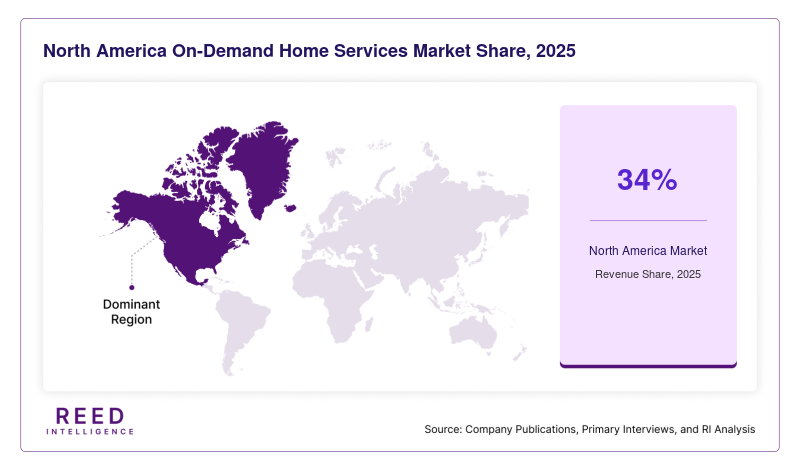
The North America market represents 34% of the 2026 global market, equivalent to USD 2.31 Billion, and reaches 30% by 2034, equivalent to USD 6.15 Billion. The region is projected to grow at a 13.03% CAGR.
North America represents a major on-demand home-services market because of its mature digital marketplace ecosystem, broad contractor base and high penetration of online consumer services. Angi, Thumbtack, Taskrabbit and Porch operate substantial home-service platforms, while Taskrabbit expanded its service availability to all 50 U.S. states in August 2025.
Europe On-Demand Home Services Market
The Europe market accounts for 25% of the 2026 market, equivalent to USD 1.70 Billion, and reaches 23% by 2034, equivalent to USD 4.72 Billion. The market is projected to grow at a 13.58% CAGR.
Europe has a developed home-maintenance and household-services base, supported by urban populations, established local contractors and growing integration of digital booking into consumer services. Taskrabbit's IKEA integration covers major markets including Spain and the United Kingdom, demonstrating continued platform-based service integration across European retail ecosystems.
APAC On-Demand Home Services Market
The APAC market represents 24% of the 2026 market, equivalent to USD 1.63 Billion, and reaches 30% by 2034, equivalent to USD 6.15 Billion. The region is projected to grow at an 18.05% CAGR, the highest regional growth rate.
APAC represents the fastest-growing regional market, supported by rapid digital adoption, expanding urban populations, growing middle-class consumption and increasing availability of app-based household services. Urban Company's expansion of high-frequency home assistance and its international operations across the UAE, Singapore and Saudi Arabia illustrate how digital home-service models are extending across Asian and adjacent markets.
Middle East and Africa On-Demand Home Services Market
The Middle East and Africa market represents 9% of the 2026 market, equivalent to USD 612.00 Million, and reaches 9% by 2034, equivalent to USD 1.85 Billion. The regional market is projected to grow at a 14.80% CAGR.
The Middle East is increasingly adopting app-based household services, particularly in the UAE and Saudi Arabia. Urban Company's May 2025 partnership with noon integrated cleaning, repair and personal-care services directly into the noon application in both markets, connecting home-service discovery with a broader digital-commerce ecosystem.
LATAM On-Demand Home Services Market
The LATAM market represents 8% of the 2026 market, equivalent to USD 544.00 Million, and reaches 8% by 2034, equivalent to USD 1.64 Billion. The region is projected to grow at a 14.79% CAGR.
LATAM is developing through increasing smartphone-based consumer commerce, expanding digital marketplaces and growing demand for reliable household maintenance and repair services. The region also provides opportunities for platforms that can formalize fragmented local service networks and improve provider discovery.
Competitive Landscape
The on-demand home services market is characterized by competition between multi-category digital marketplaces, specialized home-service platforms, franchise networks and vertically integrated consumer-service companies. The main points of competition are professional supply, geographic coverage, booking speed, pricing transparency, customer trust, service guarantees, repeat usage and digital acquisition.
Urban Company operates a full-stack model spanning beauty and wellness, home repairs and maintenance, instant household help and international services. Its 2026 reporting highlighted continued investment in InstaHelp, while the company reported 44% year-over-year revenue growth in the June 2026 quarter and 76% year-over-year growth in international net transaction value.
Key Market Players
- Urban Company
- Angi
- Taskrabbit
- Thumbtack
- Porch Group
- Neighborly
- Handy
- Housejoy
- HomeServe
- ServiceMaster
- BELFOR
- NoBroker
- Helpling
- Airtasker
- Mr. Handyman
Recent Developments
August 2026 – Angi launched its home-services marketplace as a connected app in Google Gemini. The integration allows consumers using Gemini to discover Angi and connect with local service professionals, extending Angi's AI distribution beyond its own website and application. The move followed Angi's March 2026 launch of its ChatGPT app and forms part of the company's broader AI-first transformation. Source: Angi official investor-relations announcement, August 2026.
July 2026 – Taskrabbit launched Taskrabbit Delivery following the rebranding of its acquired Dolly business. The platform now provides big-and-bulky moving, hauling and delivery services while remaining integrated with the wider Taskrabbit ecosystem. Taskrabbit acquired Dolly in 2024, and the 2026 rebranding consolidates the delivery offering under the Taskrabbit name. Source: Taskrabbit official press release, July 2026.
On-Demand Home Services Market Segments
By Service Type
- Home Cleaning
- Home Repair & Maintenance
- Home Improvement
- Moving & Delivery
- Beauty & Personal Care
- Others
By Booking Channel
- Mobile Applications
- Websites
- Phone & Offline
By End User
- Individual Households
- Property Managers & Landlords
- Residential Communities & Real Estate Operators
By Region
- North America
- Europe
- APAC
- Middle East and Africa
- LATAM