Online Brokers and Trading Platform Market Size, Share & Trends Analysis Report By Platform Type (Web-Based Platforms, Mobile Trading Applications, Desktop Trading Platforms), By Service Type (Self-Directed Trading, Automated Investing, Advisory & Wealth Management), By Asset Class (Equities, ETFs, Options & Futures, Bonds, Cryptocurrencies, Other Assets), By End User (Retail Investors, Active Traders, Institutional Investors) and By Region (North America, Europe, Asia-Pacific, Latin America, Mi
USD 3950
Online Brokers and Trading Platform Market Size
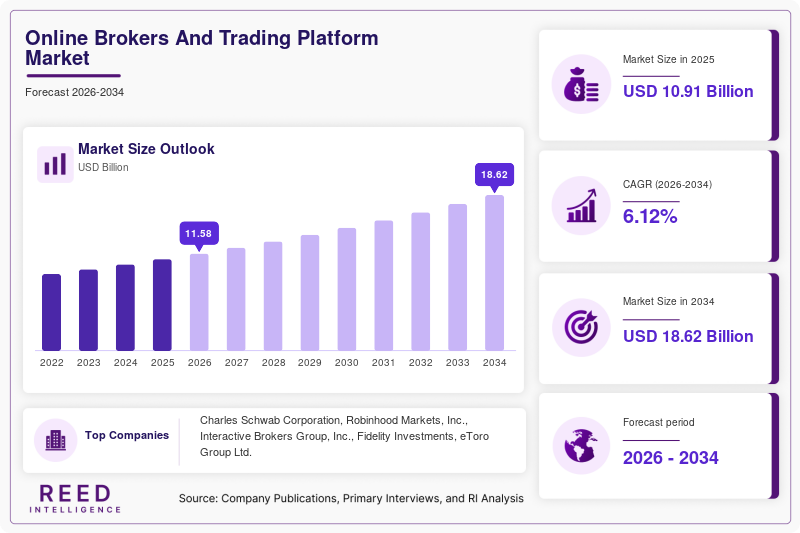
The global online brokers and trading platform market was valued at USD 10.91 billion in 2025 and is projected to grow from USD 11.58 billion in 2026 to USD 18.36 billion by 2034, registering a CAGR of 6.12% during the forecast period from 2026 to 2034.
The online brokers and trading platform market is shifting from basic digital order execution toward broader, multi-asset financial platforms combining trading, investing, cash management, research, advisory and wealth-management functions. The competitive model has also changed as electronic execution, lower transaction costs and mobile access have reduced barriers to market participation. FINRA notes that the U.S. brokerage environment has experienced widespread elimination of trading commissions, broader retail-investor access and rapid technological change, with younger investors more likely to use mobile applications and social media for investment information.
Platform providers are responding by increasing the breadth of assets and services available through a single account. Interactive Brokers, for example, provides access to stocks, options, futures, currencies, bonds and funds across more than 160 global markets. eToro similarly operates as a multi-asset platform spanning traditional and alternative assets and reported 3.81 million funded accounts at the end of 2025.
Online Brokers and Trading Platform Market Drivers
Mobile-First Investing Is Expanding Retail Access to Brokerage Services
The increasing use of mobile applications is changing how retail investors interact with brokers. FINRA's recent review of the brokerage environment identifies broader retail participation, widespread elimination of trading commissions and increased reliance by younger investors on mobile applications and social media for investment information.
The mechanism is lower friction between investment decisions and order execution. Mobile platforms allow investors to monitor portfolios, deposit funds, receive market information and execute trades from a single interface. This encourages brokers to compete through interface design, education, alerts, fractional investing and integrated financial services rather than relying solely on pricing.
The impact is particularly relevant to retail investors and younger account holders. However, regulatory scrutiny of digital engagement practices means platforms must balance personalization and engagement with investor-protection requirements.
Multi-Asset Platforms Increase Revenue Opportunities per Customer
Brokers are broadening the range of assets and financial products available through digital accounts. Interactive Brokers provides access to more than 160 markets and multiple asset classes, while eToro combines equities, ETFs, cryptoassets and other investment products within its platform.
The market mechanism is greater customer retention and deeper wallet share: an investor who can access several asset classes without moving assets to another provider has fewer reasons to maintain multiple brokerage relationships. eToro reported that 53% of its funded accounts invested in more than one asset class at the end of 2025.
This supports growth in trading, interest income, asset-based revenue and premium services. The counterbalance is increasing compliance complexity because each additional asset class can introduce different regulatory, custody and suitability requirements.
Automation and AI Are Moving Platforms Beyond Basic Trade Execution
Online brokers are increasingly incorporating automation, intelligent search, personalized information and AI-supported investing tools. eToro stated that it accelerated AI adoption during 2025 while expanding its product range and localization.
The commercial mechanism is a shift from platforms being transactional interfaces toward becoming ongoing financial-management environments. Automated investing and digital advisory services can increase engagement among users who do not actively trade, while AI-supported research and discovery tools can increase the amount of activity occurring inside a platform.
The opportunity is strongest among investors seeking simplified portfolio management and research. However, AI-based financial tools also introduce risks involving suitability, transparency, data security and potential conflicts of interest. Regulatory attention to digital engagement practices remains an important constraint.
Online Brokers and Trading Platform Market Restraints
Margin Pressure From Low-Cost and Commission-Free Trading
The widespread elimination of trading commissions has reduced one of the traditional revenue sources for retail brokerage platforms. FINRA identifies the broad elimination of trading commissions as a major structural change in the brokerage industry.
The resulting economic mechanism is straightforward: customer acquisition can increase while direct revenue per trade declines. Brokers therefore need to monetize deposits, securities lending, margin lending, subscriptions, premium products, payment services and other activities.
Large platforms with substantial customer assets can compensate through scale and diversified revenue streams, whereas smaller platforms may face greater pressure from customer-acquisition expenses and technology investment.
Regulatory and Cybersecurity Requirements Increase Operating Complexity
Digital brokers operate within highly regulated financial markets where electronic order handling, market access, customer protection, data management and cybersecurity are subject to extensive requirements. FINRA notes that the increased automation and speed of electronic trading can amplify the consequences of trading errors or malicious activity.
The market mechanism is higher technology and compliance expenditure. Brokers must invest in resilient infrastructure, surveillance, cybersecurity, identity verification, risk controls and regulatory reporting. These requirements can slow product launches and increase fixed operating costs, particularly for smaller platforms seeking to compete with large established providers.
Online Brokers and Trading Platform Market Opportunities
Integrated Financial Super-Apps Can Increase Customer Lifetime Value
The expansion of brokerage platforms into banking, retirement, cash management, advisory and alternative investments creates an opportunity to increase the amount of a customer's financial activity handled through one provider.
Robinhood's 2025 results illustrate this transition. Alongside its brokerage operations, the company expanded retirement, banking and advisory offerings; its Gold subscriber base reached 4.2 million, while Robinhood Retirement assets under custody more than doubled year over year to USD 26.5 billion.
The opportunity is strongest when customers can move from occasional trading toward long-term investing and wealth management without changing platforms. The principal limitation is competition from banks, established wealth managers and full-service brokerages with deeper customer relationships.
International Market Access Creates a Differentiation Opportunity
Global market access provides brokers with another route to differentiate from domestic-only platforms. Interactive Brokers offers access to more than 160 markets, while eToro expanded access to HKEX-listed stocks and exchange-traded products in 2025.
The commercial mechanism is increased trading activity and retention among customers seeking international diversification. Platforms can also use localized products, tax-advantaged accounts and regional partnerships to deepen market penetration.
However, international expansion increases licensing, tax, custody, currency and regulatory complexity, which can reduce the economic benefit of entering smaller markets.
Platform Type Analysis
By Platform Type
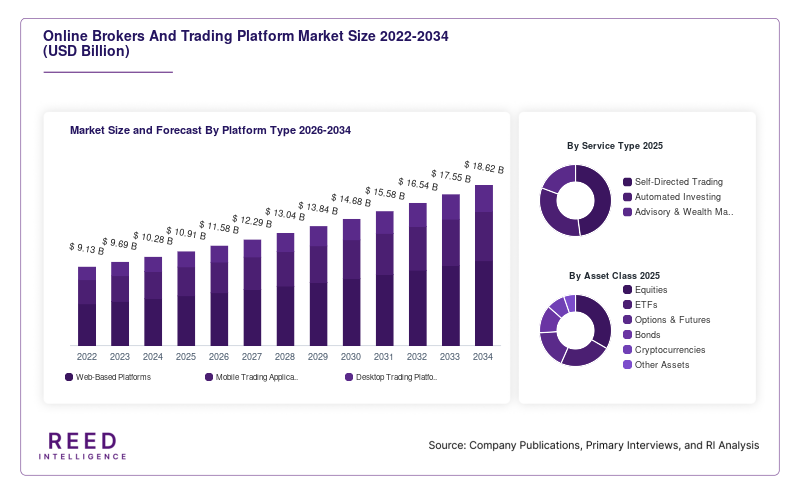
Mobile Trading Applications accounted for approximately 47% of the platform-type segment in 2025. Their position reflects the shift toward continuous portfolio monitoring and mobile-first investing. FINRA identifies mobile applications as an increasingly important channel for younger investors and notes broader technological changes across the brokerage industry.
Mobile applications allow brokers to combine trading, account funding, portfolio monitoring, alerts, educational content and financial-management features within one interface. The model also gives platforms more opportunities to introduce subscription services and cross-sell additional financial products.
The segment's principal risk is regulatory scrutiny of digital engagement techniques. Brokers must ensure that personalization and interface design do not undermine investor understanding or encourage inappropriate trading behavior.
Web-Based Platforms accounted for approximately 36% of the platform-type segment in 2025 and are projected to grow at approximately 5.7% CAGR through 2034. Web interfaces remain important for investors requiring detailed portfolio information, research tools and larger-screen trading functionality.
Desktop platforms accounted for the remaining 17% and are projected to grow at approximately 4.9% CAGR through 2034, with demand concentrated among active and professional users requiring advanced charting, execution and analytical capabilities.
Service Type Analysis
By Service Type
Self-Directed Trading accounted for approximately 55% of the service-type segment in 2025. Its leading position reflects the continued importance of investors who independently select securities and execute their own trades.
The expansion of commission-free trading and mobile applications has reduced the cost and operational friction associated with self-directed investing. Robinhood's 2025 results, including 27.0 million funded customers and 28.4 million investment accounts, illustrate the scale that consumer-oriented digital brokerage models can achieve.
The segment remains exposed to market activity and investor sentiment because trading volumes can fluctuate substantially with market conditions.
Automated Investing accounted for approximately 25% of the service-type segment in 2025 and is projected to grow at approximately 9.4% CAGR through 2034. The segment benefits from demand for simplified portfolio construction, recurring investing and automated asset allocation.
The growth mechanism is broader than active trading because automated services can attract customers who prefer long-term investing rather than frequent transactions. Robinhood's expansion of retirement and advisory products illustrates the movement of digital brokers toward longer-duration customer relationships.
Advisory & Wealth Management accounted for approximately 20% of the segment and is projected to grow at approximately 7.8% CAGR.
Asset Class Analysis
By Asset Class
Equities accounted for approximately 39% of the asset-class segment in 2025. Stocks remain the foundational product for most online brokerage platforms because they support both long-term investing and active trading.
eToro reported that 92% of its users invested in equities, cryptoassets or copied another investor as their first action on the platform during 2025, while 53% of funded accounts invested in more than one asset class.
The segment benefits from broad market familiarity and extensive liquidity, although revenue can be affected by declining commission rates and shifts in trading activity.
Cryptocurrencies accounted for approximately 14% of the asset-class segment in 2025 and are projected to grow at approximately 11.8% CAGR through 2034. Digital assets provide online brokers with an additional trading category and can increase customer engagement because crypto markets operate continuously.
eToro reported crypto trading as part of its multi-asset platform and expanded its regulatory footprint under Europe's MiCA framework.
The segment's growth remains constrained by regulatory changes, price volatility, custody requirements and differences in crypto rules across jurisdictions.
Other asset-class CAGR: ETFs are projected to grow at approximately 7.2%, Options & Futures at 7.0%, Bonds at 5.8%, and Other Assets at approximately 6.5% through 2034.
End-User Analysis
By End User
Retail Investors accounted for approximately 61% of the end-user segment in 2025. The segment benefits from low-cost digital access, simplified account opening and mobile trading.
Robinhood reported 27.0 million funded customers at the end of 2025, while Charles Schwab opened 4.7 million new brokerage accounts during 2025.
The large retail base creates opportunities to cross-sell retirement, advisory, banking, lending and premium services. At the same time, retail activity can be sensitive to market volatility and economic conditions.
Active Traders accounted for approximately 24% of the end-user segment in 2025 and are projected to grow at approximately 7.4% CAGR through 2034. Their demand is concentrated around advanced execution, real-time data, options, futures, margin and sophisticated analytical tools.
Interactive Brokers serves this customer group through advanced order types, smart routing, global market access and professional-grade trading tools.
Institutional Investors accounted for approximately 15% of the segment and are projected to grow at approximately 5.2% CAGR.
Online Brokers and Trading Platform Market Regional Analysis
North America Represents the Largest Regional Market Through High Digital Brokerage Penetration
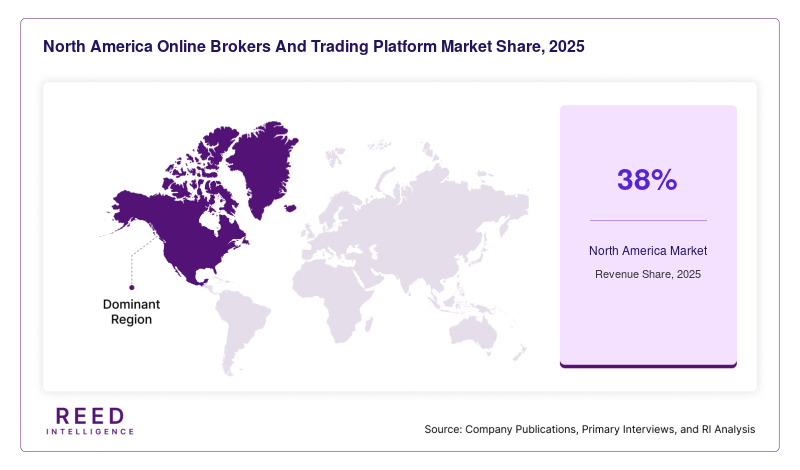
North America accounted for approximately 38% of global revenue in 2025 and is projected to grow at approximately 5.7% CAGR through 2034. The region benefits from mature electronic trading infrastructure, a large retail-investor population and strong competition among full-service and digital-first brokers.
Charles Schwab reported nearly USD 12 trillion in assets and more than 46 million client accounts in 2025, while daily average trades reached 7.7 million, up 31% from 2024.
The U.S. also has a highly developed regulatory environment covering electronic trading, market access and investor protection. FINRA highlights the continued shift toward automated execution and digital access.
The growth mechanism is increasingly based on asset gathering, retirement services, wealth management, options and premium digital products rather than traditional commissions. Canada adds another established market with significant online-investing adoption.
The principal constraint is intense competition. Large brokers have scale advantages in technology, pricing and customer acquisition, making differentiation increasingly dependent on product breadth, execution quality, user experience and integrated financial services.
Asia-Pacific Is the Fastest-Growing Regional Market as Digital Participation Broadens
Asia-Pacific accounted for approximately 28% of global revenue in 2025 and is projected to grow at approximately 7.6% CAGR through 2034. Growth is supported by expanding retail-investor participation, smartphone adoption, digital financial services and increasing access to domestic and international securities.
The region includes highly developed markets such as Japan, Australia and Hong Kong alongside rapidly expanding digital-investment markets in India and Southeast Asia. eToro's 2025 expansion of access to all HKEX-listed stocks and ETPs illustrates how platforms are broadening regional investment access.
India provides a particularly relevant structural market because digital account opening and mobile-based investing have lowered entry barriers for individual investors. However, market structures and regulatory requirements differ substantially between countries.
The growth mechanism is therefore a combination of new account creation, greater household participation, multi-asset access and mobile-first distribution. Regulatory fragmentation, local competition and differences in investor behavior can limit cross-border expansion.
Europe Represents a Mature Digital Brokerage Market With Strong Cross-Border Opportunities
Europe accounted for approximately 21% of global revenue in 2025 and is projected to grow at approximately 5.9% CAGR through 2034. The region combines mature investment markets with demand for digital platforms offering equities, ETFs, cryptoassets, savings products and tax-advantaged accounts.
eToro reported 40 million registered users across 75 countries and identified Europe as its largest market. In 2025, the company expanded its UK ISA offering and received authorization under the EU's MiCA framework for crypto services.
The regulatory environment creates both a constraint and a competitive differentiator. MiCA provides a harmonized framework for qualifying crypto services, while national investment and tax regimes continue to influence product design.
The growth mechanism is increased product localization, cross-border market access and integration of investing with broader financial services. Regulatory compliance and fragmented national markets remain important operating challenges.
Latin America Is Expanding Through Mobile-First Retail Investing
Latin America accounted for approximately 8% of global revenue in 2025 and is projected to grow at approximately 6.8% CAGR through 2034. The market is developing around mobile investing, increasing retail participation and demand for accessible investment products.
The region's growth mechanism is largely digital distribution: platforms can reach customers without building extensive branch networks, while mobile applications simplify account management and securities access.
Brazil and Mexico represent important markets because of their relatively developed financial systems and expanding digital-finance ecosystems. However, currency volatility, varying regulatory requirements and differences in capital-market depth can affect platform economics.
Middle East & Africa Remain Smaller Markets With Selective Digital Brokerage Expansion
Middle East & Africa accounted for approximately 5% of global revenue in 2025 and is projected to grow at approximately 6.3% CAGR through 2034. Adoption is concentrated in markets with developed financial centers, rising digital-finance penetration and growing demand for international investment access.
The United Arab Emirates, Saudi Arabia and South Africa provide important centers for digital investment activity. International brokers can also use multi-market access to serve customers seeking exposure beyond domestic exchanges.
The principal growth mechanism is the migration of investment activity toward digital channels and increased access to global securities. Market fragmentation, financial-literacy differences, regulatory requirements and varying levels of capital-market development remain constraints.
Online Brokers and Trading Platform Market Competitive Landscape
Competition is increasingly centered on customer assets, product breadth, execution quality, technology, pricing and the ability to combine brokerage with adjacent financial services.
Large established brokers such as Charles Schwab compete through scale, broad asset coverage, wealth-management capabilities and established customer relationships. Schwab opened 4.7 million brokerage accounts in 2025, generated 7.7 million daily average trades and continued expanding its access to private markets through its planned acquisition of Forge Global.
Digital-first platforms are competing through simplified interfaces, rapid product development and broader access to alternative assets. Robinhood ended 2025 with 27.0 million funded customers and USD 324 billion in platform assets, while eToro reported 3.81 million funded accounts and USD 18.5 billion in assets under administration.
Key Market Players
- Charles Schwab Corporation
- Robinhood Markets, Inc.
- Interactive Brokers Group, Inc.
- Fidelity Investments
- eToro Group Ltd.
- E*TRADE
- Webull Corporation
- IG Group Holdings plc
- Saxo Bank
- Plus500 Ltd.
- Trading 212
- Futu Holdings Limited
- Moomoo Technologies Inc.
- Ally Invest
- SoFi Technologies, Inc.
Online Brokers and Trading Platform Market Recent Developments
- Robinhood ended 2025 with 27.0 million funded customers and USD 324 billion in platform assets. Its Gold subscription base reached 4.2 million, while Robinhood Retirement assets more than doubled year over year to USD 26.5 billion. By July 2026, funded customers had reached 28.5 million, while platform assets stood at USD 355 billion. The development matters because it demonstrates the shift from a transaction-focused brokerage toward a broader financial platform. More customer assets provide opportunities for interest income, subscriptions, lending, retirement products and advisory services.
- Charles Schwab opened 4.7 million new brokerage accounts in 2025, while daily average trades increased 31% to 7.7 million. The company also reported nearly USD 12 trillion in assets and more than 46 million client accounts. The development reinforces the importance of scale in online brokerage. Large customer and asset bases allow established brokers to spread technology and compliance costs over a broader revenue base while cross-selling wealth-management and financial products.
Online Brokers And Trading Platform Market Segments
By Platform Type
- Web-Based Platforms
- Mobile Trading Applications
- Desktop Trading Platforms
By Service Type
- Self-Directed Trading
- Automated Investing
- Advisory & Wealth Management
By Asset Class
- Equities
- ETFs
- Options & Futures
- Bonds
- Cryptocurrencies
- Other Assets
By End User
- Retail Investors
- Active Traders
- Institutional Investors
By Region
- North America
- Europe
- APAC
- Middle East and Africa
- LATAM