Perfluoroelastomer (FFKM) Parts and Seals Market Size, Share & Trends Analysis Report By Product Type, By Application, By End User and By Region, Forecasts 2026–2034
USD 3950
Perfluoroelastomer (FFKM) Parts and Seals Market Size
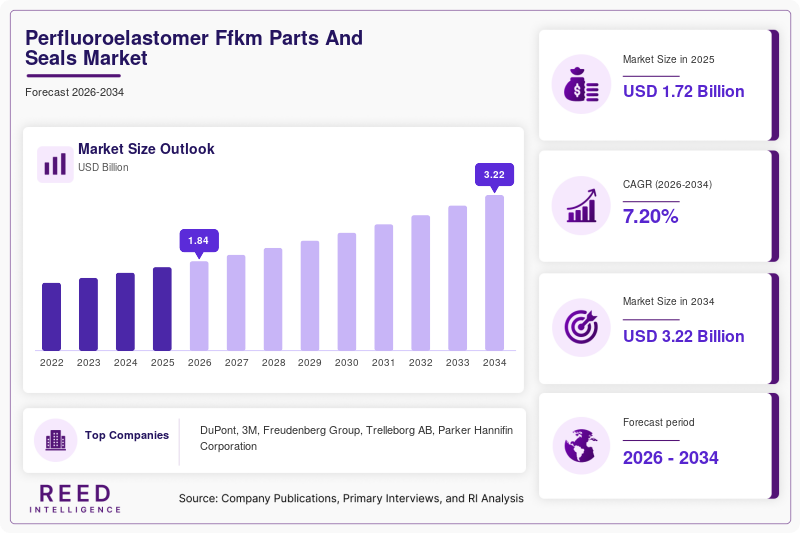
The global perfluoroelastomer (FFKM) parts and seals market was valued at USD 1.72 billion in 2025 and is projected to grow from USD 1.84 billion in 2026 to USD 3.20 billion by 2034, registering a CAGR of 7.20% during the forecast period from 2026 to 2034.
Perfluoroelastomer (FFKM) parts and seals are high-performance sealing components designed for applications requiring exceptional resistance to aggressive chemicals, elevated temperatures, plasma, vacuum environments and demanding operating conditions. They are used across semiconductor manufacturing, chemical processing, aerospace, oil and gas, pharmaceutical, food processing and other high-performance industrial applications.
FFKM materials provide superior chemical and thermal resistance compared with many conventional elastomers. Their ability to maintain sealing performance under extreme operating conditions makes them particularly important in semiconductor processing equipment, where exposure to aggressive chemicals, high temperatures and plasma environments creates stringent material requirements.
Perfluoroelastomer (FFKM) Parts and Seals Market Drivers
Expansion of Semiconductor Manufacturing
Semiconductor fabrication equipment represents an important application area for FFKM components.
As semiconductor manufacturing processes become more complex, equipment must operate under increasingly demanding chemical, temperature and vacuum conditions, increasing the requirement for highly resistant sealing materials.
Increasing Demand for High-Performance Seals
Industrial processes involving aggressive chemicals, high temperatures and demanding pressure conditions require sealing solutions capable of maintaining performance over extended operating periods.
FFKM's chemical and thermal resistance makes it suitable for these environments.
Growth of Semiconductor Equipment Investment
New semiconductor fabrication facilities and capacity expansions are increasing demand for process equipment and related components.
The expansion of semiconductor manufacturing infrastructure therefore creates opportunities for suppliers of specialized seals and elastomeric components.
Stringent Contamination-Control Requirements
Contamination can negatively affect sensitive manufacturing processes, particularly semiconductor fabrication.
FFKM components are increasingly used in applications where low outgassing, chemical compatibility and material purity are important.
Expansion of Advanced Industrial Applications
The use of high-performance elastomers is expanding across aerospace, chemical processing, pharmaceutical manufacturing and energy applications.
These industries require materials capable of maintaining sealing performance in harsh environments.
Perfluoroelastomer (FFKM) Parts and Seals Market Restraints
High Material and Component Costs
FFKM materials are significantly more expensive than conventional elastomers such as EPDM, NBR and standard fluoroelastomers.
The higher price can limit adoption in applications where operating conditions do not justify premium sealing materials.
Complex Manufacturing Requirements
Producing precision FFKM components requires specialized compounding, molding, curing and finishing processes.
Manufacturers must maintain stringent quality standards to ensure dimensional accuracy and sealing performance.
Availability of Alternative Materials
Other high-performance elastomers and engineered sealing materials can compete with FFKM in selected applications.
Material selection depends on chemical exposure, temperature, pressure, cost and required service life.
Supply Chain Sensitivity
Specialized raw materials and manufacturing capabilities can create supply-chain constraints.
Fluctuations in raw-material availability and production capacity can affect component prices and lead times.
Perfluoroelastomer (FFKM) Parts and Seals Market Opportunities
Semiconductor Fab Expansion
The construction and expansion of semiconductor fabrication facilities presents a major opportunity for FFKM seal manufacturers.
Increasing wafer-processing complexity can raise demand for advanced seals capable of operating in aggressive process environments.
Advanced Semiconductor Nodes
More advanced semiconductor manufacturing processes require highly controlled process environments.
This creates opportunities for low-contamination and high-purity FFKM components in critical process equipment.
Pharmaceutical and Biotechnology Applications
Pharmaceutical manufacturing requires reliable sealing solutions capable of meeting demanding cleanliness and chemical-resistance requirements.
The expansion of biopharmaceutical production provides additional opportunities for specialized sealing components.
Aerospace Applications
Aerospace systems operate under demanding temperature, pressure and chemical conditions.
FFKM components can provide performance advantages in selected aerospace sealing applications where reliability is critical.
Chemical Processing
Chemical processing facilities handle corrosive and aggressive substances that can degrade conventional elastomers.
The chemical resistance of FFKM creates opportunities for use in pumps, valves, reactors and other equipment.
Product Type Segment Analysis
By Product Type
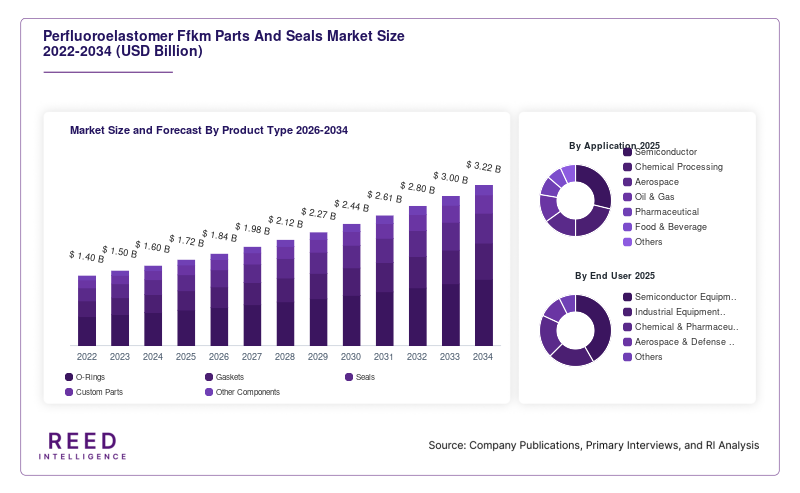
O-Rings accounted for approximately 42% of the perfluoroelastomer (FFKM) parts and seals market in 2025, making them the dominant product type. Their broad use in semiconductor equipment, chemical-processing systems, pumps, valves and other industrial machinery supports their leading position.
Custom Parts accounted for approximately 17% and are projected to grow at approximately 8.5% CAGR, making them the fastest-growing major product segment. Increasing demand for application-specific sealing solutions in advanced equipment is supporting growth.
Gaskets represented approximately 23%, other seals approximately 13%, and other components approximately 5%.
Application Segment Analysis
By Application
Semiconductor applications accounted for approximately 38% of the market in 2025, making them the largest application segment. Semiconductor manufacturing equipment requires sealing components that can withstand aggressive chemicals, plasma exposure, high temperatures and stringent contamination requirements.
Pharmaceutical applications accounted for approximately 11% and are projected to grow at approximately 8.1% CAGR, making them the fastest-growing major application segment. Increasing biopharmaceutical manufacturing capacity and demand for high-purity processing environments are supporting adoption.
Chemical processing represented approximately 24%, aerospace 12%, oil & gas 9%, food & beverage 5%, and other applications approximately 1%.
End-User Segment Analysis
By End User
Semiconductor equipment manufacturers accounted for approximately 41% of the market in 2025, making them the largest end-user segment. The demanding chemical, thermal and vacuum conditions encountered in wafer-processing equipment drive the use of high-performance FFKM components.
Chemical & pharmaceutical companies accounted for approximately 23% and are projected to grow at approximately 8.0% CAGR, making them the fastest-growing major end-user segment. Increasing investment in advanced chemical and pharmaceutical production is supporting demand for chemically resistant sealing solutions.
Industrial equipment manufacturers represented approximately 22%, aerospace and defense companies 9%, and other end users approximately 5%.
Perfluoroelastomer (FFKM) Parts and Seals Market Regional Analysis
Asia-Pacific Holds the Largest Share
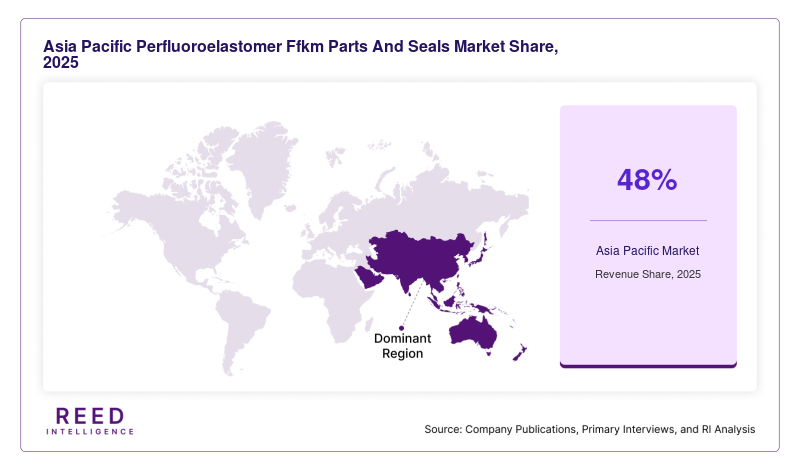
Asia-Pacific accounted for approximately 48% of the global Perfluoroelastomer (FFKM) Parts and Seals Market in 2025, making it the largest regional market. The region's position is supported by its extensive semiconductor manufacturing base, electronics production, chemical-processing industries and growing investment in advanced manufacturing infrastructure.
North America accounted for approximately 25% and is projected to grow at approximately 8.0% CAGR, making it the fastest-growing major region. Semiconductor manufacturing investments, advanced industrial applications and expansion of domestic production capabilities are supporting regional demand.
Europe Maintains Strong Industrial Demand
Europe accounted for approximately 19% of the market in 2025 and is projected to grow at approximately 6.2% CAGR.
The region benefits from established chemical, pharmaceutical, aerospace and industrial manufacturing sectors requiring high-performance sealing technologies.
Latin America Represents an Emerging Opportunity
Latin America accounted for approximately 5% of the market in 2025 and is projected to grow at approximately 6.5% CAGR.
Oil and gas, chemical processing and industrial manufacturing applications are creating opportunities for FFKM components.
Middle East & Africa Shows Specialized Demand
Middle East & Africa accounted for approximately 3% of the market in 2025 and is projected to grow at approximately 6.8% CAGR.
Oil and gas processing, chemical industries and expanding industrial infrastructure are supporting demand for high-performance sealing solutions.
Perfluoroelastomer (FFKM) Parts and Seals Market Competitive Landscape
Competition in the Perfluoroelastomer (FFKM) Parts and Seals Market is based on chemical resistance, temperature resistance, material purity, sealing performance, product customization, durability, manufacturing precision and technical support.
Leading companies are investing in material development, application-specific formulations and customized sealing solutions to address increasingly demanding industrial requirements.
Key Market Players
- DuPont
- 3M
- Freudenberg Group
- Trelleborg AB
- Parker Hannifin Corporation
- Greene Tweed
- Saint-Gobain
- ERIKS
- Garlock GmbH
- Marco Rubber & Plastics
Perfluoroelastomer (FFKM) Parts and Seals Market Recent Developments
- The continued expansion of semiconductor manufacturing capacity is increasing demand for high-performance components used in wafer-processing equipment. FFKM seals are particularly relevant in process environments involving aggressive chemicals, high temperatures and stringent contamination requirements.
- Manufacturers are developing specialized formulations designed to improve plasma resistance, chemical compatibility, thermal performance and durability. These developments are intended to extend component life in increasingly demanding process conditions.
Perfluoroelastomer Ffkm Parts And Seals Market Segments
By Product Type
- O-Rings
- Gaskets
- Seals
- Custom Parts
- Other Components
By Application
- Semiconductor
- Chemical Processing
- Aerospace
- Oil & Gas
- Pharmaceutical
- Food & Beverage
- Others
By End User
- Semiconductor Equipment Manufacturers
- Industrial Equipment Manufacturers
- Chemical & Pharmaceutical Companies
- Aerospace & Defense Companies
- Others
By Region
- North America
- Europe
- APAC
- Middle East and Africa
- LATAM