Pharma Cosmetics Market Size, Share & Trends Analysis Report By Product Type (Pharmaceuticals, Skincare, Haircare, Makeup, Fragrances, Others), By Application (Prescription Drugs, Over-the-Counter Drugs, Beauty & Personal Care, Others), By Distribution Channel (Pharmacies & Drugstores, Online Stores, Supermarkets/Hypermarkets, Specialty Stores, Direct Sales) and By Region (North America, Europe, Asia-Pacific, Latin America, Middle East & Africa) Forecasts, 2026–2034
USD 3950
Pharma Cosmetics Market Size
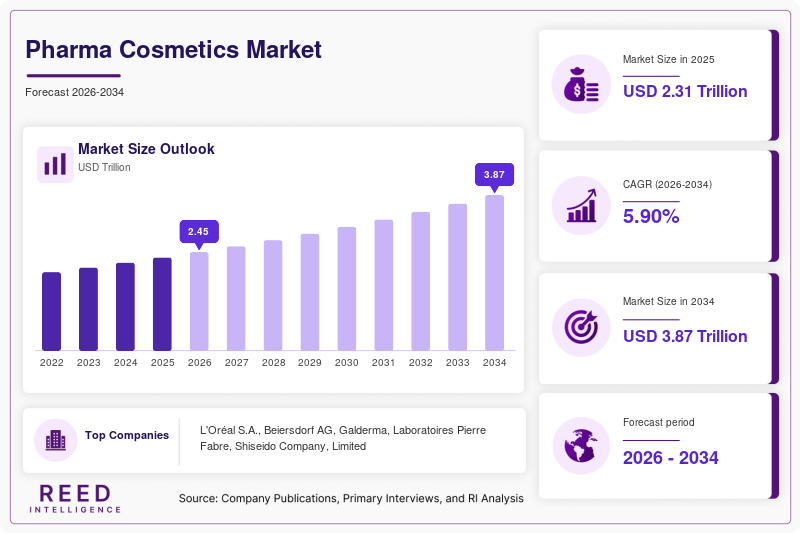
The global pharma cosmetics market was valued at USD 2.31 trillion in 2025 and is projected to grow from USD 2.45 trillion in 2026 to USD 3.87 trillion by 2034, registering a CAGR of 5.90% during the forecast period from 2026 to 2034.
The pharma cosmetics market sits at the intersection of pharmaceutical science, dermatology and consumer beauty, with demand increasingly shifting toward products that combine cosmetic functionality with evidence-based skin, hair and personal-care benefits. Skincare is particularly important because consumers are increasingly seeking products positioned around barrier support, pigmentation management, sun protection, acne care, anti-aging and other specific dermatological concerns. L'Oréal's Dermatological Beauty division reported 5.5% like-for-like growth in 2025 and highlighted continued demand for clinically supported skincare across mature and emerging markets.
The commercial model is also changing as pharmaceutical and beauty companies expand science-led portfolios, professional recommendations and digital distribution. Beiersdorf's Eucerin and Aquaphor Derma business recorded 11.7% organic growth in 2025, with innovation and expansion in emerging markets supporting demand. Galderma similarly reported growth across dermatological skincare and therapeutic dermatology in 2025, illustrating the increasing overlap between consumer skincare and medically oriented dermatology.
Pharma Cosmetics Market Drivers
Science-Based Skincare Is Expanding the Commercial Role of Dermatological Products
The market is moving toward skincare products supported by dermatological research, active ingredients and professional recommendations rather than purely cosmetic positioning. L'Oréal's Dermatological Beauty division reported 5.5% like-for-like growth in 2025 and highlighted its portfolio of La Roche-Posay, CeraVe, SkinCeuticals and Vichy, while reaching more than 320,000 healthcare professionals. Beiersdorf's Eucerin and Aquaphor business also achieved 11.7% organic growth in 2025, supported by innovations including Epigenetics Serum and Thiamidol-based products. The mechanism is straightforward: products that address identifiable skin concerns can command repeated use and stronger professional recommendation, increasing demand for clinically differentiated formulations. Skincare and dermatological products therefore capture a greater portion of consumer spending moving from general beauty toward problem-oriented care. Regulatory limits on therapeutic claims remain a counterbalance.
Aesthetic Treatments Are Creating Demand for Complementary Skincare
The convergence of aesthetic procedures and skincare is expanding the addressable market for products used before and after professional treatments. L'Oréal reports that 87% of surveyed aesthetic-procedure users had used skincare to accompany or complement their most recent procedure. This creates a commercial mechanism beyond conventional skincare routines: consumers undergoing aesthetic treatments can require products for cleansing, hydration, barrier support, pigmentation management and recovery. Companies with dermatology expertise can therefore link professional procedures with consumer skincare portfolios. Galderma's 2025 portfolio performance across Injectable Aesthetics, Dermatological Skincare and Therapeutic Dermatology illustrates how companies can participate across several stages of the dermatology and aesthetics value chain. Adoption can nevertheless be constrained by procedure costs, professional access and differences in regulatory treatment of cosmetic and therapeutic claims.
Emerging Markets Are Expanding the Addressable Consumer Base
Expansion into emerging markets is becoming a commercial mechanism for science-led beauty and dermatological brands because manufacturers can introduce specialized products into markets where premium skincare penetration remains expandable. Beiersdorf reported that emerging markets were the most important growth driver for its Derma business in 2025, particularly through Latin America and Thailand. L'Oréal also reported particularly strong momentum for its Dermatological Beauty division in emerging markets and mainland China. The opportunity comes from increasing awareness of dermatological concerns, wider pharmacy and e-commerce access and localization of product portfolios. However, affordability, local competition, regulatory requirements and economic volatility can limit conversion from consumer interest into sustained purchasing.
Pharma Cosmetics Market Restraints
Regulatory Boundaries Limit Therapeutic Claims for Cosmetic Products
The distinction between cosmetics and medicines creates a commercialization constraint for pharma cosmetics. U.S. FDA rules state that products marketed with claims to treat or prevent disease or affect the structure or function of the body may be regulated as drugs rather than cosmetics. Similar compliance obligations exist in Great Britain, where cosmetic products require safety assessment, responsible-person oversight, notification and evidence supporting claims. This increases formulation, documentation and regulatory costs and can lengthen product-development timelines. Companies also have to balance stronger efficacy communication with claims that remain within the applicable cosmetic framework.
Ingredient Compliance and Product-Safety Requirements Increase Development Complexity
Ingredient restrictions and safety requirements can increase the cost and complexity of maintaining product portfolios. Great Britain requires cosmetic products to undergo safety assessment and places responsibilities on companies for ingredients, labeling, product information and claims. European regulatory developments concerning substances classified as carcinogenic, mutagenic or toxic for reproduction further illustrate how ingredient regulation can affect formulation strategies. For manufacturers, reformulation can involve testing, packaging changes, supplier qualification and market-specific compliance work. These requirements may particularly affect smaller brands that lack the regulatory and formulation resources of multinational competitors.
Pharma Cosmetics Market Opportunities
Microbiome-Based Skincare Creates a New Science-Led Product Platform
Skin microbiome research is opening opportunities for formulations positioned around specific dermatological concerns. In September 2026, Beiersdorf introduced Eucerin DERMOPURE CLINICAL PROBIOM8 for acne-prone skin, using a patented cosmetic active ingredient based on viable skin-native probiotics after more than two decades of microbiome research. The commercial opportunity lies in translating specialized biological research into repeat-use consumer products while maintaining cosmetic regulatory compliance. Acne-prone and sensitive-skin consumers represent particularly relevant targets because they often seek products that combine tolerability with measurable performance. Adoption will depend on evidence supporting product benefits, consumer understanding and the ability to scale novel ingredients economically.
Dermatology-to-Beauty Convergence Can Expand Premium Product Portfolios
The boundary between dermatological care and premium beauty is creating opportunities for companies with scientific credibility. L'Oréal's 2025 agreement to acquire a majority stake in British skincare brand Medik8 added a science-oriented premium skincare brand to its portfolio, while the company described the category as medicalised beauty. This creates a mechanism through which established beauty companies can access consumers seeking professional-grade efficacy without moving completely into prescription medicines. Similar convergence can occur through dermatology clinics, professional recommendations, direct-to-consumer channels and premium pharmacies. The main limitation is the need to maintain credible evidence while avoiding therapeutic claims that trigger additional regulatory obligations.
Product Type Analysis
By Product Type
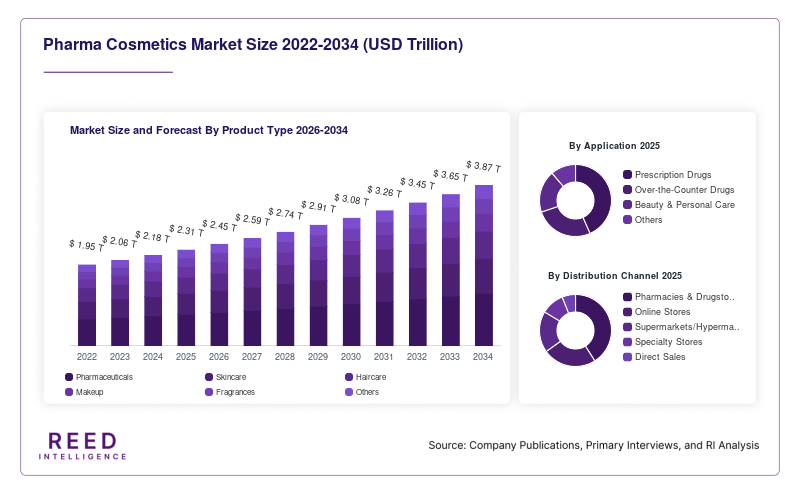
Pharmaceuticals account for approximately 46% of the global market in 2025. Their leading position reflects the higher-value revenue generated by prescription and non-prescription medicines compared with individual consumer beauty categories. Pharmaceutical demand is linked to diagnosed conditions, treatment protocols, healthcare access and recurring therapy requirements rather than discretionary beauty spending. The category also benefits from extensive R&D, regulatory pathways and established distribution through healthcare institutions and pharmacies. However, pharmaceutical revenue is subject to greater regulatory scrutiny, reimbursement conditions and development costs than conventional cosmetics. The broader market is increasingly connected with dermatology as companies such as Galderma operate across therapeutic dermatology, dermatological skincare and aesthetic products. This convergence creates opportunities for companies to build portfolios spanning clinical treatment and consumer-facing products, but the distinction between therapeutic medicines and cosmetics remains commercially important.
Skincare represents approximately 17% of the market in 2025 and is projected to expand at about 7.6% CAGR through 2034, making it the fastest-growing major product category. Demand is being shaped by consumers seeking products for specific concerns such as acne, pigmentation, photoaging, sensitivity and barrier damage. L'Oréal's Dermatological Beauty portfolio demonstrates the commercial strength of this positioning, with 2025 growth supported by La Roche-Posay, CeraVe and SkinCeuticals. Beiersdorf's Derma business also delivered double-digit organic growth in 2025, supported by product innovation. Growth can be limited by high competition, ingredient costs and increasingly demanding evidence requirements.
Application Analysis
By Application
Prescription Drugs account for approximately 37% of the 2025 market, reflecting the value contribution of physician-directed therapies and the established healthcare infrastructure supporting pharmaceutical consumption. Demand is tied to disease diagnosis, treatment guidelines, physician prescribing and reimbursement systems. The application differs from consumer cosmetics because purchasing decisions are often mediated by healthcare professionals and institutional procurement. Its future development therefore depends more heavily on pharmaceutical innovation and healthcare utilization than on beauty trends.
Beauty & Personal Care represents approximately 36% of the market and is expected to grow at about 6.4% CAGR through 2034. The category benefits from the movement toward science-backed skincare, premium active ingredients, personalization and the overlap between cosmetic routines and dermatological care. L'Oréal reported that its Dermatological Beauty division expanded across all regions in 2025, while Beiersdorf identified innovation as a major contributor to its Derma performance. The segment's expansion is also supported by direct-to-consumer and e-commerce channels, although price sensitivity and regulatory restrictions on cosmetic claims remain relevant constraints.
Distribution Channel Analysis
By Distribution Channel
Pharmacies & Drugstores account for approximately 33% of the 2025 market. Their position reflects the combination of pharmaceutical dispensing, over-the-counter products and dermatological skincare within a single purchasing environment. Pharmacy-based distribution also provides a professional context for science-led skincare, where consumers can seek advice about product suitability and active ingredients. This channel is particularly relevant to pharma cosmetics because credibility and product education can influence purchasing decisions.
Online Stores account for approximately 25% of the 2025 market and are projected to expand at about 8.2% CAGR through 2034. E-commerce enables consumers to compare ingredients, product claims, reviews and formulations while providing brands with direct access to customers. Beiersdorf reported that e-commerce sales in its Derma business again grew faster than the offline business in 2025. L'Oréal also identified e-commerce as a primary growth engine across its divisions in 2025. The main limitations are channel competition, discounting, counterfeit risk and the difficulty of replicating professional product advice online.
Pharma Cosmetics Market Regional Analysis
Asia-Pacific Pharma Cosmetics Market
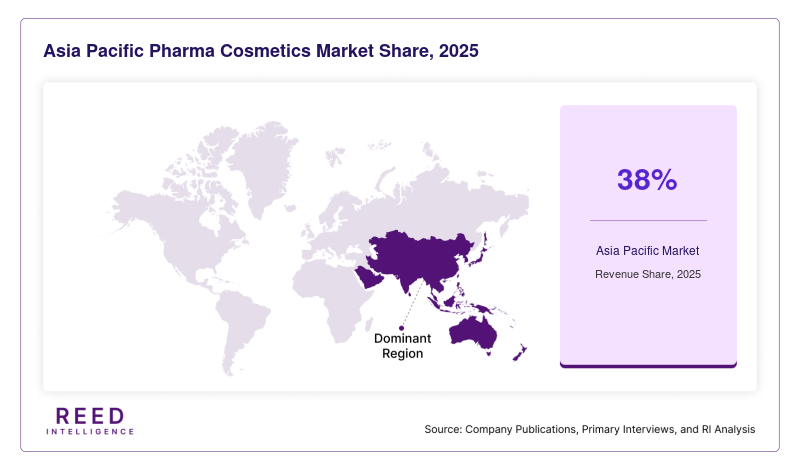
Asia-Pacific represents approximately 38% of the global market in 2025 and is the fastest-growing region at about 6.6% CAGR through 2034. The region combines large consumer populations with sophisticated beauty markets, expanding pharmaceutical manufacturing capabilities and strong demand for skincare innovation. China, Japan, India and South Korea provide different growth mechanisms: China combines large domestic consumption with extensive digital commerce; Japan has a mature premium skincare market; India offers a large pharmaceutical and consumer base; and South Korea remains influential in skincare formulation and product development.
The region is also becoming more important for global companies seeking localized growth. Shiseido operates an integrated business in China covering R&D, production, sales and services, while maintaining portfolios across skincare, makeup and fragrance. Its 2025 report also highlighted continued e-commerce development and recovery in parts of the Chinese market. Beiersdorf expanded Eucerin into Japan in December 2025, specifically developing its HARI FILLER anti-aging range for Japanese consumers.
The growth mechanism therefore extends beyond population size: localized product development, digital commerce, premium skincare and dermatological positioning are widening addressable demand. Constraints include uneven purchasing power, intense domestic competition, regulatory differences and volatility in China's consumer market.
North America Pharma Cosmetics Market
North America represents approximately 29% of the global market in 2025, with growth of about 5.3% CAGR through 2034. The region has an established pharmaceutical and beauty infrastructure, high penetration of premium skincare and extensive pharmacy, specialty retail and e-commerce networks. The U.S. remains central because it combines a large pharmaceutical industry with strong consumer demand for dermatological and prestige skincare.
The market mechanism increasingly revolves around product differentiation and evidence. FDA rules place a clear boundary between cosmetic claims and drug claims, meaning brands seeking therapeutic positioning must carefully manage intended use, labeling and evidence. This encourages companies to invest in formulation science and substantiation while limiting unsupported therapeutic messaging.
L'Oréal's Dermatological Beauty division reported that its U.S. business benefited from renewed momentum in skincare and the expansion of CeraVe into haircare. Beiersdorf also reported North American growth across its Derma categories in 2025. The region's constraints include high customer-acquisition costs, mature category penetration, regulatory compliance and competition between pharmacy, specialty, direct-to-consumer and mass retail channels.
Europe Pharma Cosmetics Market
Europe accounts for approximately 22% of the global market in 2025 and is projected to expand at about 5.1% CAGR through 2034. Europe has a strong foundation in pharmacy-led skincare, dermatology, premium cosmetics and science-based personal care. France, Germany, the U.K. and Italy are important commercial centers, while European brands have substantial international distribution.
Regulatory requirements are an important part of the market mechanism. Cosmetic manufacturers must demonstrate product safety and comply with ingredient and labeling requirements, while claims must remain consistent with the applicable regulatory classification. Great Britain's current guidance requires safety assessment, responsible-person oversight, notification and supporting evidence for cosmetic claims.
European companies are also using innovation and international expansion to support growth. Pierre Fabre reported €3.2 billion in 2025 sales, a presence in 130 territories and continued development across medical dermatology and dermo-cosmetics. Beiersdorf's European business remains an important base for its Eucerin and other skincare portfolios. Growth can be moderated by stringent compliance requirements, mature consumer markets and differences between individual national retail systems.
Latin America Pharma Cosmetics Market
Latin America represents approximately 7% of the global market in 2025 and is expected to grow at about 5.8% CAGR through 2034. The region's demand combines pharmaceutical consumption with strong beauty and personal-care expenditure, creating opportunities for products positioned around skincare, haircare and dermatological concerns. Brazil and Mexico are particularly relevant commercial markets because of their large consumer bases and established beauty industries.
Evidence from multinational companies indicates that the region is becoming increasingly important for science-based skincare. Beiersdorf identified Latin America, particularly Brazil and Mexico, as important contributors to its Derma growth in 2025. This creates a mechanism through which global brands can use established dermatological portfolios while adapting formulations and marketing to local needs.
E-commerce can further expand distribution where specialty and pharmacy networks are uneven, while local beauty brands create additional competitive pressure. Economic volatility, currency movements and consumer purchasing power remain constraints because premium skincare and specialized products can be more sensitive to discretionary-income changes. Regulatory requirements also differ by country, increasing the complexity of regional launches.
Middle East & Africa Pharma Cosmetics Market
Middle East & Africa accounts for approximately 4% of the global market in 2025 and is projected to expand at about 6.0% CAGR through 2034. Demand is supported by expanding urban consumer markets, premium beauty consumption, pharmacy development and growing interest in specialized skincare. The region also presents differentiated product requirements related to climate, sun exposure, pigmentation concerns and local consumer preferences.
The commercial opportunity is strongest where manufacturers can combine dermatological positioning with locally relevant formulations and distribution. International companies are increasingly using emerging markets to expand science-based skincare portfolios. Beiersdorf's 2025 results, for example, identified emerging markets as an important growth engine for its Derma business.
The region remains heterogeneous, however. Gulf markets have different purchasing patterns from African markets, while healthcare infrastructure and formal retail penetration vary significantly between countries. Import dependence, currency volatility, regulatory fragmentation and affordability can constrain adoption. Consequently, growth is likely to be concentrated in markets where pharmacy infrastructure, digital retail and premium consumer demand are sufficiently developed.
Pharma Cosmetics Market Competitive Landscape
Competition in the pharma cosmetics market is increasingly based on scientific credibility, active-ingredient development, dermatology partnerships, product innovation, geographic expansion and channel control rather than cosmetic branding alone.
L'Oréal has strengthened its dermatological position through brands including La Roche-Posay, CeraVe and SkinCeuticals and reached 25.8% market share in dermocosmetics according to its 2025 reporting. Its 2025 acquisition strategy also included an agreement to acquire a majority stake in Medik8, strengthening exposure to science-backed premium skincare.
Beiersdorf is using innovation and international expansion to strengthen Eucerin and Aquaphor. Its Derma business grew 11.7% organically in 2025 and gained market share across regions, while the company expanded Eucerin into Japan.
Key Market Players
- L'Oréal S.A.
- Beiersdorf AG
- Galderma
- Laboratoires Pierre Fabre
- Shiseido Company, Limited
- Unilever PLC
- Procter & Gamble
- Estée Lauder Companies
- Johnson & Johnson
- Kao Corporation
Pharma Cosmetics Market Recent Developments
- September 2026 — Beiersdorf introduced Eucerin DERMOPURE CLINICAL PROBIOM8 for acne-prone skin in September 2026. The product uses a patented cosmetic active ingredient based on viable skin-native probiotics and represents the commercial translation of more than two decades of microbiome research. The development matters because microbiome science can create differentiated product platforms around specific dermatological concerns, potentially increasing the value of science-led skincare.
- June 2025 — L'Oréal announced an agreement in June 2025 to acquire a majority stake in British premium skincare brand Medik8. The transaction added a science-backed premium skincare brand to L'Oréal's portfolio and increased its exposure to the medicalised beauty segment. The competitive implication is greater integration between premium beauty, dermatological positioning and evidence-led skincare.
Pharma Cosmetics Market Segments
By Product Type
- Pharmaceuticals
- Skincare
- Haircare
- Makeup
- Fragrances
- Others
By Application
- Prescription Drugs
- Over-the-Counter Drugs
- Beauty & Personal Care
- Others
By Distribution Channel
- Pharmacies & Drugstores
- Online Stores
- Supermarkets/Hypermarkets
- Specialty Stores
- Direct Sales
By Region
- North America
- Europe
- APAC
- Middle East and Africa
- LATAM