Phone Case Market Size, Share & Trends Analysis Report By Material (Thermoplastic Polyurethane (TPU), Silicone, Polycarbonate, Leather, Other Materials), By Product Type (Protective/Rugged Cases, Slim Cases, Wallet Cases, Clear Cases, Designer & Fashion Cases), By Distribution Channel (Online, Offline) and By Region (North America, Europe, Asia-Pacific, Middle East and Africa, LATAM) Forecasts, 2026–2034
USD 3950
Phone Case Market Size
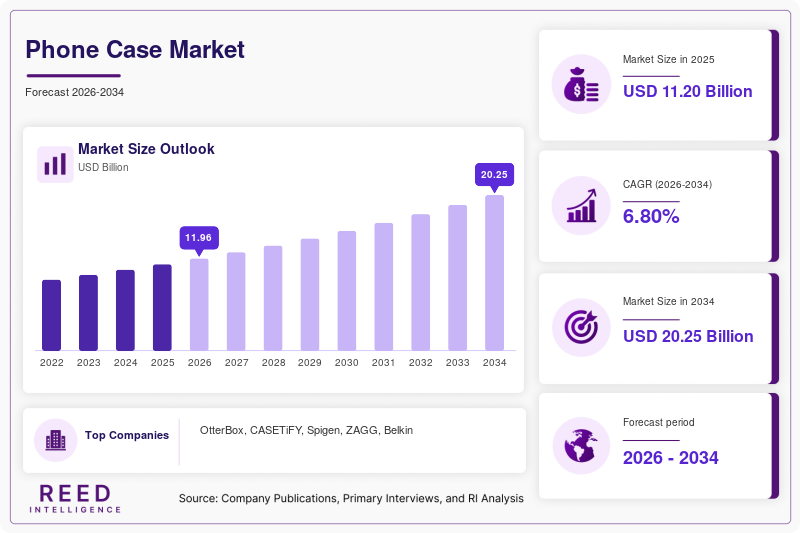
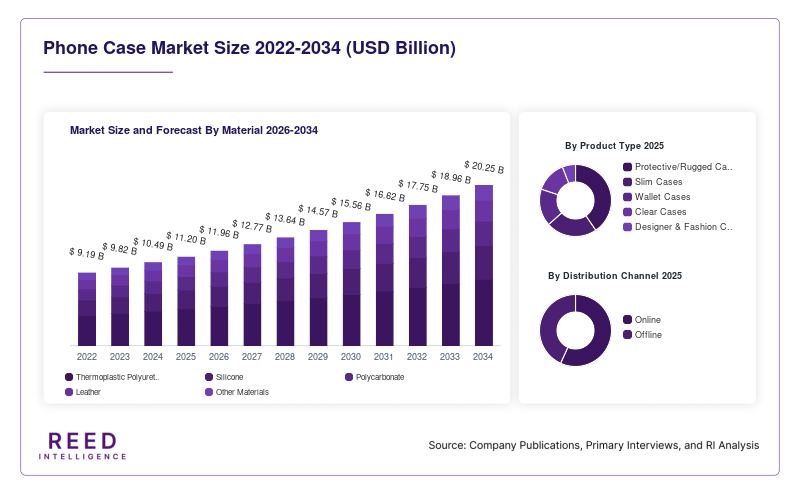
The Phone Case Market was valued at USD 11.20 billion in 2025 and is estimated to reach USD 11.96 billion in 2026. , the market is projected to reach USD 20.25 billion by 2034, expanding at a CAGR of 6.80% from 2026 to 2034.
The phone case market is evolving from a basic device-protection category into a broader consumer-accessories market combining protection, aesthetics, functionality and personalization. Cases are increasingly differentiated through shock absorption, drop protection, thinness, grip, wireless-charging compatibility, camera protection, magnetic attachment and material design.
The underlying market mechanism remains straightforward: every new smartphone generation creates a potential accessory replacement cycle, while device upgrades, accidental damage, fashion preferences and case wear create additional replacement demand. However, smartphone shipment volumes are becoming less reliable as a standalone growth indicator. IDC's 2026 data shows global smartphone shipments contracting while average selling prices rise sharply, suggesting that accessory suppliers can increasingly capture value from premium devices even when unit volumes weaken.
Phone Case Market Drivers
Premiumization of Smartphones Increases Protection Value
The increasing value of smartphones is strengthening the economic rationale for protective accessories. IDC expects the global smartphone ASP to rise substantially in 2026 as component-cost pressures push manufacturers toward higher-value devices.
For phone-case manufacturers, the implication is not necessarily that every premium smartphone creates a proportionally higher number of cases; instead, it increases the potential value captured per accessory. Premium phones also encourage demand for cases offering stronger drop protection, camera protection, magnetic compatibility and higher-quality finishes.
Consumer Personalization Supports Replacement Purchases
Phone cases serve a dual purpose as protective equipment and personal accessories. Consumers can change a case without changing their smartphone, creating a replacement market independent of handset upgrades.
This supports differentiated product categories such as designer cases, transparent cases, customized graphics, premium leather alternatives and cases built around specific lifestyles. Social-media-driven aesthetics and frequent product launches can further shorten the effective design cycle for fashion-oriented cases.
Expansion of New Smartphone Form Factors
The introduction of foldable smartphones and other changing device designs creates additional requirements for accessory manufacturers. IDC expects foldables to remain one of the more resilient smartphone categories in the current market environment.
Foldable phones require cases that accommodate hinges, flexible displays, unusual dimensions and different opening mechanisms. This creates an opportunity for manufacturers capable of engineering cases for device-specific mechanical requirements rather than relying solely on standardized shell designs.
Phone Case Market Restraints
Smartphone Shipment Volatility
Phone-case demand ultimately depends on the installed smartphone ecosystem, and weaker smartphone shipments can reduce demand for model-specific new cases. IDC currently forecasts a significant contraction in global smartphone shipments during 2026, making handset-unit growth a constraint for accessory manufacturers.
However, the effect is partially moderated by premiumization, longer device ownership and replacement of worn or damaged cases.
Price Competition and Product Commoditization
Basic cases made from common materials such as TPU, silicone and polycarbonate face relatively low differentiation. Online marketplaces allow consumers to compare numerous visually similar products, putting pressure on prices and margins.
Manufacturers therefore need to differentiate through material quality, testing, protection performance, customization, branding and design. The market can consequently experience volume growth without equivalent improvement in profitability for undifferentiated suppliers.
Phone Case Market Opportunities
Premium Protective Cases
Premium smartphones create an opportunity for cases positioned around high-impact protection, camera protection, magnetic accessories and premium materials. The shift toward more expensive smartphones increases the potential willingness to pay for accessories that protect a significant consumer investment.
Sustainable and Recycled Materials
Sustainability provides another differentiation pathway as consumers and brands seek alternatives to conventional virgin plastics. Recycled polymers, bio-based materials, lower-packaging designs and take-back programs can allow case manufacturers to compete beyond price and appearance.
The opportunity is particularly relevant for established brands that can document material sourcing and lifecycle claims rather than relying solely on sustainability-oriented marketing.
Foldable Smartphone Cases
Foldable smartphones require specialized case geometries and hinge protection. As foldable devices expand beyond early-adopter markets, accessory suppliers can develop dedicated cases with flexible structures, hinge mechanisms, integrated stands and magnetic attachment systems.
Phone Case Market Material Segment Analysis
TPU is internally modelled as the largest material segment, representing approximately 35% of the 2025 market, or USD 3.92 billion. Its position reflects the combination of flexibility, impact absorption, relatively lightweight construction and suitability for mass-market phone cases.
Silicone is modelled at approximately 25% of the 2025 market, equivalent to USD 2.80 billion. Silicone cases remain relevant because of their soft-touch surface, grip and ability to support simple colors and designs.
Polycarbonate accounts for an internally modelled 20% share, representing approximately USD 2.24 billion in 2025. Its rigidity makes it useful for structured protective designs and cases that combine hard shells with softer impact-absorbing layers.
Leather is modelled at approximately 10% of the 2025 market, or USD 1.12 billion. The segment is concentrated toward premium and fashion-oriented consumers, with competition increasingly extending to premium synthetic and alternative materials.
Other materials account for the remaining 10%, equivalent to approximately USD 1.12 billion in 2025. This category includes specialty polymers, fabrics, wood-based designs, recycled materials and other niche constructions.
Phone Case Market Product Type Segment Analysis
Protective and rugged cases are internally modelled as the largest product category at 40% of the 2025 market, corresponding to USD 4.48 billion. Demand is supported by consumers seeking drop, scratch, camera and everyday-use protection, particularly for premium smartphones.
Slim cases represent an internally modelled 25% share, or USD 2.80 billion in 2025. These products address consumers who want protection while preserving the original dimensions and handling characteristics of the smartphone.
Wallet cases account for approximately 15% of the 2025 market, representing USD 1.68 billion. Their appeal comes from combining phone protection with card and cash storage, although their growth is constrained by the increasing adoption of digital payments and minimalist smartphone accessories.
Clear cases are modelled at 10%, equivalent to USD 1.12 billion in 2025. They remain attractive because they allow consumers to display the original smartphone design while maintaining basic protection.
Designer and fashion cases account for the remaining 10%, representing approximately USD 1.12 billion in 2025. This category benefits from customization, collaborations, seasonal designs and the positioning of phone cases as fashion accessories.
Online channels are internally modelled to account for 62% of the 2025 Phone Case Market, representing approximately USD 6.94 billion. Online marketplaces and direct-to-consumer websites provide broad product variety, rapid model-specific launches, customized designs and convenient comparison of prices and features.
The channel is particularly suitable for phone cases because products are lightweight, standardized for specific device models and relatively easy to ship.
Offline distribution is modelled at 38%, corresponding to approximately USD 4.26 billion in 2025. Electronics stores, mobile-phone retailers, carrier outlets and specialty accessory stores remain important because consumers can purchase cases immediately after buying a smartphone and physically inspect material quality and fit.
Phone Case Market Regional Analysis
North America Phone Case Market
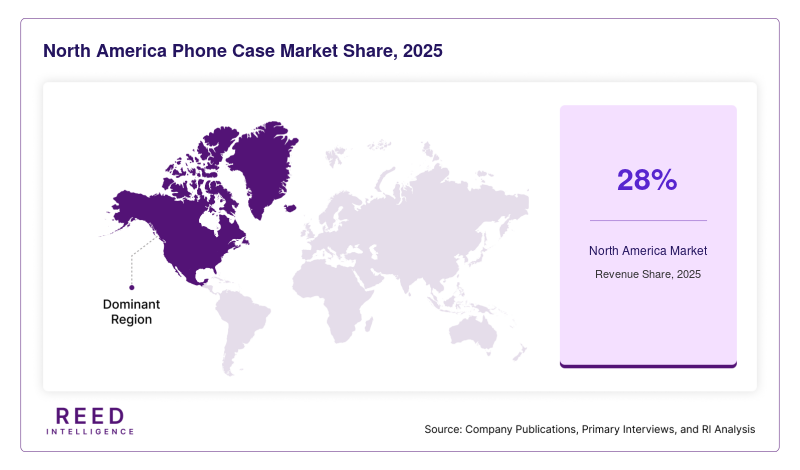
North America is internally modelled at 28% of the 2025 market, equivalent to approximately USD 3.14 billion. The region has a large installed base of premium smartphones and strong demand for branded protective accessories. Premiumization is particularly relevant because IDC reports that North America has a high concentration of premium smartphone shipments.
Europe Phone Case Market
Europe is modelled at 23% of the 2025 market, representing approximately USD 2.58 billion. Demand is supported by established smartphone penetration, premium-device ownership and consumer interest in both functional protection and design-oriented accessories. Sustainability and material transparency also provide differentiation opportunities for European-focused brands.
Asia-Pacific Phone Case Market
Asia-Pacific is modelled as the largest regional market at 35% of the 2025 market, equivalent to approximately USD 3.92 billion, with an internally assigned CAGR of 7.4%. The region's large smartphone user base, broad range of device price tiers, extensive electronics manufacturing ecosystem and rapidly changing smartphone portfolios create a substantial addressable market for cases.
India is also an important example of the premiumization dynamic: IDC reported that India's smartphone ASP reached a record level in Q1 2026 even as shipment volume declined.
Latin America Phone Case Market
Latin America is internally modelled at 8% of the 2025 market, corresponding to approximately USD 0.90 billion. Demand is primarily connected with the large installed smartphone base and replacement of cases independently of handset upgrades. Price sensitivity makes affordable TPU and silicone cases particularly important, while online marketplaces broaden product availability.
Middle East and Africa Phone Case Market
The Middle East and Africa are modelled at 6% of the 2025 market, representing approximately USD 0.67 billion. Demand varies significantly by country and income level, with premium protective cases concentrated in higher-income markets and value-oriented cases accounting for a larger proportion of demand in price-sensitive markets.
Phone Case Market Competitive Landscape
Competition in the phone-case market is fragmented across global accessory brands, smartphone-specific accessory companies, fashion brands, independent designers, contract manufacturers and online marketplace sellers.
Major brands compete by building recognizable protection technologies, proprietary materials, device compatibility and design ecosystems. OtterBox has positioned itself strongly around protective smartphone cases, while Case-Mate and Speck compete across protective and fashion-oriented categories. CASETiFY emphasizes customization, collaborations and design-led products, creating differentiation beyond basic protection.
Key Market Players
- OtterBox
- CASETiFY
- Spigen
- ZAGG
- Belkin
- Speck Products
- Case-Mate
- Urban Armor Gear (UAG)
- Mous
- ESR
Phone Case Market Recent Market Developments
- Smartphone unit demand has weakened in 2026 while device prices have increased. IDC's latest forecast expects worldwide smartphone shipments to decline substantially in 2026, while the average selling price rises, creating a more value-oriented environment for smartphone accessories.
- Premium smartphones are becoming more resilient than entry-level devices. IDC reports that premium models are proving more resistant to current cost pressures, supporting the market for higher-value protective accessories.
Phone Case Market Segments
By Material
- Thermoplastic Polyurethane (TPU)
- Silicone
- Polycarbonate
- Leather
- Other Materials
By Product Type
- Protective/Rugged Cases
- Slim Cases
- Wallet Cases
- Clear Cases
- Designer & Fashion Cases
By Distribution Channel
- Online
- Offline
By Region
- North America
- Europe
- APAC
- Middle East and Africa
- LATAM