Polyimide Foam Market Size, Share & Trends Analysis Report By Type, By Application, By End User and By Region, Forecasts 2026–2034
USD 3950
Polyimide Foam Market Size
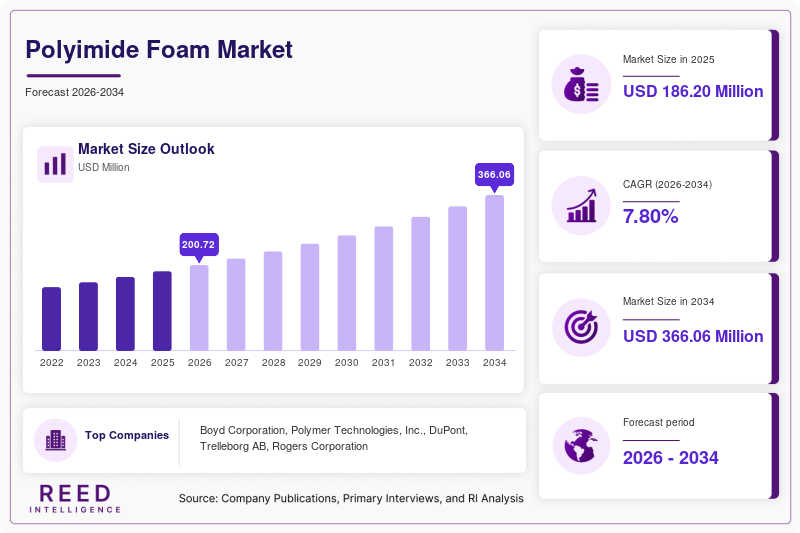
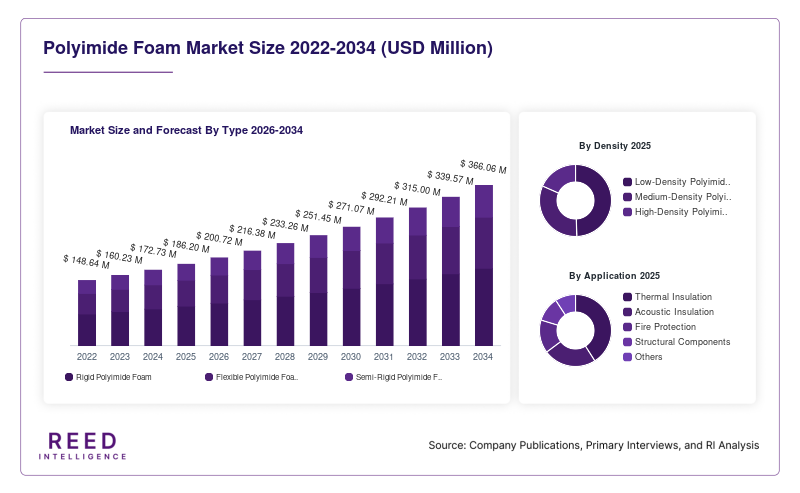
The global polyimide foam market was valued at USD 186.20 million in 2025 and is projected to grow from USD 200.72 million in 2026 to USD 362.10 million by 2034, registering a CAGR of 7.80% during the forecast period from 2026 to 2034.
Polyimide foam is a lightweight, high-performance polymer foam known for its combination of low density, thermal stability, flame resistance, low smoke generation and acoustic insulation properties. It is used in applications where conventional polymer foams may not provide adequate performance under high-temperature, fire-sensitive or weight-constrained conditions.
The market is supported by increasing demand for lightweight materials in aerospace, defense, transportation, marine and industrial applications. Polyimide foam is particularly suitable for aircraft interiors, thermal insulation, acoustic management, fire-resistant structures and other demanding environments.
Polyimide Foam Market Drivers
Growing Aerospace Applications
Aerospace is one of the major application areas for polyimide foam because of its low weight, thermal stability and fire-resistant characteristics.
Increasing aircraft production, cabin modernization and fleet replacement are supporting demand for lightweight insulation materials.
Increasing Demand for Lightweight Materials
Reducing component weight is an important objective across aerospace, transportation and industrial manufacturing.
Polyimide foam provides insulation and structural functionality without adding substantial weight.
Stringent Fire-Safety Requirements
Transportation and aerospace manufacturers require materials with controlled flame, smoke and toxicity characteristics.
Polyimide foam's fire-resistant properties make it suitable for applications where conventional foam materials may face limitations.
Growth in Thermal and Acoustic Insulation
Polyimide foam provides both thermal and acoustic insulation capabilities.
Increasing requirements for cabin comfort, noise reduction and thermal management are supporting adoption in aircraft and other transportation applications.
Expansion of Advanced Transportation
Growth in high-performance transportation systems is creating opportunities for specialized lightweight insulation materials.
Polyimide foam can be used where temperature resistance, weight reduction and fire performance are important.
Polyimide Foam Market Restraints
High Material Cost
Polyimide foam generally costs more than conventional insulation foams such as polyurethane or polyethylene.
The higher price can limit adoption in cost-sensitive applications.
Complex Manufacturing Processes
Producing high-performance polyimide foam with controlled density, cell structure and thermal characteristics requires specialized processing technologies.
Manufacturing complexity can increase production costs.
Limited Awareness Outside Specialized Industries
Polyimide foam remains a specialized material compared with conventional polymer foams.
Limited awareness among smaller manufacturers can constrain adoption in new applications.
Availability of Alternative Materials
Aerogel, phenolic foam, silicone foam, polyurethane and other advanced insulation materials can compete with polyimide foam depending on application requirements.
Material selection is often influenced by cost, temperature resistance, weight and performance specifications.
Polyimide Foam Market Opportunities
Aircraft Interior Modernization
Aircraft operators and manufacturers are increasingly upgrading cabin interiors and insulation systems.
The combination of lightweight construction and fire performance creates opportunities for polyimide foam in aircraft applications.
Electric and Advanced Transportation
Electrification and development of advanced transportation systems are increasing demand for lightweight thermal-management materials.
Polyimide foam can serve specialized insulation requirements in high-performance environments.
Marine and Shipbuilding Applications
Fire safety and weight reduction are important considerations in marine transportation.
Polyimide foam's thermal and fire-resistant characteristics create opportunities in ship interiors and insulation systems.
Advanced Industrial Insulation
Industrial equipment operating at elevated temperatures requires insulation materials capable of maintaining performance under demanding conditions.
This creates opportunities for polyimide foam in specialized industrial applications.
Development of Improved Foam Grades
Manufacturers are developing polyimide foam products with improved mechanical strength, acoustic performance, thermal resistance and processing characteristics.
Product innovation can expand the material's addressable applications.
Type Segment Analysis
By Type
Rigid polyimide foam accounted for approximately 48% of the polyimide foam market in 2025, making it the largest type segment. Its combination of thermal insulation, structural stability and fire resistance supports adoption across aerospace and industrial applications.
Flexible polyimide foam accounted for approximately 34% and is projected to grow at approximately 8.6% CAGR, making it the fastest-growing major type segment. Increasing use in complex geometries, acoustic insulation and transportation interiors is supporting demand.
Semi-rigid polyimide foam represented approximately 18% of the market.
Density Segment Analysis
By Density
Medium-density polyimide foam accounted for approximately 45% of the market in 2025, making it the largest density segment. Its balance of weight, insulation performance and mechanical properties makes it suitable for a broad range of applications.
Low-density polyimide foam accounted for approximately 33% and is projected to grow at approximately 8.5% CAGR, making it the fastest-growing density segment. Demand for lightweight insulation in aerospace and transportation applications is supporting adoption.
High-density polyimide foam represented approximately 22% of the market.
Application Segment Analysis
By Application
Thermal insulation accounted for approximately 41% of the market in 2025, making it the largest application segment. Polyimide foam provides thermal protection in applications exposed to temperature extremes.
Acoustic insulation accounted for approximately 27% and is projected to grow at approximately 8.4% CAGR, making it the fastest-growing major application segment. Increasing emphasis on cabin noise reduction and passenger comfort is supporting demand.
Fire protection represented approximately 17%, structural components 10%, and other applications approximately 5%.
End-User Segment Analysis
By End User
Aerospace and defense accounted for approximately 52% of the market in 2025, making it the largest end-user segment. The industry's requirements for lightweight, thermally stable and fire-resistant materials make polyimide foam suitable for aircraft interiors, insulation and specialized components.
Transportation accounted for approximately 17% and is projected to grow at approximately 8.7% CAGR, making it the fastest-growing major end-user segment. Demand for lightweight and thermally efficient materials across advanced transportation systems is supporting growth.
Industrial applications represented approximately 14%, marine 9%, construction 5%, and other end users approximately 3%.
Polyimide Foam Market Regional Analysis
North America Holds the Largest Share
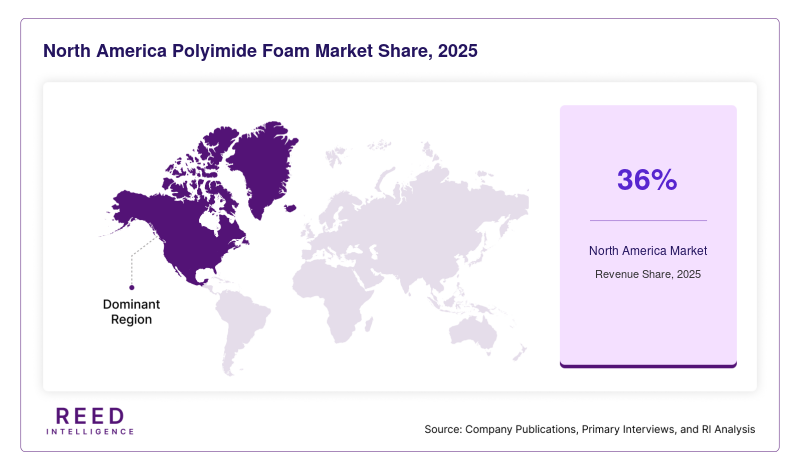
North America accounted for approximately 36% of the global polyimide foam market in 2025, making it the largest regional market. The region benefits from a large aerospace and defense industry, established advanced-materials manufacturing capabilities and ongoing aircraft modernization.
Asia-Pacific accounted for approximately 30% and is projected to grow at approximately 9.0% CAGR, making it the fastest-growing major region. Increasing aircraft manufacturing, industrialization, transportation investment and development of advanced manufacturing capabilities are supporting regional demand.
Europe Maintains Strong Aerospace Demand
Europe accounted for approximately 24% of the market in 2025 and is projected to grow at approximately 7.0% CAGR.
The region benefits from established aerospace and transportation industries and continued investment in lightweight and fire-resistant materials.
Latin America Shows Emerging Demand
Latin America accounted for approximately 6% of the market in 2025 and is projected to grow at approximately 6.8% CAGR.
Aircraft fleet development, industrial investment and transportation modernization are creating opportunities for advanced insulation materials.
Middle East & Africa Represents a Developing Market
Middle East & Africa accounted for approximately 4% of the market in 2025 and is projected to grow at approximately 6.5% CAGR.
Growth in aviation infrastructure, transportation investment and industrial development is supporting gradual adoption.
Polyimide Foam Market Competitive Landscape
Competition in the polyimide foam market is based on thermal performance, fire resistance, density, acoustic properties, mechanical strength, product customization, manufacturing consistency and cost efficiency.
Manufacturers are focusing on developing lighter, higher-performing foam grades and expanding applications beyond traditional aerospace insulation.
Key Market Players
Polyimide Foam Market Recent Developments
- Aircraft manufacturers and suppliers are increasingly focusing on materials that reduce weight without compromising fire and thermal performance. Polyimide foam is positioned for applications where lightweight insulation is required.
- Aircraft and transportation manufacturers are placing greater emphasis on cabin noise reduction and passenger comfort. This is supporting the development and use of lightweight acoustic insulation materials.
Polyimide Foam Market Segments
By Type
- Rigid Polyimide Foam
- Flexible Polyimide Foam
- Semi-Rigid Polyimide Foam
By Density
- Low-Density Polyimide Foam
- Medium-Density Polyimide Foam
- High-Density Polyimide Foam
By Application
- Thermal Insulation
- Acoustic Insulation
- Fire Protection
- Structural Components
- Others
By End User
- Aerospace & Defense
- Transportation
- Marine
- Industrial
- Construction
- Others
By Region
- North America
- Europe
- APAC
- Middle East and Africa
- LATAM