Printed Antenna Market Size, Share & Demand Report By Type (Flexible Printed Antennas, Inkjet Printed Antennas, Screen Printed Antennas), By Application (Consumer Electronics, Automotive Connectivity, Healthcare Devices, Industrial IoT), By End-Use (Telecommunications, Automotive, Healthcare, Consumer Electronics), By Region & Segment Forecasts, 2026–2034
USD 3950
Market Overview
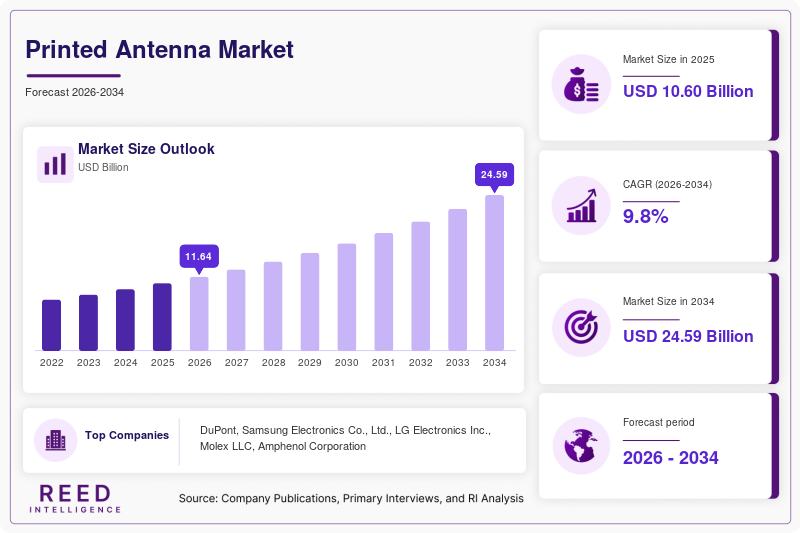
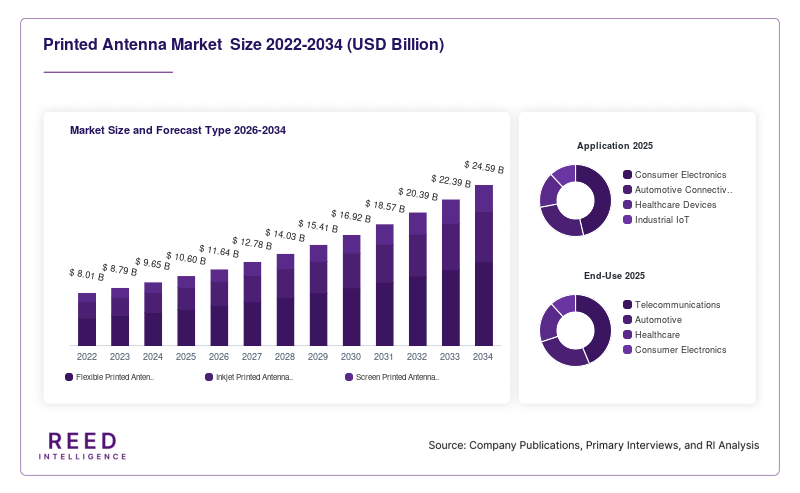
The Printed Antenna Market size was valued at approximately USD 10.6 billion in 2026 and is projected to reach around USD 22.4 billion by 2034, registering a CAGR of 9.8% during the forecast period (2026–2034). The market growth is driven by increasing demand for lightweight, low-cost, and flexible communication components across consumer electronics, automotive, healthcare, and industrial sectors. Printed antennas, manufactured using conductive inks on flexible substrates, offer cost efficiency and scalability, making them suitable for high-volume applications such as IoT devices and wearable electronics.
One of the primary global factors supporting market expansion is the rapid proliferation of Internet of Things (IoT) ecosystems. As connected devices increase across smart homes, smart cities, and industrial automation, the need for compact and efficient antennas has surged. Printed antennas enable seamless integration into devices with minimal space requirements, thereby supporting miniaturization trends in electronics manufacturing.
Key Highlights
- North America dominated the market with a 35.1% share in 2025.
- Asia Pacific is expected to grow at the fastest CAGR of 10.9% during 2026–2034.
- By type, flexible printed antennas accounted for the largest share of 42.8%.
- while inkjet-printed antennas are projected to grow at a CAGR of 11.6%.
- By application, consumer electronics led with a 39.5% share, whereas automotive connectivity is expected to expand at a CAGR of 10.8%.
- The United States remained the dominant country, with market values of USD 2.8 billion in 2024 and USD 3.1 billion in 2025.
Market Trends
Integration of Printed Antennas in Wearable and Flexible Electronics
The increasing adoption of wearable devices has significantly influenced the Printed Antenna Market. Manufacturers are integrating printed antennas into smartwatches, fitness trackers, and healthcare monitoring devices due to their flexibility and lightweight nature. These antennas can be embedded into fabrics or flexible substrates, allowing seamless design without compromising performance. As consumers demand more compact and ergonomic devices, companies are focusing on developing antennas that can conform to different shapes. Additionally, advancements in conductive inks and substrate materials are improving durability and signal transmission, making printed antennas more reliable for wearable applications.
Expansion of 5G and Advanced Connectivity Solutions
The global rollout of 5G networks is driving demand for high-performance antenna solutions, including printed variants. Printed antennas are being optimized to support higher frequencies and improved bandwidth required for 5G communication. Telecom equipment manufacturers are increasingly adopting these antennas for base stations and small cells due to their cost-effectiveness and ease of mass production. Furthermore, the trend toward smart cities and connected infrastructure is accelerating the deployment of devices that rely on printed antennas for communication. This shift is expected to sustain long-term demand as industries continue transitioning toward high-speed connectivity.
Market Drivers
Rising Adoption of IoT Devices Across Industries
The growing penetration of IoT devices is a major driver of the Printed Antenna Market. Industries such as manufacturing, healthcare, and logistics are deploying connected devices to enhance operational efficiency and real-time monitoring. Printed antennas play a critical role in enabling wireless communication within these devices. Their low production cost and adaptability make them ideal for large-scale deployment. Additionally, governments and enterprises are investing in smart infrastructure projects, further boosting demand for IoT-enabled solutions. As the number of connected devices continues to rise, the need for compact and efficient antennas will increase, driving market growth.
Cost Efficiency and Scalability of Printed Electronics
Printed antennas offer significant cost advantages compared to traditional antennas. The use of printing techniques reduces material waste and manufacturing time, enabling high-volume production at lower costs. This scalability is particularly beneficial for consumer electronics manufacturers that require large quantities of components. Moreover, printed antennas can be produced on flexible substrates, reducing the need for complex assembly processes. These factors contribute to lower overall production costs, making printed antennas an attractive option for various applications. As companies focus on cost optimization, the adoption of printed antenna technology is expected to accelerate.
Market Restraint
Performance Limitations Compared to Conventional Antennas
Despite their advantages, printed antennas face certain performance limitations that may hinder market growth. Compared to traditional antennas, printed variants may exhibit lower efficiency and reduced signal strength, particularly in high-frequency applications. These limitations can affect their adoption in critical communication systems where reliability is essential. Additionally, environmental factors such as temperature and humidity can impact the performance of printed antennas, especially those used in outdoor or industrial settings.
The industry is addressing these challenges through research and development, focusing on improving materials and design techniques. However, achieving performance parity with conventional antennas remains a challenge. For example, in aerospace or defense applications, where precision and reliability are critical, printed antennas are often not the preferred choice. This limitation restricts their adoption in certain high-end applications. Nevertheless, ongoing advancements in conductive materials and printing technologies are expected to gradually mitigate these issues, although they may continue to pose a constraint in the short term.
Market Opportunities
Growth in Smart Packaging and RFID Applications
The increasing use of smart packaging solutions presents a significant opportunity for the Printed Antenna Market. Printed antennas are widely used in RFID tags and labels for tracking and authentication purposes. Industries such as retail, logistics, and pharmaceuticals are adopting smart packaging to improve supply chain visibility and prevent counterfeiting. The ability to produce antennas at low cost and integrate them into packaging materials makes them highly suitable for these applications. As global trade expands and supply chains become more complex, the demand for smart packaging solutions is expected to rise, creating new growth avenues for printed antenna manufacturers.
Emerging Applications in Automotive Connectivity
The automotive industry is rapidly adopting advanced connectivity solutions, creating opportunities for printed antennas. Modern vehicles are equipped with multiple communication systems, including GPS, infotainment, and vehicle-to-everything (V2X) technologies. Printed antennas offer a lightweight and cost-effective solution for integrating these systems into vehicles. Additionally, the shift toward electric and autonomous vehicles is increasing the need for reliable communication components. Manufacturers are exploring innovative ways to embed printed antennas into vehicle structures, enhancing design flexibility. This trend is expected to drive demand for printed antennas in the automotive sector over the forecast period.
Segmental Analysis
By Type
Flexible printed antennas dominated the market in 2024, accounting for a share of 42.8%. These antennas are widely used due to their ability to conform to various shapes and surfaces, making them suitable for applications such as wearable devices and smart packaging. Their lightweight nature and cost efficiency further contribute to their popularity. Manufacturers are increasingly adopting flexible substrates to enhance product performance and durability. Additionally, advancements in materials and printing technologies are improving the efficiency of flexible printed antennas, making them a preferred choice across industries.
Inkjet-printed antennas are the fastest-growing subsegment, with a projected CAGR of 11.6% during the forecast period. This growth is driven by the precision and scalability offered by inkjet printing technology. The ability to produce complex antenna designs with minimal material waste is a key advantage. Additionally, inkjet printing enables rapid prototyping, allowing manufacturers to develop and test new designs quickly. As demand for customized antenna solutions increases, the adoption of inkjet-printed antennas is expected to grow significantly.
By Application
Consumer electronics dominated the application segment in 2024, holding a share of 39.5%. The widespread use of smartphones, tablets, and wearable devices has driven demand for compact and efficient antennas. Printed antennas are increasingly being integrated into these devices due to their ability to support miniaturization. Additionally, the growing trend of smart homes and connected devices is further boosting demand. Manufacturers are focusing on developing antennas that offer improved performance while maintaining a compact form factor.
Automotive connectivity is the fastest-growing application segment, with a CAGR of 10.8% during the forecast period. The increasing adoption of connected and autonomous vehicles is driving demand for advanced communication systems. Printed antennas offer a cost-effective solution for integrating multiple communication functionalities into vehicles. Additionally, the shift toward electric vehicles is creating new opportunities for printed antenna manufacturers. As the automotive industry continues to evolve, the demand for printed antennas is expected to increase.
By End-Use
The telecommunications sector dominated the end-use segment in 2024, accounting for a share of 36.7%. The expansion of communication networks and increasing demand for high-speed connectivity are key factors driving this segment. Printed antennas are widely used in telecom equipment due to their cost efficiency and scalability. Additionally, the rollout of 5G networks is further boosting demand. Manufacturers are focusing on developing antennas that can support higher frequencies and improved bandwidth.
Healthcare is the fastest-growing end-use segment, with a projected CAGR of 10.5% during the forecast period. The increasing adoption of wearable medical devices and remote monitoring solutions is driving demand for printed antennas. These antennas enable reliable communication in compact devices, making them suitable for healthcare applications. Additionally, advancements in medical technology are creating new opportunities for printed antenna manufacturers. As the healthcare industry continues to embrace digital transformation, the demand for printed antennas is expected to grow.
Regional Analysis
North America
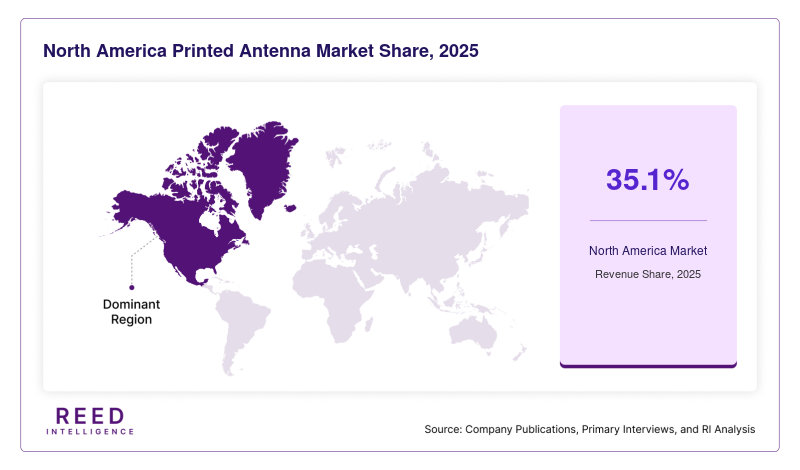
North America held a dominant share of 35.1% in 2025 and is expected to maintain steady growth with a CAGR of 9.2% during the forecast period. The region’s strong technological infrastructure and high adoption of advanced communication technologies contribute to market growth. The presence of leading electronics manufacturers and significant investments in research and development further support the expansion of the Printed Antenna Market. Additionally, increasing demand for IoT devices and smart home solutions is driving the adoption of printed antennas across various applications.
The United States dominates the regional market due to its advanced technology ecosystem and high consumer demand for connected devices. A unique growth factor in the country is the rapid deployment of 5G networks, which is driving the need for efficient antenna solutions. Companies are focusing on developing innovative printed antenna designs to meet the requirements of high-speed connectivity, further boosting market growth.
Europe
Europe accounted for a significant share of the Printed Antenna Market in 2025 and is projected to grow at a CAGR of 8.7% through 2034. The region’s focus on sustainability and energy-efficient technologies is driving the adoption of printed electronics, including antennas. Governments are promoting the use of environmentally friendly materials, encouraging manufacturers to adopt printed antenna solutions. Additionally, the growing demand for smart devices and connected infrastructure is supporting market growth.
Germany is the dominant country in Europe, driven by its strong automotive and industrial sectors. A unique growth factor is the increasing integration of printed antennas in automotive applications, particularly in connected and autonomous vehicles. The country’s emphasis on innovation and advanced manufacturing technologies further enhances its position in the market.
Asia Pacific
Asia Pacific is the fastest-growing region, with a projected CAGR of 10.9% during the forecast period. The region’s large consumer base and rapid industrialization are key factors driving market growth. Countries such as China, Japan, and South Korea are leading the adoption of printed antennas due to their strong electronics manufacturing industries. Additionally, increasing investments in 5G infrastructure and IoT technologies are boosting demand for printed antennas.
China dominates the Asia Pacific market, supported by its extensive manufacturing capabilities and growing domestic demand for electronic devices. A unique growth factor is the country’s focus on expanding smart city initiatives, which require a large number of connected devices. This trend is expected to significantly increase the demand for printed antennas in the region.
Middle East & Africa
The Middle East & Africa region is experiencing moderate growth, with a CAGR of 7.5% during the forecast period. The adoption of printed antennas is driven by increasing investments in telecommunications infrastructure and smart city projects. Governments are focusing on digital transformation, which is creating opportunities for the deployment of connected devices. Additionally, the growing demand for consumer electronics is contributing to market expansion.
The United Arab Emirates is the dominant country in the region, driven by its advanced infrastructure and focus on innovation. A unique growth factor is the rapid development of smart city projects, which require efficient communication solutions. This is expected to drive the adoption of printed antennas in various applications.
Latin America
Latin America holds a smaller share of the Printed Antenna Market but is expected to grow at a CAGR of 8.1% during the forecast period. The region’s increasing adoption of digital technologies and expanding telecommunications sector are key growth drivers. Additionally, the growing demand for affordable electronic devices is supporting the adoption of printed antennas.
Brazil is the leading country in Latin America, driven by its large consumer base and growing electronics industry. A unique growth factor is the increasing adoption of IoT solutions in agriculture and logistics, which require efficient communication components. This trend is expected to boost demand for printed antennas in the region.
Competitive Landscape
The Printed Antenna Market is characterized by the presence of several global and regional players focusing on innovation and strategic partnerships. Key companies are investing in research and development to enhance product performance and expand their application scope. The market is moderately competitive, with players competing on factors such as technology, cost, and product quality.
One of the leading companies in the market is DuPont, which has a strong presence in printed electronics. The company has been focusing on developing advanced conductive inks and materials to improve antenna performance. A recent development includes the launch of new ink formulations designed to enhance signal efficiency in high-frequency applications. Other companies are also adopting strategies such as mergers, acquisitions, and collaborations to strengthen their market position and expand their product portfolios.
Key Players List
- DuPont
- Samsung Electronics
- LG Electronics
- Molex
- Amphenol Corporation
- TE Connectivity
- Laird Connectivity
- Pulse Electronics
- TDK Corporation
- Linx Technologies
- Optomec
- NovaCentrix
- Brewer Science
- Agfa-Gevaert
- Canatu
Recent Developments
- DuPont introduced advanced conductive inks for high-frequency printed antennas in 2025.
- Samsung Electronics expanded its printed antenna integration in wearable devices in 2024.
- Molex announced a partnership with automotive manufacturers to develop printed antenna solutions for connected vehicles in 2025.
Printed Antenna Market Segments
Type
- Flexible Printed Antennas
- Inkjet Printed Antennas
- Screen Printed Antennas
Application
- Consumer Electronics
- Automotive Connectivity
- Healthcare Devices
- Industrial IoT
End-Use
- Telecommunications
- Automotive
- Healthcare
- Consumer Electronics
By Region
- North America
- Europe
- APAC
- Middle East and Africa
- LATAM