Pterostilbene Market Size, Share & Trends Analysis Report By Product Type (Natural Pterostilbene, Synthetic Pterostilbene), By Application (Dietary Supplements, Pharmaceuticals, Cosmetics, Food & Beverages, Others), By Distribution Channel (Online Retail, Pharmacies, Health Stores, Others) and By Region (North America, Europe, Asia-Pacific, Latin America, Middle East & Africa) Forecasts, 2026–2034
USD 3950
Pterostilbene Market Size
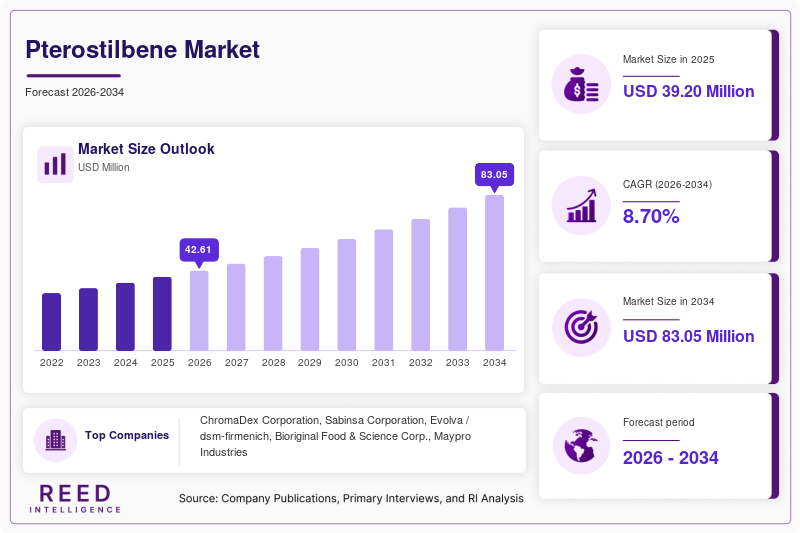
The global pterostilbene market was valued at USD 39.20 million in 2025 and is projected to grow from USD 42.61 million in 2026 to USD 83.50 million by 2034, registering a CAGR of 8.70% during the forecast period from 2026 to 2034.
Pterostilbene is a naturally occurring stilbenoid and a methylated analogue of resveratrol that is being commercialized primarily as a specialty nutraceutical ingredient, while pharmaceutical, cosmetic and functional-food applications remain additional areas of development. Its greater metabolic stability and bioavailability relative to resveratrol have been cited as reasons for continued research interest.
The commercial demand base is concentrated around dietary supplements and standardized botanical ingredients. Suppliers are positioning pterostilbene through differentiated purity, standardized botanical extraction, formulation compatibility and research support. For example, Sabinsa currently lists pterostilbene standardized extracts from Pterocarpus marsupium at several concentrations, including 5%, 30% and 90%. ChromaDex has also commercialized pTeroPure, a branded pterostilbene ingredient.
Pterostilbene Market Drivers
Greater Interest in Bioavailable Polyphenols Is Expanding the Commercial Case for Pterostilbene
Pterostilbene's relationship with resveratrol provides an important commercialization mechanism. Scientific literature describes pterostilbene as having greater bioavailability and metabolic stability than resveratrol, characteristics associated with its methoxy groups and greater lipophilicity.
This difference allows ingredient companies to position pterostilbene as a differentiated stilbenoid rather than simply another antioxidant ingredient. The commercial impact is strongest in premium nutraceutical formulations where manufacturers can justify specialty-ingredient positioning through purity, formulation characteristics and scientific documentation.
ChromaDex's pTeroPure product illustrates this model, with the company developing a branded pterostilbene ingredient around standardized quality and research-backed positioning. The counterbalance is that improved pharmacokinetic characteristics do not automatically establish clinical efficacy; recent scientific reviews continue to emphasize that pharmacokinetic advantages need to be translated into demonstrated human outcomes.
Human Research Is Expanding the Evidence Base for Commercial Formulation
Human clinical research creates a mechanism through which pterostilbene suppliers can move from general antioxidant positioning toward more specific formulation applications. An 80-participant randomized controlled trial examined pterostilbene's effects on metabolic parameters, while a separate clinical safety study evaluated administration for 6–8 weeks.
More recent evidence includes a 2025 randomized, double-blind pilot study involving 30 healthy men who consumed 10 or 100 mg/day for 12 weeks. The study reported no adverse events and investigated changes in blood microRNA expression.
The market mechanism is not that these studies establish broad therapeutic efficacy. Rather, repeated human investigation provides ingredient manufacturers and formulators with evidence that can support further product development and clinical research. The limitation remains the relatively small scale and duration of available human studies.
Standardized Botanical Ingredients Are Creating Higher-Value Product Differentiation
Pterostilbene can be supplied either as a purified compound or through standardized botanical extracts. Sabinsa, for example, markets Silbinol standardized extracts from Pterocarpus marsupium at multiple pterostilbene concentrations and separately offers pTeroWhite at 90% pterostilbene.
This creates a commercial mechanism based on specification rather than commodity volume. Supplement, cosmetic and functional-food manufacturers can select different ingredient formats according to concentration, formulation and positioning requirements.
The opportunity is particularly relevant to suppliers that can provide standardized composition, traceability and technical documentation. However, botanical variability, extraction economics and regulatory requirements can increase production and quality-control costs.
Pterostilbene Market Restraints
Limited Long-Term Human Evidence Restricts Expansion Into Strongly Regulated Health Applications
Although pterostilbene has been investigated in human studies, the clinical evidence base remains considerably smaller than the preclinical literature. The 2014 metabolic-parameter trial included 80 participants and produced mixed findings, including an increase in LDL cholesterol with pterostilbene monotherapy alongside reductions in blood pressure at the higher dose.
This matters commercially because supplement positioning, pharmaceutical development and health claims require different levels of evidence. A biological mechanism or favorable laboratory result does not establish a disease-treatment indication.
The restraint is therefore strongest for pharmaceutical applications, where developers require substantially more evidence than is generally necessary for ingredient commercialization. Continued clinical research could reduce this constraint, but larger and longer controlled trials remain necessary before broad therapeutic conclusions can be established.
Regulatory Requirements Can Limit Food and Beverage Formulation
Pterostilbene's incorporation into food and beverage products is subject to the regulatory framework applicable to the intended use and jurisdiction. In the United States, FDA explains that substances intentionally added to food generally require premarket approval unless an applicable exclusion, including a valid GRAS basis, applies.
This creates additional requirements for manufacturers seeking to move pterostilbene beyond capsules and specialty supplements into mainstream food or beverage formats. Ingredient safety documentation, intended-use conditions and regulatory status become part of commercial product development.
The constraint can be reduced through standardized ingredients, toxicological documentation and appropriate regulatory submissions, but these activities increase development costs and can lengthen commercialization timelines.
Pterostilbene Market Opportunities
Pharmaceutical and Clinical-Nutrition Research Can Expand Pterostilbene Beyond the Supplement Category
The largest commercial gap is the difference between extensive preclinical interest and the smaller human evidence base. Pterostilbene has been investigated in relation to metabolic, cardiovascular, inflammatory and aging-related mechanisms, while human trials have already examined metabolic parameters and safety.
A stronger clinical evidence base could allow manufacturers to develop more targeted products and could increase demand from clinical-nutrition and pharmaceutical research programs.
The opportunity is especially relevant to standardized high-purity pterostilbene and delivery systems designed to improve formulation performance. Patent activity also demonstrates continued development of pharmaceutical and nutraceutical compositions; a 2026 U.S. patent grant covers pterostilbene cocrystals and their use in medicament or dietary-supplement compositions.
The main barrier is evidence risk: commercial development could remain limited if larger trials fail to demonstrate clinically meaningful benefits.
Water-Soluble and Formulation-Optimized Ingredients Can Broaden Food, Beverage and Cosmetic Applications
Pterostilbene's physicochemical characteristics create formulation challenges, particularly in aqueous products. Recent scientific work notes that increased lipophilicity can create formulation difficulties in aqueous nutraceutical and functional-beverage systems and identifies delivery approaches such as nanoemulsions, nanoliposomes, micellar systems and cyclodextrin complexes as areas of interest.
This creates an identifiable product-development opportunity: suppliers able to offer stable, dispersible or otherwise formulation-compatible pterostilbene ingredients can target applications that are less accessible to conventional powdered ingredients.
Sabinsa already markets pTeroSol, a water-soluble extract from Pterocarpus marsupium, demonstrating commercial activity around water-compatible botanical formats.
Product Type Analysis
By Product Type
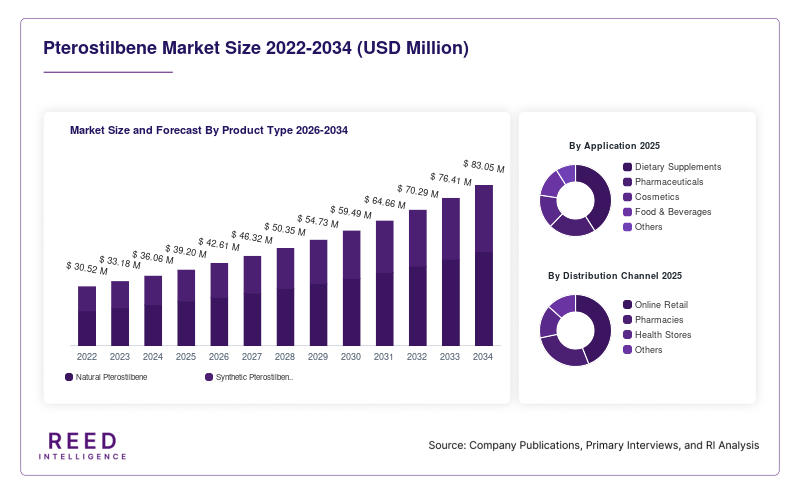
Natural Pterostilbene accounted for approximately 59% of the product-type segment in 2025, making it the largest category. Demand is supported by the use of Pterocarpus marsupium and other botanical sources in standardized nutraceutical ingredients.
Sabinsa currently lists multiple Pterocarpus marsupium extracts standardized for pterostilbene, including 5%, 30% and 90% specifications. The availability of different concentrations allows formulators to select ingredients according to dosage, formulation and positioning requirements.
Natural sourcing also fits the broader commercial preference for plant-derived active ingredients in nutraceutical and cosmetic formulations. However, natural extraction introduces variability in raw-material availability and requires standardized quality controls. Synthetic pterostilbene remains relevant where manufacturers prioritize consistent molecular specifications and scalable production.
Synthetic Pterostilbene represented approximately 41% of the product-type segment in 2025 and is projected to grow at approximately 9.2% CAGR through 2034.
The commercial mechanism is consistency. Synthetic production can provide a defined molecular compound rather than depending on botanical extraction yield and raw-material variability. This is particularly relevant for pharmaceutical research, analytical work and high-purity nutraceutical formulations.
Patent activity around pterostilbene solid forms, cocrystals and preparation processes further demonstrates continuing technical development around the compound.
Natural Pterostilbene is projected to grow at approximately 8.3% CAGR, supported by demand for standardized botanical ingredients.
Application Analysis
By Application
Dietary Supplements accounted for approximately 46% of application demand in 2025. The segment benefits from the compound's positioning as a polyphenolic ingredient associated with antioxidant, metabolic and healthy-aging research.
The commercial pathway is comparatively straightforward: ingredient suppliers can sell standardized pterostilbene to supplement manufacturers, which then incorporate it into capsules, tablets, powders or combination formulations. ChromaDex's pTeroPure and Sabinsa's standardized Silbinol products illustrate this ingredient-supplier model.
The principal constraint is claims substantiation. Human evidence does not justify treating pterostilbene as a proven therapy for broad disease categories, and product positioning must remain consistent with applicable regulations.
Pharmaceuticals represented approximately 17% of application demand in 2025 and are projected to grow at approximately 10.1% CAGR through 2034, making the segment the fastest-growing application category.
The growth mechanism is research rather than established therapeutic prescribing. Pterostilbene's investigation across metabolic and inflammatory pathways creates opportunities for pharmaceutical formulation, drug development research and specialized delivery technologies.
Recent patent activity strengthens this development signal. A Chinese patent application published in 2025 describes pterostilbene-related compounds and pharmaceutical compositions for anti-inflammatory applications, while a U.S. patent granted in April 2026 covers pterostilbene cocrystals and compositions.
Cosmetics accounted for approximately 15% and is projected to grow at 9.0% CAGR, while Food & Beverages accounted for approximately 13% and is projected to grow at 8.4% CAGR. Other applications accounted for approximately 9% and are projected to grow at 7.5% CAGR.
Distribution Channel Analysis
By Distribution Channel
Online Retail accounted for approximately 44% of distribution-channel demand in 2025. Pterostilbene is a specialty ingredient with a relatively narrow consumer awareness base, making digital product discovery, educational content and direct-to-consumer supplement sales important parts of the commercial pathway.
The channel also allows brands to communicate ingredient specifications, dosage information and research references directly to consumers. However, the absence of physical professional guidance can increase the importance of accurate labeling and responsible health claims.
Pharmacies represented approximately 27% of distribution demand in 2025 and are projected to grow at approximately 8.1% CAGR.
Pharmacy distribution can support consumer confidence in specialty health ingredients because products are purchased within an established health-product environment. Its expansion depends on product availability, pharmacist awareness and consumer familiarity with pterostilbene.
Health Stores accounted for approximately 18% and are projected to grow at 8.0% CAGR, while Other channels represented approximately 11% and are projected to grow at 7.1% CAGR.
Pterostilbene Market Regional Analysis
Asia-Pacific Holds the Largest Regional Share Through Botanical Supply and Nutraceutical Manufacturing Capabilities
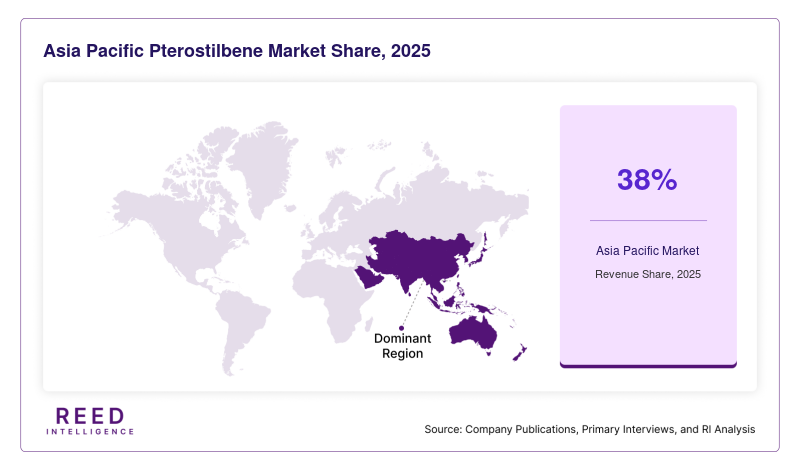
Asia-Pacific accounted for approximately 38% of the global market in 2025. The region combines botanical raw-material availability, established herbal-extract manufacturing and expanding nutraceutical production.
India is particularly relevant to the natural-ingredient supply chain because Pterocarpus marsupium is used as the source of commercial standardized pterostilbene extracts. Sabinsa, for example, manufactures standardized botanical ingredients and operates manufacturing facilities in India and the United States.
China also contributes to the technical supply landscape, with a 2024-priority patent application describing a preparation method for pterostilbene.
Asia-Pacific is projected to grow at approximately 9.3% CAGR, supported by ingredient manufacturing, nutraceutical formulation and research activity. Supply consistency, regulatory differences between markets and varying consumer awareness remain constraints.
North America Maintains a Strong Market Position Through Specialty Supplement Demand and Ingredient Innovation
North America represented approximately 29% of global market share in 2025. The region benefits from established dietary-supplement channels and the presence of ingredient companies commercializing branded pterostilbene products.
ChromaDex developed pTeroPure as a branded pterostilbene ingredient, while clinical research conducted in the United States has contributed to the human evidence base.
The region is projected to grow at approximately 8.9% CAGR through 2034. Growth is linked to specialty nutraceutical products, healthy-aging formulations and continued interest in clinically researched ingredients.
Regulatory scrutiny remains an important counterbalance. FDA distinguishes dietary supplements from food additives and does not pre-approve dietary supplements for safety and effectiveness before marketing under the U.S. framework.
Europe Expands Through Premium Nutraceutical and Cosmetic Formulations
Europe accounted for approximately 21% of the global market in 2025 and is projected to grow at approximately 8.4% CAGR.
Demand is concentrated around premium nutritional, wellness and cosmetic applications where standardized botanical ingredients can provide differentiation. European manufacturers also have access to established ingredient-distribution networks serving supplement and personal-care formulators.
The principal market constraint is regulatory compliance around ingredient claims and food use. Companies targeting European consumers therefore need strong technical documentation and disciplined claims management.
Latin America Develops Through Supplement and Botanical-Ingredient Consumption
Latin America represented approximately 7% of the global market in 2025 and is projected to grow at approximately 8.2% CAGR.
The market is supported by demand for botanical and nutraceutical products, although pterostilbene remains a specialized ingredient rather than a mass-market active.
The growth mechanism is therefore primarily product-led: greater availability of imported and locally formulated supplements can increase consumer exposure to the ingredient. Distribution costs, regulatory differences and lower awareness compared with North America and Europe remain constraints.
Middle East & Africa Remains an Emerging Market for Specialty Nutraceutical Ingredients
Middle East & Africa accounted for approximately 5% of global revenue in 2025 and is projected to grow at approximately 7.5% CAGR.
Growth is associated with increasing availability of imported nutraceutical products and premium wellness formulations. The region's opportunity is greater in markets with established pharmacy and specialty-health retail networks.
The relatively small base means market expansion is dependent on distributor access, product education and regulatory approvals. Limited local manufacturing of specialized pterostilbene ingredients also increases reliance on international suppliers.
Pterostilbene Market Competitive Landscape
Competition in the pterostilbene market is shaped by ingredient purity, botanical standardization, manufacturing consistency, formulation compatibility, intellectual property, research support and distribution relationships rather than by large-volume commodity production alone.
ChromaDex has established a branded ingredient position through pTeroPure. Historical company materials identify pTeroPure as a high-purity pterostilbene ingredient, while ChromaDex's intellectual-property strategy has included rights associated with pterostilbene applications.
Sabinsa Corporation competes through standardized botanical extracts and a broad nutraceutical/cosmeceutical ingredient portfolio. Its current product catalog includes Silbinol at multiple pterostilbene concentrations and pTeroWhite at 90% pterostilbene.
Key Market Players
- ChromaDex Corporation
- Sabinsa Corporation
- Evolva / dsm-firmenich
- Bioriginal Food & Science Corp.
- Maypro Industries
- K V Natural Ingredients Pvt. Ltd.
- Life Extension
- NOW Foods
- Pure Encapsulations
- InterHealth Nutraceuticals
- Jarrow Formulas
- Swanson Health Products
- Doctor's Best
- Douglas Laboratories
- Source Naturals
Pterostilbene Market Recent Developments
- A randomized, double-blind pilot study published in 2025 evaluated continuous pterostilbene intake at 10 mg/day and 100 mg/day for 12 weeks in 30 healthy men. The study reported no adverse events and investigated changes in blood microRNA expression. The market implication is primarily evidentiary: additional human data provides ingredient developers with a basis for further clinical research and formulation development, although the study's small sample and limited duration do not establish broad therapeutic efficacy.
- A Chinese patent application published in July 2025 describes pterostilbene-related compounds, pharmaceutical compositions and applications for anti-inflammatory drugs. The application has a January 2024 priority date and remained pending in the available patent record. The development matters because it demonstrates continued investigation of pterostilbene-related chemistry beyond conventional dietary-supplement applications. If such formulation or compound-development programs progress, they could broaden demand toward pharmaceutical research.
Pterostilbene Market Segments
By Product Type
- Natural Pterostilbene
- Synthetic Pterostilbene
By Application
- Dietary Supplements
- Pharmaceuticals
- Cosmetics
- Food & Beverages
- Others
By Distribution Channel
- Online Retail
- Pharmacies
- Health Stores
- Others
By Region
- North America
- Europe
- APAC
- Middle East and Africa
- LATAM