Ruby Market Size, Share & Trends Analysis Report By Type, By Origin, By Application, By Distribution Channel and By Region, Forecasts 2026–2034
USD 3950
Ruby Market Size
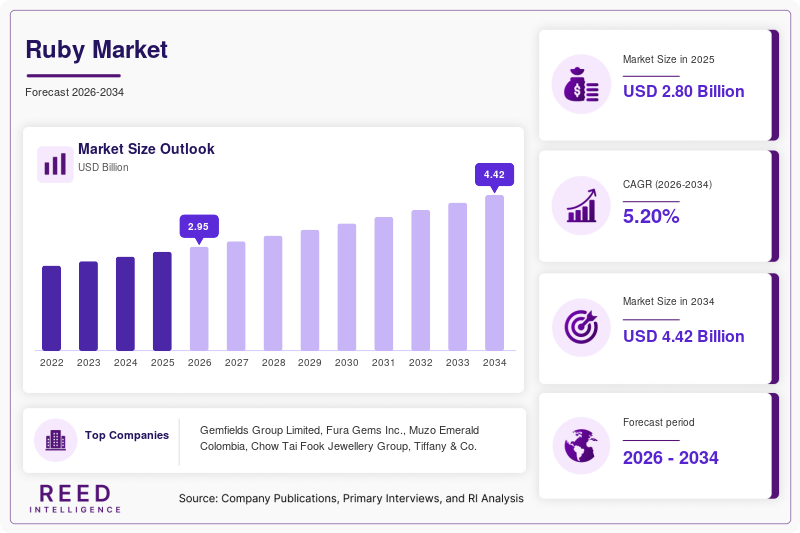
The global ruby market was valued at USD 2.80 billion in 2025 and is projected to grow from USD 2.95 billion in 2026 to USD 4.30 billion by 2034, registering a CAGR of 5.20% during the forecast period from 2026 to 2034.
Ruby is a precious gemstone belonging to the corundum mineral family and is valued primarily for its red coloration, rarity, durability and optical characteristics. Rubies are used extensively in fine jewelry, including rings, necklaces, earrings, bracelets and luxury watches, while high-quality stones are also collected as investment and heritage gemstones.
The global ruby market is influenced by consumer spending on luxury jewelry, gemstone availability, mining activity, treatment technologies, changing fashion preferences and demand for rare and high-quality stones. Natural rubies with strong color, high clarity and desirable geographic provenance can command substantial premiums.
Ruby Market Drivers
Growing Demand for Colored Gemstone Jewelry
Consumer interest in colored gemstones is increasing as buyers seek alternatives to traditional diamond jewelry.
Ruby's distinctive red color and association with luxury make it an important gemstone in premium jewelry collections.
Rising Luxury Jewelry Consumption
Growth in high-income consumer populations is supporting expenditure on premium jewelry and gemstones.
Ruby jewelry benefits from demand for luxury accessories, special-occasion jewelry and high-value collectible pieces.
Cultural and Traditional Significance
Rubies have longstanding cultural significance in several Asian markets and are frequently incorporated into traditional jewelry.
This cultural association supports continued demand, particularly in major gemstone-consuming markets.
Increasing Interest in Rare Gemstones
High-quality natural rubies are relatively scarce compared with many other gemstones.
Interest from collectors and luxury consumers supports demand for exceptional stones with desirable color, clarity, size and provenance.
Expansion of Online Jewelry Retail
Online jewelry platforms are improving consumer access to gemstone products.
Digital channels allow retailers to reach international customers and provide detailed information about gemstone characteristics, certification and treatment.
Ruby Market Restraints
Limited Availability of High-Quality Natural Rubies
Fine-quality untreated rubies are relatively scarce.
Limited supply can constrain market volume and contribute to significant price variation across quality grades.
High Price Volatility
Ruby prices vary substantially according to color, clarity, size, origin, treatment and certification.
Price fluctuations can affect consumer purchasing decisions and inventory management for retailers.
Treatment Disclosure Concerns
Many natural rubies undergo treatments to improve appearance.
Differences in treatment status can significantly affect value, making transparent disclosure and certification important.
Synthetic and Alternative Gemstones
Laboratory-created rubies can provide consistent appearance at lower prices.
The availability of synthetic stones creates competition in price-sensitive jewelry and industrial applications.
Ruby Market Opportunities
Growth of Certified Gemstones
Demand for independently graded and certified gemstones is increasing among consumers purchasing higher-value rubies.
Certification can provide information regarding natural origin, treatment and other gemstone characteristics.
Traceability and Responsible Sourcing
Consumers and luxury brands are increasingly interested in gemstone provenance.
Improved mine-to-market traceability can create opportunities for suppliers that can demonstrate responsible sourcing.
Premium Ruby Jewelry
Luxury jewelry brands can capture additional value through carefully selected high-quality rubies combined with distinctive designs and provenance stories.
Online International Sales
Digital commerce provides opportunities for ruby dealers and jewelry retailers to reach customers across geographic markets.
Virtual consultations and gemstone certification information can improve buyer confidence.
Emerging Luxury Markets
Increasing disposable incomes in developing economies are creating new consumer groups for premium jewelry and colored gemstones.
Type Segment Analysis
By Type
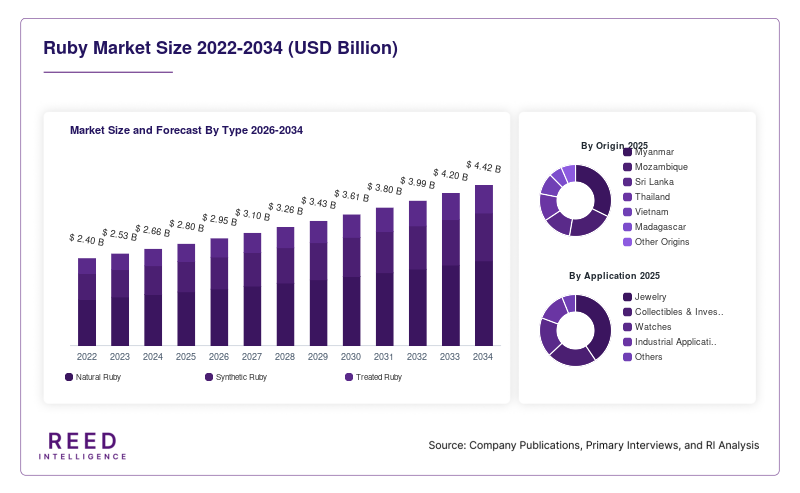
Natural rubies accounted for approximately 78% of the ruby market in 2025, making them the largest type segment. Their scarcity, natural origin, collector appeal and use in premium jewelry support their dominant position.
Synthetic rubies accounted for approximately 9% and are projected to grow at approximately 7.1% CAGR, making them the fastest-growing major type segment. Consistent quality, lower prices and applications in jewelry and technical products are supporting their expansion.
Treated rubies represented approximately 13% of the market. Treatment is widely used to improve the appearance of natural ruby stones.
Origin Segment Analysis
By Origin
Mozambique-origin rubies accounted for approximately 28% of the market in 2025, making Mozambique the largest origin segment. The country's ruby deposits have become an important source of commercially significant natural rubies.
Vietnam-origin rubies accounted for approximately 7% and are projected to grow at approximately 6.3% CAGR, supported by demand for stones with distinctive provenance and color characteristics.
Myanmar represented approximately 24%, Sri Lanka 15%, Thailand 8%, Madagascar 7%, and other origins approximately 11%.
Application Segment Analysis
By Application
Jewelry applications accounted for approximately 83% of the ruby market in 2025, making jewelry the largest application segment. Rubies are widely used in rings, earrings, necklaces, bracelets, pendants and luxury watches.
Collectibles and investment accounted for approximately 9% and are projected to grow at approximately 6.4% CAGR, making this the fastest-growing major application segment. Interest in rare, high-quality and certified gemstones is supporting collector demand.
Industrial applications represented approximately 5%, while other applications accounted for approximately 3%.
Distribution Channel Segment Analysis
By Distribution Channel
Specialty jewelry stores accounted for approximately 39% of the ruby market in 2025, making them the largest distribution channel. Consumers purchasing high-value gemstones often prefer physical stores where they can inspect stones and receive professional guidance.
Online retail accounted for approximately 14% and is projected to grow at approximately 8.1% CAGR, making it the fastest-growing major channel. Improved digital product presentation, gemstone certification and secure logistics are supporting online purchases.
Luxury jewelry brands represented approximately 24%, independent gemstone dealers 13%, auction houses 6%, and other channels approximately 4%.
Ruby Market Regional Analysis
Asia-Pacific Holds the Largest Share
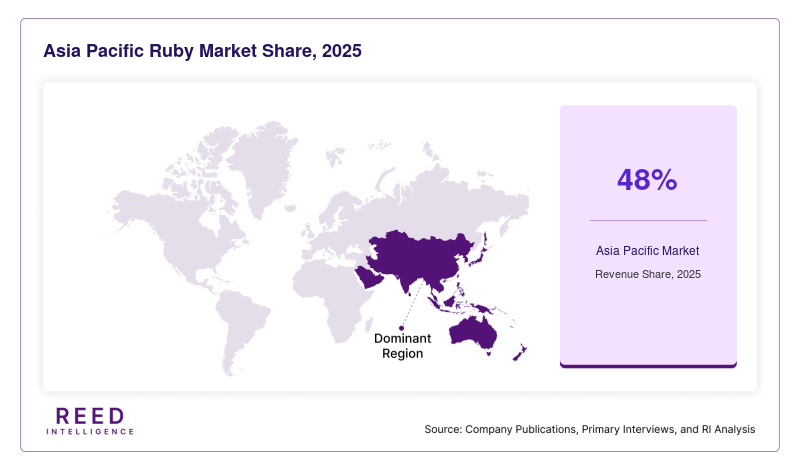
Asia-Pacific accounted for approximately 48% of the global ruby market in 2025, making it the largest regional market. The region benefits from strong cultural demand for gemstones, established jewelry markets, major trading centers and growing luxury consumption.
Asia-Pacific is projected to grow at approximately 5.8% CAGR, making it the fastest-growing major region.
Europe Maintains Strong Luxury Demand
Europe accounted for approximately 21% of the market in 2025 and is projected to grow at approximately 4.4% CAGR.
Established luxury jewelry markets, high-value gemstone trading and demand for premium colored gemstones support regional consumption.
North America Shows Growing Consumer Interest
North America accounted for approximately 19% of the market in 2025 and is projected to grow at approximately 5.0% CAGR.
Demand is supported by luxury jewelry consumption, colored gemstone preferences and expanding online jewelry sales.
Middle East & Africa Represents an Important Gemstone Market
Middle East & Africa accounted for approximately 8% of the market in 2025 and is projected to grow at approximately 5.1% CAGR.
Luxury consumption, jewelry traditions and the region's proximity to important gemstone-producing and trading markets support demand.
Latin America Shows Emerging Demand
Latin America accounted for approximately 4% of the market in 2025 and is projected to grow at approximately 4.7% CAGR.
Expanding luxury consumption and development of modern jewelry retail channels are supporting market growth.
Ruby Market Competitive Landscape
Competition in the ruby market is based on gemstone quality, color, origin, treatment status, certification, rarity, sourcing transparency, brand reputation, craftsmanship and distribution networks.
The market includes gemstone miners, dealers, cutters, jewelry manufacturers, luxury brands, auction houses and online retailers. High-value natural rubies are often differentiated through provenance, certification and individual stone characteristics.
Key Market Players
- Gemfields Group Limited
- Fura Gems Inc.
- Muzo Emerald Colombia
- Chow Tai Fook Jewellery Group
- Tiffany & Co.
- Cartier
- Van Cleef & Arpels
- Bulgari
- Sotheby's
- Christie's
Ruby Market Recent Developments
- Consumers purchasing higher-value natural rubies are increasingly seeking independent gemstone certification. Certification can provide information on origin, treatment and other characteristics that influence gemstone value.
- Jewelry companies and consumers are paying greater attention to the provenance of natural gemstones. Mine-to-market traceability can help address concerns surrounding responsible sourcing and supply-chain transparency.
Ruby Market Segments
By Type
- Natural Ruby
- Synthetic Ruby
- Treated Ruby
By Origin
- Myanmar
- Mozambique
- Sri Lanka
- Thailand
- Vietnam
- Madagascar
- Other Origins
By Application
- Jewelry
- Collectibles & Investment
- Watches
- Industrial Applications
- Others
By Distribution Channel
- Specialty Jewelry Stores
- Luxury Jewelry Brands
- Independent Gemstone Dealers
- Online Retail
- Auction Houses
- Other Channels
By Region
- North America
- Europe
- APAC
- Middle East and Africa
- LATAM