Safety Net Market Size, Share & Trends Analysis Report By Product Type (Personnel Safety Nets, Debris Safety Nets, Vertical Safety Nets, Horizontal Safety Nets), By Material (Polypropylene, Polyethylene, Nylon, Polyester), By Application (Construction, Sports & Recreation, Industrial, Agriculture, Other Applications), By End Use (Commercial Construction, Residential Construction, Infrastructure, Industrial Facilities, Other End Uses) and By Region (North America, Europe, Asia-Pacific, Middle Eas
USD 3950
Safety Net Market Size
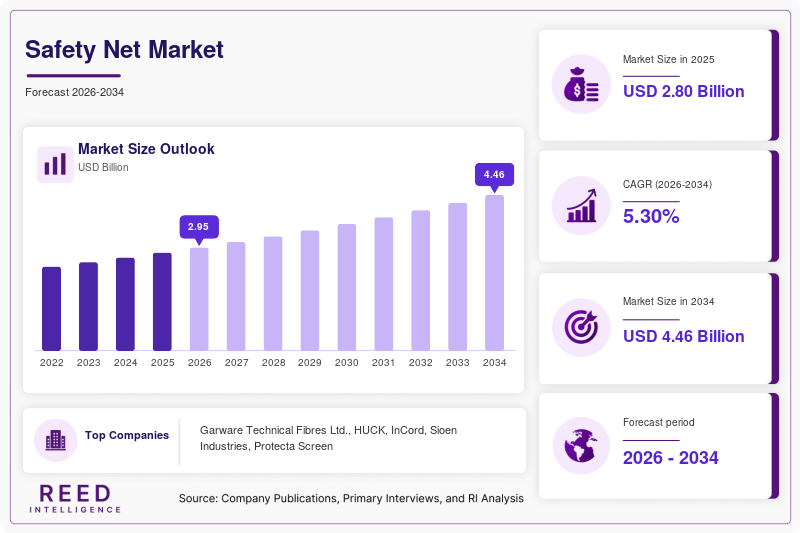
The safety net market was valued at USD 2.80 billion in 2025 and is estimated to reach USD 2.95 billion in 2026. The market is projected to reach USD 4.60 billion by 2034, registering a CAGR of 5.30% during 2026–2034.
The safety net market is primarily tied to the use of passive protection systems that prevent or arrest falls of workers and contain falling objects, with construction representing the principal commercial demand base. Safety nets are particularly relevant where workers operate above lower levels and where guardrails or individual fall-arrest equipment may not provide the most practical protection. OSHA recognizes safety nets as one of the conventional fall-protection systems for workers exposed to elevated fall hazards.
Demand is being reinforced by continued attention to construction fall prevention. NIOSH reported in 2026 that falls remain the leading work-related cause of death in construction and highlighted roofing, residential construction, structural framing and ladder-related activities as important fall-risk areas.
Safety Net Market Drivers
Construction Fall Hazards Sustain Demand for Passive Fall-Protection Systems
Construction remains the central demand mechanism because work at height creates recurring requirements for fall protection. NIOSH's 2026 construction safety assessment identifies falls as the leading cause of work-related death in construction, while its 2024 analysis reported that construction workers represented nearly half of fatal occupational slips, trips and falls.
Safety nets provide a collective protection option for construction crews working around roofs, structural frames, bridges and other elevated work areas. OSHA specifically recognizes safety-net systems alongside guardrails and personal fall-arrest systems for qualifying construction hazards.
The commercial mechanism is straightforward: as projects involve more elevated work, contractors must incorporate compliant protection systems into site planning. The counterbalance is that safety nets compete with guardrails, personal fall-arrest systems and other engineering controls.
Regulatory Compliance Converts Fall-Protection Requirements into Equipment Demand
Safety-net purchases are closely influenced by workplace-safety requirements because compliance requires employers to select and maintain suitable fall-protection systems. OSHA specifies installation, impact-absorption, clearance, inspection and mesh requirements for safety-net systems.
These requirements affect purchasing because contractors cannot evaluate nets solely on price; the product must meet applicable performance and installation criteria. OSHA also requires defective nets to be removed from service and safety nets to be inspected regularly.
This creates recurring demand beyond initial project installation because damaged, deteriorated or relocated systems may require inspection, testing, repair or replacement. However, requirements vary by jurisdiction and application, limiting the ability of manufacturers to use one specification universally.
Demand for Combined Personnel and Debris Protection Broadens Product Value
Safety nets increasingly serve dual purposes by protecting workers while also containing tools, materials and debris. Garware Technical Fibres specifically markets triple-layer systems for fall and debris arrest as well as containment configurations for construction and infrastructure projects.
The mechanism increases the value of a single installed protection system because contractors can address more than one site hazard with integrated netting. This is particularly relevant on high-rise and infrastructure projects where falling objects can create hazards for workers and people below.
The opportunity is strongest for manufacturers able to supply customized dimensions, mesh sizes and layered systems. The limitation is that more specialized configurations can increase procurement and installation requirements.
Safety Net Market Restraints
Safety Nets Compete with Other Fall-Protection Systems
Safety nets are one option within a broader hierarchy of fall protection. OSHA identifies guardrails, safety nets and personal fall-arrest systems as conventional alternatives for many construction situations.
This creates a direct substitution mechanism. Contractors may choose another system where site geometry, installation access, project duration or worker mobility makes nets less suitable. OSHA also notes that the nature and location of work can determine which fall-protection method is appropriate.
Consequently, market expansion depends not only on construction activity but also on the share of elevated-work applications where safety nets provide a practical advantage.
Installation, Inspection and Testing Requirements Add Operating Costs
Safety nets require more than product procurement. OSHA requires appropriate installation, clearance, impact capability and periodic inspection, with additional testing requirements for certain installations.
These requirements increase the total cost of ownership and can influence contractor purchasing decisions. The need for trained personnel and site-specific installation can also limit use on short-duration projects.
Manufacturers can mitigate this constraint through lighter materials, easier installation systems, customized dimensions and products designed to simplify inspection and handling.
Safety Net Market Opportunity
Lightweight and Durable Netting Can Improve Protection on Complex Construction Sites
A specific opportunity lies in safety nets designed for easier installation and handling without sacrificing impact performance or durability. Garware's differentiated safety nets emphasize UV stabilization, dimensional stability, uniform mesh and lighter-weight configurations, while its construction products can be customized to project requirements.
The commercial problem is that construction sites frequently require protection systems to be installed, relocated and adapted as structures progress. Products that reduce handling requirements can potentially lower labor and installation costs.
The opportunity is particularly relevant to high-rise construction, infrastructure projects and residential construction where work areas change rapidly. Adoption will depend on certification, demonstrated performance, installer familiarity and the ability to meet local standards.
Safety Net Market Product Type Analysis
Personnel Safety Nets Hold the Largest Share Because Worker Fall Protection Is the Core Construction Requirement
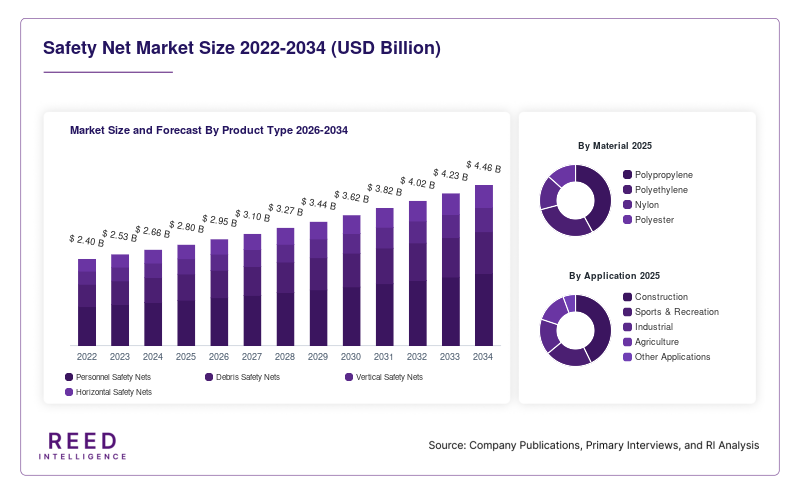
Personnel Safety Nets account for approximately 54% of the 2025 market, making them the largest product-type segment. Their position is linked to the primary function of safety-net systems: arresting workers who fall from elevated working surfaces.
OSHA recognizes safety nets as a conventional fall-protection method for qualifying construction hazards and specifies requirements for installation, impact absorption, mesh size and inspection.
The recurring demand base includes construction sites, bridges, structural projects and other elevated work environments. HUCK also positions safety nets as collective protection that allows workers to move freely within protected areas.
The segment's principal risk is substitution by guardrails and personal fall-arrest systems where those methods are more practical. Product differentiation through lighter construction, UV resistance and customized dimensions can help manufacturers address installation constraints.
Debris Safety Nets Expand Faster as Projects Require Protection Beyond Worker Falls
Debris Safety Nets are projected to register the fastest product-type CAGR of approximately 6.10% during 2026–2034. Their increasing relevance comes from the need to control falling tools, materials and construction debris in addition to protecting personnel.
Garware offers containment configurations and triple-layer safety nets designed for both fall and debris arrest, illustrating the move toward multifunctional netting.
The commercial mechanism is particularly strong on dense construction sites where falling objects can expose workers, pedestrians and adjacent properties to additional hazards. As construction sites become more congested, combined fall-and-debris protection can reduce the need for separate protective arrangements.
Expansion can nevertheless be limited where contractors already use dedicated debris screens, enclosed scaffolding or other containment systems.
Safety Net Market Material Analysis
Polypropylene accounts for approximately 42% of the 2025 market, making it the largest material segment. Its use is supported by the availability of high-tenacity configurations for construction safety nets. HUCK, for example, offers knotless polypropylene construction nets, while Garware manufactures safety nets using PPMF and other synthetic materials.
Polyethylene represents approximately 27% of the 2025 market. Demand is associated with applications requiring lightweight synthetic netting and resistance to outdoor conditions.
Nylon accounts for approximately 19% of the 2025 market. Manufacturers use nylon in safety applications where strength and flexibility are important. Garware lists nylon among the materials used in its safety-net products.
Polyester represents approximately 12% of the 2025 market. Its use is concentrated in applications where dimensional stability, durability and specific environmental-performance requirements influence material selection.
Safety Net Market Application Analysis
Construction is the dominant application, supported by the need to protect workers and contain objects during elevated work. OSHA specifically identifies safety nets as a fall-protection option in construction, including work involving leading edges, steep roofs and residential construction.
Sports applications include protective netting around sporting facilities and recreational environments. The purchasing mechanism differs from construction because requirements are generally associated with ball containment, participant protection and facility configuration rather than worker fall arrest.
Industrial applications include protection around elevated platforms, warehouses, production facilities and specialized work areas. Demand depends on site-specific hazards and the degree to which collective protection is preferable to individual PPE.
Agricultural applications include protective and containment netting, although the commercial requirements differ from construction safety nets. Garware, for example, maintains separate agricultural netting categories covering insect, shade, anti-hail and crop-support applications.
Other applications include specialized protection around infrastructure, maintenance activities and temporary work environments where conventional barriers may be difficult to install.
Safety Net Market End-Use Analysis
Commercial construction represents the largest end-use base because multi-story buildings, structural work and elevated installation activities create recurring fall-protection requirements. OSHA's construction standards specifically address fall hazards on elevated surfaces and leading edges.
Residential construction has a substantial requirement for fall protection, particularly roofing and framing. OSHA requires conventional fall protection, including safety nets, for residential construction workers exposed to falls of six feet or more, subject to the applicable provisions.
Infrastructure projects such as bridges and large structures are important applications because safety nets can protect workers beneath elevated work surfaces. OSHA's technical guidance specifically identifies bridges and large structures as common applications for safety-net systems.
Industrial facilities use safety nets where elevated maintenance, installation or production activities create fall hazards. The demand mechanism depends on facility design and whether collective protection provides an advantage over personal fall-arrest systems.
Other end uses include specialized maintenance, temporary structures and applications where netting provides a practical passive barrier or fall-arrest solution.
Safety Net Market Regional Analysis
North America Holds the Largest Regional Share Through Strong Fall-Protection Enforcement and Construction Demand
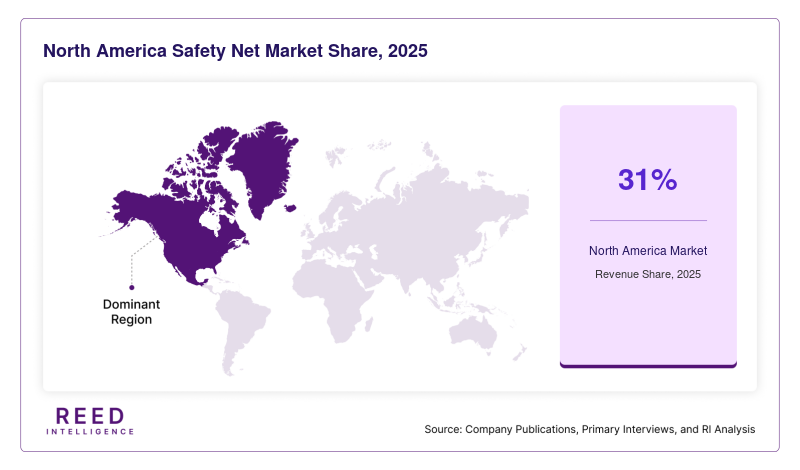
North America accounts for approximately 31% of the 2025 market. The region benefits from established workplace-safety requirements and a large construction market in which fall protection is a formal component of jobsite planning.
In the U.S., OSHA requires fall protection for workers exposed to qualifying elevated hazards and recognizes safety nets alongside guardrails and personal fall-arrest systems.
NIOSH's 2026 construction assessment continues to identify falls as the leading cause of work-related death in construction and emphasizes the importance of planning, equipment and training.
The commercial mechanism is therefore a combination of construction activity, regulatory compliance and replacement demand. The market is also supported by specialized suppliers such as InCord, which provides residential contractor safety-net systems designed for interior construction applications.
Europe Maintains a Mature Market Through Established Building-Safety Practices
Europe accounts for approximately 27% of the 2025 market. Demand is supported by construction activity, work-at-height safety requirements and established technical standards for protective netting.
European manufacturers compete on certified products, material performance, customized dimensions and installation systems. HUCK, for example, offers construction safety nets using high-tenacity polypropylene and identifies its building-protection safety nets as EN-certified.
The region's mature safety culture creates a market where certification and compliance can influence purchasing decisions as strongly as price. The main constraint is construction-cycle volatility and competition from alternative fall-protection technologies.
Asia-Pacific Is the Fastest-Growing Region as Construction Activity and Safety Adoption Expand
Asia-Pacific is projected to register the fastest regional CAGR of approximately 6.25% during 2026–2034. The growth mechanism combines construction activity, high-rise development, infrastructure investment and increasing attention to occupational safety.
The region also has an established manufacturing base for technical textiles and netting. Garware Technical Fibres, headquartered in India, manufactures construction and infrastructure safety nets using PPMF, nylon and HDPE and serves customers across multiple geographies.
As construction sites become larger and more complex, demand can shift toward customized net systems that provide both personnel and debris protection. Cost sensitivity remains a constraint, particularly where contractors prioritize lower-cost alternatives over certified higher-performance systems.
Middle East and Africa Develop Through Large Construction and Infrastructure Projects
Middle East and Africa account for approximately 9% of the 2025 market. Demand is closely associated with large-scale construction, infrastructure development and elevated work environments.
Safety nets can be commercially attractive on high-rise and major infrastructure projects because they provide collective protection beneath active work areas. The application becomes more relevant as projects involve multiple levels and substantial worker movement.
Market development can be constrained by differences in regulatory enforcement, procurement standards and construction practices between countries. Suppliers able to provide certified products and project-specific installation support can address these barriers.
Latin America Represents a Developing Market Linked to Construction Safety Adoption
Latin America accounts for approximately 8% of the 2025 market. Construction activity and increasing attention to worker protection support demand for passive fall-protection equipment.
The commercial mechanism is strongest where contractors formalize site safety procedures and incorporate fall-protection systems into project planning. Safety nets can be useful where workers need to move freely across elevated work areas.
Price sensitivity and variations in safety enforcement can slow adoption. Local availability, certification and installer expertise therefore remain important purchasing factors.
Safety Net Market Competitive Landscape
Competition in the safety net market is fragmented across technical-textile manufacturers, specialized net producers, construction-safety suppliers and regional installation companies.
Garware Technical Fibres has a broad technical-textile portfolio spanning safety, sports, agriculture, fisheries and industrial applications. Its safety portfolio includes personnel fall-arrest nets, debris containment nets, triple-layer systems and customized netting.
HUCK competes through a dedicated construction-safety range covering multiple dimensions and mesh configurations. Its construction products use high-tenacity knotless polypropylene and are offered with different border and suspension arrangements.
Key Market Players
Safety Net Market Recent Developments
- In April 2026, NIOSH reported that falls remained the leading work-related cause of death in construction and continued its National Campaign to Prevent Falls in Construction. The 2026 campaign emphasized planning, equipment inspection, training and fall-protection implementation.
- Garware's current safety portfolio includes differentiated safety nets, braided safety nets and triple-layer netting, with configurations designed for personnel fall arrest, debris containment and customized work-at-height applications.
Safety Net Market Segments
By Product Type
- Personnel Safety Nets
- Debris Safety Nets
- Vertical Safety Nets
- Horizontal Safety Nets
By Material
- Polypropylene
- Polyethylene
- Nylon
- Polyester
By Application
- Construction
- Sports & Recreation
- Industrial
- Agriculture
- Other Applications
By End Use
- Commercial Construction
- Residential Construction
- Infrastructure
- Industrial Facilities
- Other End Uses
By Region
- North America
- Europe
- APAC
- Middle East and Africa
- LATAM