Sales Consulting Services Market Size, Share & Trends Analysis Report By Service Type (Sales Strategy Consulting, Sales Process Consulting, Sales Training & Enablement, Sales Technology Consulting, Sales Organization & Performance Consulting), By Enterprise Size (Large Enterprises, Small & Medium Enterprises), By End Use (IT & Telecommunications, BFSI, Healthcare, Manufacturing, Retail & E-commerce, Professional Services, Other Industries), By Engagement Model (Project-Based Consulting, Retainer
USD 3950
Sales Consulting Services Market Size
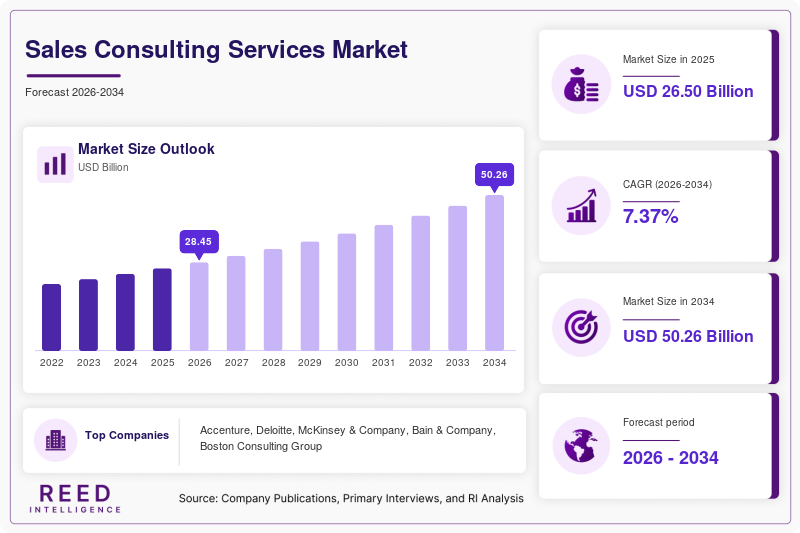
The sales consulting services market was valued at USD 26.50 billion in 2025 and is estimated to reach USD 28.45 billion in 2026. The market is projected to reach USD 50.25 billion by 2034, registering a 7.37% CAGR during 2026–2034.
The sales consulting services market is being reshaped by the need to improve sales productivity, revenue forecasting, customer acquisition economics and the integration of technology into commercial operations. Companies increasingly use external consultants when internal sales organizations need to redesign go-to-market models, improve pipeline management, introduce sales automation or align sales teams with changing customer-buying processes.
The technology layer is becoming particularly important. Salesforce reports that sales organizations are increasing their use of AI, while its State of Sales research identifies sales productivity and data quality as continuing priorities for sales teams.
Sales Consulting Services Market Drivers
AI Adoption Is Increasing Demand for Sales-Process and Technology Consulting
Generative AI and predictive analytics are changing how sales teams prospect, qualify leads, prepare for meetings and manage customer interactions. Salesforce's latest State of Sales research identifies AI as an increasingly important component of sales organizations' technology strategies.
The market mechanism is not simply greater technology spending. Organizations must determine where AI should be deployed, how customer data should be structured, how sales representatives should use AI-generated recommendations and how CRM workflows should change. These requirements create consulting demand around sales technology architecture, process redesign, governance and employee adoption.
The impact is strongest among large organizations with complex CRM environments and substantial sales teams. The counterbalance is that increasingly capable software vendors are incorporating implementation and advisory capabilities directly into their offerings, potentially reducing some standalone consulting requirements.
Pressure to Improve Sales Productivity Increases External Advisory Demand
Sales organizations face pressure to generate more revenue from existing commercial resources. McKinsey's research on B2B sales transformation identifies productivity, digital engagement and data-driven commercial processes as important areas for sales organizations seeking performance improvements.
This creates demand for consultants that can identify inefficient sales stages, redesign account coverage, improve pipeline discipline and establish performance metrics. The economic mechanism is straightforward: reducing non-selling activity or improving conversion at individual stages can increase output without proportionally increasing headcount.
Demand is particularly relevant for organizations undergoing restructuring or entering new markets. However, consulting programs can face resistance when recommendations require changes to compensation, territory ownership or established sales processes.
Complex B2B Buying Processes Increase Demand for Go-to-Market Transformation
B2B purchasing has become more multi-channel and involves multiple stakeholders, increasing the complexity of customer acquisition. Gartner's research has highlighted the increasing importance of digital and self-service interactions in B2B buying journeys.
This changes the role of sales consulting from improving salesperson activity alone to coordinating marketing, sales, customer success and digital channels. Consultants can therefore address account segmentation, customer journeys, sales coverage, qualification models and channel strategies as connected commercial systems.
The resulting opportunity is greatest for technology, professional services, industrial and other complex B2B businesses. The limitation is that organizations with relatively simple transaction-based sales models have less need for extensive transformation programs.
Sales Consulting Services Market Restraints
Internal Sales Teams and Software Vendors Can Substitute for Some Consulting Work
Organizations increasingly have access to CRM analytics, sales-enablement platforms, AI assistants and training tools that can perform functions historically delivered by consultants. Salesforce, Microsoft and other enterprise-software providers continue to integrate AI and automation into commercial workflows.
The substitution mechanism is strongest for standardized activities such as basic sales training, reporting and routine process analysis. Consulting firms therefore face pressure to move toward complex transformation, industry expertise and implementation services.
Consulting Budgets Are Sensitive to Corporate Spending Cycles
Sales consulting is generally discretionary compared with essential operating expenditure. During periods of economic uncertainty, companies may delay transformation projects, reduce external advisory budgets or narrow engagements to initiatives with measurable financial returns.
This creates greater demand for outcome-oriented projects and performance measurement. Providers that cannot demonstrate improvements in productivity, pipeline conversion, customer acquisition costs or revenue generation may face longer sales cycles or smaller project scopes.
Sales Consulting Services Market Opportunities
Revenue Operations Integration Creates Demand for Cross-Functional Consulting
Revenue operations connects sales, marketing, customer success, analytics and technology around common processes and metrics. As organizations adopt this model, consulting demand can shift from isolated sales optimization toward integrated commercial transformation.
The opportunity is particularly relevant for mid-sized and large B2B organizations where disconnected CRM data, inconsistent definitions and fragmented customer handoffs can reduce visibility across the revenue funnel. Consultants can address operating models, data structures, process ownership and performance measurement.
Adoption may be constrained where organizations already possess mature revenue-operations teams or have standardized commercial processes.
AI Sales Enablement Creates a New Consulting Layer
AI-assisted prospecting, account research, meeting preparation and forecasting creates implementation questions that software alone does not resolve. Companies need to determine which workflows should be automated, how human approval should operate and how sales teams should adapt to new tools.
This creates opportunities for consultants specializing in AI adoption, CRM integration, sales-process redesign and workforce enablement. The commercial opportunity is strongest when organizations have large sales teams and multiple technology systems.
However, rapid software development can shorten the useful life of consulting frameworks and increase the need for specialized rather than generic advisory capabilities.
Sales Consulting Services Market Service Type Segment Analysis
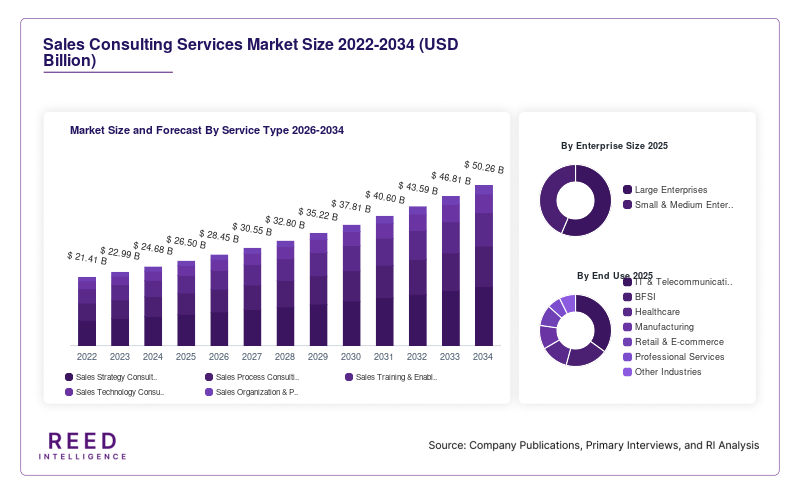
Sales Strategy Consulting is internally modeled as the largest service category, accounting for approximately 27.0% of the 2025 market, equivalent to USD 7.16 billion. Strategy projects typically address go-to-market design, customer segmentation, sales coverage, territory planning and channel strategy, giving them a broader organizational impact than individual training assignments.
The segment is modeled to reach approximately USD 13.10 billion by 2034, representing about 26.1% share and a modeled 6.90% CAGR.
Its continued demand is linked to organizations entering new markets, restructuring sales organizations or responding to changes in customer purchasing behavior. The principal risk is that mature enterprises may increasingly build strategy and revenue-operations capabilities internally.
Sales Technology Consulting is internally modeled at approximately 18.0% of the 2025 market, equivalent to USD 4.77 billion. CRM platforms, sales automation, analytics and AI tools increasingly affect prospecting, pipeline management, forecasting and account management.
The segment is modeled to reach approximately USD 10.16 billion by 2034, increasing its share to about 20.2%, corresponding to a modeled 8.75% CAGR.
Growth is supported by technology integration requirements rather than software adoption alone. Companies need assistance selecting tools, redesigning workflows, integrating data and training users. The main constraint is the increasing advisory and implementation capability embedded within major software vendors.
Sales Consulting Services Market Enterprise Size Analysis
Large enterprises represent approximately 68% of the 2025 market, equivalent to USD 18.02 billion. Their larger sales organizations, multiple geographic markets, complex technology environments and greater transformation budgets make them major consulting customers.
SMEs account for approximately 32% of the 2025 market, or USD 8.48 billion. Their consulting requirements are generally concentrated around sales strategy, CRM implementation, sales-process design and sales enablement. Cloud-based consulting and standardized delivery models can reduce the cost barrier for smaller organizations.
Sales Consulting Services Market End-Use Analysis
IT and telecommunications represent approximately 24% of the 2025 market, or USD 6.36 billion. Complex B2B sales cycles, subscription models, channel structures and rapid product changes create recurring requirements for sales strategy and technology optimization.
BFSI accounts for approximately 16% of the 2025 market, equivalent to USD 4.24 billion. Financial institutions require structured customer segmentation, relationship management and compliance-aware sales processes, creating demand for specialized commercial consulting.
Healthcare represents approximately 13% of the 2025 market, or USD 3.45 billion. Complex stakeholder structures and specialized purchasing processes create demand for account planning, sales enablement and customer engagement strategies.
Manufacturing contributes approximately 14% of 2025 market revenue, equivalent to USD 3.71 billion. Long sales cycles, technical products, distributors and account-based selling increase the value of sales-process optimization.
Retail and e-commerce represent approximately 12% of the 2025 market, or USD 3.18 billion. Demand is concentrated around customer acquisition, channel integration, sales analytics and technology-enabled commercial processes.
Professional services account for approximately 11% of the 2025 market, equivalent to USD 2.92 billion. Firms with complex solution selling use consultants to refine account targeting, pricing, business development and sales enablement.
Other industries collectively account for approximately 10% of the 2025 market, or USD 2.65 billion. Demand varies according to sales complexity, customer concentration and technology adoption.
Sales Consulting Services Market Engagement Model Analysis
Project-based engagements represent approximately 45% of the 2025 market, equivalent to USD 11.93 billion. They are commonly used for discrete initiatives such as sales transformation, CRM implementation, territory redesign or go-to-market restructuring.
Retainer-based consulting accounts for approximately 35%, or USD 9.28 billion, of the 2025 market. Retainers provide recurring access to specialized expertise and are particularly relevant where organizations require continuing sales strategy or performance support.
Performance-based consulting represents approximately 20% of the 2025 market, equivalent to USD 5.30 billion. These engagements link some consulting fees to measurable commercial outcomes, aligning provider incentives with sales performance but also creating challenges around attribution and measurement.
Sales Consulting Services Market Regional Analysis
North America Represents the Largest Regional Market Because of High Adoption of Sales Technology and External Commercial Advisory
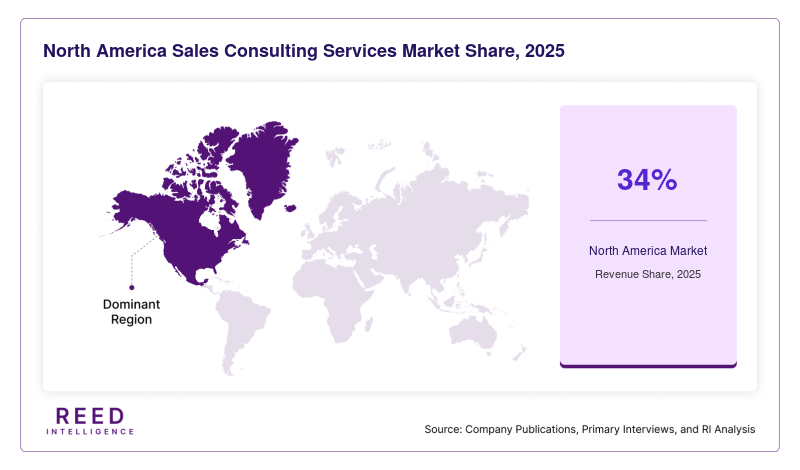
North America is internally modeled as the largest regional market, accounting for approximately 34% of global revenue in 2025, equivalent to USD 9.01 billion. Its share is modeled at 32.5% by 2034, with market value reaching approximately USD 16.33 billion and a modeled 6.84% CAGR.
The region has a large concentration of technology companies, professional-services organizations and enterprise buyers with sophisticated CRM and revenue-operations infrastructures. Salesforce's sales research also reflects significant adoption of AI and automation within modern sales organizations.
The market mechanism is increasingly tied to technology implementation and sales transformation rather than traditional training alone. Large enterprises can justify specialized consulting where sales structures involve multiple channels, territories and customer segments.
The main constraint is internalization: large companies increasingly maintain revenue-operations, analytics and sales-enablement teams that can perform some consulting functions internally.
Europe Maintains a Mature Consulting Market Supported by Enterprise Transformation
Europe accounts for approximately 27% of the 2025 market, or USD 7.16 billion. Its share is modeled at 26% by 2034, with market value reaching approximately USD 13.07 billion and a modeled 6.90% CAGR.
Demand is supported by digital transformation, CRM modernization and sales-process standardization across multinational organizations. The region's diverse national markets also create requirements for localized go-to-market strategies.
Consulting demand is increasingly connected to the integration of technology with commercial operating models. Organizations need to align sales processes with digital customer journeys while maintaining governance over customer data.
Economic uncertainty and fragmented business environments can lengthen project approval cycles, particularly for discretionary transformation programs.
Asia-Pacific Has the Highest Modeled Regional Growth Rate as Companies Expand Digital Sales Capabilities
Asia-Pacific represents approximately 24% of the 2025 market, equivalent to USD 6.36 billion. Its share is internally modeled to rise to 26% by 2034, with market value reaching approximately USD 13.07 billion and a modeled 8.36% CAGR.
The region combines established enterprise markets with rapidly expanding technology, manufacturing, financial-services and digital-commerce ecosystems. As companies expand across countries, consulting requirements increase around territory design, channel strategy, CRM adoption and sales enablement.
The strongest commercial mechanism is the professionalization of sales organizations as businesses scale and adopt more sophisticated technology platforms.
Differences in business practices, languages, sales structures and technology maturity across countries can increase implementation complexity.
Middle East and Africa Offers Demand Concentrated in Enterprise Transformation and Diversification Projects
Middle East and Africa account for approximately 8% of the 2025 market, or USD 2.12 billion. The regional share is modeled at 8.5% by 2034, with market value reaching approximately USD 4.27 billion and a modeled 8.10% CAGR.
Demand is concentrated in technology, financial services, telecommunications, professional services and large infrastructure-linked organizations. Enterprise transformation programs can generate consulting requirements around customer acquisition, sales organization design and technology adoption.
The opportunity is particularly relevant where organizations are developing new commercial capabilities rather than optimizing highly mature sales structures.
Budget constraints, uneven digital maturity and differences between national markets can restrict the scale of consulting programs.
Latin America Represents a Developing Market with Demand Tied to Sales Modernization
Latin America represents approximately 7% of the 2025 market, equivalent to USD 1.86 billion. Its share is modeled at 7% by 2034, with market value reaching approximately USD 3.52 billion and a modeled 7.33% CAGR.
The market is supported by increasing use of CRM systems, digital sales channels and structured customer-management processes. Consulting demand is strongest where companies are moving from relationship-driven sales toward data-supported commercial models.
SMEs provide an additional addressable customer base because external consultants can supply capabilities that would otherwise require dedicated internal teams.
Currency volatility, constrained consulting budgets and differences in technology adoption can limit project scale.
Sales Consulting Services Market Competitive Landscape
Competition in sales consulting is fragmented because providers compete across different layers of the commercial value chain. Global management-consulting firms compete for enterprise-wide transformation, while specialist sales consultancies focus on sales effectiveness, enablement, CRM implementation or specific industries.
Accenture competes through the combination of strategy, technology implementation, data and AI capabilities. Its competitive positioning is strengthened when clients want sales transformation integrated with broader digital transformation rather than delivered as an isolated sales project.
Deloitte combines consulting, technology and industry capabilities, allowing it to compete for complex commercial-transformation programs involving CRM, analytics and operating-model changes.
Key Market Players
- Accenture
- Deloitte
- McKinsey & Company
- Bain & Company
- Boston Consulting Group
- Gartner
- PwC
- KPMG
- EY
- Sales Performance International
Sales Consulting Services Market Recent Developments
- Salesforce's recent sales research identifies increasing adoption of AI among sales organizations, particularly for tasks such as prospecting, research, forecasting and workflow support. The market implication is a shift in consulting requirements. Instead of simply advising sales representatives on selling techniques, consultants increasingly need to address AI workflow design, CRM integration, data quality, governance and workforce adoption.
- Recent consulting research increasingly links sales transformation with digital channels, analytics and technology-enabled customer engagement. McKinsey's work on B2B sales transformation emphasizes the relationship between commercial productivity and digitally enabled sales models. This expands the competitive field because traditional sales consultants increasingly compete with technology consultancies and systems integrators.
Sales Consulting Services Market Segments
By Service Type
- Sales Strategy Consulting
- Sales Process Consulting
- Sales Training & Enablement
- Sales Technology Consulting
- Sales Organization & Performance Consulting
By Enterprise Size
- Large Enterprises
- Small & Medium Enterprises
By End Use
- IT & Telecommunications
- BFSI
- Healthcare
- Manufacturing
- Retail & E-commerce
- Professional Services
- Other Industries
By Engagement Model
- Project-Based Consulting
- Retainer-Based Consulting
- Performance-Based Consulting
By Region
- North America
- Europe
- APAC
- Middle East and Africa
- LATAM