SAP Cloud Platform Service Market Size, Share & Trends Analysis Report By Service Type, By Deployment Model, By Enterprise Size, By Application, By Industry Vertical and By Region, Forecasts 2026–2034
USD 3950
SAP Cloud Platform Service Market Size
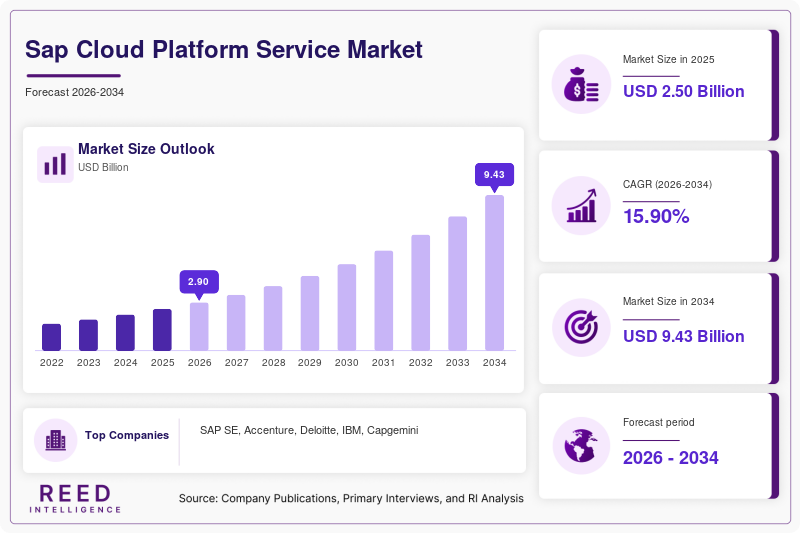
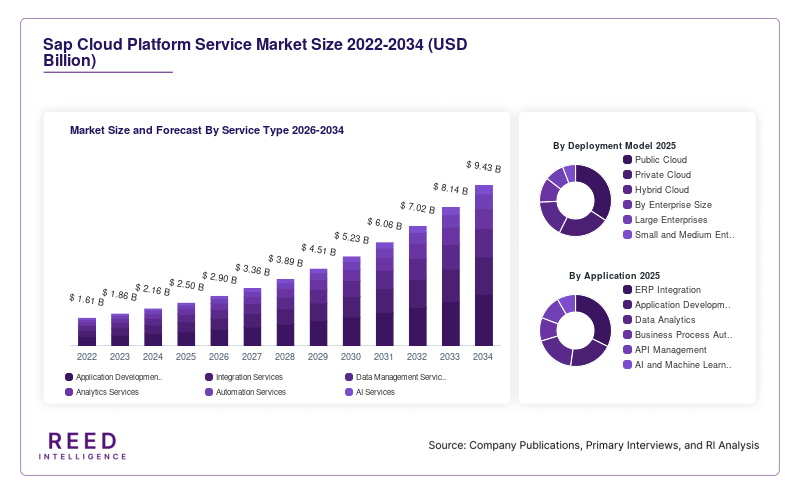
The global SAP cloud platform service market was valued at USD 2.50 billion in 2025 and is projected to grow from USD 2.90 billion in 2026 to USD 9.35 billion by 2034, registering a CAGR of 15.90% during the forecast period from 2026 to 2034.
SAP Cloud Platform services comprise cloud-based application development, integration, data management, analytics, automation and extension capabilities used by enterprises to build and connect applications within the SAP ecosystem.
SAP has evolved its cloud platform strategy around SAP Business Technology Platform (SAP BTP), which brings together application development and automation, data and analytics, integration, and artificial intelligence capabilities. SAP describes BTP as a technology platform designed to help organizations integrate, extend and innovate across their business applications and data environments.
SAP Cloud Platform Service Market Drivers
Accelerating Enterprise Cloud Adoption
Organizations across industries are increasingly migrating applications, infrastructure and data workloads to cloud environments.
Cloud deployment allows enterprises to scale computing resources, simplify infrastructure management and support geographically distributed operations. This transition is creating demand for cloud platform services capable of supporting enterprise application development and integration.
Expansion of SAP S/4HANA Cloud
The migration from legacy SAP ERP environments toward SAP S/4HANA Cloud is an important demand driver.
As organizations modernize their core ERP environments, they require integration, extension and data-management capabilities to connect SAP applications with existing enterprise systems and newer cloud applications.
Growing Need for Application Integration
Large organizations commonly operate applications from multiple vendors and across multiple cloud environments.
Integration services help connect ERP, CRM, supply-chain, human-resources, finance and third-party applications. SAP's integration capabilities support API management, application integration and event-driven architectures.
Increasing Demand for Enterprise AI
AI is becoming increasingly integrated into enterprise applications and business processes.
SAP has been incorporating generative AI and its Joule AI assistant into its cloud ecosystem, creating opportunities for platform services that support AI-enabled applications, automation and data-driven decision-making.
Growing Demand for Low-Code and Pro-Code Development
Organizations are looking for ways to accelerate application development while reducing development complexity.
Low-code and pro-code capabilities allow business users and professional developers to build applications, workflows and extensions that interact with enterprise data and business processes.
SAP Cloud Platform Service Market Restraints
Complexity of Enterprise Cloud Migration
Migration from highly customized legacy SAP environments to cloud architectures can be complex.
Organizations may need to redesign integrations, migrate data, modernize applications and retrain employees, increasing the time and resources required for cloud transformation.
Data Security and Compliance Requirements
Enterprise cloud platforms manage sensitive financial, customer, employee and operational information.
Organizations must address data residency, access control, encryption, identity management and industry-specific compliance requirements before moving critical workloads to cloud environments.
Shortage of Specialized Skills
SAP cloud implementations require expertise across SAP architecture, integration, data management, security, application development and cloud technologies.
A shortage of qualified professionals can increase implementation costs and extend project timelines.
Vendor Ecosystem Dependence
Enterprises heavily invested in SAP infrastructure may become dependent on SAP-specific technologies, implementation partners and ecosystem capabilities.
Integration with non-SAP environments can also require additional development and management resources.
SAP Cloud Platform Service Market Opportunities
Migration to SAP Business Technology Platform
The continued development of SAP Business Technology Platform (SAP BTP) creates opportunities across application development, integration, data management, analytics and automation.
Organizations modernizing their SAP landscapes can use BTP to extend applications without extensively modifying the underlying ERP core.
Generative AI and Intelligent Automation
The integration of generative AI with enterprise applications represents a significant opportunity.
AI assistants, intelligent document processing, automated workflows and natural-language interfaces can expand demand for platform services that connect AI models with enterprise data and business processes.
Multi-Cloud and Hybrid Cloud Integration
Enterprises increasingly operate across public cloud, private cloud and on-premise environments.
This creates demand for integration and management capabilities that allow SAP applications to communicate with systems deployed across heterogeneous IT environments.
Industry-Specific Cloud Solutions
Industry-specific requirements in manufacturing, healthcare, financial services, retail and utilities create opportunities for customized SAP cloud extensions and applications.
Partners and developers can build specialized solutions on SAP's cloud platform to address sector-specific workflows.
Expansion of Cloud-Based Analytics
The growing volume of enterprise data is increasing demand for cloud-based analytics, data integration and real-time decision support.
SAP's cloud data and analytics capabilities provide opportunities for organizations seeking to combine operational and analytical data.
Service Type Segment Analysis
Integration Services Hold the Largest Share
Integration services accounted for approximately 30% of the SAP cloud platform service market in 2025, making them the largest service segment. Enterprises require integration capabilities to connect SAP applications with third-party cloud applications, legacy systems, APIs and data sources.
AI services accounted for approximately 13% and are projected to grow at approximately 21.5% CAGR, making them the fastest-growing major service segment. Increasing adoption of generative AI, intelligent automation and AI-assisted enterprise applications is supporting demand.
Application development services represented approximately 22%, data management services 17%, analytics services 11%, and automation services approximately 7%.
Deployment Model Segment Analysis
Public Cloud Holds the Largest Share
Public cloud accounted for approximately 46% of the market in 2025, supported by enterprises seeking scalable infrastructure and managed cloud capabilities.
Hybrid cloud accounted for approximately 31% and is projected to grow at approximately 17.2% CAGR, making it the fastest-growing major deployment segment. Many enterprises continue to maintain on-premise SAP workloads while progressively adopting cloud services.
Private cloud represented approximately 23% of the market.
Enterprise Size Segment Analysis
Large Enterprises Hold the Largest Share
Large enterprises accounted for approximately 71% of the market in 2025, reflecting the extensive SAP installations and complex integration requirements of large organizations.
Small and medium enterprises accounted for approximately 29% and are projected to grow at approximately 18.1% CAGR, making them the faster-growing segment. Cloud-based deployment can reduce the infrastructure burden associated with traditional enterprise software implementations, increasing accessibility for smaller organizations.
Application Segment Analysis
ERP Integration Holds the Largest Share
ERP integration accounted for approximately 29% of the market in 2025, reflecting the central role of SAP ERP systems within enterprise technology environments.
AI and machine learning accounted for approximately 12% and are projected to grow at approximately 22.4% CAGR, making this the fastest-growing major application segment as enterprises integrate AI into business processes and enterprise applications.
Application development represented approximately 21%, data analytics 17%, business process automation 13%, and API management approximately 8%.
SAP Cloud Platform Service Market Regional Analysis
North America Holds the Largest Share
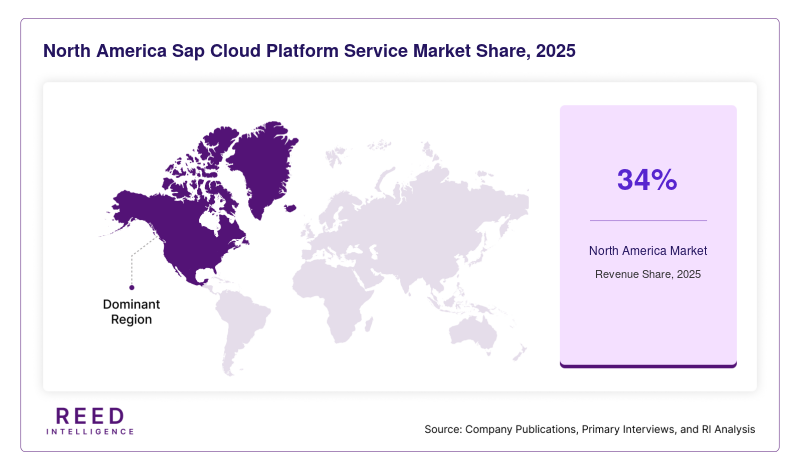
North America accounted for approximately 34% of the SAP cloud platform service market in 2025, making it the dominant regional market. The region benefits from high enterprise cloud adoption, extensive SAP deployments, mature IT services ecosystems and strong investment in AI and digital transformation.
Asia-Pacific accounted for approximately 25% and is projected to grow at approximately 18.3% CAGR, making it the fastest-growing major region. Cloud adoption, enterprise digitization, manufacturing expansion and increasing SAP deployments across emerging economies are supporting growth.
Europe Maintains Strong SAP Adoption
Europe accounted for approximately 29% of the market in 2025 and is projected to grow at approximately 14.9% CAGR.
The region has a substantial installed base of SAP enterprise software, particularly among manufacturing, automotive, chemicals, industrial and consumer-goods companies. Cloud migration and modernization of legacy SAP environments are supporting demand.
Latin America Shows Increasing Adoption
Latin America accounted for approximately 7% of the market in 2025 and is projected to grow at approximately 15.8% CAGR.
Organizations are increasingly adopting cloud ERP, digital integration and analytics capabilities as they modernize enterprise IT infrastructure.
Middle East & Africa Represent an Emerging Opportunity
Middle East & Africa accounted for approximately 5% of the market in 2025 and is projected to grow at approximately 16.4% CAGR.
Digital transformation initiatives, cloud adoption and investments in enterprise applications are creating opportunities for SAP cloud services.
SAP Cloud Platform Service Market Competitive Landscape
Competition in the SAP cloud platform service market is shaped by cloud capabilities, SAP expertise, integration capabilities, AI and automation expertise, implementation experience, industry specialization, global delivery infrastructure and managed services.
SAP's partner ecosystem is particularly important because enterprises frequently rely on systems integrators and technology-service providers for implementation, migration, application development and ongoing management.
Key Market Players
SAP Cloud Platform Service Market Recent Developments
- SAP continues to expand SAP Business Technology Platform across application development, integration, data and analytics, automation and AI. The platform is positioned as a foundation for extending SAP applications while maintaining a clean core.
- SAP has continued integrating Joule and generative AI capabilities across its cloud application portfolio. The company's AI strategy is increasingly focused on embedding AI into business processes rather than treating it solely as a standalone technology.
Sap Cloud Platform Service Market Segments
By Service Type
- Application Development Services
- Integration Services
- Data Management Services
- Analytics Services
- Automation Services
- AI Services
By Deployment Model
- Public Cloud
- Private Cloud
- Hybrid Cloud
- By Enterprise Size
- Large Enterprises
- Small and Medium Enterprises
By Application
- ERP Integration
- Application Development
- Data Analytics
- Business Process Automation
- API Management
- AI and Machine Learning
By Industry Vertical
- Manufacturing
- BFSI
- & E-commerce
- Healthcare
- IT & Telecommunications
- Energy & Utilities
- Government
- Others
By Region
- North America
- Europe
- APAC
- Middle East and Africa
- LATAM