Screw Jacks Market Size, Share & Trends Analysis Report By Type (Machine Screw Jacks, Ball Screw Jacks, Worm Gear Screw Jacks, Bevel Gear Screw Jacks), By Application (Material Handling, Lifting Platforms, Industrial Automation, Construction, Food & Beverage, Automotive), By End User (Manufacturing, Automotive, Construction, Energy, Food & Beverage, Logistics), and By Region (North America, Europe, Asia-Pacific, Middle East and Africa, Latin America) Forecasts, 2026–2034
USD 3950
Screw Jacks Market Size
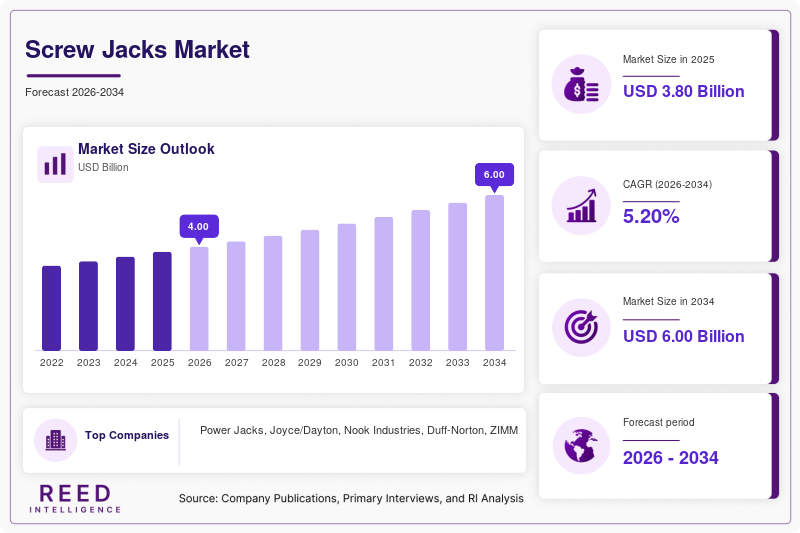
The screw jacks market was valued at USD 3.80 billion in 2025 and is projected to grow from USD 4.00 billion in 2026 to USD 5.90 billion by 2034, registering a CAGR of 5.20% during the forecast period from 2026 to 2034.
Screw jacks convert rotary motion into controlled linear movement and are used where equipment requires lifting, positioning, height adjustment, or synchronized mechanical movement. Demand is closely connected with industrial automation, material handling, machinery manufacturing and applications requiring precise mechanical positioning.
The market is supported by the continued modernization of manufacturing equipment. Industrial automation increases the need for repeatable positioning systems, while machine builders increasingly integrate lifting and adjustment mechanisms into production lines, handling equipment and specialized machinery. Screw jacks remain relevant where mechanical simplicity, load control and synchronized movement are required.
Screw Jacks Market Drivers
Industrial Automation Increases Demand for Controlled Mechanical Positioning
The expansion of automated manufacturing equipment creates demand for actuators capable of accurately positioning machinery, fixtures, platforms and components. Screw jacks can be configured into synchronized lifting systems and integrated with electric motors, gearboxes and control systems.
The market mechanism is particularly relevant in machinery where several lifting points must move together. Instead of relying on independent manual adjustment, interconnected screw-jack systems can provide coordinated movement and repeatable positioning.
Demand is therefore concentrated in industrial automation, material handling, machinery manufacturing and production equipment. Ball-screw configurations can be particularly relevant where efficiency and positioning performance are prioritized.
The counterbalance is competition from electric linear actuators and servo-driven systems, which can provide faster movement and more sophisticated electronic control in certain applications.
Expansion of Material Handling Equipment Supports Mechanical Lifting Applications
Warehousing, manufacturing and industrial facilities require equipment for lifting, positioning and transferring loads. Screw jacks can be incorporated into lifting platforms, conveyors, adjustable workstations and other material-handling machinery.
The commercial mechanism is equipment customization: manufacturers can design mechanical lifting systems around the required load, stroke and operating configuration. Multiple screw jacks can also be synchronized through mechanical transmission arrangements.
Demand is consequently linked to investment in material-handling equipment, production machinery and industrial infrastructure rather than consumer demand.
However, hydraulic lifting equipment remains widely used for applications involving very high loads or rapid lifting cycles. This limits screw-jack adoption where speed and extremely high lifting capacity outweigh positioning precision and mechanical controllability.
Demand for Compact and Electrically Integrated Actuation Supports Product Upgrades
Equipment manufacturers increasingly require lifting mechanisms that can be integrated with motors, sensors and automated controls. Screw-jack suppliers can address this requirement through electrically driven systems combining gearboxes, motors and lifting components.
The market mechanism is the movement from standalone mechanical components toward packaged actuation assemblies. Integrated systems can reduce engineering complexity for machinery manufacturers and support automated adjustment.
This trend is relevant to industrial automation, packaging, manufacturing machinery and specialized lifting equipment.
The main limitation is that sophisticated integrated systems can carry higher acquisition costs than basic manual screw jacks. Buyers therefore evaluate the productivity and maintenance benefits against the initial equipment investment.
Screw Jacks Market Restraints
Alternative Linear Actuation Technologies Limit Screw Jack Adoption
Screw jacks compete with hydraulic cylinders, pneumatic actuators and electric linear actuators. Each technology provides different combinations of speed, force, precision, efficiency and control.
The constraint is strongest when customers require rapid movement, high dynamic performance or electronically controlled positioning. In these applications, servo-driven electric actuators can offer capabilities that traditional mechanical screw-jack arrangements may not provide without additional components.
Screw-jack manufacturers can reduce this constraint through motorized designs, ball screws, sensors and integrated controls. Nevertheless, technology selection remains highly application-specific, preventing a single actuation architecture from becoming universal.
Maintenance Requirements Can Affect Adoption in High-Duty Applications
Mechanical screw-jack systems contain gears, screws, bearings and other moving components that require appropriate lubrication, alignment and inspection. In high-cycle industrial applications, maintenance requirements can influence equipment-selection decisions.
The economic mechanism is downtime risk. If an actuator requires frequent servicing or suffers from wear under demanding operating conditions, the resulting maintenance burden can increase the total cost of ownership.
Manufacturers address this issue through improved materials, lubrication systems, protective housings and more efficient screw configurations. However, demanding applications may still favor alternative actuation systems where maintenance intervals and operating conditions make them economically preferable.
Screw Jacks Market Opportunities
Smart and Motorized Screw Jack Systems Can Extend the Addressable Automation Market
A major opportunity lies in combining screw jacks with electric motors, sensors and automated control systems. These configurations can transform a conventional mechanical lifting component into an adjustable positioning system suitable for automated machinery.
The commercial opportunity is strongest among machine builders and industrial automation integrators that need synchronized movement and repeatable positioning without designing an actuator completely from scratch.
Integrated systems can also support remote adjustment and automated production-line changes. Adoption will depend on system cost, control compatibility, operating environment and the required level of positioning accuracy.
High-Efficiency Ball Screw Designs Can Address Performance-Sensitive Applications
Ball screw jacks provide lower friction and higher mechanical efficiency than conventional machine-screw configurations. This makes them relevant for applications where energy consumption, positioning performance or repeated operation is important.
The opportunity is particularly relevant to automated production equipment and precision machinery. As machinery manufacturers increasingly evaluate energy consumption and productivity across the equipment lifecycle, higher-efficiency actuation can become more attractive.
The limiting factor is cost. Ball-screw systems generally require more sophisticated components and may not provide sufficient economic benefit for low-duty or infrequently adjusted lifting applications.
Type Segment Analysis
By Type
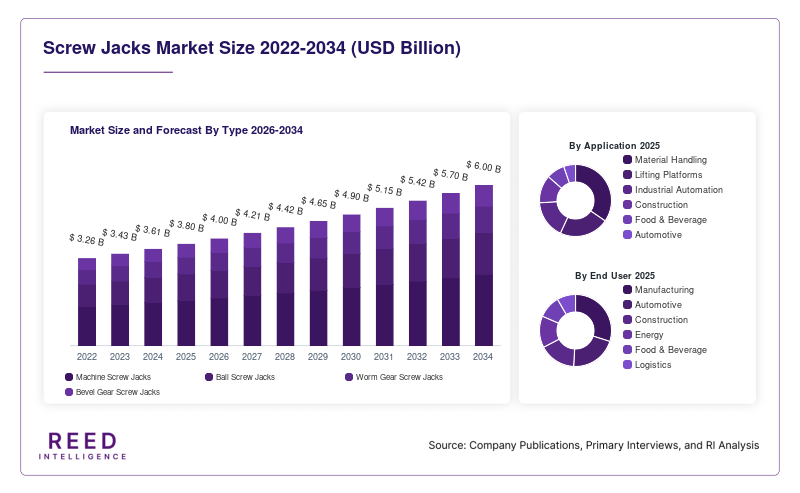
Machine Screw Jacks account for approximately 42% of the global market in 2025. Their position is supported by broad applicability in lifting, adjustment and positioning equipment where moderate speed and load control are sufficient. Their comparatively straightforward mechanical architecture makes them suitable for industrial machinery, maintenance equipment and manually or electrically driven lifting systems.
Ball Screw Jacks account for approximately 27% and are projected to grow at approximately 7.10% CAGR, making them the fastest-growing type. Their lower friction and higher efficiency make them more relevant to repeated-duty and precision-oriented applications, particularly as industrial machinery incorporates greater automation.
Worm Gear Screw Jacks represent approximately 19% and are projected to grow at approximately 4.80% CAGR, while Bevel Gear Screw Jacks account for approximately 12% and are projected to grow at approximately 5.60% CAGR. Bevel configurations can support systems requiring different transmission arrangements, but adoption remains tied to specific machine designs.
Application Analysis
By Application
Material Handling accounts for approximately 29% of the market in 2025. Screw jacks are incorporated into lifting platforms, conveyors, adjustable equipment and machinery used to move or position industrial loads.
Industrial Automation accounts for approximately 23% and is projected to grow at approximately 7.20% CAGR, making it the fastest-growing application. Automated machinery requires repeatable positioning and synchronized movement, creating demand for motorized screw-jack assemblies.
Lifting Platforms represent approximately 18% and are projected to grow at approximately 5.40% CAGR, while Automotive accounts for approximately 12% and grows at approximately 5.80% CAGR.
Construction represents approximately 10% and grows at approximately 4.60% CAGR, while Food & Beverage accounts for approximately 8% and grows at approximately 5.10% CAGR. Food-processing applications require equipment compatible with hygiene and operating-environment requirements, limiting the use of unsuitable mechanical configurations.
End-User Analysis
By End User
Manufacturing Holds the Largest Share as Screw Jacks Are Embedded in Production and Machinery Systems
Manufacturing accounts for approximately 31% of the global market in 2025. Industrial machinery, production lines and material-handling systems create recurring demand for lifting and positioning components.
Logistics accounts for approximately 17% and is projected to grow at approximately 7.00% CAGR, making it the fastest-growing end-user segment. Warehouse automation and material-handling equipment create applications for motorized lifting and positioning mechanisms.
Automotive represents approximately 19% and grows at approximately 5.90% CAGR, supported by machinery and production equipment.
Construction accounts for approximately 14% and grows at approximately 4.70% CAGR, while Energy represents approximately 10% and grows at approximately 4.90% CAGR.
Food & Beverage accounts for approximately 9% and grows at approximately 5.20% CAGR, while other industrial users account for approximately 10% and grow at approximately 5.00% CAGR.
Screw Jacks Market Regional Analysis
Asia-Pacific Represents the Largest Regional Market as Manufacturing and Automation Create a Broad Equipment Base
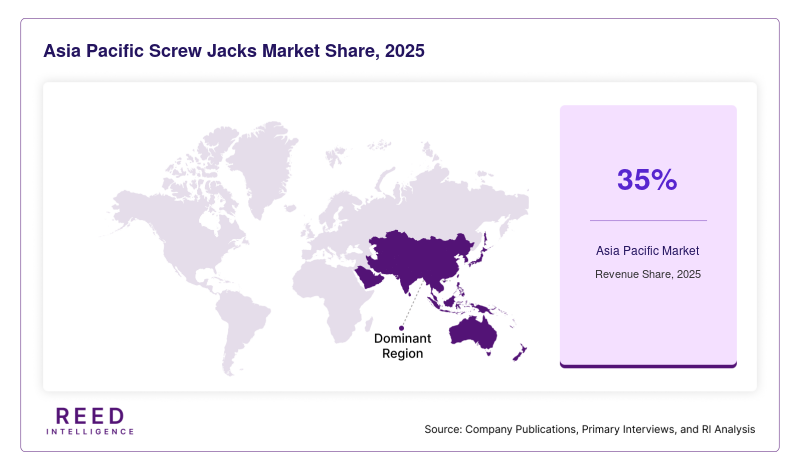
Asia-Pacific accounts for approximately 35% of the global screw jacks market in 2025 and is projected to grow at approximately 6.20% CAGR through 2034.
The region has a large industrial manufacturing base spanning automotive, machinery, electronics, food processing and material handling. These industries use lifting and positioning mechanisms within production equipment and automated systems.
China, Japan, South Korea and India represent important manufacturing markets, while Southeast Asian production hubs add demand for machinery and factory automation.
The future growth mechanism is connected to continued equipment modernization and the integration of automated positioning systems into production facilities. Machine builders also create demand because screw jacks are components rather than standalone end-user products.
The main constraints include competition from alternative electric actuators and differences in automation investment between individual countries.
Europe Maintains a Mature Market Supported by Precision Machinery and Industrial Automation
Europe accounts for approximately 27% of the market in 2025 and is projected to grow at approximately 4.90% CAGR through 2034.
European demand is concentrated in industrial machinery, automotive manufacturing, food processing, material handling and specialized equipment.
The region's emphasis on manufacturing efficiency and automated production supports applications requiring accurate mechanical positioning. Ball-screw and motorized configurations can benefit where equipment manufacturers prioritize efficiency and repeatable movement.
Germany, Italy, France and the United Kingdom represent important industrial markets with established machinery-manufacturing ecosystems.
However, mature industrial infrastructure means that demand increasingly comes from equipment replacement, modernization and automation upgrades rather than first-time industrialization. High engineering and labor costs can also encourage automation while increasing pressure on machinery manufacturers to optimize component costs.
North America Maintains Strong Demand Through Automated Manufacturing and Material Handling
North America accounts for approximately 24% of the market in 2025 and is projected to grow at approximately 5.10% CAGR through 2034.
The region's demand base includes manufacturing, automotive, logistics, food processing, energy and industrial machinery. Screw jacks are used where equipment requires controlled lifting and positioning.
The growth mechanism is closely linked to factory automation and warehouse modernization. Motorized and integrated screw-jack systems can support automated adjustment and material-handling equipment.
The United States represents the principal demand center, with Canada providing additional industrial and energy-related applications.
The key constraint is substitution by electric linear actuators and hydraulic systems. Buyers increasingly compare complete system performance rather than selecting screw jacks solely on component cost.
Middle East and Africa Develop Through Industrial Infrastructure and Specialized Equipment Demand
Middle East and Africa account for approximately 8% of the market in 2025 and are projected to grow at approximately 4.60% CAGR through 2034.
Demand is linked to construction, energy, manufacturing, logistics and food-processing infrastructure. Screw jacks can be incorporated into lifting and positioning equipment used in industrial facilities.
The Middle East provides demand from industrial development and energy-related equipment, while selected African markets offer opportunities as manufacturing and logistics infrastructure develops.
The market remains relatively application-specific because industrial automation penetration and machinery manufacturing capabilities vary across countries.
Capital expenditure cycles, imported equipment costs and limited local component manufacturing can constrain adoption.
Latin America Develops Through Manufacturing and Industrial Equipment Investment
Latin America accounts for approximately 6% of the market in 2025 and is projected to grow at approximately 4.80% CAGR through 2034.
Automotive manufacturing, food processing, mining-related equipment, logistics and general manufacturing provide demand for mechanical lifting and positioning components.
Brazil and Mexico represent important industrial markets, with Mexico's manufacturing ecosystem supporting demand from automotive and industrial machinery applications.
Growth depends on investment in production equipment and automation. Imported machinery also creates an indirect channel for screw-jack demand because components are frequently incorporated into equipment supplied by international machinery manufacturers.
Currency volatility, capital expenditure constraints and dependence on imported industrial components can limit investment.
Screw Jacks Market Competitive Landscape
Competition in the screw-jack market is driven by mechanical performance, load capacity, efficiency, customization, product reliability, application engineering and integration capability. Manufacturers compete across conventional machine screw jacks, ball screw jacks, bevel gear configurations and complete lifting systems. The competitive distinction increasingly extends beyond the jack itself to motorization, control integration and engineered assemblies.
Power Jacks has a broad range of mechanical and electromechanical lifting products, allowing it to address standard and engineered applications. Its product breadth supports competition in industrial automation and machinery applications.
Joyce/Dayton competes through mechanical screw-jack and lifting-system products for industrial equipment applications. Engineering customization and configuration flexibility are relevant where customers require application-specific lifting solutions.
Key Market Players
- Power Jacks
- Joyce/Dayton
- Nook Industries
- Duff-Norton
- ZIMM
- Servomech
- Neff Gewindetriebe
- GROB GmbH Antriebstechnik
- Varvel
- KSH International
Screw Jacks Market Recent Developments
- 2026 – Power Jacks continued expanding its engineered lifting-system portfolio, including mechanical and electromechanical solutions designed for industrial machinery. The development supports the industry's movement toward integrated lifting systems rather than standalone screw-jack components.
- 2025 – ZIMM continued development of modular screw-jack systems, including configurations designed for synchronized lifting applications. Such modularity can reduce engineering effort for machine builders and support customized automation projects.
Screw Jacks Market Segments
By Type
- Machine Screw Jacks
- Ball Screw Jacks
- Worm Gear Screw Jacks
- Bevel Gear Screw Jacks
By Application
- Material Handling
- Lifting Platforms
- Industrial Automation
- Construction
- Food & Beverage
- Automotive
By End User
- Manufacturing
- Automotive
- Construction
- Energy
- Food & Beverage
- Logistics
By Region
- North America
- Europe
- APAC
- Middle East and Africa
- LATAM