Tire Changing Machines Market Size, Share & Trends Analysis Report By Type, By Operation, By Rim Size, By End User and By Region, Forecasts 2026–2034
USD 3950
Tire Changing Machines Market Size
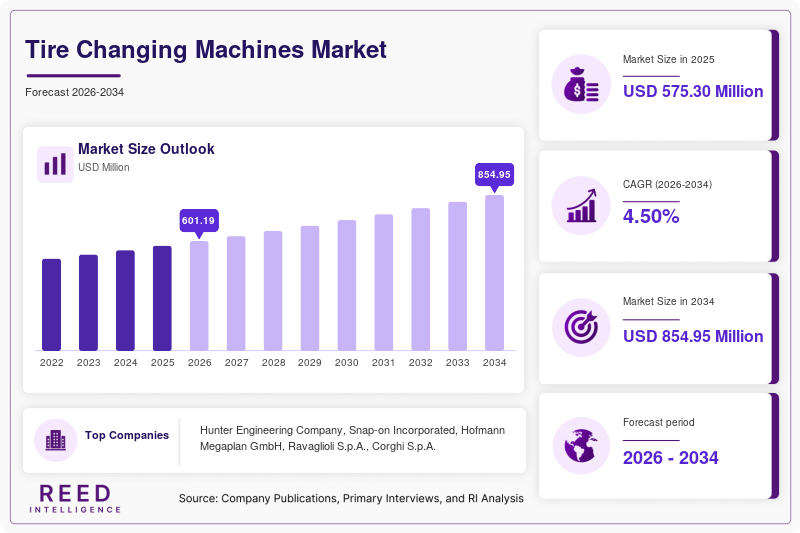
The global tire changing machines market was valued at USD 575.30 million in 2025 and is projected to grow from USD 601.19 million in 2026 to USD 848.00 million by 2034, registering a CAGR of 4.50% during the forecast period from 2026 to 2034.
Tire changing machines are specialized automotive service equipment used to remove and install tires on vehicle wheels. These machines are widely used in tire service centers, automotive repair shops, dealerships, fleet maintenance facilities and wheel-service operations.
The market is supported by the expanding global vehicle parc, increasing tire replacement requirements, growth in automotive maintenance services and rising adoption of automated workshop equipment. As vehicles become more sophisticated and tire and wheel configurations become more diverse, service providers increasingly require equipment capable of handling different tire sizes and designs.
Tire Changing Machines Market Drivers
Growth in Vehicle Ownership
Increasing vehicle ownership across emerging and developed markets is expanding the installed vehicle base requiring periodic tire replacement and maintenance.
A larger vehicle parc generates recurring demand for tire-changing equipment among automotive service providers.
Increasing Tire Replacement Demand
Tires are consumable automotive components that require replacement based on mileage, wear, road conditions and age.
The recurring nature of tire replacement supports long-term demand for tire-changing machines.
Expansion of Automotive Service Centers
The growth of independent garages, tire dealerships and specialized automotive service centers is increasing demand for workshop equipment.
New service facilities require tire-changing machines as part of their wheel-service equipment portfolio.
Adoption of Automated Workshop Equipment
Automated tire changers can reduce physical effort and improve service productivity compared with manual processes.
Increasing labor costs and demand for faster service are encouraging workshops to adopt more automated equipment.
Growth of Commercial Vehicle Fleets
Commercial trucks, buses and other fleet vehicles require regular tire inspection and replacement.
Fleet expansion creates demand for heavy-duty tire-changing equipment capable of handling larger wheels and tires.
Tire Changing Machines Market Restraints
High Initial Equipment Cost
Advanced automatic and specialized tire-changing machines require significant investment.
Small independent workshops may continue to use basic equipment because of budget constraints.
Maintenance Requirements
Tire changers contain mechanical, hydraulic, pneumatic and electronic components that require periodic maintenance.
Equipment downtime can affect workshop productivity.
Availability of Low-Cost Alternatives
Lower-cost manual and semi-automatic machines are available in many markets.
Price-sensitive customers may prioritize lower acquisition costs over advanced automation.
Skilled Operator Requirements
Although automation reduces physical effort, operators still require training to configure equipment properly and handle different tire and wheel combinations.
Improper operation can result in tire or rim damage.
Tire Changing Machines Market Opportunities
Growth of Electric Vehicles
Electric vehicles increasingly use specialized tire and wheel configurations and can place different requirements on service equipment.
The expanding EV fleet creates opportunities for tire changers designed for modern wheel assemblies and low-profile tires.
Increasing Demand for Automatic Machines
Workshops are increasingly seeking machines that improve productivity and reduce manual intervention.
Fully automatic and leverless machines therefore offer opportunities for manufacturers.
Expansion in Emerging Markets
Vehicle ownership and automotive service infrastructure are expanding in Asia-Pacific, Latin America and other emerging markets.
New workshops and tire service facilities are creating additional demand for equipment.
Connected Workshop Equipment
Integration of sensors, digital controls, diagnostic systems and service monitoring can improve equipment usability and maintenance.
Connected machines can provide opportunities for manufacturers to differentiate their products.
Specialized Machines for Large Wheels
Growth in SUVs, light commercial vehicles, trucks and buses is increasing demand for equipment capable of servicing larger wheel assemblies.
Manufacturers can expand their addressable market through heavy-duty and specialized tire changers.
Type Segment Analysis
By Type
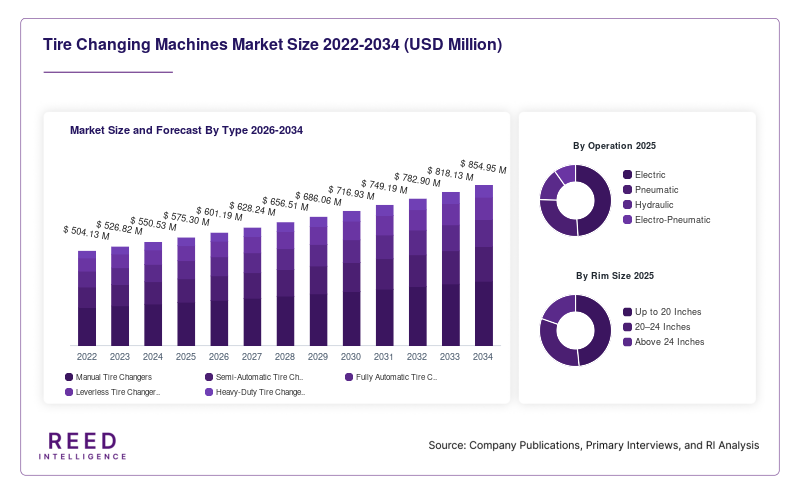
Semi-automatic tire changers accounted for approximately 39% of the tire changing machines market in 2025, making them the largest type segment. Their balance between equipment cost, operational efficiency and manual control makes them suitable for a broad range of independent garages and tire service centers.
Fully automatic tire changers accounted for approximately 24% and are projected to grow at approximately 6.1% CAGR, making them the fastest-growing major type segment. Increasing labor costs, demand for faster servicing and the need to reduce physical intervention are supporting adoption.
Manual tire changers represented approximately 18%, leverless machines 11%, and heavy-duty tire changers approximately 8%.
Operation Segment Analysis
By Operation
Pneumatic tire-changing machines accounted for approximately 44% of the market in 2025, making them the largest operation segment. Pneumatic systems provide the power and control required for many professional tire-service applications.
Electro-pneumatic machines accounted for approximately 22% and are projected to grow at approximately 5.8% CAGR, making them the fastest-growing major operation segment. Integration of electronic controls with pneumatic systems is improving precision and ease of operation.
Electric machines represented approximately 26%, while hydraulic systems accounted for approximately 8%.
Rim Size Segment Analysis
By Rim Size
Tire changers supporting rims up to 20 inches accounted for approximately 47% of the market in 2025, making them the largest rim-size segment. Passenger vehicles continue to represent a substantial share of tire-service activity.
Above 24-inch rim machines accounted for approximately 17% and are projected to grow at approximately 6.0% CAGR, making them the fastest-growing major rim-size segment. Increasing use of larger wheels on commercial vehicles, SUVs and specialized vehicles is supporting demand.
The 20–24-inch segment represented approximately 36% of the market.
End-User Segment Analysis
By End User
Tire service centers accounted for approximately 37% of the market in 2025, making them the largest end-user segment. These facilities perform high volumes of tire replacement, wheel servicing and related maintenance activities.
Fleet maintenance facilities accounted for approximately 16% and are projected to grow at approximately 5.7% CAGR, making them the fastest-growing major end-user segment. Expansion of commercial vehicle fleets and the need to maintain vehicle uptime are supporting demand.
Automotive repair shops represented approximately 27%, dealerships 12%, vehicle manufacturers 5%, and other users approximately 3%.
Tire Changing Machines Market Regional Analysis
Asia-Pacific Holds the Largest Share
Asia-Pacific accounted for approximately 36% of the global tire changing machines market in 2025, making it the largest regional market. The region benefits from a large and expanding vehicle population, extensive automotive manufacturing, increasing aftermarket activity and growing investment in automotive service infrastructure.
Asia-Pacific is projected to grow at approximately 5.4% CAGR, making it the fastest-growing major region.
North America Maintains Strong Aftermarket Demand
North America accounted for approximately 28% of the market in 2025 and is projected to grow at approximately 4.0% CAGR.
The region benefits from a large installed vehicle base, mature automotive aftermarket networks and significant demand for tire replacement and maintenance.
Europe Shows Strong Demand for Advanced Equipment
Europe accounted for approximately 25% of the market in 2025 and is projected to grow at approximately 3.8% CAGR.
Established automotive service networks and demand for efficient workshop equipment support continued market development.
Latin America Shows Expanding Service Infrastructure
Latin America accounted for approximately 7% of the market in 2025 and is projected to grow at approximately 4.8% CAGR.
Growing vehicle ownership and expansion of independent automotive workshops are supporting demand.
Middle East & Africa Represents an Emerging Market
Middle East & Africa accounted for approximately 4% of the market in 2025 and is projected to grow at approximately 4.6% CAGR.
Increasing vehicle use, commercial transportation and development of automotive service infrastructure are creating opportunities for tire-changing equipment.

Tire Changing Machines Market Competitive Landscape
Competition in the tire changing machines market is based on equipment reliability, operating speed, automation level, supported tire sizes, rim protection, ease of operation, after-sales service, pricing and distribution coverage.
Manufacturers are increasingly developing automatic and leverless systems capable of servicing low-profile tires, large wheels and modern vehicle configurations.
Key Market Players
- Hunter Engineering Company
- Snap-on Incorporated
- Hofmann Megaplan GmbH
- Ravaglioli S.p.A.
- Corghi S.p.A.
- Giuliano Industrial S.p.A.
- CEMB S.p.A.
- Beissbarth GmbH
- Tire Service International
- Atlas Automotive Equipment
Tire Changing Machines Market Recent Developments
- Automotive workshops are increasingly investing in automated tire-changing equipment to improve productivity and reduce physical labor. Automatic systems can shorten service times and support higher tire-service volumes.
- Leverless tire changers are gaining attention because they can reduce the risk of wheel damage and simplify servicing of low-profile and performance tires.
Tire Changing Machines Market Segments
By Type
- Manual Tire Changers
- Semi-Automatic Tire Changers
- Fully Automatic Tire Changers
- Leverless Tire Changers
- Heavy-Duty Tire Changers
By Operation
- Electric
- Pneumatic
- Hydraulic
- Electro-Pneumatic
By Rim Size
- Up to 20 Inches
- 20–24 Inches
- Above 24 Inches
By End User
- Tire Service Centers
- Automotive Repair Shops
- Dealerships
- Fleet Maintenance Facilities
- Vehicle Manufacturers
- Others
By Region
- North America
- Europe
- APAC
- Middle East and Africa
- LATAM