Adhesives and Sealants Market Size, Share & Trends Analysis Report By Product Type (Water-Based Adhesives, Solvent-Based Adhesives, Hot-Melt Adhesives, Reactive & Structural Adhesives, Silicone Sealants, Polyurethane Sealants, Acrylic Sealants), By Technology (Water-Based, Solvent-Based, Hot-Melt, Reactive), By Application (Building & Construction, Automotive & Transportation, Packaging, Electronics, Consumer & Industrial), By Distribution Channel (Direct Sales, Distributors, Specialty Stores, O
USD 3950
Adhesives and Sealants Market Size
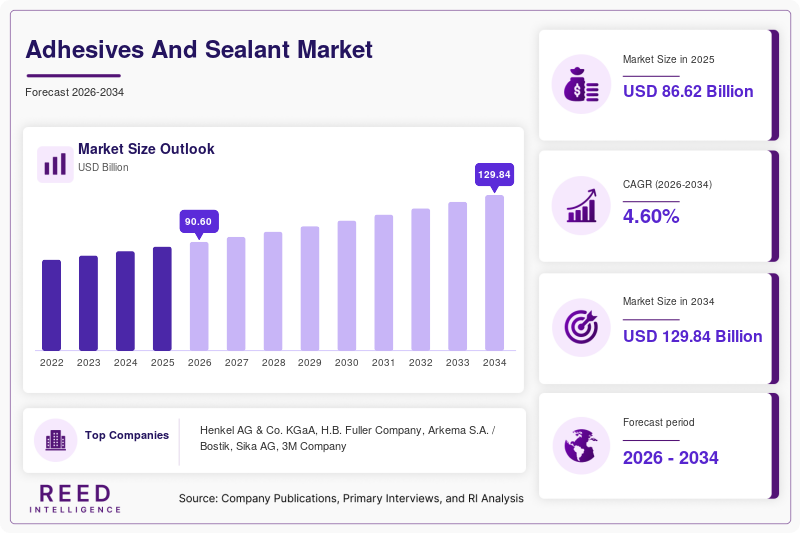
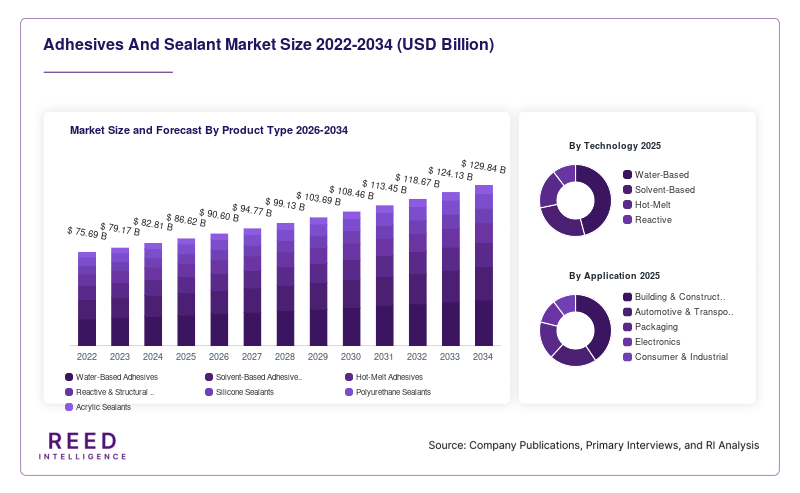
The global adhesives and sealants market was valued at USD 86.62 billion in 2025 and is projected to grow from USD 90.55 billion in 2026 to USD 130.06 billion by 2034, registering a CAGR of 4.60% during the forecast period from 2026 to 2034.
The adhesives and sealants market is supported by their increasing use as joining, bonding, sealing, waterproofing, insulation and assembly materials across construction, transportation, packaging, electronics, consumer products and industrial manufacturing. Unlike mechanical fastening systems, adhesives can join dissimilar materials while reducing visible fasteners and, in selected applications, supporting lighter product designs.
Demand is increasingly differentiated by application requirements. Henkel's Adhesive Technologies portfolio spans mobility and electronics, packaging and consumer goods, and craftsmen, construction and professional applications, while Arkema identifies construction, transportation, automotive, packaging, hygiene and industrial assembly among its principal adhesive markets.
Adhesives and Sealants Market Drivers
Electrification and Lightweight Vehicle Design Increase Demand for Engineered Bonding Solutions
Vehicle manufacturers increasingly use adhesives and sealants in battery systems, lightweight structures, interiors, electronics and assembly operations. Henkel identifies electrification and connectivity as major trends affecting its Mobility & Electronics adhesives business, while Arkema's Bostik portfolio includes adhesives specifically developed for lithium-ion battery assembly, including cell-to-module, pack assembly and battery-system encapsulation. The market mechanism is a shift from conventional fastening toward materials and assembly processes requiring controlled bonding, thermal management, sealing and vibration resistance. This particularly benefits reactive, structural and thermally functional formulations. Counterbalancing factors include qualification requirements, automotive production cycles and the need to demonstrate long-term durability under demanding operating conditions.
Packaging Demand Supports Adhesive Consumption Across Flexible and Rigid Formats
Adhesives are embedded in packaging production through lamination, labeling, carton conversion and other joining processes. Arkema's Bostik business supplies adhesives for flexible packaging and lamination and describes solutions addressing both sustainability and cost requirements. The commercial mechanism is the continued need to bond multiple substrates while maintaining package integrity, printability and production speed. Flexible packaging is particularly relevant because multilayer structures require reliable adhesion between films, paper, foils and other materials. The market is simultaneously moving toward lower-emission and more recyclable packaging systems, creating demand for reformulated adhesives. However, packaging producers remain sensitive to material costs and processing efficiency.
Construction and Infrastructure Maintenance Sustain Sealant Demand
Sealants are required where structures need protection against moisture, air leakage, movement and environmental exposure. Arkema identifies waterproofing, sealing, insulation, façade systems, roofing, windows, doors and industrial flooring among Bostik's construction applications. Aging infrastructure also creates replacement and maintenance demand. Henkel's 2024 acquisition of Seal for Life expanded its protective coating and sealing portfolio for infrastructure markets including renewable energy, oil and gas and water systems. The mechanism is therefore broader than new construction: maintenance, retrofit and asset-life extension generate recurring requirements for sealing and protective products. Construction cycles and project financing remain important constraints.
Adhesives and Sealants Market Restraints
Raw-Material Exposure Creates Cost and Margin Pressure
Adhesive and sealant formulations depend on polymers, resins, solvents, additives, silicones and other chemical inputs. Changes in input costs can affect formulation economics and create pressure on manufacturers and downstream customers. The effect is particularly important for commodity-oriented products where customers have limited tolerance for price increases. Producers can mitigate some pressure through reformulation, procurement strategies and higher-value products, but qualification requirements can make rapid formulation changes difficult in automotive, aerospace, electronics and other regulated applications. The result is a market in which technological differentiation and application-specific formulations can provide greater pricing resilience than standardized products.
Environmental and Product-Compliance Requirements Increase Formulation Complexity
Environmental regulation is encouraging manufacturers to reduce emissions and develop formulations with improved sustainability characteristics. The EU Construction Products Regulation has introduced a revised framework that addresses environmental sustainability and digital transition, while construction adhesives and sealants fall within identified product areas. Henkel's 2026 proposed acquisition of ATP Adhesive Systems also highlights the commercial relevance of water-based, lower-VOC bonding technologies, with Henkel stating that more than 90% of ATP's portfolio uses water-based technologies. Compliance can increase R&D, testing and certification requirements and can slow adoption where customers need to requalify alternative formulations.
Adhesives and Sealants Market Opportunities
Water-Based and Lower-Emission Formulations Create a Product-Upgrade Opportunity
Customers in packaging, construction, automotive and industrial applications increasingly need formulations that combine performance with lower environmental impact. Henkel's proposed acquisition of ATP Adhesive Systems in 2026 illustrates this shift: ATP specializes in high-performance water-based specialty tapes used across automotive, electronics, medical, construction and graphics applications. The opportunity extends beyond tapes to water-based adhesives and sealants that can satisfy performance requirements while reducing solvent-related emissions. Adoption depends on achieving comparable bond strength, curing speed, durability and processing efficiency. Where these requirements are met, reformulation can create premium product opportunities rather than relying solely on volume expansion.
Battery, Electronics and Thermal-Management Applications Support Higher-Value Adhesives
Electrification creates bonding requirements that differ from conventional vehicle assembly. Battery packs and electronic systems require solutions capable of bonding, sealing, insulating and sometimes managing thermal conditions. Arkema's Bostik portfolio already includes adhesives for lithium-ion battery assembly and battery-system encapsulation. Henkel similarly identifies semiconductors, automobiles and industrial goods within its Mobility & Electronics technology focus. The commercial opportunity lies in specialized formulations that become integrated into manufacturing processes and therefore face higher qualification and switching barriers. The principal limitation is the technical and validation burden required before an adhesive can be adopted in safety-critical applications.
Product Type Analysis
By Product Type
Water-Based Adhesives accounted for approximately 28% of the global market in 2025. Their broad application base includes packaging, paper converting, woodworking, construction, labels, textiles and consumer products. Their market position is supported by the ability to formulate products with comparatively low solvent content while maintaining suitability for high-volume manufacturing processes. The category also benefits from customers seeking lower-emission alternatives. Henkel's 2026 ATP transaction illustrates the direction of product development toward water-based specialty bonding technologies across automotive, electronics, medical, construction and graphics applications. However, drying requirements, substrate compatibility and performance limitations in particular high-temperature or moisture-sensitive applications can favor reactive or solvent-based technologies.
Reactive & Structural Adhesives accounted for approximately 18% of the market in 2025 and are projected to expand at about 6.3% CAGR through 2034. These products are increasingly relevant to applications requiring high bond strength, durability and resistance to demanding operating environments. Automotive electrification, electronics, industrial assembly and transportation provide particularly relevant applications. Henkel and Arkema both identify automotive, electronics, transportation and battery applications within their advanced adhesive portfolios. Their growth is supported by the replacement of mechanical fastening in selected assemblies and by the use of lightweight or dissimilar materials. Qualification costs, curing requirements and higher formulation prices can limit adoption.
Other product-type growth: Solvent-Based Adhesives are projected to grow at approximately 3.7% CAGR, Hot-Melt Adhesives at 5.1%, Silicone Sealants at 4.8%, Polyurethane Sealants at 5.0%, and Acrylic Sealants at approximately 4.4% through 2034.
Technology Analysis
By Technology
Water-Based Technology accounted for approximately 31% of the market in 2025. Its position reflects broad use in packaging, paper conversion, construction and consumer-product manufacturing, combined with demand for formulations that can reduce reliance on solvent-heavy systems. The technology is also gaining strategic attention from major suppliers. Henkel's proposed ATP acquisition is centered on high-performance water-based specialty tapes, with the company linking the technology to lower-VOC and sustainability requirements.
Reactive Technology accounted for approximately 24% of the market in 2025 and is projected to grow at about 6.2% CAGR through 2034. Its expansion is tied to structural bonding, electronics, automotive, battery assembly and industrial applications where high performance and long-term durability justify more specialized formulations. Arkema identifies engineering adhesives and battery-related bonding among its technology applications.
Other technology growth: Hot-Melt Technology is projected to grow at approximately 5.2% CAGR, while Solvent-Based Technology is projected to grow at approximately 3.7% CAGR through 2034.
Application Analysis
By Application
Building & Construction accounted for approximately 29% of the global market in 2025. Construction adhesives and sealants are used across flooring, roofing, façade systems, windows, doors, waterproofing, insulation and other building applications. Arkema identifies these applications across its Bostik construction portfolio. Regulatory requirements are also reinforcing the importance of product performance documentation and environmental characteristics. The revised EU Construction Products Regulation became largely applicable in January 2026 and specifically covers construction adhesives and joint sealants within its product framework. Construction cycles and interest-rate-sensitive building activity remain the principal demand constraint.
Automotive & Transportation accounted for approximately 23% of the market in 2025 and is projected to grow at about 6.1% CAGR through 2034. Adhesive consumption is increasing in applications involving lightweight structures, vehicle interiors, electronic components, battery systems and sealing. Henkel links its Mobility & Electronics portfolio to electrification, connectivity and autonomous-driving trends, while Arkema offers bonding solutions for automotive and lithium-ion battery applications. Higher qualification requirements can create strong customer retention once products are approved, but automotive production cycles and stringent performance testing can lengthen adoption timelines.
Other application growth: Packaging is projected to grow at approximately 4.9% CAGR, Electronics at 5.8%, and Consumer & Industrial at approximately 4.1% through 2034.
Distribution Channel Analysis
By Distribution Channel
Direct Sales accounted for approximately 51% of the market in 2025. Industrial customers frequently purchase adhesives and sealants according to technical specifications, production requirements and application conditions. Direct relationships therefore allow manufacturers to provide formulation support, application engineering, testing and customized products. H.B. Fuller, for example, states that it provides technical support and customized solutions across industrial and construction applications.
Online Channels accounted for approximately 9% of the market in 2025 and are projected to grow at about 8.0% CAGR through 2034. Digital purchasing is particularly relevant to smaller contractors, maintenance professionals, DIY users and low-volume industrial buyers seeking standardized adhesives and sealants. Online channels improve product comparison and availability but are less suitable for complex formulations requiring technical consultation, site testing or application engineering.
Other distribution-channel growth: Distributors are projected to grow at approximately 4.4% CAGR, while Specialty Stores are projected to grow at approximately 3.9% CAGR through 2034.
Adhesives and Sealants Market Regional Analysis
Asia-Pacific Represents the Largest and Fastest-Growing Regional Market
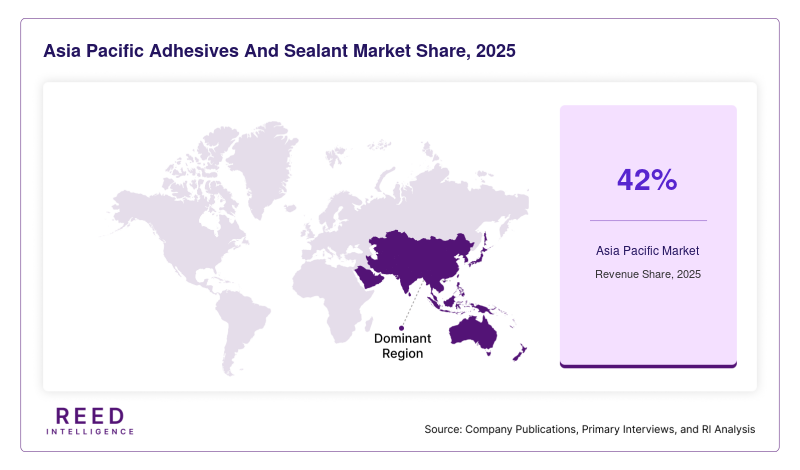
Asia-Pacific accounted for approximately 42% of the global market in 2025 and is projected to grow at about 5.5% CAGR through 2034. The region's position is supported by its large manufacturing base across electronics, automotive, packaging, consumer goods and construction. Adhesive suppliers increasingly serve these industries through localized production and technical support. H.B. Fuller operates across Asia Pacific as part of a global sales network spanning 34 countries, while Arkema's adhesive business also maintains a substantial Asian presence. China, Japan, South Korea and India provide major demand centers through electronics, automotive production, infrastructure and consumer-goods manufacturing. The principal growth mechanism is industrial production combined with increasing use of specialized bonding solutions. Raw-material volatility, construction cycles and competition from local producers can constrain expansion.
North America Maintains a Major Market Through Industrial, Construction and Packaging Demand
North America accounted for approximately 25% of the market in 2025 and is projected to grow at about 4.3% CAGR through 2034. The region benefits from established automotive, aerospace, electronics, packaging, construction and maintenance industries. H.B. Fuller operates across North America and supplies adhesives and sealants for packaging, construction, transportation, medical, electronics and other applications. Henkel's proposed acquisition of ATP also strengthens its access to North American specialty tape markets serving automotive, electronics, medical and construction customers. Mature industrial customers provide opportunities for high-value specialized products, while cyclical construction and manufacturing activity can moderate volume growth.
Europe Develops Through Sustainable Formulations and High-Specification Industrial Applications
Europe accounted for approximately 21% of the market in 2025 and is projected to grow at about 3.8% CAGR through 2034. The region has a mature industrial and construction customer base and increasingly emphasizes environmental performance, product documentation and regulatory compliance. The EU Construction Products Regulation entered into force in January 2025 and became largely applicable from January 2026, creating a revised regulatory framework that includes construction adhesives and sealants. Arkema's Adhesive Solutions business generated 43% of its 2025 sales in Europe, demonstrating the importance of the region within a major global supplier's adhesive operations. Regulatory compliance can increase development costs but can also support demand for differentiated low-emission and sustainable formulations.
Latin America Expands Through Construction, Packaging and Industrial Manufacturing
Latin America accounted for approximately 7% of the market in 2025 and is projected to grow at about 4.0% CAGR through 2034. Construction, packaging, consumer goods and automotive production provide the main demand bases. Adhesive consumption benefits when manufacturers substitute bonding for mechanical fastening or require materials for flexible packaging and product assembly. Brazil and Mexico represent important industrial and construction markets, while the region also serves as a manufacturing base connected to North American supply chains. Currency fluctuations, construction investment cycles and raw-material costs can affect purchasing decisions and limit the pace of adoption for higher-priced specialized formulations.
Middle East & Africa Represents a Smaller Market with Infrastructure and Construction as Key Demand Channels
Middle East & Africa accounted for approximately 5% of the market in 2025 and is projected to grow at about 4.2% CAGR through 2034. Construction, infrastructure, industrial maintenance and energy-related applications form important demand pools. Henkel's 2025 acquisition of South African MRO supplier Nordbak strengthened its position in mining, infrastructure and industrial applications in an emerging market. Infrastructure maintenance can create recurring demand for protective coatings and sealants even when new construction activity fluctuates. However, differences in infrastructure investment, imported raw-material dependence and uneven industrial development constrain the regional market.
Adhesives and Sealants Market Competitive Landscape
The market is characterized by a mix of large multinational suppliers, specialized adhesive manufacturers and regional formulators. Competition is based on formulation performance, application engineering, technical support, manufacturing footprint, regulatory compliance, sustainability characteristics, customer qualification and distribution reach.
The largest suppliers increasingly compete through portfolio breadth rather than a single adhesive chemistry. Henkel operates Adhesive Technologies across mobility and electronics, packaging and consumer goods, and craftsmen, construction and professional applications. H.B. Fuller operates across hygiene, health and consumable adhesives, engineering adhesives and building adhesive solutions, serving packaging, medical, construction, transportation, electronics and other industries.
Key Market Players
- Henkel AG & Co. KGaA
- H.B. Fuller Company
- Arkema S.A. / Bostik
- Sika AG
- 3M Company
- Dow Inc.
- RPM International Inc.
- Illinois Tool Works Inc.
- Avery Dennison Corporation
- Pidilite Industries Limited
Adhesives and Sealants Market Recent Developments
- January 2026 — Henkel announced an agreement to acquire Swiss-based ATP Adhesive Systems, a specialist in high-performance water-based specialty tapes. ATP serves automotive, electronics, medical, building and construction, and graphics applications, and Henkel stated that more than 90% of the portfolio uses water-based technologies. The transaction would broaden Henkel's bonding portfolio beyond liquid adhesives and strengthen its position in lower-VOC, water-based technologies.
- February 2026 — Henkel announced an agreement to acquire Dutch specialty-coatings company Stahl for €2.1 billion. Stahl supplies high-performance coatings for flexible materials used in automotive, fashion and lifestyle, and packaging applications. The development expands Henkel's adjacent coatings capabilities and creates additional cross-selling potential across customers already served by its Adhesive Technologies business.
Adhesives And Sealant Market Segments
By Product Type
- Water-Based Adhesives
- Solvent-Based Adhesives
- Hot-Melt Adhesives
- Reactive & Structural Adhesives
- Silicone Sealants
- Polyurethane Sealants
- Acrylic Sealants
By Technology
- Water-Based
- Solvent-Based
- Hot-Melt
- Reactive
By Application
- Building & Construction
- Automotive & Transportation
- Packaging
- Electronics
- Consumer & Industrial
By Distribution Channel
- Direct Sales
- Distributors
- Specialty Stores
- Online Channels
By Region
- North America
- Europe
- APAC
- Middle East and Africa
- LATAM