Aircraft Engineering Services (AES) Market Size, Share & Trends Analysis Report By Service Type (Design & Engineering, Certification & Compliance, Modification & Upgradation, Testing & Validation and Technical Support), By Aircraft Type (Commercial Aircraft, Military Aircraft, Business & General Aviation and Helicopters), By Application (Airframe, Propulsion, Avionics, Cabin Systems and Others), By End User (OEMs, Airlines, MRO Providers and Defense Organizations) and By Region (North America, E
USD 3950
Aircraft Engineering Services (AES) Market Size
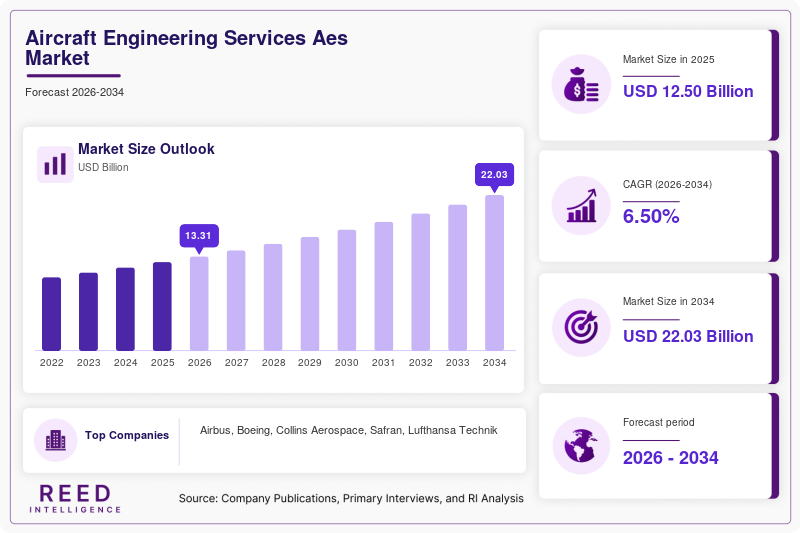
The global aircraft engineering services (AES) market was valued at USD 12.50 billion in 2025 and is projected to grow from USD 13.31 billion in 2026 to USD 20.30 billion by 2034, registering a CAGR of 6.50% during the forecast period from 2026 to 2034.
Aircraft Engineering Services (AES) comprise specialized engineering activities supporting the design, development, certification, modification, testing, maintenance and modernization of aircraft and aircraft systems. These services cover airframe engineering, propulsion, avionics, electrical systems, cabin interiors, structural analysis, configuration management and regulatory compliance.
The market is benefiting from the increasing complexity of modern aircraft, expansion of commercial and military fleets, aircraft modification programs and growing demand for engineering support throughout the aircraft lifecycle.
Aircraft Engineering Services (AES) Market Drivers
Increasing Aircraft Fleet Size
The expansion of the global commercial aircraft fleet is generating long-term demand for engineering services.
Aircraft require engineering support throughout their operational lifecycle, including structural assessment, modifications, repairs, avionics upgrades, cabin reconfiguration and certification activities.
Fleet expansion therefore creates opportunities for both original-equipment engineering and aftermarket engineering-service providers.
Increasing Aircraft Modernization
Airlines and aircraft operators are increasingly modernizing existing aircraft rather than relying solely on new aircraft acquisitions.
Engineering services are required for cabin upgrades, avionics modernization, connectivity installation, structural modifications, fuel-efficiency improvements and regulatory compliance.
The continued operation of older aircraft also increases demand for structural analysis and engineering support.
Growing Aircraft System Complexity
Modern aircraft incorporate sophisticated avionics, sensors, communication systems, flight-control technologies and electrical architectures.
The increasing integration of these systems requires multidisciplinary engineering capabilities covering mechanical, electrical, software and systems engineering.
This complexity is supporting demand for specialized AES providers.
Expansion of Aircraft Modification Programs
Aircraft modification represents an important source of demand for engineering services.
Operators increasingly require aircraft to be modified for new missions, passenger configurations, cargo operations, connectivity systems and specialized equipment.
Each modification generally requires engineering assessment, design, testing and certification support.
Aircraft Engineering Services (AES) Market Restraints
High Certification and Compliance Requirements
Aircraft engineering activities must comply with stringent aviation safety and certification requirements.
Engineering organizations need qualified personnel, documented processes and specialized capabilities to satisfy regulatory requirements.
These compliance obligations can increase project costs and development timelines.
Shortage of Specialized Aerospace Engineers
The aerospace sector requires engineers with specialized knowledge in aerodynamics, structures, propulsion, avionics, software, materials and certification.
Competition for experienced engineering talent can increase labor costs and constrain the ability of service providers to scale projects quickly.
Long Aircraft Development Cycles
Aircraft development programs can extend over several years.
Engineering service providers supporting major aircraft programs may therefore face lengthy project cycles and significant resource commitments before commercial returns are realized.
Aircraft Engineering Services (AES) Market Opportunities
Digital Engineering Creates New Opportunities
Digital engineering is transforming aircraft development and lifecycle management.
Model-based systems engineering, simulation, digital twins and cloud-based collaboration allow engineering teams to evaluate aircraft designs and system performance before physical implementation.
These technologies can increase engineering efficiency and create new service opportunities for specialized providers.
Aircraft Electrification Drives Engineering Demand
The development of more-electric aircraft is increasing engineering requirements for electrical power generation, distribution, thermal management and system integration.
Hybrid-electric and other emerging propulsion technologies may further increase demand for specialized engineering expertise.
Growing MRO Engineering Requirements
The expanding commercial aircraft fleet is increasing the need for engineering support within maintenance, repair and overhaul operations.
Engineering organizations provide structural analysis, repair design, modifications, reliability assessments and certification documentation for aircraft undergoing maintenance.
Defense Aircraft Modernization
Military aircraft modernization programs create demand for engineering services covering avionics upgrades, mission-system integration, structural modifications, weapons-system integration and lifecycle support.
Defense programs can provide long-duration engineering opportunities due to the extended operational lives of military platforms.
Service Type Segment Analysis
Design & Engineering Holds the Largest Share
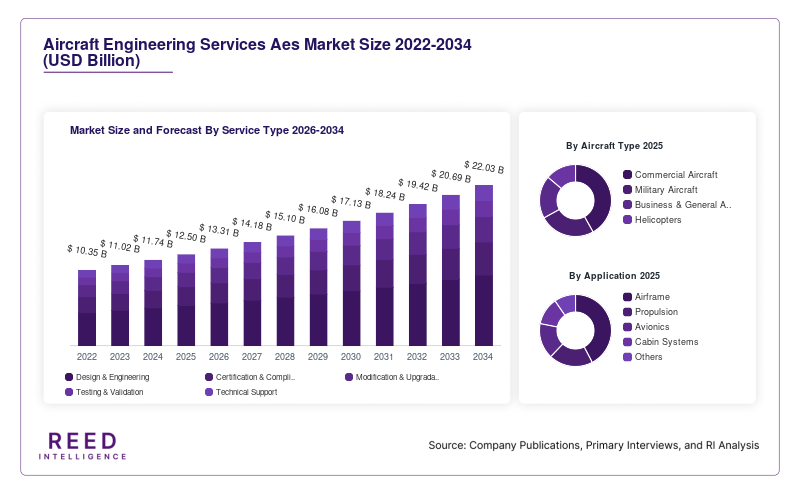
Design & engineering accounted for approximately 34% of the Aircraft Engineering Services Market in 2025, making it the largest service segment. Aircraft manufacturers and system suppliers require engineering expertise for airframe design, component development, system integration and aircraft performance optimization.
The increasing complexity of aircraft platforms continues to support demand for multidisciplinary engineering services.
Modification & upgradation accounted for approximately 24% and is projected to grow at approximately 7.4% CAGR, making it the fastest-growing major service segment. Fleet modernization, cabin reconfiguration, connectivity installation and avionics upgrades are increasing demand for modification engineering.
Certification & compliance represented approximately 18%, testing & validation 14%, and technical support approximately 10%.
Aircraft Type Segment Analysis
Commercial Aircraft Hold the Largest Share
Commercial aircraft accounted for approximately 56% of the market in 2025, making them the largest aircraft-type segment. The large global commercial fleet generates engineering requirements throughout the aircraft lifecycle, from development and certification to modifications and operational support.
Fleet expansion and aircraft modernization continue to support demand from airlines, OEMs and MRO providers.
Military aircraft accounted for approximately 23% and are projected to grow at approximately 7.2% CAGR, making them the fastest-growing major aircraft-type segment. Defense modernization programs and the integration of advanced mission systems are creating additional engineering requirements.
Business & general aviation represented approximately 13%, while helicopters accounted for approximately 8%.
Application Segment Analysis
Airframe Holds the Largest Share
Airframe engineering accounted for approximately 31% of the market in 2025, making it the largest application segment. Airframe engineering includes structural design, analysis, repair engineering, fatigue assessment and aircraft modification support.
The continued operation of aging aircraft fleets creates recurring requirements for structural engineering and repair solutions.
Avionics accounted for approximately 25% and is projected to grow at approximately 7.8% CAGR, making it the fastest-growing major application segment. Increasing avionics integration, connectivity, navigation, communications and flight-management technologies are driving engineering demand.
Propulsion represented approximately 21%, cabin systems 14%, and other applications approximately 9%.
End-User Segment Analysis
OEMs Hold the Largest Share
OEMs accounted for approximately 39% of the market in 2025, making them the largest end-user segment. Aircraft manufacturers rely on engineering services for aircraft development, system integration, certification and production support.
MRO providers accounted for approximately 22% and are projected to grow at approximately 7.6% CAGR, making them the fastest-growing major end-user segment. Increasing aircraft utilization, fleet aging and maintenance complexity are increasing engineering requirements within MRO operations.
Airlines represented approximately 21%, while defense organizations accounted for approximately 18%.
Aircraft Engineering Services (AES) Market Regional Analysis
North America Holds the Largest Share
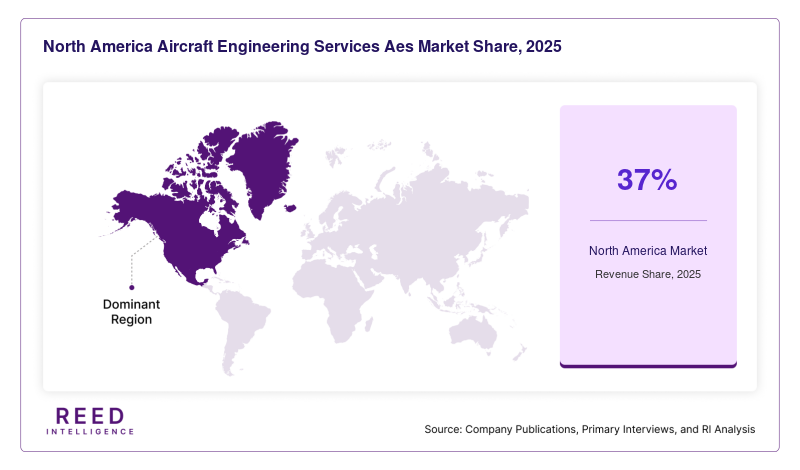
North America accounted for approximately 37% of the global Aircraft Engineering Services Market in 2025, making it the largest regional market. The region benefits from a large aerospace manufacturing base, extensive commercial and military aircraft fleets, major MRO operations and a mature aerospace engineering ecosystem.
The United States represents a major center for aircraft development, defense programs, aircraft modifications and engineering services.
Asia-Pacific accounted for approximately 25% and is projected to grow at approximately 8.0% CAGR, making it the fastest-growing major region. Rapid commercial aviation expansion, fleet modernization, increasing aerospace manufacturing capabilities and defense investments are supporting regional demand.
Europe Maintains a Strong Aerospace Engineering Ecosystem
Europe accounted for approximately 29% of the market in 2025 and is projected to grow at approximately 5.9% CAGR.
The region has an established aerospace manufacturing ecosystem and significant engineering capabilities spanning commercial aviation, defense, helicopters and business aviation.
The development of more-electric aircraft and sustainable aviation technologies is also creating specialized engineering requirements.
Asia-Pacific Is the Fastest-Growing Region
Asia-Pacific is projected to grow at approximately 8.0% CAGR through 2034. Increasing air travel is driving aircraft fleet expansion, while governments and aerospace companies are developing domestic aircraft manufacturing and MRO capabilities.
China, India, Japan, South Korea and other regional markets are investing in aerospace engineering capabilities, supporting demand for both local and international service providers.
Latin America Shows Steady Expansion
Latin America accounted for approximately 5% of the market in 2025 and is projected to grow at approximately 5.4% CAGR.
Commercial fleet modernization, MRO expansion and aircraft modification activities are supporting demand for engineering services.
Middle East & Africa Represents an Emerging Market
Middle East & Africa accounted for approximately 4% of the market in 2025 and is projected to grow at approximately 6.3% CAGR.
Airline fleet expansion, defense aviation investment and the development of regional MRO infrastructure are creating opportunities for aircraft engineering service providers.
Aircraft Engineering Services (AES) Market Competitive Landscape
Competition in the Aircraft Engineering Services Market is based on technical expertise, certification capabilities, engineering workforce, digital engineering capabilities, aircraft-platform experience, project execution, turnaround time and global service coverage.
Leading companies are investing in digital engineering, model-based systems engineering, simulation, artificial intelligence and digital-twin technologies to improve engineering productivity.
Key Market Players
- Airbus
- Boeing
- Collins Aerospace
- Safran
- Lufthansa Technik
- ST Engineering
- Tata Advanced Systems
- Cyient
- Infosys
- HCLTech
Aircraft Engineering Services (AES) Market Recent Developments
- Airbus continues to invest in digital design, simulation and model-based engineering technologies to improve aircraft development and lifecycle management. The increasing use of digital engineering is enabling manufacturers and suppliers to manage complex aircraft systems more efficiently.
- Boeing continues to develop digital engineering capabilities across aircraft design, manufacturing and lifecycle support. Digital tools and simulation are increasingly being integrated into aircraft development processes to improve engineering collaboration and product-development efficiency.
Aircraft Engineering Services Aes Market Segments
By Service Type
- Design & Engineering
- Certification & Compliance
- Modification & Upgradation
- Testing & Validation
- Technical Support
By Aircraft Type
- Commercial Aircraft
- Military Aircraft
- Business & General Aviation
- Helicopters
By Application
- Airframe
- Propulsion
- Avionics
- Cabin Systems
- Others
By End User
- OEMs
- Airlines
- MRO Providers
- Defense Organizations
By Region
- North America
- Europe
- APAC
- Middle East and Africa
- LATAM