Aircraft Tractor Market Size, Share & Trends Analysis Report By Type (Conventional Towbar Tractors, Towbarless Tractors and Electric Aircraft Tractors), By Aircraft Type (Commercial Aircraft, Military Aircraft, Business & General Aviation and Helicopters), By Propulsion (Diesel, Electric and Hybrid), By Towing Capacity (Up to 50 Tons, 50–150 Tons and Above 150 Tons), By Application (Aircraft Towing, Pushback Operations, Hangar Operations and Maintenance Operations) and By Region (North America,
USD 3950
Aircraft Tractor Market Size
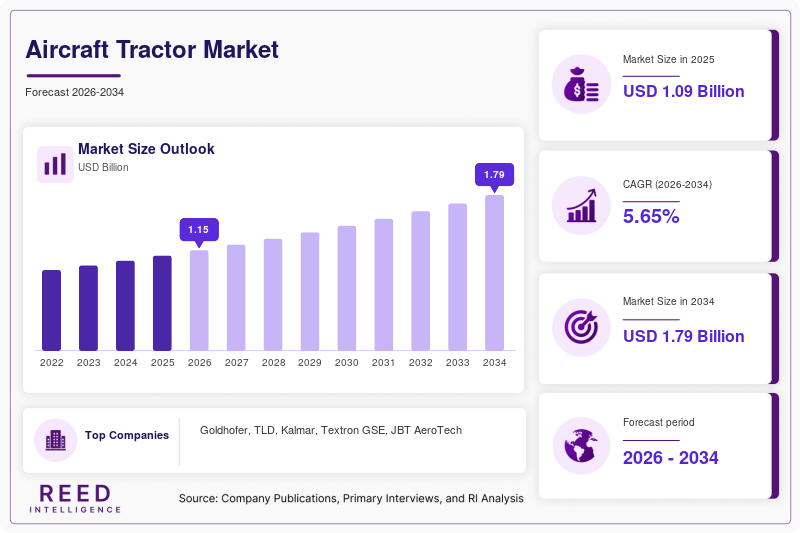
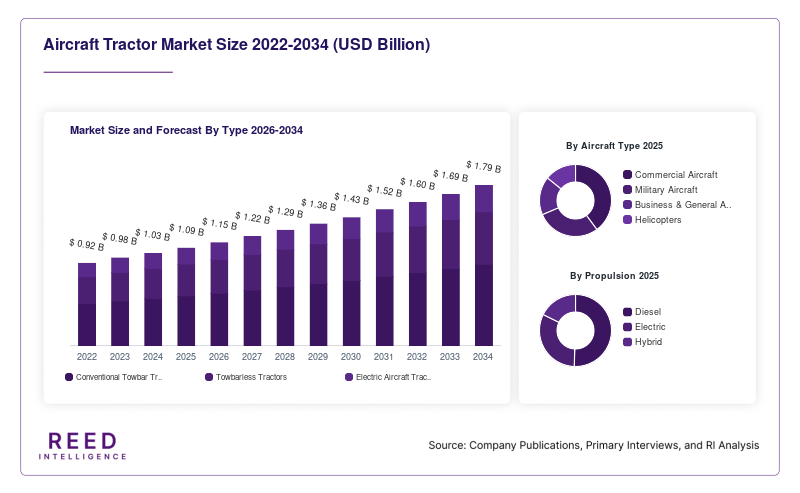
The global aircraft tractor market was valued at USD 1.09 billion in 2025 and is projected to grow from USD 1.15 billion in 2026 to USD 1.79 billion by 2034, registering a CAGR of 5.65% during the forecast period from 2026 to 2034.
Aircraft tractors, also known as aircraft tugs or tow tractors, are specialized ground-support vehicles used to move aircraft between gates, taxiways, maintenance facilities, hangars and parking areas. They are essential components of airport ground-support equipment because aircraft generally cannot be moved safely and efficiently on the ground using their own propulsion systems for every maneuver.
The market is supported by the expansion of commercial aviation, increasing aircraft movements, airport infrastructure development and the modernization of ground-support fleets. Airports and ground-handling companies are also increasingly replacing conventional diesel-powered equipment with electric and hybrid alternatives to reduce emissions, noise and operating costs.
Aircraft Tractor Market Drivers
Increasing Global Air Traffic
Growth in passenger air travel increases aircraft movements at airports and consequently raises demand for ground-support equipment.
Every aircraft movement requires ground-handling activities, including pushback, repositioning, parking and maintenance movements.
The expansion of airline fleets and airport capacity therefore supports long-term demand for aircraft tractors.
Airport Infrastructure Expansion
New airports, terminal expansions and additional aircraft stands require larger ground-support equipment fleets.
Emerging aviation markets are investing in airport infrastructure to accommodate increasing passenger volumes and aircraft movements.
These investments create opportunities for aircraft-tractor manufacturers and ground-support-equipment providers.
Electrification of Ground Support Equipment
Airports are increasingly introducing electric ground-support vehicles as part of efforts to reduce emissions and improve environmental performance.
Electric aircraft tractors can provide lower local emissions and reduced noise compared with conventional diesel-powered equipment.
The development of higher-capacity batteries and faster charging infrastructure is supporting the adoption of electric tractors.
Increasing Aircraft Size
Modern wide-body and large narrow-body aircraft can require substantial towing capacity.
The introduction and continued operation of larger aircraft are increasing demand for tractors capable of handling greater aircraft weights while maintaining safe and precise maneuverability.
Aircraft Tractor Market Restraints
High Initial Cost of Electric Tractors
Electric aircraft tractors generally require greater upfront investment than conventional diesel equipment.
Battery systems, charging infrastructure and specialized electrical components can increase acquisition costs, particularly for smaller airports and ground-handling operators.
High Maintenance Requirements for Conventional Equipment
Diesel-powered tractors require regular maintenance of engines, transmissions and other mechanical systems.
Although electric tractors can reduce certain maintenance requirements, operators with mixed fleets may need to maintain multiple technologies simultaneously.
Airport-Specific Operating Requirements
Aircraft tractors must meet specific requirements based on aircraft types, apron layouts, towing distances and operational procedures.
Different aircraft categories may require different towing capacities and tractor configurations, increasing fleet-management complexity.
Aircraft Tractor Market Opportunities
Electric Aircraft Tractors Create Significant Opportunities
The transition toward low-emission airport ground operations is creating opportunities for electric aircraft tractor manufacturers.
Airports are increasingly setting environmental targets that encourage ground handlers to adopt battery-electric equipment.
Manufacturers that provide high-capacity electric tractors with rapid charging and long operating cycles can address these requirements.
Autonomous Ground Support Equipment
Automation and driver-assistance technologies are creating opportunities for intelligent aircraft tractors.
Advanced positioning systems, cameras, sensors and collision-avoidance technologies can improve safety and operational efficiency.
Future autonomous or semi-autonomous towing solutions could further transform aircraft ground handling.
Airport Modernization in Emerging Markets
Rapid airport development in Asia-Pacific, the Middle East and other emerging aviation markets is generating demand for new ground-support equipment.
New airport facilities can adopt modern electric and automated ground-handling fleets from the outset.
Growing Demand for Towbarless Tractors
Towbarless tractors provide greater flexibility for aircraft handling and can eliminate the need for separate towbar equipment in applicable operations.
Their maneuverability and operational efficiency make them attractive to airports and ground-handling companies managing diverse aircraft fleets.
Type Segment Analysis
Conventional Towbar Tractors Hold the Largest Share
Conventional towbar tractors accounted for approximately 43% of the global aircraft tractor market in 2025, making them the largest type segment. Their established technology, broad aircraft compatibility and extensive installed base support continued demand across airports and ground-handling operations.
Conventional tractors remain widely used because they can accommodate different aircraft through interchangeable towbar configurations.
Electric aircraft tractors accounted for approximately 27% and are projected to grow at approximately 8.4% CAGR, making them the fastest-growing major type segment. Airport decarbonization programs and the increasing availability of battery-powered ground-support equipment are accelerating electric tractor adoption.
Towbarless tractors represented approximately 30% of the market.
Aircraft Type Segment Analysis
Commercial Aircraft Hold the Largest Share
Commercial aircraft accounted for approximately 68% of the aircraft tractor market in 2025, making them the dominant aircraft-type segment. The large commercial aircraft fleet and high frequency of airport operations create substantial demand for pushback, towing and repositioning equipment.
Airline fleet expansion and increasing airport traffic continue to support this segment.
Military aircraft accounted for approximately 16% and are projected to grow at approximately 6.4% CAGR, making them the fastest-growing major aircraft-type segment. Defense-airport modernization and increasing requirements for specialized ground-support equipment are supporting demand.
Business & general aviation represented approximately 11%, while helicopters accounted for approximately 5%.
Propulsion Segment Analysis
Diesel Aircraft Tractors Hold the Largest Share
Diesel-powered tractors accounted for approximately 56% of the market in 2025, reflecting their established installed base, high operating range and ability to support demanding towing applications.
Diesel tractors remain important at airports where extensive towing capacity and continuous operation are required.
Electric tractors accounted for approximately 29% and are projected to grow at approximately 9.1% CAGR, making them the fastest-growing propulsion segment. Environmental targets, lower local emissions and advances in battery technology are supporting adoption.
Hybrid tractors represented approximately 15%.
Towing Capacity Segment Analysis
50–150 Tons Holds the Largest Share
Aircraft tractors with a towing capacity of 50–150 tons accounted for approximately 46% of the market in 2025, making this the largest capacity segment. This range provides flexibility for many narrow-body and medium-sized aircraft operations.
Above 150 tons accounted for approximately 27% and is projected to grow at approximately 6.5% CAGR, making it the fastest-growing major capacity segment. Increasing use of large aircraft and the need to handle heavy wide-body platforms are supporting demand for high-capacity tractors.
Up to 50 tons represented approximately 27%.
Application Segment Analysis
Pushback Operations Hold the Largest Share
Pushback operations accounted for approximately 38% of the market in 2025, making them the largest application segment. Aircraft tractors are routinely required to move aircraft from gates before engine start and departure.
Aircraft towing accounted for approximately 32% and is projected to grow at approximately 6.2% CAGR, making it the fastest-growing major application segment. Increasing aircraft movements and airport maintenance requirements are supporting demand for towing equipment.
Hangar operations represented approximately 18%, while maintenance operations accounted for approximately 12%.
Aircraft Tractor Market Regional Analysis
North America Holds the Largest Share
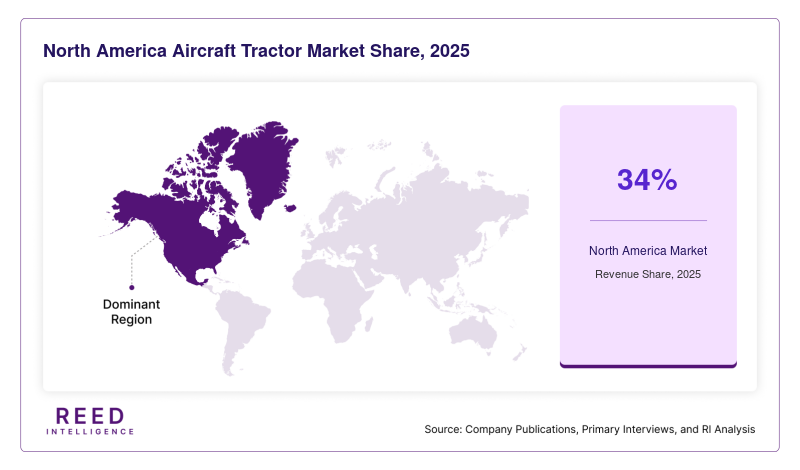
North America accounted for approximately 34% of the global aircraft tractor market in 2025, making it the largest regional market. The region has a large commercial aircraft fleet, extensive airport infrastructure and a mature ground-support-equipment industry.
Airports and ground handlers are increasingly upgrading equipment fleets, including transitioning toward electric ground-support vehicles.
Asia-Pacific accounted for approximately 29% and is projected to grow at approximately 7.1% CAGR, making it the fastest-growing major region. Rising passenger traffic, airport construction, airline fleet expansion and ground-support-equipment modernization are driving demand.
Europe Maintains Strong Demand for Advanced Ground Equipment
Europe accounted for approximately 27% of the market in 2025 and is projected to grow at approximately 5.0% CAGR.
European airports are increasingly focused on reducing ground-operation emissions, supporting demand for electric aircraft tractors and other low-emission equipment.
Airport modernization and replacement of aging ground-support fleets are additional market drivers.
Asia-Pacific Is the Fastest-Growing Region
Asia-Pacific is projected to grow at approximately 7.1% CAGR through 2034. Rapid expansion of air travel and airport infrastructure is creating new demand for ground-handling equipment.
China, India, Southeast Asia and other regional markets are expanding airport capacity and modernizing ground operations.
The region also provides significant opportunities for electric ground-support-equipment deployment.
Latin America Shows Steady Growth
Latin America accounted for approximately 6% of the market in 2025 and is projected to grow at approximately 4.7% CAGR.
Airport modernization, increasing passenger traffic and airline fleet expansion are supporting demand for aircraft towing equipment.
Middle East & Africa Represents an Emerging Opportunity
Middle East & Africa accounted for approximately 4% of the market in 2025 and is projected to grow at approximately 6.0% CAGR.
Large airport-development programs, airline fleet expansion and increasing investments in airport ground infrastructure are supporting demand for aircraft tractors.
Aircraft Tractor Market Competitive Landscape
Competition in the aircraft tractor market is based on towing capacity, aircraft compatibility, maneuverability, reliability, energy efficiency, battery performance, operator safety, after-sales support and total operating cost.
Manufacturers are increasingly investing in electric drivetrains, autonomous technologies, advanced control systems and towbarless configurations.
Key Market Players
- Goldhofer
- TLD
- Kalmar
- Textron GSE
- JBT AeroTech
- Mulag
- Mototok
- TUG Technologies
- Douglas Equipment
- Aviation GSE
Aircraft Tractor Market Recent Developments
- Goldhofer continues to expand its aircraft-towing portfolio with technologies designed for increasingly efficient and lower-emission airport ground operations. The company's development of advanced towing systems reflects growing demand for high-capacity equipment with improved maneuverability and operating efficiency.
- TLD continues to develop electric ground-support equipment as airports and ground handlers pursue lower-emission operations. Electric aircraft tractors are becoming increasingly relevant for airports seeking to reduce fuel consumption and local emissions from apron activities.
Aircraft Tractor Market Segments
By Type
- Conventional Towbar Tractors
- Towbarless Tractors
- Electric Aircraft Tractors
By Aircraft Type
- Commercial Aircraft
- Military Aircraft
- Business & General Aviation
- Helicopters
By Propulsion
- Diesel
- Electric
- Hybrid
By Towing Capacity
- Up to 50 Tons
- 50–150 Tons
- Above 150 Tons
By Application
- Aircraft Towing
- Pushback Operations
- Hangar Operations
- Maintenance Operations
By Region
- North America
- Europe
- APAC
- Middle East and Africa
- LATAM