Automobile Remanufacturing Market Size, Share & Trends Analysis Report By Component, By Vehicle Type, By Product Type, By Sales Channel, By End User and By Region, Forecasts 2026–2034
USD 3950
Automobile Remanufacturing Market Size
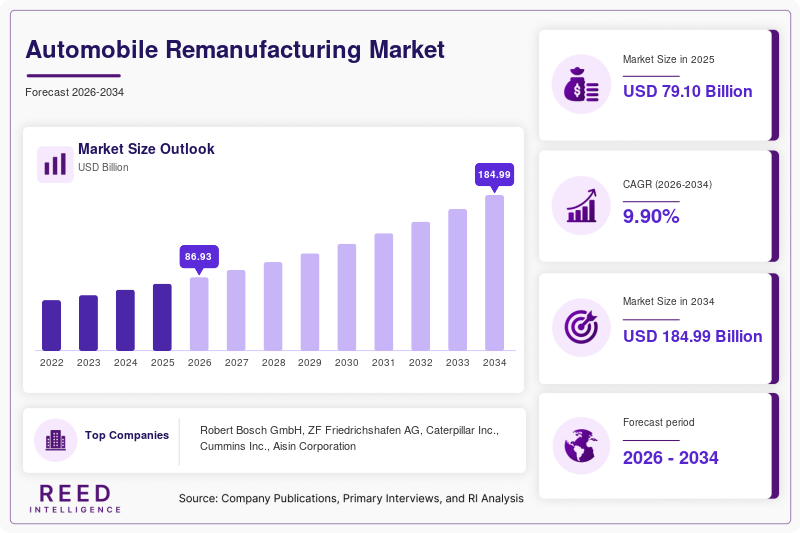
The global automobile remanufacturing market was valued at USD 79.10 billion in 2025 and is projected to grow from USD 86.93 billion in 2026 to USD 184.99 billion by 2034, registering a CAGR of 9.90% during the forecast period from 2026 to 2034.
Automobile remanufacturing involves the industrial process of restoring used automotive components to functional condition through inspection, disassembly, cleaning, machining, replacement of worn parts, reassembly and testing. Remanufactured components can include engines, transmissions, starters, alternators, turbochargers, steering systems, braking components and other automotive parts.
The market is supported by the increasing age of vehicles, demand for cost-effective replacement components, growing automotive aftermarket activity and increasing emphasis on resource efficiency. Remanufactured components can provide an alternative to new replacement parts while allowing manufacturers and specialized remanufacturers to recover value from used components.
Automobile Remanufacturing Market Drivers
Increasing Average Vehicle Age
Vehicles are remaining in operation for longer periods in many markets.
As vehicles age, demand for replacement engines, transmissions, starters, alternators and other components increases, creating opportunities for remanufactured parts.
Cost Advantages of Remanufactured Components
Remanufactured components can offer customers a lower-cost alternative to new replacement components, depending on the part and application.
Cost-conscious consumers, repair shops and fleet operators are therefore important sources of demand.
Growth of the Automotive Aftermarket
The expanding global vehicle parc is increasing demand for maintenance, repair and replacement parts.
Remanufacturing provides an established supply source for aftermarket components.
Sustainability and Resource Efficiency
Remanufacturing allows usable materials and components to be recovered instead of being discarded.
Increasing interest in resource efficiency, waste reduction and circular production models is supporting industry development.
Expansion of Commercial Vehicle Fleets
Trucks, buses and other commercial vehicles often accumulate high mileage and require regular component maintenance.
Fleet operators can use remanufactured components as part of maintenance programs designed to manage operating costs.
Automobile Remanufacturing Market Restraints
Quality Perception
Some consumers and vehicle owners may associate remanufactured components with lower quality than new parts.
Manufacturers must demonstrate reliability through testing, warranties and quality-control processes.
Core Availability
Remanufacturing depends on access to suitable used components, often referred to as cores.
Insufficient availability or inefficient collection systems can constrain production.
Technological Complexity of Modern Vehicles
Modern vehicles increasingly incorporate electronics, sensors and integrated control systems.
Remanufacturing advanced components can require specialized diagnostic equipment, software and technical expertise.
Competition from Low-Cost Replacement Parts
New aftermarket components, particularly low-cost products from independent suppliers, can compete directly with remanufactured parts.
Price competition can affect margins for remanufacturers.
Automobile Remanufacturing Market Opportunities
Expansion of Circular Automotive Systems
Automotive manufacturers and suppliers are increasingly incorporating circular-economy principles into component lifecycle management.
This creates opportunities for structured core collection, remanufacturing and resale programs.
Electric Vehicle Component Remanufacturing
As electric vehicles become more widespread, opportunities are emerging around remanufacturing selected EV components such as electric motors, power electronics and battery-related systems.
The market is developing as the installed EV population ages.
Fleet Maintenance Programs
Fleet operators can benefit from standardized component replacement and maintenance programs.
Remanufacturers can develop dedicated supply agreements for commercial vehicle fleets.
Digital Core Tracking
Digital identification and tracking technologies can improve the collection, classification and movement of used automotive components.
Improved core logistics can increase remanufacturing efficiency.
Expansion in Emerging Markets
Growing vehicle populations and developing automotive aftermarket infrastructure in emerging economies are creating additional demand for affordable replacement components.
Component Segment Analysis
By Component
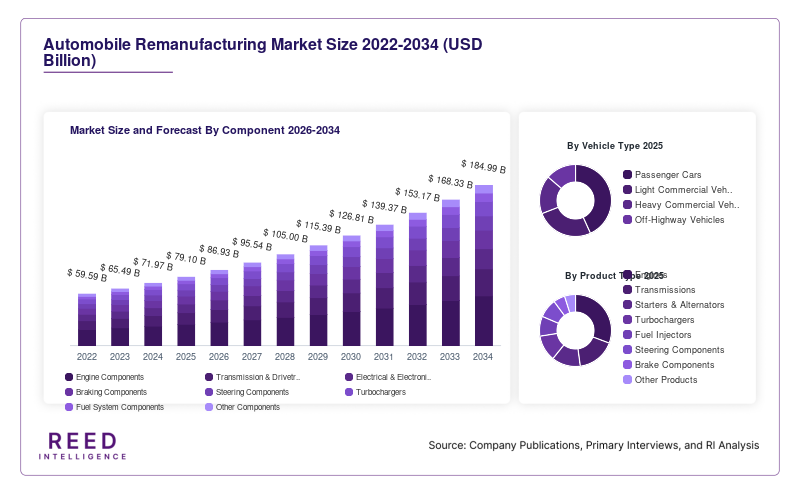
Engine components accounted for approximately 31% of the automobile remanufacturing market in 2025, making them the largest component segment. Engines and associated components are high-value systems with substantial replacement and repair requirements as vehicles accumulate mileage.
Electrical and electronic components accounted for approximately 17% and are projected to grow at approximately 11.3% CAGR, making them the fastest-growing major component segment. Increasing electronic content in modern vehicles and the growing need to recover and restore expensive components are supporting demand.
Transmission and drivetrain components represented approximately 24%, braking components 9%, steering components 7%, turbochargers 6%, fuel-system components 4%, and other components approximately 2%.
Vehicle Type Segment Analysis
By Vehicle Type
Passenger cars accounted for approximately 62% of the automobile remanufacturing market in 2025, making them the largest vehicle-type segment. The large global passenger-vehicle population creates substantial demand for replacement components throughout the vehicle lifecycle.
Heavy commercial vehicles accounted for approximately 18% and are projected to grow at approximately 10.8% CAGR, making them the fastest-growing major vehicle category. High utilization rates and the importance of minimizing vehicle downtime support remanufactured component adoption among fleet operators.
Light commercial vehicles represented approximately 15%, while off-highway vehicles accounted for approximately 5%.
Product Type Segment Analysis
By Product Type
Remanufactured engines accounted for approximately 27% of the market in 2025, making engines the largest product segment. Engine replacement is often significantly more economical than replacing an entire vehicle, particularly for commercial and older vehicles.
Turbochargers accounted for approximately 9% and are projected to grow at approximately 11.5% CAGR, making them the fastest-growing major product segment. Increasing turbocharger penetration and the high replacement cost of new units support remanufacturing demand.
Transmissions represented approximately 23%, starters and alternators 15%, fuel injectors 8%, steering components 7%, brake components 6%, and other products approximately 5%.
Sales Channel Segment Analysis
By Sales Channel
The independent aftermarket accounted for approximately 48% of the automobile remanufacturing market in 2025, making it the largest sales channel. Independent repair shops and parts distributors provide extensive access to remanufactured components for vehicle owners.
Online channels accounted for approximately 9% and are projected to grow at approximately 13.2% CAGR, making them the fastest-growing sales channel. Digital parts marketplaces are improving product discovery, comparison and purchasing convenience.
OEM channels represented approximately 29%, while authorized distributors accounted for approximately 14%.
End-User Segment Analysis
By End User
Individual vehicle owners accounted for approximately 43% of the market in 2025, making them the largest end-user segment. The cost advantages associated with remanufactured components can make them attractive for owners maintaining older vehicles.
Fleet operators accounted for approximately 24% and are projected to grow at approximately 11.4% CAGR, making them the fastest-growing major end-user segment. Fleet operators prioritize component reliability, maintenance cost control and vehicle uptime.
Repair shops represented approximately 21%, dealerships 8%, and other commercial users approximately 4%.
Automobile Remanufacturing Market Regional Analysis
North America Holds the Largest Share
North America accounted for approximately 34% of the global automobile remanufacturing market in 2025, making it the largest regional market. The region has a mature automotive aftermarket, established remanufacturing industry, large vehicle parc and strong demand for replacement components.
North America is projected to grow at approximately 9.2% CAGR.
Europe Shows Strong Circular-Economy Adoption
Europe accounted for approximately 29% of the market in 2025 and is projected to grow at approximately 9.5% CAGR.
Established automotive manufacturing, aftermarket infrastructure and increasing interest in resource efficiency support remanufacturing activity.
Asia-Pacific Is the Fastest-Growing Region
Asia-Pacific accounted for approximately 25% of the market in 2025 and is projected to grow at approximately 11.4% CAGR, making it the fastest-growing major region.
Expanding vehicle populations, increasing aftermarket demand and growing automotive manufacturing capabilities are supporting market development.
Latin America Shows Growing Aftermarket Demand
Latin America accounted for approximately 7% of the market in 2025 and is projected to grow at approximately 9.1% CAGR.
Aging vehicle fleets and demand for cost-effective replacement components are supporting remanufacturing adoption.
Middle East & Africa Represents an Emerging Market
Middle East & Africa accounted for approximately 5% of the market in 2025 and is projected to grow at approximately 8.6% CAGR.
Commercial vehicle use, vehicle maintenance requirements and growing automotive service infrastructure are creating opportunities.

Automobile Remanufacturing Market Competitive Landscape
Competition in the automobile remanufacturing market is based on component quality, testing standards, warranty coverage, remanufacturing capabilities, core availability, product range, pricing, distribution networks and technical expertise.
Manufacturers and suppliers are increasingly developing structured core-return programs and investing in advanced testing and diagnostic technologies.
Key Market Players
- Robert Bosch GmbH
- ZF Friedrichshafen AG
- Caterpillar Inc.
- Cummins Inc.
- Aisin Corporation
- Jasper Engines & Transmissions
- Maval Industries LLC
- Cardone Industries
- Valeo
- Meritor, Inc.
Automobile Remanufacturing Market Recent Developments
- Remanufacturers are strengthening core-return systems to improve the recovery of used automotive components. Efficient core collection provides a consistent input stream for remanufacturing operations.
- Manufacturers are increasingly using automated inspection, diagnostic equipment and performance testing to verify remanufactured component quality. These systems can improve consistency and reliability.
Automobile Remanufacturing Market Segments
By Component
- Engine Components
- Transmission & Drivetrain Components
- Electrical & Electronic Components
- Braking Components
- Steering Components
- Turbochargers
- Fuel System Components
- Other Components
By Vehicle Type
- Passenger Cars
- Light Commercial Vehicles
- Heavy Commercial Vehicles
- Off-Highway Vehicles
By Product Type
- Engines
- Transmissions
- Starters & Alternators
- Turbochargers
- Fuel Injectors
- Steering Components
- Brake Components
- Other Products
By Sales Channel
- OEM
- Authorized Distributors
- Independent Aftermarket
- Online Channels
By End User
- Individual Vehicle Owners
- Repair Shops
- Fleet Operators
- Dealerships
- Other Commercial Users
By Region
- North America
- Europe
- APAC
- Middle East and Africa
- LATAM