Broadcast Media Market Size, Share & Trends Analysis Report By Type, By Platform, By Revenue Model, By Content Type, By Application and By Region, Forecasts 2026–2034
USD 3950
Broadcast Media Market Size
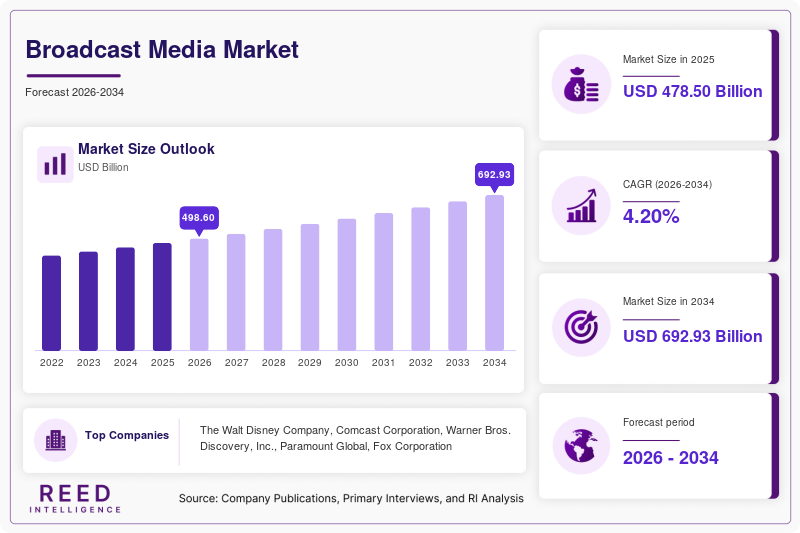
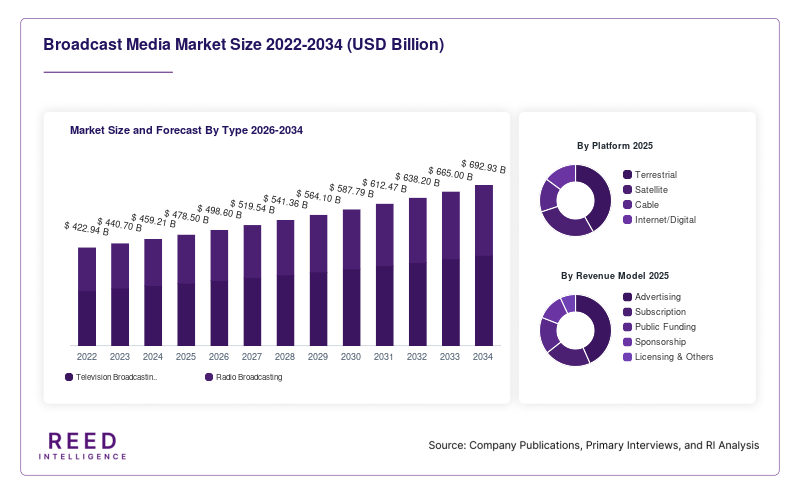
The global broadcast media market was valued at USD 478.50 billion in 2025 and is projected to grow from USD 498.60 billion in 2026 to USD 692.93 billion by 2034, registering a CAGR of 4.20% during the forecast period from 2026 to 2034.
The global broadcast media industry encompasses television and radio broadcasting delivered through terrestrial, satellite, cable and digital distribution platforms. Broadcasters generate revenue through advertising, subscriptions, licensing, sponsorships and other commercial models while increasingly distributing content across connected devices and digital platforms.
The market is undergoing a transition from traditional linear broadcasting toward hybrid distribution models that combine conventional broadcast networks with streaming, connected television, digital audio and on-demand services. Broadcasters are investing in digital infrastructure to retain audiences as viewing and listening habits become increasingly fragmented.
Broadcast Media Market Drivers
Continued Demand for Live Content
Live sports, breaking news, political events, award shows and other real-time programming remain important drivers of broadcast consumption.
The ability to deliver large-scale live events simultaneously to millions of viewers continues to provide traditional broadcasters with a significant distribution role.
Growth of Connected Television
Connected TVs are allowing consumers to access broadcast, streaming and on-demand content through the same devices.
This convergence is encouraging broadcasters to develop hybrid strategies that combine traditional channels with digital platforms.
Increasing Digital Advertising
Advertisers are increasingly shifting budgets toward digital and addressable television advertising.
Data-driven advertising enables broadcasters and platforms to provide more targeted campaigns based on audience characteristics and viewing behavior.
Expansion of Multiplatform Distribution
Broadcasters are increasingly distributing content through websites, mobile applications, connected-TV platforms and social media.
Multiplatform distribution allows broadcasters to reach audiences beyond conventional television and radio networks.
Increasing Demand for Local and Regional Content
Local news, regional sports and community programming continue to support audience engagement.
Broadcasters with strong local content capabilities can maintain relevance even as audiences gain access to global digital content.
Broadcast Media Market Restraints
Competition From Streaming Platforms
Subscription video-on-demand and advertising-supported streaming platforms compete directly for audience attention and advertising budgets.
The expansion of streaming has contributed to fragmentation in television viewing and increased competitive pressure on traditional broadcasters.
Declining Linear Viewing in Some Markets
Consumer behavior is shifting toward on-demand and time-shifted viewing.
Younger audiences in particular increasingly consume video through mobile devices, social platforms and streaming services, creating challenges for conventional linear broadcasting models.
High Content Production Costs
Premium programming, particularly live sports and original entertainment, requires substantial investment.
Rising rights fees, production expenses and distribution costs can place pressure on broadcaster profitability.
Advertising Market Volatility
Advertising remains a major source of revenue for many broadcasters.
Economic slowdowns, changes in advertiser spending and competition from digital advertising platforms can affect broadcasting revenues.
Broadcast Media Market Opportunities
Addressable and Programmatic TV Advertising
Digital television infrastructure enables more targeted advertising than traditional broadcast models.
Programmatic and addressable advertising can allow broadcasters to improve campaign measurement and offer advertisers more precise audience targeting.
Hybrid Broadcast-Broadband Services
Combining broadcast distribution with broadband connectivity creates opportunities for interactive television and personalized content experiences.
Hybrid models can provide traditional broadcast reliability while adding on-demand and interactive features.
Cloud-Based Broadcasting
Cloud production and distribution technologies can reduce infrastructure requirements and improve operational flexibility.
Broadcasters can use cloud platforms for production, editing, storage, content management and distribution.
Artificial Intelligence in Broadcasting
AI can support automated transcription, captioning, content tagging, video editing, recommendation systems, audience analytics and workflow automation.
These applications can improve production efficiency and help broadcasters manage large volumes of content.
Expansion of Emerging Markets
Rising television penetration, improving digital infrastructure and increasing advertising expenditure create opportunities in emerging economies.
Asia-Pacific, Latin America, the Middle East and Africa offer growth opportunities as media consumption and digital connectivity expand.
Type Segment Analysis
Television Broadcasting Holds the Largest Share
Television broadcasting accounted for approximately 82% of the broadcast media market in 2025, making it the dominant type segment. Television maintains a broad audience base across news, entertainment, sports and other programming categories.
Radio broadcasting accounted for approximately 18% and is projected to grow at approximately 3.6% CAGR, supported by local news, music, talk programming and radio's continued accessibility through terrestrial and digital channels.
Platform Segment Analysis
Cable Holds the Largest Share
Cable accounted for approximately 35% of the market in 2025, supported by established pay-TV infrastructure and extensive household distribution networks.
Internet/digital platforms accounted for approximately 24% and are projected to grow at approximately 8.2% CAGR, making them the fastest-growing major platform segment. Increasing connected-TV adoption and digital distribution are supporting expansion.
Terrestrial broadcasting represented approximately 25%, while satellite represented approximately 16%.
Revenue Model Segment Analysis
Advertising Holds the Largest Share
Advertising accounted for approximately 45% of the broadcast media market in 2025, making it the largest revenue segment. Television and radio advertising remain important channels for brand awareness and mass-market communication.
Licensing & other revenue accounted for approximately 12% and is projected to grow at approximately 5.3% CAGR, making it the fastest-growing major revenue segment. Content licensing, syndication and related commercial opportunities are expanding as broadcasters distribute programming across more platforms.
Subscription revenue represented approximately 29%, public funding 8%, and sponsorship approximately 6%.
Content Type Segment Analysis
Entertainment Holds the Largest Share
Entertainment accounted for approximately 39% of the market in 2025, making it the largest content segment. Entertainment programming remains a central component of television schedules and attracts substantial advertising audiences.
Sports accounted for approximately 20% and is projected to grow at approximately 5.4% CAGR, making it the fastest-growing major content segment. Live sports continue to attract large audiences and command significant advertising and content-rights value.
News represented approximately 24%, educational programming 9%, music 5%, and other content approximately 3%.
Broadcast Media Market Regional Analysis
North America Holds the Largest Share
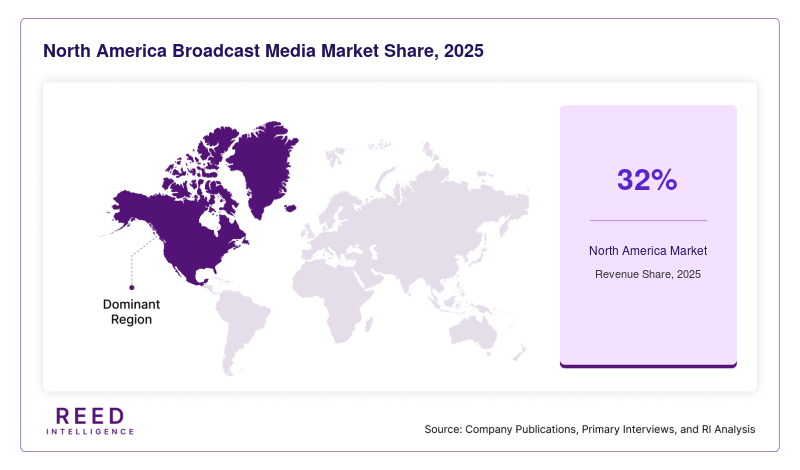
North America accounted for approximately 32% of the global broadcast media market in 2025, making it the dominant regional market. The region benefits from mature television and radio infrastructure, significant advertising expenditure, extensive pay-TV penetration and established digital broadcasting ecosystems.
Asia-Pacific accounted for approximately 31% and is projected to grow at approximately 5.4% CAGR, making it the fastest-growing major region. Population scale, expanding media consumption, digital connectivity and increasing advertising expenditure are supporting regional growth.
Europe Maintains a Mature Broadcast Market
Europe accounted for approximately 24% of the market in 2025 and is projected to grow at approximately 3.4% CAGR.
The region has well-established public and commercial broadcasting networks, strong sports and entertainment programming and increasing integration between traditional broadcasting and digital distribution.
Latin America Shows Expanding Digital Adoption
Latin America accounted for approximately 8% of the market in 2025 and is projected to grow at approximately 4.5% CAGR.
Increasing internet connectivity, digital television adoption and rising advertising expenditure are supporting market development.
Middle East & Africa Represents an Emerging Market
Middle East & Africa accounted for approximately 5% of the market in 2025 and is projected to grow at approximately 5.0% CAGR.
Growing media consumption, expanding digital infrastructure and investment in broadcasting capabilities are creating opportunities across the region.
Broadcast Media Market Competitive Landscape
Competition in the broadcast media market is based on content quality, audience reach, programming rights, advertising capabilities, distribution infrastructure, digital platforms, technology investment and brand recognition.
Broadcasters are increasingly developing multiplatform distribution strategies to combine linear television and radio with streaming, websites, mobile applications and connected-TV services.
Key Market Players
- The Walt Disney Company
- Comcast Corporation
- Warner Bros. Discovery, Inc.
- Paramount Global
- Fox Corporation
- Sony Group Corporation
- Bertelsmann SE & Co. KGaA
- Nexstar Media Group, Inc.
- Sinclair, Inc.
- RTL Group
Broadcast Media Market Recent Developments
- Major broadcasters continue expanding distribution through connected-TV platforms and digital applications. This approach allows traditional media companies to reach audiences that increasingly combine linear television with streaming and on-demand consumption.
- Broadcasters are increasingly using AI for transcription, subtitling, content discovery, video clipping, metadata generation, audience analytics and production automation. These applications can reduce repetitive production tasks and improve the speed of content preparation.
Broadcast Media Market Segments
By Type
- Television Broadcasting
- Radio Broadcasting
By Platform
- Terrestrial
- Satellite
- Cable
- Internet/Digital
By Revenue Model
- Advertising
- Subscription
- Public Funding
- Sponsorship
- Licensing & Others
By Content Type
- News
- Sports
- Entertainment
- Educational
- Music
- Others
By Application
- Residential
- Commercial
- Public Sector
By Region
- North America
- Europe
- APAC
- Middle East and Africa
- LATAM