Disaster Restoration Service Market Size, Share & Trends Analysis Report By Service Type, By Disaster Type, By End User and By Region, Forecasts 2026–2034
USD 3950
Disaster Restoration Service Market Size
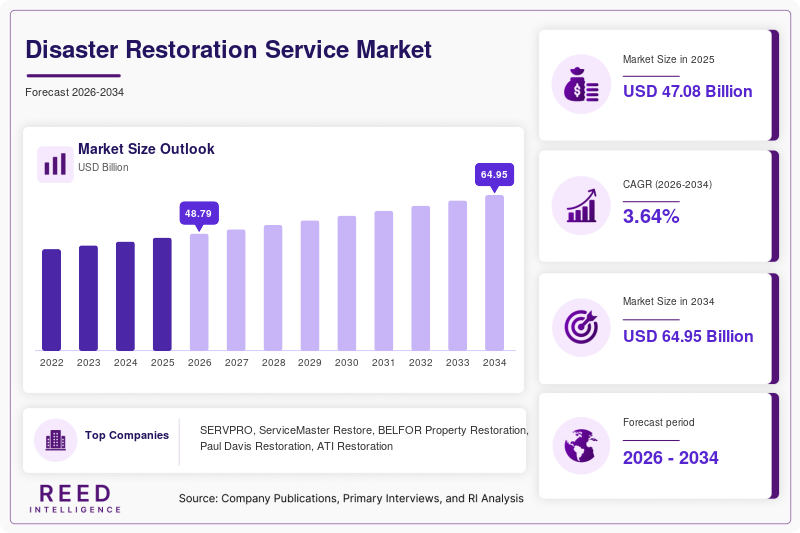
The global disaster restoration service market was valued at USD 47.08 billion in 2025 and is projected to grow from USD 48.80 billion in 2026 to USD 64.90 billion by 2034, registering a CAGR of 3.64% during the forecast period from 2026 to 2034.
Disaster restoration services encompass the professional assessment, cleanup, repair, remediation and restoration of residential, commercial and industrial properties affected by water, fire, storms, floods, mold and other catastrophic events.
Restoration service providers typically undertake emergency response, water extraction, structural drying, smoke and fire damage cleanup, mold remediation, debris removal, reconstruction and property restoration. Demand is influenced by the frequency and severity of natural disasters, aging infrastructure, urbanization, insurance coverage and the increasing need for rapid property recovery.
Disaster Restoration Service Market Drivers
Increasing Frequency of Natural Disasters
Floods, hurricanes, storms, wildfires and other natural disasters can cause extensive structural and property damage.
Increasing disaster-related property losses are generating recurring demand for emergency restoration and reconstruction services.
Rising Urbanization and Property Development
Expansion of residential and commercial properties increases the overall asset base exposed to water, fire, storm and other forms of damage.
As urban areas become more densely developed, restoration requirements following localized disasters can also increase.
Growth in Insurance Claims
Property insurance plays an important role in disaster restoration because covered losses frequently require professional assessment, cleanup and repair.
Growth in property insurance penetration can therefore support demand for restoration contractors.
Aging Infrastructure
Older buildings, plumbing networks, electrical systems and roofing structures can be more vulnerable to water damage, fire incidents and structural deterioration.
Maintenance and restoration requirements associated with aging properties support the market.
Increasing Demand for Rapid Response
Delays following water or fire damage can increase secondary property damage.
Restoration companies offering 24/7 emergency response, rapid water extraction and immediate stabilization services are therefore gaining importance.
Disaster Restoration Service Market Restraints
High Operating and Equipment Costs
Restoration companies require specialized equipment such as extraction systems, industrial dehumidifiers, air scrubbers, moisture meters and remediation tools.
Maintaining emergency-response capabilities can increase operating costs.
Labor Availability
Restoration work often requires trained technicians capable of handling hazardous materials, structural damage, water extraction and remediation.
Shortages of skilled workers can limit service capacity.
Seasonal Demand Fluctuations
Storms, hurricanes, flooding and freezing events can create sudden increases in restoration demand.
This can produce significant variations in workforce and equipment requirements across seasons.
Complex Insurance Processes
Insurance claims can involve inspections, documentation, estimates and approval procedures.
Longer claim-resolution cycles can delay restoration projects and affect service-provider cash flow.
Disaster Restoration Service Market Opportunities
Growth in Disaster Preparedness
Property owners, businesses and insurers are increasingly focused on reducing the impact of disasters.
This creates opportunities for restoration providers to offer emergency preparedness, inspection and pre-loss planning services.
Technology-Enabled Restoration
Digital property assessments, moisture sensors, remote monitoring, drones and restoration-management software can improve response and project coordination.
Technology adoption creates opportunities for companies to differentiate their services.
Expansion of Mold Remediation Services
Water intrusion can create conditions favorable to mold growth.
Increasing awareness of indoor environmental quality is supporting demand for specialized mold inspection and remediation services.
Commercial Restoration Contracts
Hotels, retail facilities, hospitals, warehouses and industrial properties require rapid restoration to minimize operational downtime.
Long-term commercial contracts can provide restoration companies with recurring business opportunities.
Reconstruction and Renovation Services
Many major disaster events require more than cleanup and drying.
Restoration providers that offer reconstruction, remodeling and rebuilding can capture a larger portion of the property-recovery process.
Service Type Segment Analysis
By Service Type
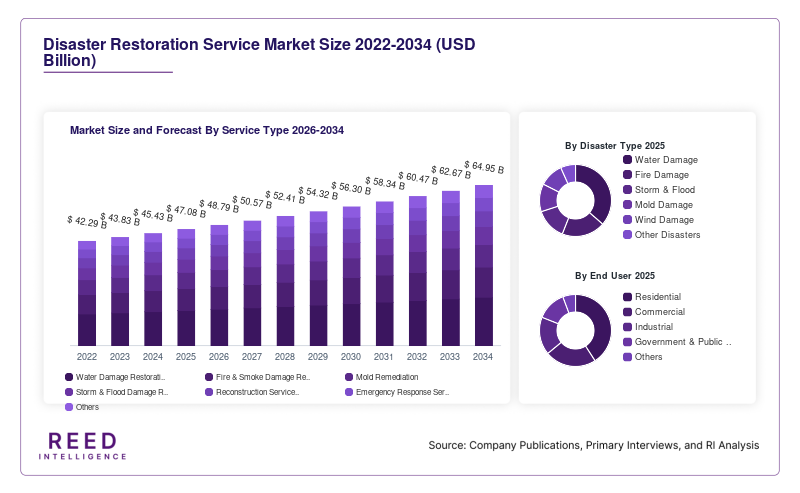
Water damage restoration accounted for approximately 38% of the disaster restoration service market in 2025, making it the largest service segment. Plumbing failures, flooding, appliance leaks, roof damage and other water-related incidents generate frequent restoration requirements across residential and commercial properties.
Storm & flood damage restoration accounted for approximately 17% and is projected to grow at approximately 4.7% CAGR, making it the fastest-growing major service segment. Increasing exposure to severe weather events and flood-related property damage is supporting demand.
Fire and smoke damage restoration represented approximately 21%, mold remediation 12%, reconstruction services 8%, emergency response services 3%, and other services approximately 1%.
Disaster Type Segment Analysis
By Disaster Type
Water-related disasters accounted for approximately 39% of the market in 2025, making water damage the largest disaster-type segment. Water intrusion can affect flooring, walls, electrical systems, furnishings and structural components, frequently requiring immediate professional intervention.
Storm and flood events accounted for approximately 24% and are projected to grow at approximately 4.6% CAGR, making them the fastest-growing major disaster category.
Fire damage represented approximately 21%, mold-related damage 10%, wind damage 4%, and other disasters approximately 2%.
End-User Segment Analysis
By End User
Residential properties accounted for approximately 47% of the disaster restoration service market in 2025, making them the largest end-user segment. Homes are frequently affected by water leaks, flooding, fires, storms and mold, creating recurring demand for restoration services.
Commercial properties accounted for approximately 31% and are projected to grow at approximately 4.1% CAGR, making them the fastest-growing major end-user segment. Businesses increasingly prioritize rapid restoration to minimize operational interruptions and revenue losses.
Industrial properties represented approximately 14%, government and public infrastructure 6%, and other end users approximately 2%.
Disaster Restoration Service Market Regional Analysis
North America Holds the Largest Share
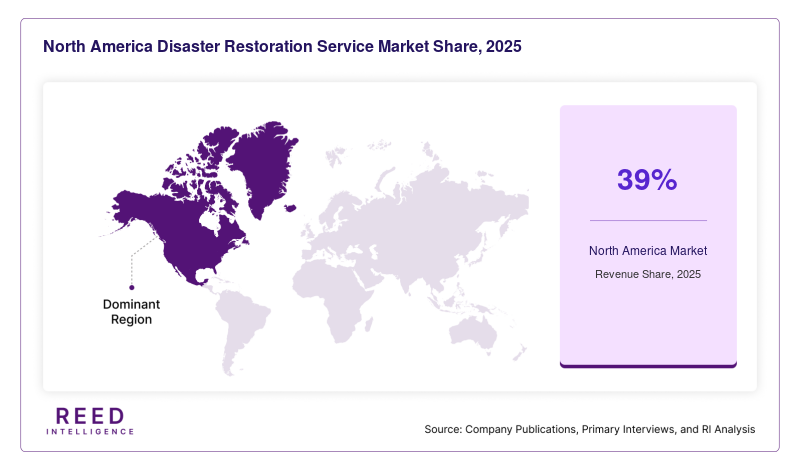
North America accounted for approximately 39% of the global disaster restoration service market in 2025, making it the largest regional market. The region has a large property base, developed insurance markets, established restoration networks and significant exposure to storms, floods, wildfires and other disasters.
North America is projected to grow at approximately 3.8% CAGR.
Asia-Pacific Shows Strong Growth
Asia-Pacific accounted for approximately 27% of the market in 2025 and is projected to grow at approximately 4.6% CAGR, making it the fastest-growing major region.
Rapid urbanization, expanding construction activity, climate-related risks and increasing insurance penetration are supporting restoration demand.
Europe Maintains Established Demand
Europe accounted for approximately 21% of the market in 2025 and is projected to grow at approximately 3.1% CAGR.
The region's established property base, insurance infrastructure and demand for building remediation support continued market development.
Latin America Shows Moderate Expansion
Latin America accounted for approximately 8% of the market in 2025 and is projected to grow at approximately 3.6% CAGR.
Flooding, storms, infrastructure development and growing urban populations are contributing to restoration requirements.
Middle East & Africa Represents an Emerging Market
Middle East & Africa accounted for approximately 5% of the market in 2025 and is projected to grow at approximately 3.3% CAGR.
Infrastructure development, urban expansion and increasing awareness of professional restoration services are creating opportunities across the region.
Disaster Restoration Service Market Competitive Landscape
Competition in the disaster restoration service market is based on response time, geographic coverage, technician availability, service quality, insurance relationships, equipment capabilities, project-management expertise and ability to provide both restoration and reconstruction services.
Large restoration networks compete alongside regional and independent contractors. Companies are increasingly investing in digital estimating platforms, emergency-response systems, specialized drying equipment and centralized project management.
Key Market Players
- SERVPRO
- ServiceMaster Restore
- BELFOR Property Restoration
- Paul Davis Restoration
- ATI Restoration
- PuroClean
- Rainbow International Restoration
- 1-800 WATER DAMAGE
- Restoration 1
- First Onsite Property Restoration
Disaster Restoration Service Market Recent Developments
- Restoration companies are increasing their 24/7 emergency-response capabilities to reduce the time between a disaster event and the start of remediation. Rapid response can help limit secondary damage and accelerate property recovery.
- Restoration providers are increasingly using digital estimating, project-management and customer communication platforms. These systems can improve documentation, scheduling and coordination with property owners and insurers.
Disaster Restoration Service Market Segments
By Service Type
- Water Damage Restoration
- Fire & Smoke Damage Restoration
- Mold Remediation
- Storm & Flood Damage Restoration
- Reconstruction Services
- Emergency Response Services
- Others
By Disaster Type
- Water Damage
- Fire Damage
- Storm & Flood
- Mold Damage
- Wind Damage
- Other Disasters
By End User
- Residential
- Commercial
- Industrial
- Government & Public Infrastructure
- Others
By Service Model
- Insurance-Managed
- Direct Customer
- Property Management Contracts
- Commercial Service Contracts
By Region
- North America
- Europe
- APAC
- Middle East and Africa
- LATAM