Dress Up Games Market Size, Share & Trends Analysis Report By Platform, By Game Type, By Age Group, By Distribution Channel and By Region, Forecasts 2026–2034
USD 3950
Dress Up Games Market Size
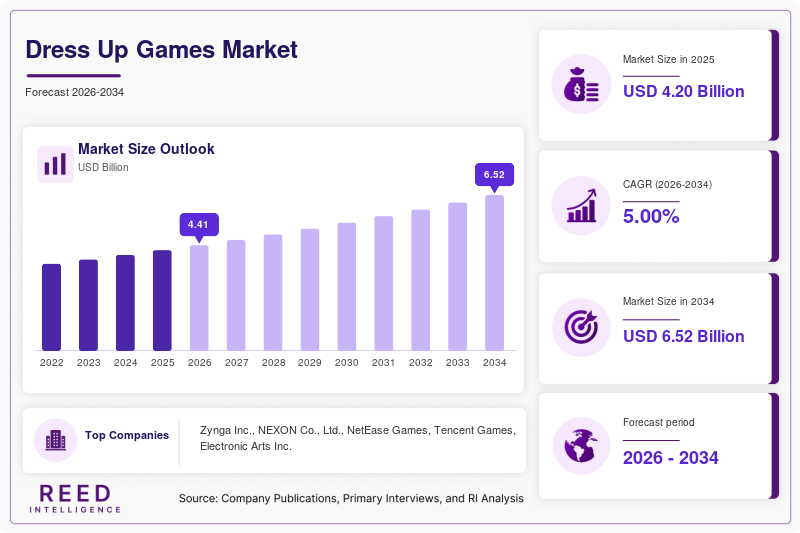
The global dress up games market was valued at USD 4.20 billion in 2025 and is projected to grow from USD 4.41 billion in 2026 to USD 6.52 billion by 2034, registering a CAGR of 5.00% during the forecast period from 2026 to 2034.
Dress up games are interactive digital games that allow players to customize characters through clothing, accessories, hairstyles, makeup and other visual elements. The category spans mobile games, browser-based games, PC games and console-based experiences and is closely connected with casual gaming, avatar customization, social gaming and virtual identity.
The market is supported by the widespread use of smartphones, increasing engagement with casual games and growing demand for character customization. Developers are increasingly incorporating social features, collectible items, seasonal events and user-generated content to encourage recurring engagement.
Dress Up Games Market Drivers
Rising Mobile Gaming Adoption
The continued expansion of smartphone usage provides developers with access to a large global audience for casual and customization-oriented games.
Mobile dress up games can be distributed through established app ecosystems and accessed without specialized gaming hardware.
Growing Demand for Character Customization
Players increasingly expect games to provide personalized avatars and visual identities.
Dress up games are inherently focused on customization, allowing users to experiment with clothing, accessories, hairstyles and appearance.
Expansion of Casual Gaming
Casual games appeal to users seeking relatively accessible gameplay and shorter sessions.
Dress up games fit this model because their core mechanics generally require limited gaming expertise and can be played across a broad range of devices.
Social and Community Features
Developers are increasingly integrating social sharing, competitions, rankings and community interaction into dress up games.
These features can increase engagement and encourage players to return to the platform.
Growth of Virtual Goods
Digital clothing, accessories, character items and themed collections provide opportunities for in-game monetization.
Limited-time collections and event-based items can create recurring opportunities for virtual-goods sales.
Dress Up Games Market Restraints
High Competition in Mobile Gaming
The mobile gaming market contains a large number of casual and free-to-play titles.
This makes user acquisition and retention increasingly challenging for dress up game developers.
Short Player Retention Cycles
Some dress up games depend heavily on novelty and frequent content updates.
Games that fail to introduce new characters, outfits or customization options may experience declining engagement.
Dependence on Advertising and In-App Purchases
Many dress up games use advertising and virtual purchases as primary monetization models.
Changes in advertising economics, platform policies or consumer spending patterns can affect developer revenue.
Data Privacy and Child-Safety Requirements
Some dress up games attract younger audiences, increasing the importance of privacy, parental controls, age-appropriate content and advertising compliance.
Regulatory requirements can increase development and operating costs.
Dress Up Games Market Opportunities
Expansion of User-Generated Content
User-generated outfits, character designs and customization assets can increase the amount of content available within a game.
Community-driven creation can also strengthen player engagement.
Integration of Augmented Reality
AR can allow players to visualize clothing, accessories and character designs in interactive environments.
The technology provides opportunities to combine dress up mechanics with social and camera-based experiences.
AI-Powered Personalization
Artificial intelligence can support personalized recommendations for outfits, accessories and character styles.
AI-generated content can also help developers expand customization libraries more efficiently.
Cross-Platform Gaming
Connecting mobile, PC and browser experiences can enable users to access their customized characters and digital items across devices.
Cross-platform ecosystems can also broaden the potential user base.
Fashion and Brand Collaborations
Partnerships with fashion brands, entertainment franchises and digital creators can introduce recognizable clothing collections and themed customization content.
Such collaborations can create new monetization and user-acquisition opportunities.
Platform Segment Analysis
By Platform
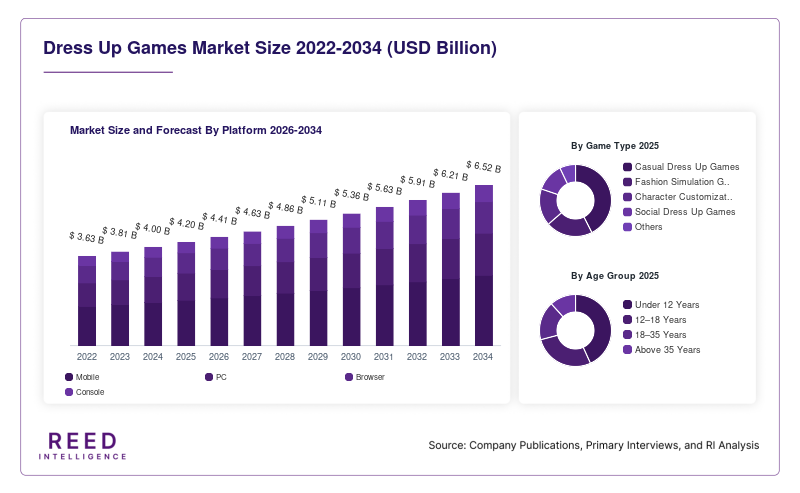
Mobile accounted for approximately 64% of the dress up games market in 2025, making it the dominant platform segment. Its position is supported by widespread smartphone adoption, easy access to app stores and the suitability of mobile devices for short-duration casual gaming and character customization.
Browser-based games accounted for approximately 14% and are projected to grow at approximately 6.1% CAGR, making them the fastest-growing major platform segment. Browser accessibility, low hardware requirements and instant play without extensive installation requirements support continued demand.
PC represented approximately 15%, while consoles accounted for approximately 7%.
Game Type Segment Analysis
By Game Type
Casual dress up games accounted for approximately 41% of the market in 2025, making them the largest game type segment. Their accessible gameplay, simple customization mechanics and broad appeal across different player groups support their leading position.
Social Dress Up Games accounted for approximately 18% and are projected to grow at approximately 6.4% CAGR, making them the fastest-growing major game type segment. Increasing integration of social interaction, sharing, competitions and community-based customization is supporting growth.
Fashion simulation games represented approximately 24%, character customization games 13%, and other game types approximately 4%.
Age Group Segment Analysis
By Age Group
Players aged 12–18 accounted for approximately 36% of the market in 2025, making this the largest age-group segment. Strong engagement with mobile games, social platforms and avatar-based digital experiences supports demand among this audience.
Players aged 18–35 accounted for approximately 31% and are projected to grow at approximately 6.0% CAGR, making them the fastest-growing major age group. Increasing adoption of fashion-oriented digital experiences, social gaming and personalized avatars is supporting expansion.
Users under 12 represented approximately 21%, while users above 35 accounted for approximately 12%.
Distribution Channel Segment Analysis
By Distribution Channel
App stores accounted for approximately 59% of the market in 2025, making them the leading distribution channel. Established mobile ecosystems provide developers with global distribution, integrated payment systems and access to large gaming audiences.
Online game platforms accounted for approximately 19% and are projected to grow at approximately 6.2% CAGR, making them the fastest-growing major distribution channel. Increased browser-based gaming and web-accessible gaming experiences are supporting expansion.
Gaming consoles represented approximately 10%, direct downloads 8%, and other channels approximately 4%.
Dress Up Games Market Regional Analysis
Asia-Pacific Holds the Largest Share
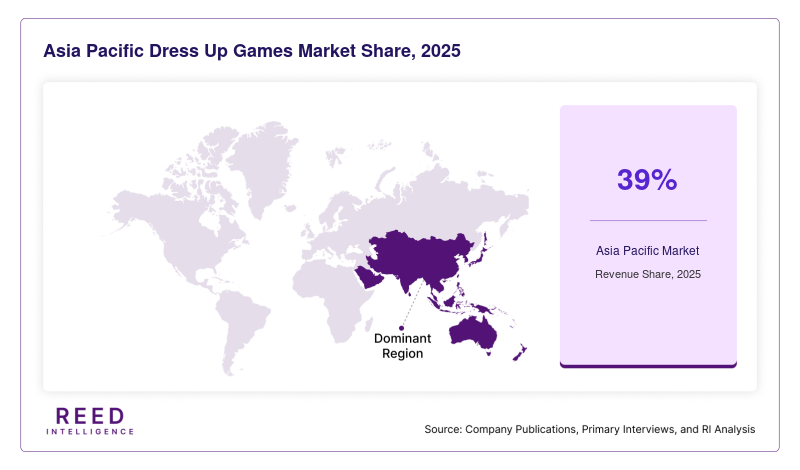
Asia-Pacific accounted for approximately 39% of the global dress up games market in 2025, making it the largest regional market. The region's position is supported by a large mobile-gaming audience, extensive smartphone adoption, strong gaming ecosystems and widespread interest in character customization and social gaming.
Latin America accounted for approximately 9% and is projected to grow at approximately 6.2% CAGR, making it the fastest-growing major region. Expanding smartphone penetration, increasing digital gaming participation and growing availability of mobile gaming platforms are supporting regional expansion.
North America Maintains Strong Demand
North America accounted for approximately 27% of the market in 2025 and is projected to grow at approximately 4.6% CAGR.
The region benefits from high digital-game engagement, established mobile gaming ecosystems and strong consumer spending on digital content.
Europe Represents a Mature Market
Europe accounted for approximately 22% of the market in 2025 and is projected to grow at approximately 4.8% CAGR.
Strong smartphone penetration, established gaming markets and growing interest in social and casual gaming support regional demand.
Middle East & Africa Shows Emerging Adoption
Middle East & Africa accounted for approximately 3% of the market in 2025 and is projected to grow at approximately 5.8% CAGR.
Increasing smartphone adoption, expanding digital entertainment consumption and improving access to mobile gaming platforms are creating new opportunities.
Dress Up Games Market Competitive Landscape
Competition in the dress up games market is based on game design, customization depth, visual quality, content updates, user engagement, social functionality, monetization capabilities and cross-platform accessibility.
Developers are increasingly focusing on frequent content releases, themed collections, community features and collaborations to differentiate their games.
Key Market Players
- Zynga Inc.
- NEXON Co., Ltd.
- NetEase Games
- Tencent Games
- Electronic Arts Inc.
- Crowdstar
- Tapps Games
- TabTale
- Nanobit
- Ninja Kiwi
Dress Up Games Market Recent Developments
- Game developers are increasingly exploring AI-assisted personalization to recommend outfits, accessories and character combinations based on player preferences. AI can also support the creation and organization of larger libraries of customization content.
- Dress up games are increasingly incorporating social sharing, competitions, rankings and community interaction. These features enable players to showcase customized characters and participate in recurring events.
Dress Up Games Market Segments
By Platform
- Mobile
- PC
- Browser
- Console
By Game Type
- Casual Dress Up Games
- Fashion Simulation Games
- Character Customization Games
- Social Dress Up Games
- Others
By Age Group
- Under 12 Years
- 12–18 Years
- 18–35 Years
- Above 35 Years
By Distribution Channel
- App Stores
- Online Game Platforms
- Gaming Consoles
- Direct Downloads
- Others
By Region
- North America
- Europe
- APAC
- Middle East and Africa
- LATAM