Flake Silver Powder Market Size, Share & Trends Analysis Report By Purity, By Application, By End User and By Region, Forecasts 2026–2034
USD 3950
Flake Silver Powder Market Size
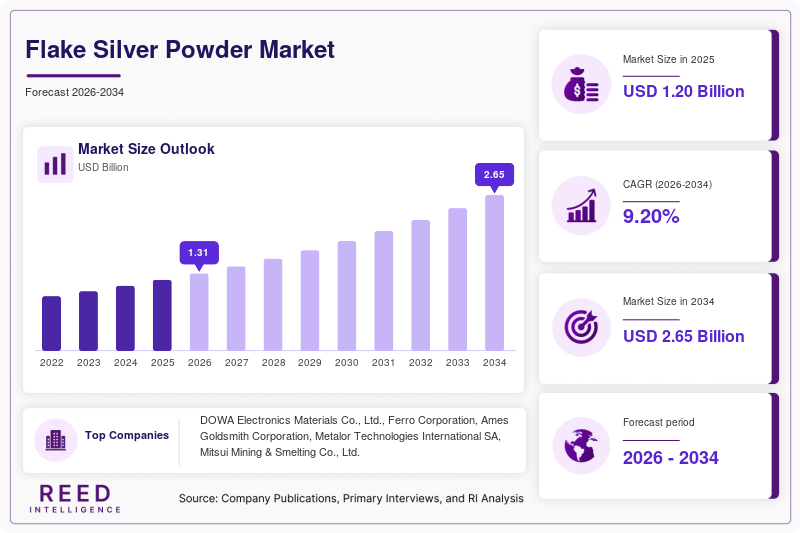
The global flake silver powder market was valued at USD 1.20 billion in 2025 and is projected to grow from USD 1.31 billion in 2026 to USD 2.50 billion by 2034, registering a CAGR of 9.20% during the forecast period from 2026 to 2034.
Flake silver powder is a finely processed silver material characterized by its platelet-like particle structure and high electrical and thermal conductivity. It is primarily used in conductive pastes, electronic components, photovoltaic applications, printed electronics, sensors and other advanced industrial applications.
The market is supported by increasing demand for conductive materials in electronics, continued miniaturization of electronic components and the expansion of solar-energy technologies. Flake silver powder is particularly valuable where high conductivity, reliability and resistance to oxidation are required.
Flake Silver Powder Market Drivers
Growing Demand for Electronic Components
The continued expansion of consumer electronics, telecommunications equipment, automotive electronics and industrial electronics is increasing demand for conductive materials.
Flake silver powder is widely used in conductive pastes and electronic components because of its excellent electrical conductivity.
Expansion of Photovoltaic Manufacturing
Silver-based conductive materials are used in photovoltaic cell manufacturing, particularly in conductive pastes.
Increasing solar-energy deployment and expansion of photovoltaic manufacturing capacity are supporting demand for high-performance silver powders.
Growth of Printed Electronics
Printed electronics use conductive inks and pastes to create circuits and functional components on different substrates.
The increasing use of printed sensors, displays, RFID components and flexible electronic devices is creating opportunities for flake silver powder.
Increasing Electronics Miniaturization
Electronic components are becoming smaller while requiring high electrical performance.
Flake-shaped silver particles can support the development of conductive materials with desirable packing and connectivity characteristics.
Expansion of Electric Vehicles
Electric vehicles require large numbers of electronic components, sensors, power-management systems and other electrical systems.
Growing vehicle electrification is therefore creating additional demand for advanced conductive materials.
Flake Silver Powder Market Restraints
High Silver Prices
Silver is a relatively expensive raw material compared with many alternative conductive materials.
Fluctuations in silver prices can increase production costs and affect purchasing decisions among manufacturers.
Availability of Alternative Conductive Materials
Copper, nickel, aluminum and other conductive materials can replace silver in certain applications.
Although silver offers excellent conductivity and other performance advantages, cost-sensitive applications may adopt alternative materials.
Raw Material Price Volatility
Silver prices can be affected by investment demand, industrial consumption, mining supply and broader commodity-market conditions.
Price volatility can create uncertainty for powder manufacturers and downstream users.
Processing Complexity
Producing flake silver powder with controlled particle size, morphology and purity requires specialized processing technologies.
Manufacturing complexity can increase production costs.
Flake Silver Powder Market Opportunities
Expansion of Flexible Electronics
Flexible displays, wearable electronics, flexible sensors and printed circuits are creating new applications for conductive silver materials.
Flake silver powder can be incorporated into conductive formulations for flexible substrates.
Advanced Semiconductor Packaging
Increasing semiconductor integration is driving demand for advanced conductive materials used in packaging and interconnection technologies.
This creates opportunities for high-purity and finely controlled silver powders.
Growth of 5G and High-Frequency Electronics
Expansion of high-speed communication infrastructure is increasing demand for advanced electronic components.
Conductive silver materials can be used in specialized components requiring strong electrical performance.
Development of Silver-Reduced Conductive Formulations
Manufacturers are developing formulations that use smaller quantities of silver while maintaining electrical conductivity.
Improved particle morphology and dispersion can help reduce material consumption and production costs.
Growth of Solar Energy
Continued expansion of solar photovoltaic capacity provides a significant application opportunity for conductive silver powders.
Technological improvements that optimize silver consumption per solar cell can influence both market volume and material requirements.
Purity Segment Analysis
By Purity
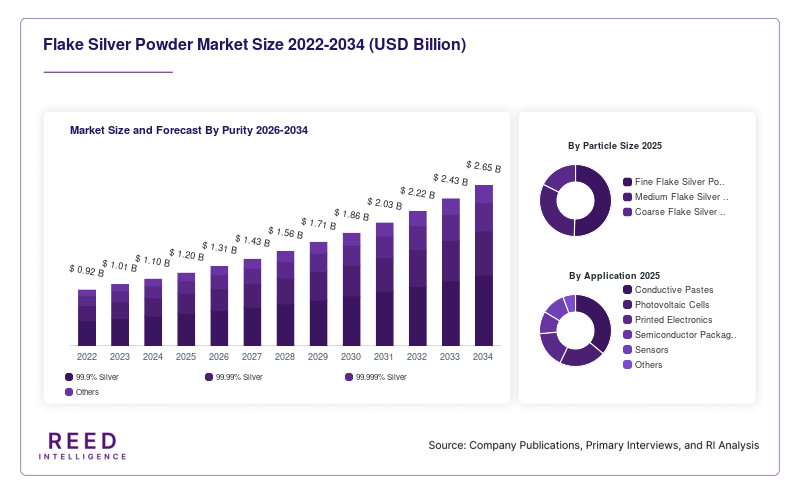
99.99% purity silver powder accounted for approximately 46% of the flake silver powder market in 2025, making it the largest purity segment. Its combination of high conductivity, purity and suitability for electronic and industrial applications supports widespread adoption.
99.999% purity silver powder accounted for approximately 21% and is projected to grow at approximately 10.2% CAGR, making it the fastest-growing major purity segment. Increasing requirements for highly reliable electronic and semiconductor applications are supporting demand.
99.9% purity represented approximately 27%, while other purity grades accounted for approximately 6%.
Particle Size Segment Analysis
By Particle Size
Fine flake silver powder accounted for approximately 48% of the market in 2025, making it the largest particle-size segment. Fine particles provide desirable characteristics for conductive formulations and advanced electronic applications.
Medium flake silver powder accounted for approximately 35% and is projected to grow at approximately 9.4% CAGR, making it the fastest-growing major particle-size segment. Its balance of conductivity, processing characteristics and cost makes it suitable for a broad range of industrial applications.
Coarse flake silver powder represented approximately 17% of the market.
Application Segment Analysis
By Application
Conductive pastes accounted for approximately 42% of the market in 2025, making them the largest application segment. Silver's high conductivity makes it an important material in conductive formulations used for electronic components and circuits.
Printed electronics accounted for approximately 15% and are projected to grow at approximately 11.0% CAGR, making them the fastest-growing major application segment. Increasing adoption of flexible circuits, sensors and printed electronic devices is supporting growth.
Photovoltaic cells represented approximately 25%, semiconductor packaging 10%, sensors 5%, and other applications approximately 3%.
End-User Segment Analysis
By End User
Electronics and semiconductor manufacturers accounted for approximately 43% of the market in 2025, making them the largest end-user segment. Increasing electronic-device production, component miniaturization and semiconductor packaging requirements are supporting demand.
Solar-energy manufacturers accounted for approximately 25% and are projected to grow at approximately 10.5% CAGR, making them the fastest-growing major end-user segment. Expansion of photovoltaic manufacturing and global solar deployment is driving consumption of silver-based conductive materials.
Automotive represented approximately 12%, telecommunications 8%, industrial applications 7%, and other end users approximately 5%.
Flake Silver Powder Market Regional Analysis
Asia-Pacific Holds the Largest Share
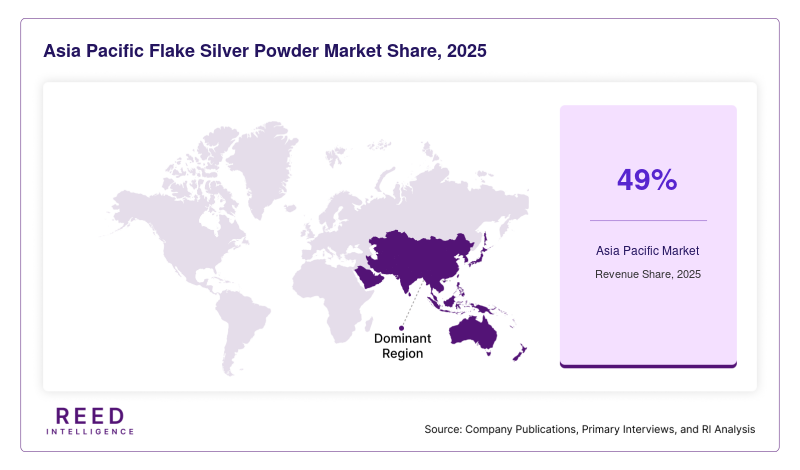
Asia-Pacific accounted for approximately 49% of the global flake silver powder market in 2025, making it the largest regional market. The region benefits from extensive electronics manufacturing, semiconductor production, photovoltaic manufacturing and expanding electric-vehicle production.
Asia-Pacific is also projected to grow at approximately 10.4% CAGR, making it the fastest-growing major region. Increasing electronics production and solar-cell manufacturing in China, Japan, South Korea and other Asian markets are supporting demand.
North America Maintains Advanced-Technology Demand
North America accounted for approximately 21% of the market in 2025 and is projected to grow at approximately 8.1% CAGR.
The region benefits from semiconductor research, advanced electronics manufacturing, renewable-energy investment and increasing demand for high-performance conductive materials.
Europe Shows Growth Through Automotive Electrification
Europe accounted for approximately 19% of the market in 2025 and is projected to grow at approximately 8.0% CAGR.
Growth is supported by automotive electrification, renewable-energy deployment, electronics manufacturing and investments in advanced materials.
Latin America Represents an Emerging Market
Latin America accounted for approximately 6% of the market in 2025 and is projected to grow at approximately 7.4% CAGR.
Increasing renewable-energy investments and expansion of electronics-related manufacturing are creating opportunities.
Middle East & Africa Offers Long-Term Potential
Middle East & Africa accounted for approximately 5% of the market in 2025 and is projected to grow at approximately 7.1% CAGR.
Solar-energy development and diversification of industrial and electronics capabilities are supporting gradual market expansion.
Flake Silver Powder Market Competitive Landscape
Competition in the flake silver powder market is based on purity, particle size, particle morphology, conductivity, dispersion characteristics, production consistency, customization capabilities and cost efficiency.
Manufacturers are investing in advanced powder-processing technologies to improve particle characteristics while reducing material waste and production costs.
Key Market Players
- DOWA Electronics Materials Co., Ltd.
- Ferro Corporation
- Ames Goldsmith Corporation
- Metalor Technologies International SA
- Mitsui Mining & Smelting Co., Ltd.
- TANAKA Precious Metals
- Umicore
- American Elements
- Fujifilm Wako Pure Chemical Corporation
- KAKEN TECH Co., Ltd.
Flake Silver Powder Market Recent Developments
- Manufacturers are increasingly developing silver powders and conductive formulations that achieve required electrical performance with lower silver consumption. This is particularly relevant to cost-sensitive electronics and photovoltaic applications.
- Producers are refining particle morphology, size distribution and surface characteristics to improve conductivity and dispersion. These improvements can enhance the performance of conductive pastes and printed electronic materials.
Flake Silver Powder Market Segments
By Purity
- 99.9% Silver
- 99.99% Silver
- 99.999% Silver
- Others
By Particle Size
- Fine Flake Silver Powder
- Medium Flake Silver Powder
- Coarse Flake Silver Powder
By Application
- Conductive Pastes
- Photovoltaic Cells
- Printed Electronics
- Semiconductor Packaging
- Sensors
- Others
By End User
- Electronics & Semiconductors
- Solar Energy
- Automotive
- Telecommunications
- Industrial
- Others
By Region
- North America
- Europe
- APAC
- Middle East and Africa
- LATAM