Fuel Quality Testing Market Size, Share & Trends Analysis Report By Fuel Type, By Testing Method, By Application, By End User and By Region, Forecasts 2026–2034
USD 3950
Fuel Quality Testing Market Size
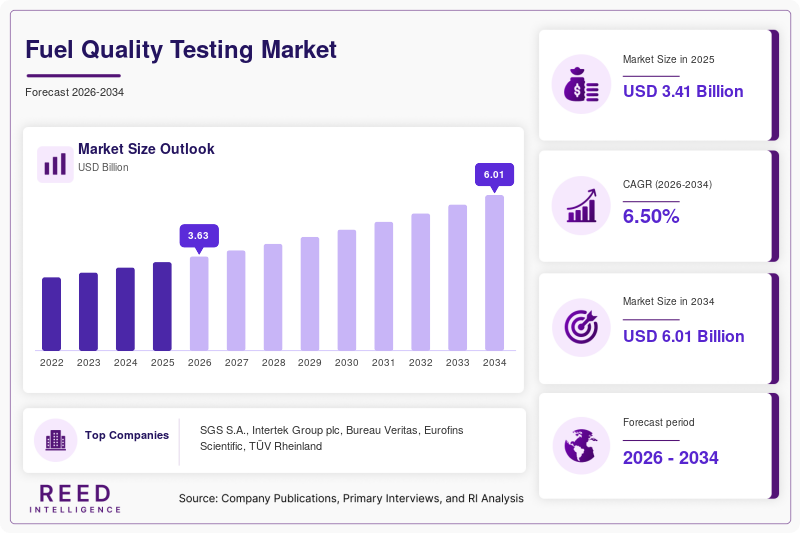
The global fuel quality testing market was valued at USD 3.41 billion in 2025 and is projected to grow from USD 3.63 billion in 2026 to USD 6.01 billion by 2034, registering a CAGR of 6.50% during the forecast period from 2026 to 2034.
Fuel quality testing refers to the laboratory and field-based analysis of fuels to determine their chemical, physical and performance characteristics. Testing services are used to assess parameters such as density, viscosity, flash point, sulfur content, water contamination, octane or cetane characteristics, composition and overall compliance with applicable fuel specifications.
The market is supported by increasing fuel-quality regulations, the international movement of petroleum products, growing demand for reliable fuel performance and the expansion of testing requirements across refining, transportation, aviation, marine and power-generation industries.
Fuel Quality Testing Market Drivers
Increasing Fuel Quality Regulations
Governments and regulatory bodies are implementing increasingly stringent fuel-quality and emissions requirements.
Testing enables refiners, distributors and fuel users to verify that products meet required specifications before commercialization or consumption.
Growth in Petroleum Product Trade
Fuel is traded across international markets through complex supply chains involving producers, storage terminals, transportation companies and distributors.
Independent testing helps establish product quality and specification compliance at different points in the supply chain.
Rising Demand for Fuel Performance
Fuel quality directly affects engine performance, fuel efficiency, emissions and equipment reliability.
Automotive, aviation, marine and industrial operators increasingly rely on testing to identify contamination and quality deviations.
Increasing Use of Biofuel Blends
The incorporation of ethanol, biodiesel, renewable diesel and other alternative components into conventional fuels creates additional testing requirements.
Laboratories need to evaluate fuel composition, stability and compatibility to ensure that blended products meet specifications.
Expansion of Aviation and Marine Fuel Testing
Aviation and marine operations require strict fuel-quality controls because fuel problems can affect equipment performance and operational reliability.
Growth in air and maritime transportation therefore supports specialized fuel-testing demand.
Fuel Quality Testing Market Restraints
High Cost of Advanced Testing Equipment
Modern fuel laboratories require sophisticated analytical instruments for chemical composition, trace contaminants and performance testing.
The initial investment can be substantial for smaller laboratories and testing facilities.
Complexity of Fuel Formulations
The growing variety of fuel formulations and blended products requires laboratories to maintain specialized analytical capabilities.
Testing complexity can increase turnaround times and operating costs.
Availability of In-House Testing Facilities
Large refiners and fuel companies may maintain their own laboratories rather than outsourcing all testing requirements.
This can limit demand for independent testing services in certain applications.
Skilled Personnel Requirements
Advanced fuel analysis requires trained laboratory professionals capable of operating analytical instruments and interpreting test results.
A shortage of specialized personnel can constrain laboratory expansion.
Fuel Quality Testing Market Opportunities
Testing of Renewable and Alternative Fuels
The growth of renewable diesel, sustainable aviation fuel, biodiesel and other alternative fuels is creating new testing requirements.
Testing providers can expand their capabilities to cover emerging fuel compositions and specifications.
Growth of Sustainable Aviation Fuel
Increasing development and adoption of sustainable aviation fuel is creating opportunities for specialized testing related to composition, contaminants, thermal stability and fuel-performance characteristics.
Digitalization of Testing Laboratories
Laboratories are increasingly adopting laboratory information management systems, automated instruments and digital reporting platforms.
Digitalization can improve traceability, productivity and turnaround times.
Portable Fuel Testing
Portable analytical equipment allows fuel quality checks to be performed closer to storage facilities, transportation points and end users.
Demand for rapid field testing can create opportunities for portable testing technologies.
Expansion of Independent Inspection Services
Independent testing and inspection can provide greater confidence in fuel quality during transactions between producers, traders and users.
Increasing complexity in fuel supply chains is supporting demand for third-party verification.
Fuel Type Segment Analysis
By Fuel Type
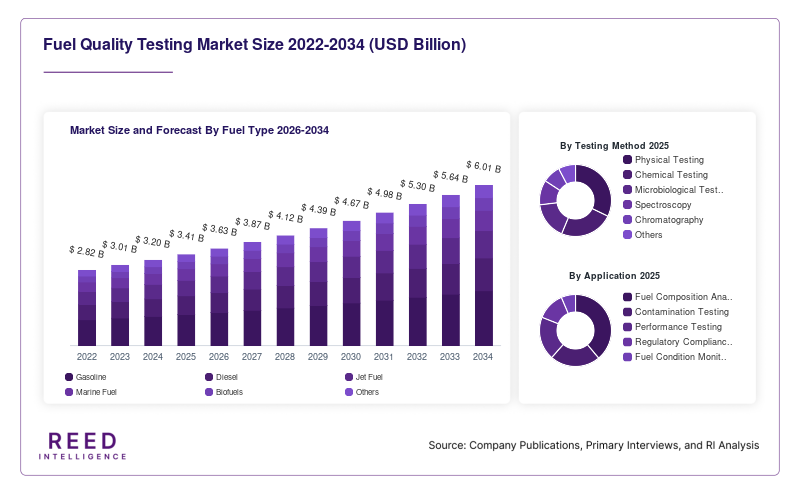
Diesel accounted for approximately 34% of the fuel quality testing market in 2025, making it the largest fuel-type segment. Its extensive use in commercial transportation, industrial equipment, logistics and power generation creates substantial demand for quality and contamination testing.
Biofuels accounted for approximately 14% and are projected to grow at approximately 9.2% CAGR, making them the fastest-growing major fuel-type segment. Increasing use of biodiesel, renewable diesel and blended fuels is creating additional analytical requirements.
Gasoline represented approximately 28%, jet fuel 16%, marine fuel 5%, and other fuels approximately 3%.
Testing Method Segment Analysis
By Testing Method
Chemical testing accounted for approximately 31% of the market in 2025, making it the largest testing-method segment. Chemical analysis is widely used to determine fuel composition, contaminants and specification-related parameters.
Spectroscopy accounted for approximately 17% and is projected to grow at approximately 8.1% CAGR, making it the fastest-growing major testing-method segment. Increasing demand for rapid and precise compositional analysis is supporting adoption.
Physical testing represented approximately 26%, chromatography 18%, microbiological testing 4%, and other methods approximately 4%.
Application Segment Analysis
By Application
Fuel composition analysis accounted for approximately 30% of the market in 2025, making it the largest application segment. Composition testing is essential for verifying fuel characteristics and ensuring that products comply with applicable specifications.
Fuel Condition Monitoring accounted for approximately 17% and is projected to grow at approximately 7.7% CAGR, making it the fastest-growing major application segment. Increasing emphasis on preventing contamination, degradation and equipment-related fuel problems is supporting demand.
Contamination testing represented approximately 25%, performance testing 18%, and regulatory compliance testing approximately 10%.
End-User Segment Analysis
By End User
Oil and gas companies accounted for approximately 31% of the market in 2025, making them the largest end-user segment. Refiners, producers and fuel suppliers require extensive testing throughout production, storage and distribution.
Aviation accounted for approximately 14% and is projected to grow at approximately 7.8% CAGR, making it one of the fastest-growing major end-user segments. Strict aviation fuel specifications and increasing air-transport activity support specialized fuel-testing requirements.
Refineries represented approximately 22%, fuel distributors and traders 12%, marine 8%, automotive 7%, power generation 4%, and other end users approximately 2%.
Fuel Quality Testing Market Regional Analysis
North America Holds the Largest Share
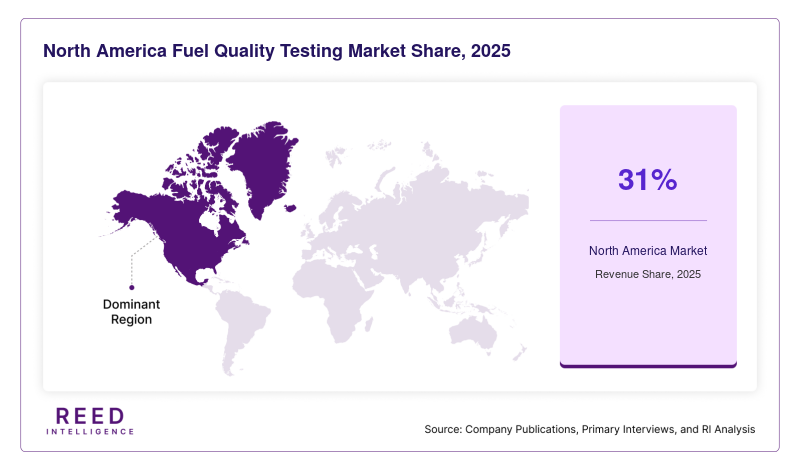
North America accounted for approximately 31% of the global fuel quality testing market in 2025, making it the largest regional market. The region benefits from extensive petroleum infrastructure, established testing laboratories, fuel-quality regulations and large transportation and industrial markets.
Asia-Pacific accounted for approximately 30% and is projected to grow at approximately 8.0% CAGR, making it the fastest-growing major region. Expanding refining capacity, growing transportation fuel consumption, industrialization and increasing adoption of fuel-quality standards are supporting market growth.
Europe Maintains Strong Regulatory Demand
Europe accounted for approximately 25% of the market in 2025 and is projected to grow at approximately 5.8% CAGR.
Strict fuel-quality and emissions requirements, renewable-fuel adoption and established laboratory infrastructure support demand for fuel testing.
Latin America Shows Increasing Demand
Latin America accounted for approximately 8% of the market in 2025 and is projected to grow at approximately 6.5% CAGR.
Growing fuel consumption, refining activity and development of biofuel markets are supporting demand for testing services.
Middle East & Africa Represents an Emerging Market
Middle East & Africa accounted for approximately 6% of the market in 2025 and is projected to grow at approximately 6.3% CAGR.
The region's large petroleum industry, expanding refining capacity and increasing fuel-trade activity are supporting market opportunities.
Fuel Quality Testing Market Competitive Landscape
Competition in the fuel quality testing market is based on testing accuracy, laboratory capabilities, turnaround time, geographic coverage, accreditation, regulatory expertise, technology, pricing and industry specialization.
Testing companies are expanding analytical capabilities for conventional fuels, biofuels and emerging low-carbon fuel products while investing in automation and digital laboratory systems.
Key Market Players
- SGS S.A.
- Intertek Group plc
- Bureau Veritas
- Eurofins Scientific
- TÜV Rheinland
- TÜV SÜD
- Applus+
- ALS Limited
- AmSpec Group
- Core Laboratories
Fuel Quality Testing Market Recent Developments
- Testing laboratories are expanding capabilities for biodiesel, renewable diesel and other alternative fuel products. The increasing diversity of fuel formulations is creating demand for analytical methods capable of assessing composition, stability and contaminants.
- The development of sustainable aviation fuel is increasing demand for specialized analytical testing. Testing is used to assess fuel characteristics and verify compliance with aviation specifications.
Fuel Quality Testing Market Segments
By Fuel Type
- Gasoline
- Diesel
- Jet Fuel
- Marine Fuel
- Biofuels
- Others
By Testing Method
- Physical Testing
- Chemical Testing
- Microbiological Testing
- Spectroscopy
- Chromatography
- Others
By Application
- Fuel Composition Analysis
- Contamination Testing
- Performance Testing
- Regulatory Compliance Testing
- Fuel Condition Monitoring
By End User
- Oil & Gas Companies
- Refineries
- Fuel Distributors & Traders
- Aviation
- Marine
- Automotive
- Power Generation
- Others
By Region
- North America
- Europe
- APAC
- Middle East and Africa
- LATAM