Crane Cameras Market Size, Share, Demand Report By Type (Fixed Crane Cameras, PTZ Crane Cameras, Wireless Crane Cameras), By Application (Construction Sites, Ports & Logistics, Mining Operations), By Distribution Channel (Direct Sales, Equipment Distributors, System Integrators, Online Sales, Industrial Safety Suppliers) By Region & Segment Forecasts, 2026–2034
USD 3950
Crane Cameras Market Size
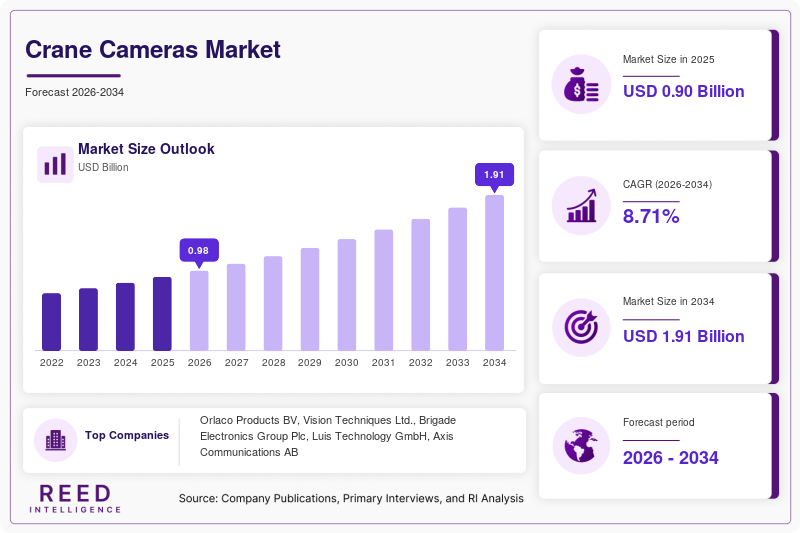
Crane Cameras market size is projected at USD 0.98 billion in 2026 and is expected to hit USD 1.91 billion by 2034 with a CAGR of 8.71%. Increasing workplace safety regulations, growing infrastructure development projects, and rising adoption of remote monitoring technologies are supporting industry expansion. The report provides detailed analysis of market segmentation, technology adoption, production volumes, and competitive landscape across major global regions.
The Crane Cameras market comprises camera systems installed on cranes to improve operational visibility, safety, load monitoring, and equipment management. Global production exceeded 5.8 million units in 2025, with wireless camera systems accounting for approximately 41% of total shipments. Construction applications contributed nearly 48% of industry revenue, while ports and logistics represented 29%. Adoption of camera-assisted crane operations surpassed 54% across large-scale infrastructure projects, reinforcing the Crane Cameras market.
Crane Cameras Market Trends
Rising Adoption of Wireless and AI-Enabled Monitoring Systems
Manufacturers are increasingly introducing wireless high-definition camera systems equipped with AI-assisted object detection and real-time monitoring capabilities. More than 2.4 million wireless crane camera units were shipped globally during 2025, representing over 41% of total production. Adoption of remote monitoring technologies increased from 33% in 2022 to 52% in 2025. Growing emphasis on workplace safety and operational efficiency continues to shape Crane Cameras trends.
The integration of cloud connectivity, low-latency video transmission, and predictive maintenance capabilities is accelerating technology transformation. Nearly 46% of newly deployed crane monitoring systems incorporated wireless video communication features during 2025. Ports, logistics facilities, and mining operations collectively accounted for over 2 million camera installations. Demand for advanced visibility systems remains a defining factor in Crane Cameras trends.
Crane Cameras Market Drivers
Increasing Infrastructure Development and Workplace Safety Requirements
Global infrastructure investments exceeded USD 3.4 trillion in 2025, generating substantial demand for crane monitoring solutions. More than 780,000 tower cranes and mobile cranes were active across major construction projects worldwide. Safety compliance regulations expanded by approximately 11% across industrialized economies, while installation rates of camera-equipped cranes increased by 9.4% year-over-year. These developments continue to support Crane Cameras market growth.
Crane Cameras Market Restraints
High Equipment and Installation Costs
Advanced crane camera systems can increase equipment costs by 20% to 45% compared with conventional monitoring methods. Installation and maintenance expenses rose by approximately 6.5% during 2025 due to increasing demand for ruggedized hardware and connectivity solutions. Nearly 31% of small contractors continue to delay technology upgrades because of budget constraints. Such factors limit broader adoption of the Crane Cameras market.
Crane Cameras Market Opportunities
Expansion of Smart Construction and Industrial Automation
The global smart construction sector surpassed USD 38 billion in 2025, creating strong opportunities for advanced crane monitoring technologies. Adoption of connected construction equipment increased by 14% year-over-year, while more than 1.2 million cranes worldwide integrated digital monitoring solutions. Automated load management and AI-assisted safety systems are creating new revenue streams within the Crane Cameras market.
Challenges in Crane Cameras Market
Harsh Operating Environments and Connectivity Limitations
Crane cameras frequently operate under extreme temperatures, dust exposure, heavy rainfall, and vibration conditions. Approximately 22% of industrial operators reported connectivity disruptions in remote worksites during 2025. Equipment downtime associated with communication failures increased by 4.7% across selected mining and construction operations. Addressing durability and network reliability remains a critical challenge for the Crane Cameras market.
Crane Cameras Market Segmentation
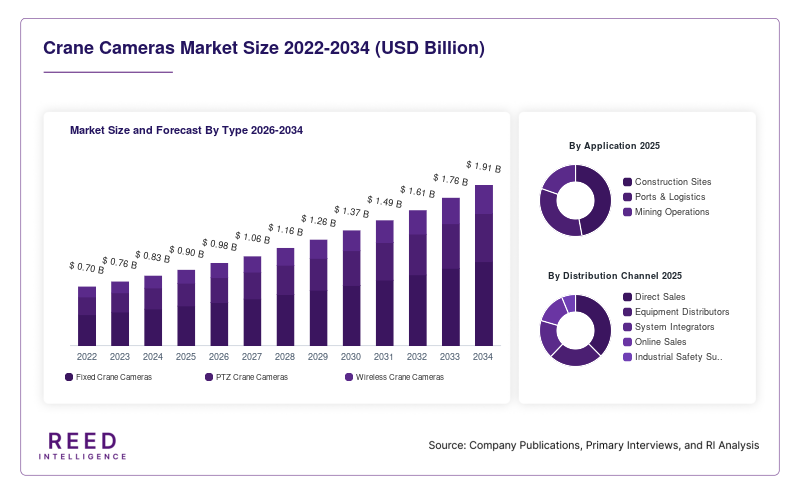
The market is segmented by type and application, with wireless crane cameras accounting for approximately 41% of revenue during 2025. Construction site applications dominated the market with nearly 48% share due to increasing infrastructure investments and stricter safety requirements.
By Type
Fixed crane cameras represented approximately 30% of total market revenue during 2025. Production exceeded 1.7 million units globally. These systems provide continuous monitoring from designated viewing angles and are widely utilized in cost-sensitive construction and industrial applications.
PTZ crane cameras accounted for nearly 29% of industry revenue. Annual production surpassed 1.6 million units. These systems offer pan, tilt, and zoom functionality, enabling operators to monitor multiple work zones and improve load positioning accuracy across large operational environments.
Wireless crane cameras held the leading share of approximately 41%. Production exceeded 2.4 million units during 2025. Features such as real-time HD transmission, reduced cabling requirements, and remote accessibility have increased adoption rates across construction, logistics, and mining operations.
By Application
Construction sites accounted for approximately 48% of total market revenue. More than 2.7 million camera units were deployed across residential, commercial, and infrastructure projects during 2025. Usage penetration exceeded 57% among large-scale urban development projects, driven by safety and productivity requirements.
Ports and logistics applications represented nearly 29% of market revenue. Annual installations exceeded 1.6 million units across container terminals, shipping facilities, and distribution centers. Camera systems play a critical role in cargo handling, operator visibility, and accident prevention.
Mining operations contributed approximately 23% of industry revenue. More than 1.3 million camera units were installed globally in 2025. High-durability camera systems support equipment monitoring, worker safety, and operational efficiency in challenging environmental conditions.
Crane Cameras Regional Outlook
North America Crane Cameras Market
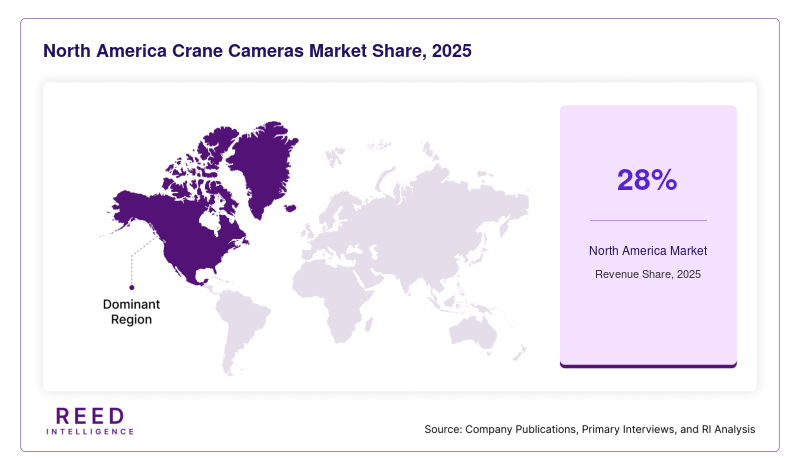
North America accounted for approximately 28% of global revenue during 2025. The United States contributed nearly 80% of regional demand, supported by infrastructure modernization projects and workplace safety regulations. Annual consumption exceeded 1.5 million units.
Europe Crane Cameras Market
Europe represented approximately 26% of global market revenue. Germany, the United Kingdom, France, and Italy collectively accounted for over 67% of regional demand. Production and installation volumes exceeded 1.3 million units across industrial and construction sectors.
Asia-Pacific Crane Cameras Market
Asia-Pacific dominated the market with approximately 36% revenue share and over 48% of global production output. China produced more than 2.2 million units annually, while India, Japan, and South Korea experienced strong growth in infrastructure and industrial automation investments.
Latin America Crane Cameras Market
Latin America accounted for nearly 6% of global revenue. Brazil and Mexico collectively contributed more than 61% of regional demand. Annual installations exceeded 350,000 units across construction and mining operations.
Middle East & Africa Crane Cameras Market
The Middle East & Africa region represented approximately 4% of total revenue. Saudi Arabia, the UAE, and South Africa emerged as key markets. Infrastructure megaprojects and mining activities supported installations exceeding 250,000 units during 2025.
Top players in Crane Cameras Market
- Orlaco Products BV
- Vision Techniques Ltd.
- Brigade Electronics Group Plc
- Luis Technology GmbH
- Axis Communications AB
- Hikvision Digital Technology Co., Ltd.
- Dahua Technology Co., Ltd.
- Bosch Security Systems
- Rear View Safety Inc.
- Motec GmbH
- The Crosby Group
- Prolec Ltd.
- Wipac Ltd.
- VEI Group
- Tadano Ltd.
Orlaco Products BV
- Estimated market share ranges between 14% and 16%.
- Recognized as a leading supplier of vision solutions for cranes, heavy equipment, and industrial machinery.
- Strong presence in Europe, North America, and Asia-Pacific markets.
- Focuses on high-definition wireless monitoring systems and ruggedized camera technologies.
- Extensive product portfolio supports construction, logistics, and mining applications.
- Continuous investment in safety-focused innovations and operator assistance technologies strengthens its competitive position in the Crane Cameras market.
Brigade Electronics Group Plc
- Estimated market share ranges between 10% and 12%.
- Maintains a strong position in industrial safety and vehicle monitoring systems.
- Offers advanced camera-monitor systems, obstacle detection technologies, and wireless visibility solutions.
- Serves major construction, transportation, and logistics customers globally.
- Strong distribution partnerships support broad market penetration.
- Ongoing product development initiatives focused on connected safety technologies contribute to long-term market expansion.
Recent Developments in Crane Cameras Market
- 2026: Multiple manufacturers introduced AI-powered crane camera systems with object recognition and collision warning capabilities.
- 2025: Wireless HD camera solutions with extended transmission ranges were launched for large infrastructure projects.
- 2025: Several industrial equipment suppliers integrated cloud-connected monitoring platforms into crane safety systems.
Crane Cameras Market Segments
By Type
- Fixed Crane Cameras
- PTZ Crane Cameras
- Wireless Crane Cameras
By Application
- Construction Sites
- Ports & Logistics
- Mining Operations
By Distribution Channel
- Direct Sales
- Equipment Distributors
- System Integrators
- Online Sales
- Industrial Safety Suppliers
By Region
- North America
- Europe
- APAC
- Middle East and Africa
- LATAM