Extendable Makeup Mirrors Market Size, Share, Demand Report By Type (Wall-Mounted Extendable Mirrors, Tabletop Extendable Mirrors, LED Extendable Mirrors), By Application (Residential Use, Commercial Use, Professional Beauty Use) By Region & Segment Forecasts, 2026–2034
USD 3950
Extendable Makeup Mirrors Market Size
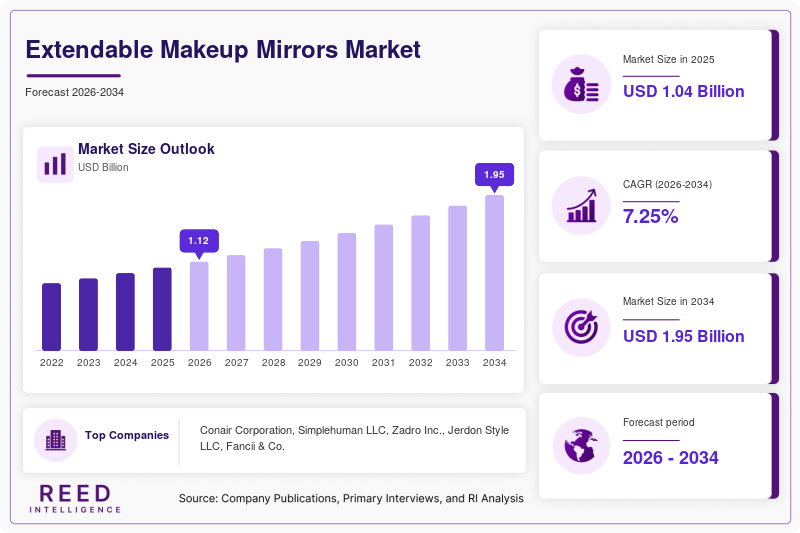
Extendable Makeup Mirrors market size is projected at USD 1.12 billion in 2026 and is expected to hit USD 1.96 billion by 2034 with a CAGR of 7.25%. The market expansion is supported by rising consumer spending on personal grooming products, increasing demand for smart beauty accessories, and wider availability through online retail channels. Detailed market evaluation includes segment-level analysis, competitive benchmarking, production capacity assessment, and distribution network evaluation across major economies.
The Extendable Makeup Mirrors market comprises adjustable cosmetic mirrors designed for grooming, skincare, and makeup applications. Global production exceeded 68 million units in 2025, with Asia-Pacific contributing nearly 48% of manufacturing output. Residential users accounted for approximately 61% of total installations, while professional beauty establishments represented 22% of total consumption. Penetration of LED-enabled mirrors surpassed 46% in premium product categories. Growing consumer preference for magnification functionality, flexible extension arms, and energy-efficient lighting continues to strengthen the Extendable Makeup Mirrors market.
Extendable Makeup Mirrors Market Trends
Rising Adoption of Smart and LED-Integrated Mirrors
Manufacturers are increasingly incorporating touch sensors, dimmable LED systems, Bluetooth connectivity, and rechargeable battery technology into products. More than 31 million LED extendable mirrors were shipped globally during 2025, representing over 45% of total industry volume. Adoption rates of smart lighting features increased from 28% in 2022 to nearly 43% in 2025. Premium cosmetic retailers and beauty studios are accelerating procurement of technologically advanced mirrors, reinforcing Extendable Makeup Mirrors market trends.
Growing demand for sustainable materials and energy-efficient components is reshaping product development strategies. Recycled aluminum and low-power LED modules now account for approximately 36% of new product launches. Online sales channels generated nearly 54% of total unit sales during 2025, compared with 41% in 2022. Consumer demand for portable, foldable, and multifunctional mirrors remains strong across urban households, supporting Extendable Makeup Mirrors market trends.
Extendable Makeup Mirrors Market Drivers
Growing Beauty and Personal Care Expenditure Worldwide
Global beauty and personal care expenditure exceeded USD 640 billion in 2025, creating favorable conditions for cosmetic accessory sales. More than 72% of urban consumers use dedicated grooming mirrors regularly, while demand from beauty salons increased by 8.4% year-over-year. Approximately 18 million new residential installations were recorded during 2025. Rising investments in personal grooming and skincare routines continue to accelerate Extendable Makeup Mirrors market growth.
Extendable Makeup Mirrors Market Restraints
Price Sensitivity and Availability of Low-Cost Alternatives
The presence of conventional mirrors priced 40%–70% lower than extendable variants limits adoption in cost-sensitive markets. Nearly 35% of consumers in developing economies continue to prefer standard mirrors due to affordability concerns. Fluctuations in aluminum, stainless steel, and LED component costs increased production expenses by 6.8% during 2025. These factors restrict broader penetration of premium products within the Extendable Makeup Mirrors market.
Extendable Makeup Mirrors Market Opportunities
Expansion of E-Commerce and Smart Home Integration
Online beauty accessory sales surpassed USD 18 billion globally in 2025, creating substantial opportunities for manufacturers. Smart home adoption reached approximately 24% of households in developed markets, increasing demand for connected grooming products. Companies introducing voice-controlled lighting and adjustable magnification features reported sales increases ranging from 12% to 18%. Digital retail expansion continues to create favorable Extendable Makeup Mirrors market opportunities.
Challenges in Extendable Makeup Mirrors Market
Intense Competition and Product Differentiation
More than 400 organized manufacturers and numerous regional suppliers compete globally, creating pricing pressure across multiple product categories. Average selling prices declined by approximately 4% between 2023 and 2025 despite technological enhancements. Counterfeit and low-quality imports represent nearly 9% of total unit volume in selected regions. Continuous innovation remains necessary for maintaining competitiveness within the Extendable Makeup Mirrors market.
Extendable Makeup Mirrors Market Segmentation
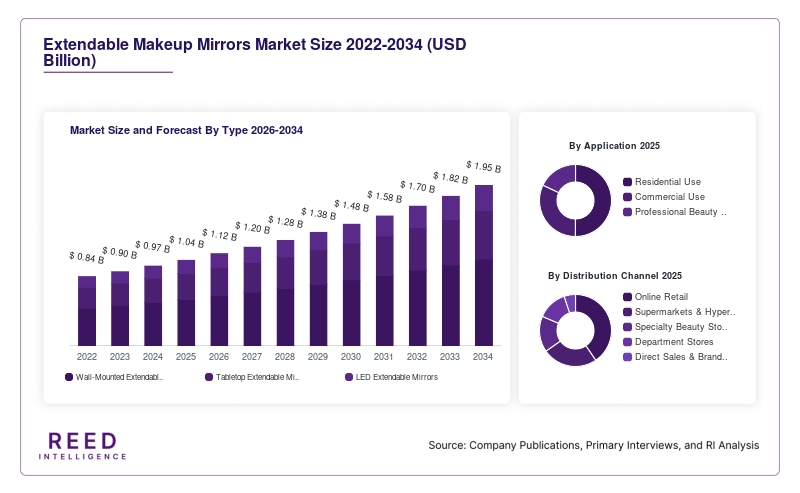
The market is segmented by type and application, with LED extendable mirrors accounting for approximately 42% of revenue share during 2025. Residential applications remained dominant with over 61% share, supported by increasing household grooming expenditures and rising online product accessibility.
By Type
Wall-mounted products represented nearly 34% of global revenue in 2025. Annual production exceeded 23 million units, supported by strong demand from hotels, residential bathrooms, and luxury apartments. Typical extension lengths range between 25 cm and 45 cm, with magnification levels reaching 10x.
Tabletop mirrors accounted for approximately 24% of market revenue. Production surpassed 16 million units in 2025. These products feature portability, compact dimensions, and dual-sided reflective surfaces, making them suitable for residential and travel applications.
LED extendable mirrors held the largest share at around 42%. Global production exceeded 29 million units during 2025. Advanced models include adjustable brightness, color-temperature control, and rechargeable batteries. Penetration among premium consumers surpassed 55%.
By Application
Residential applications generated approximately 61% of total revenue. More than 41 million units were sold to households in 2025. Growing skincare awareness, beauty influencer marketing, and home grooming routines continue to increase adoption rates above 70% among urban consumers.
Commercial facilities including hotels, spas, and wellness centers accounted for around 21% of market revenue. Annual installations exceeded 14 million units. Premium hospitality establishments increasingly utilize LED-equipped mirrors to enhance guest experiences and operational efficiency.
Professional beauty applications represented approximately 18% of total revenue. More than 12 million units were deployed across salons, makeup studios, and dermatology clinics. High-magnification optics, adjustable arms, and advanced illumination systems remain essential technical requirements.
Extendable Makeup Mirrors Regional Outlook
North America Extendable Makeup Mirrors Market
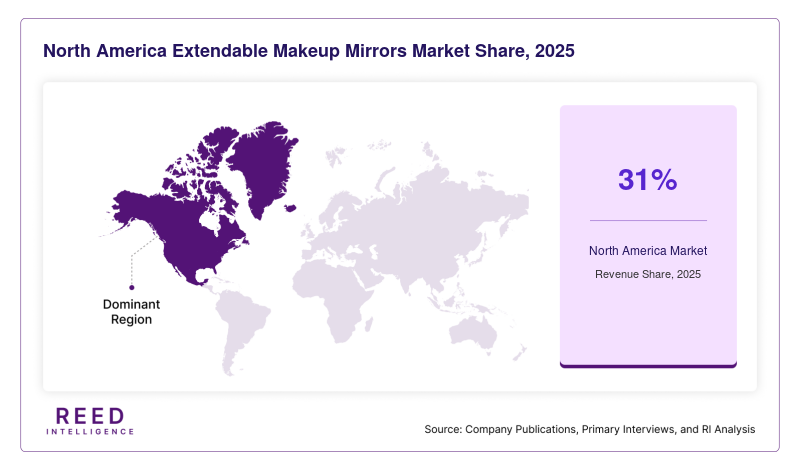
North America accounted for approximately 31% of global revenue during 2025. The United States contributed nearly 78% of regional sales, while Canada represented 15%. Annual consumption exceeded 18 million units, supported by high disposable income and premium beauty product adoption.
Europe Extendable Makeup Mirrors Market
Europe held around 27% market share. Germany, the United Kingdom, France, and Italy collectively contributed more than 68% of regional demand. Production volume surpassed 14 million units, with strong preference for sustainable and energy-efficient products.
Asia-Pacific Extendable Makeup Mirrors Market
Asia-Pacific dominated global manufacturing with nearly 48% of production output and accounted for approximately 32% of revenue. China produced over 26 million units annually, while Japan, South Korea, and India demonstrated rising consumer adoption. E-commerce penetration exceeded 58% across key markets.
Latin America Extendable Makeup Mirrors Market
Latin America represented about 6% of global revenue. Brazil accounted for more than 42% of regional demand, supported by expanding beauty and cosmetics industries. Annual consumption exceeded 3.5 million units.
Middle East & Africa Extendable Makeup Mirrors Market
The region contributed approximately 4% of global sales. The UAE, Saudi Arabia, and South Africa emerged as key markets. Luxury hospitality projects and growing beauty awareness supported consumption of over 2 million units in 2025.
Top players in Extendable Makeup Mirrors
- Conair Corporation
- Simplehuman LLC
- Zadro Inc.
- Jerdon Style LLC
- Fancii & Co.
- KEDSUM
- Rucci International
- Danielle Creations
- Ovente
- Homedics Inc.
- Impressions Vanity
- Joseph Joseph Ltd.
- Glamcor Global LLC
- Riki Loves Riki
- Deweisn
Simplehuman LLC
- Estimated market share: 12%–14%.
- Maintains strong positioning in premium LED mirror categories.
- Focuses on sensor-activated lighting, Tru-Lux illumination systems, and rechargeable technology.
- Strong distribution across North America and Europe.
- Premium pricing strategy supports high revenue generation despite moderate shipment volumes.
- Continuous investment in product innovation strengthens brand recognition among professional and residential consumers.
Conair Corporation
- Estimated market share: 9%–11%.
- Broad product portfolio across mass-market and premium categories.
- Extensive retail presence through supermarkets, beauty chains, and e-commerce channels.
- Strong manufacturing scale supports competitive pricing and high-volume shipments.
- Expanding LED-enabled product offerings and portable mirror solutions improve customer reach.
- Established brand reputation contributes to consistent global sales performance.
Recent Developments in Extendable Makeup Mirrors
- 2026: Multiple manufacturers introduced USB-C rechargeable LED extendable mirrors with battery life exceeding 10 hours.
- 2025: Smart mirror launches featuring touchless controls and adjustable color temperature gained commercial adoption.
- 2025: Several companies expanded production facilities in Asia-Pacific to support rising global demand.
Extendable Makeup Mirrors Market Segments
By Type
- Wall-Mounted Extendable Mirrors
- Tabletop Extendable Mirrors
- LED Extendable Mirrors
By Application
- Residential Use
- Commercial Use
- Professional Beauty Use
By Distribution Channel
- Online Retail
- Supermarkets & Hypermarkets
- Specialty Beauty Stores
- Department Stores
- Direct Sales & Brand Stores
By Region
- North America
- Europe
- APAC
- Middle East and Africa
- LATAM