Gas-to-Liquid (GTL) Market Size, Share Demand Report By Technology (Fischer-Tropsch Synthesis, Methanol-to-Gasoline, Syngas Production), By Application (Liquid Fuels, Lubricants, Chemicals), Regional Insights & Segment Forecasts, 2026–2034
USD 3950
Gas-to-Liquid (GTL) Market Size
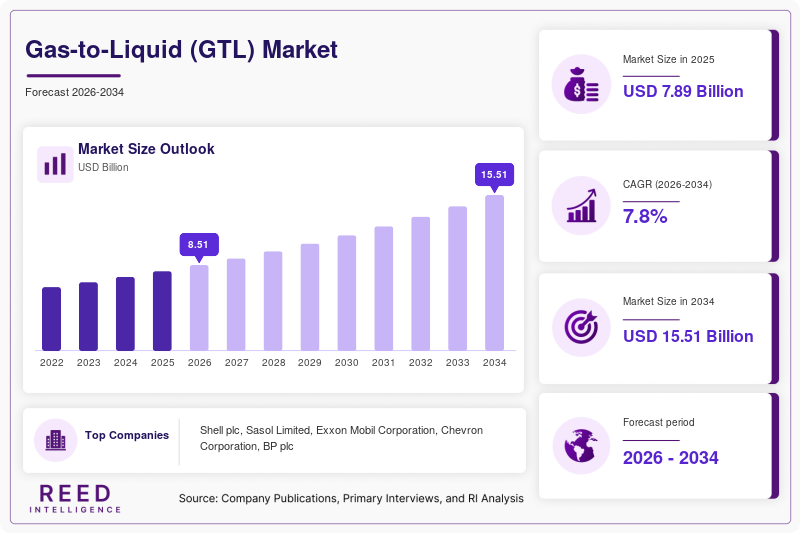
Gas-to-Liquid (GTL) market size is projected at USD 8.5 billion in 2026 and is expected to hit USD 15.2 billion by 2034 with a CAGR of 7.8% during the forecast period. The increasing demand for cleaner-burning fuels and high-quality synthetic products, the growing utilization of stranded natural gas reserves, and the rising focus on energy security and diversification underpin market expansion. This report delivers a comprehensive analysis of the Gas-to-Liquid (GTL) market, including segmentation by technology and application, competitive dynamics, and regional growth patterns, equipping stakeholders with critical intelligence. The Gas-to-Liquid (GTL) market continues to demonstrate robust growth potential, fueled by the global transition toward cleaner energy sources, the abundant natural gas resources, and the continuous innovation in GTL technology.
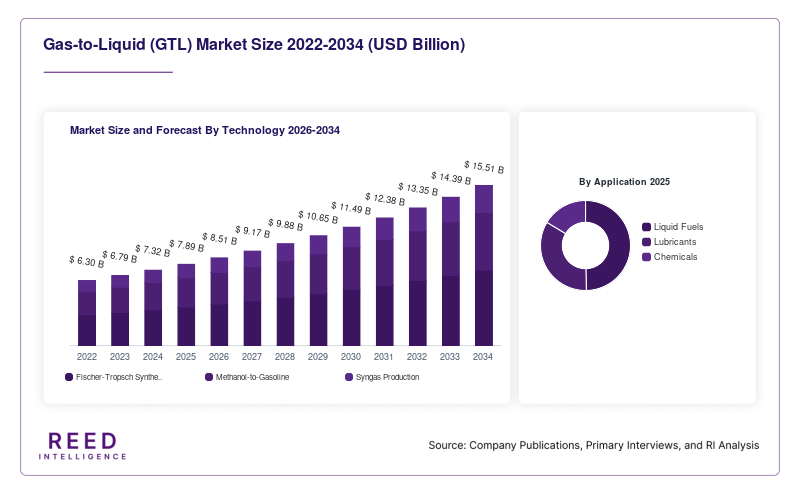
Gas-to-Liquid (GTL) technology is a process that converts natural gas or other gaseous hydrocarbons into liquid products, such as synthetic fuels, lubricants, and chemicals. The process typically involves the production of syngas (a mixture of hydrogen and carbon monoxide), followed by the Fischer-Tropsch synthesis or other conversion routes. The global GTL market is driven by the need for clean and high-performance liquid products. The global production capacity of GTL liquids exceeded 400,000 barrels per day in 2025, reflecting a 6% increase from 2022. Adoption patterns reveal that the Fischer-Tropsch synthesis segment dominates the market, accounting for 70% of total capacity, followed by methanol-to-gasoline at 20%, and syngas production at 10%. The Gas-to-Liquid (GTL) market's trajectory is closely linked to the growth of the global energy and chemicals markets, and the increasing demand for sulfur-free and high-quality synthetic products.
Gas-to-Liquid (GTL) Market Trends
Growing Demand for Cleaner Fuels and Specialty Products
The Gas-to-Liquid (GTL) market is witnessing a significant trend toward the production of cleaner fuels and specialty products, driven by stringent environmental regulations and the demand for high-performance materials. The revenue from GTL-derived products, such as synthetic diesel and jet fuel, grew to USD 5.0 billion in 2025, a year-on-year increase of 8%, as 40% of new GTL production in 2025 was directed towards fuel applications. Adoption rates of GTL diesel in the transportation sector reached 15%, with this figure projected to exceed 25% by 2030. The Gas-to-Liquid (GTL) market's trend toward cleaner fuels is reinforced by the need to reduce sulfur and aromatic content in fuels, the growing demand for high-cetane diesel, and the increasing focus on sustainable aviation fuels.
Increasing Focus on Small-Scale and Modular GTL Plants
The increasing focus on small-scale and modular GTL plants is a major trend shaping the Gas-to-Liquid (GTL) market, driven by the need to monetize stranded gas reserves and reduce capital costs. The market has seen a 20% increase in the development of small-scale GTL projects since 2022, with 15% of new investments in 2025 directed towards modular and compact designs. The use of advanced micro-channel reactors and intensified processes has also gained traction. The Gas-to-Liquid (GTL) market's trend toward modularization is reinforced by the need to lower entry barriers, reduce project lead times, and enable deployment in remote locations.
Gas-to-Liquid (GTL) Market Drivers
The Gas-to-Liquid (GTL) market's expansion is primarily driven by the increasing demand for cleaner-burning fuels, with the global transportation fuel market valued at USD 2 trillion in 2025 and growing. The abundance of natural gas reserves and the need to monetize stranded gas resources have also been major drivers. The growing focus on energy security and diversification has fueled interest in GTL technology. Additionally, the rising demand for high-quality synthetic lubricants and chemicals has driven market growth. The Gas-to-Liquid (GTL) market's growth is further reinforced by the continuous innovation in GTL technology, leading to improved efficiency and cost-effectiveness.
Gas-to-Liquid (GTL) Market Restraints
Despite favorable growth prospects, the Gas-to-Liquid (GTL) market faces significant constraints, primarily related to the high capital investment cost of GTL plants, which can be a barrier for new projects. The complexity of the technology and the need for large-scale operations can also be a constraint. The Gas-to-Liquid (GTL) market's growth is also tempered by the competition from other fuel sources and the volatility of oil and gas prices.
Gas-to-Liquid (GTL) Market Opportunities
The Gas-to-Liquid (GTL) market presents significant opportunities in the rapidly expanding market for sustainable aviation fuels (SAF), where the global market is projected to reach USD 15 billion by 2028. The adoption of GTL-derived SAF is expected to grow at a CAGR of 15% through 2034, driven by the need to decarbonize the aviation sector. Emerging opportunities also exist in the development of GTL for the production of high-value chemicals and waxes. The Gas-to-Liquid (GTL) market's opportunity profile is further enhanced by the growing trend of circular economy and the use of renewable feedstocks.
Challenges in Gas-to-Liquid (GTL) Market
The Gas-to-Liquid (GTL) market faces persistent challenges related to the management of high capital and operational costs, as GTL plants are highly complex and capital-intensive. The complexity of scaling up and integrating new technologies presents a challenge. The market is also contending with the challenge of ensuring a competitive cost position against conventional crude oil-derived products. Additionally, the Gas-to-Liquid (GTL) market is challenged by the need for continuous innovation to improve efficiency and reduce costs.
Gas-to-Liquid (GTL) Market Segmentation
The Gas-to-Liquid (GTL) market is segmented by Technology and Application to provide a comprehensive market perspective. By Technology, Fischer-Tropsch Synthesis dominates with a 70% market share, driven by its commercial maturity. The Application segment is led by Liquid Fuels, which accounts for 55% of the market, followed by Chemicals at 25%, and Lubricants at 20%.
By Technology
Fischer-Tropsch Synthesis represent the largest segment in the Gas-to-Liquid (GTL) market, commanding a 70% share, with a production capacity of 280,000 bpd in 2025. This technology is characterized by its ability to produce a wide range of hydrocarbons from syngas. Technical specifications include operating temperature and pressure, catalyst type, and product distribution. The Gas-to-Liquid (GTL) market's Fischer-Tropsch segment is driven by its use in large-scale commercial plants.
Methanol-to-Gasoline capture a 20% share of the Gas-to-Liquid (GTL) market, with a production capacity of 80,000 bpd in 2025. This technology is characterized by its production of high-octane gasoline from methanol. Technical specifications include methanol conversion, catalyst type, and product quality. The Gas-to-Liquid (GTL) market's MTG segment is driven by its use in producing high-quality gasoline.
Syngas Production represent the remaining 10% of the Gas-to-Liquid (GTL) market, with a production capacity of 40,000 bpd in 2025. This segment encompasses the initial step of converting natural gas into syngas. The Gas-to-Liquid (GTL) market's syngas segment is characterized by its role as a foundational technology.
By Application
Liquid Fuels dominates the Gas-to-Liquid (GTL) market, accounting for 55% of the production, representing 220,000 bpd in 2025. This segment includes use in transportation fuels, where GTL diesel and jet fuel offer superior properties. Usage penetration exceeds 10% in some premium fuel markets. The Gas-to-Liquid (GTL) market's liquid fuels segment is characterized by its focus on performance and emissions reduction.
Chemicals accounts for 25% of the Gas-to-Liquid (GTL) market, with a production volume of 100,000 bpd in 2025. This segment encompasses the production of chemical intermediates and base chemicals. The segment is growing at a steady CAGR, driven by the demand for high-quality feedstock. The Gas-to-Liquid (GTL) market's chemicals segment is characterized by its focus on purity and specificity.
Lubricants represents the remainder of the Gas-to-Liquid (GTL) market, accounting for 20% of total production, with 80,000 bpd in 2025. This segment includes use in high-performance lubricants and base oils. The segment is projected to grow at a steady CAGR through 2034. The Gas-to-Liquid (GTL) market's lubricants segment is characterized by its focus on high viscosity index and oxidation stability.
Gas-to-Liquid (GTL) Market Regional Outlook
Middle East & Africa Gas-to-Liquid (GTL) Market
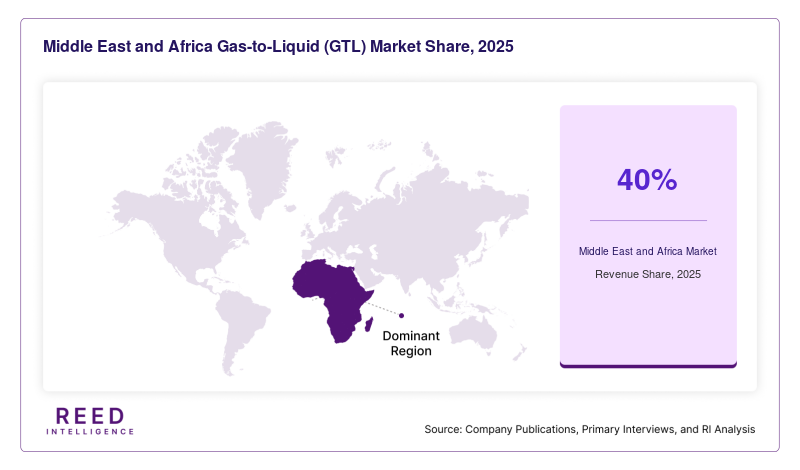
Leads the Gas-to-Liquid (GTL) market, commanding a 40% share, with a production capacity of 160,000 bpd in 2025. Qatar, Nigeria, and South Africa are the primary drivers, accounting for 70% of regional capacity, driven by the large gas reserves and the strategic focus on monetization. The Middle East & Africa Gas-to-Liquid (GTL) market is characterized by its large-scale projects.
Asia-Pacific Gas-to-Liquid (GTL) Market
Represents the second-largest market, capturing a 25% share with a production capacity of 100,000 bpd in 2025. China, India, and Australia are the primary drivers, accounting for 70% of regional demand, driven by the growing energy demand and the need for cleaner fuels. The Asia-Pacific Gas-to-Liquid (GTL) market is projected to grow at the fastest CAGR of 10% through 2034, presenting attractive opportunities for market expansion.
North America Gas-to-Liquid (GTL) Market
Accounts for 20% of the global Gas-to-Liquid (GTL) market, with a production capacity of 80,000 bpd in 2025. The United States dominates regional capacity, driven by the abundant shale gas resources. The Gas-to-Liquid (GTL) market in North America is characterized by its focus on innovation and small-scale projects.
Europe and Latin America Gas-to-Liquid (GTL) Market
Together account for the remaining 15% of the Gas-to-Liquid (GTL) market, with Brazil leading the Latin American market. Both regions are projected to grow at CAGRs exceeding 8%, driven by the increasing focus on sustainable fuels.
Top players in Gas-to-Liquid (GTL) Market
- Shell plc
- Sasol Limited
- Exxon Mobil Corporation
- Chevron Corporation
- BP plc
- TotalEnergies SE
- Eni S.p.A.
- PetroChina Company Limited
- Sinopec Corp.
- Gazprom PJSC
- Linde plc
- Air Products and Chemicals, Inc.
- Haldor Topsoe A/S
- Johnson Matthey plc
- Velocys plc
Shell plc
Shell holds a dominant position in the Gas-to-Liquid (GTL) market, with an estimated 22% global market share, primarily through its Pearl GTL plant in Qatar, the world's largest GTL facility. The company's portfolio of GTL products, including high-quality fuels and lubricants, is widely recognized for its performance and sustainability. Shell's market leadership is reinforced by its significant R&D investment and its integrated value chain. Shell commands over 25% of the global GTL capacity, positioning it as a key player.
Sasol Limited
Sasol is a leading player in the Gas-to-Liquid (GTL) market, commanding approximately 15% of the global market share through its extensive experience in Fischer-Tropsch technology. The company's expertise in coal-to-liquids (CTL) and GTL, and its strong presence in the African and global markets, have solidified its position. Sasol's focus on developing innovative and sustainable GTL solutions has strengthened its position. The company's commitment to quality has enhanced its brand equity.
Exxon Mobil Corporation holds a significant 10% market share, with particular strength in the technology and licensing segment, where it commands a 12% share. The company's focus on integrated energy solutions is a key differentiator. Chevron Corporation is a major player in the global energy market, holding a 9% share.
Recent Developments in Gas-to-Liquid (GTL) Market
- 2025: Shell announced a significant investment in a new small-scale GTL project using modular technology, targeting stranded gas resources in North America.
- 2025: Sasol launched a new range of high-performance GTL-derived base oils for the lubricants market, offering superior viscosity and oxidation stability.
Gas-to-Liquid (GTL) Market Segments
By Technology
- Fischer-Tropsch Synthesis
- Methanol-to-Gasoline
- Syngas Production
By Application
- Liquid Fuels
- Lubricants
- Chemicals
By Region
- North America
- Europe
- APAC
- Middle East and Africa
- LATAM