Grain Probe Sampler Market Size, Share Demand Report By Type (Manual Grain Probe Samplers, Pneumatic Grain Probe Samplers, Automatic Grain Probe Samplers), By Application (Grain Elevators & Storage Facilities, Grain Processing Plants, Agricultural Testing Laboratories) By Region & Segment Forecasts, 2026–2034
USD 3950
Grain Probe Sampler Market Size
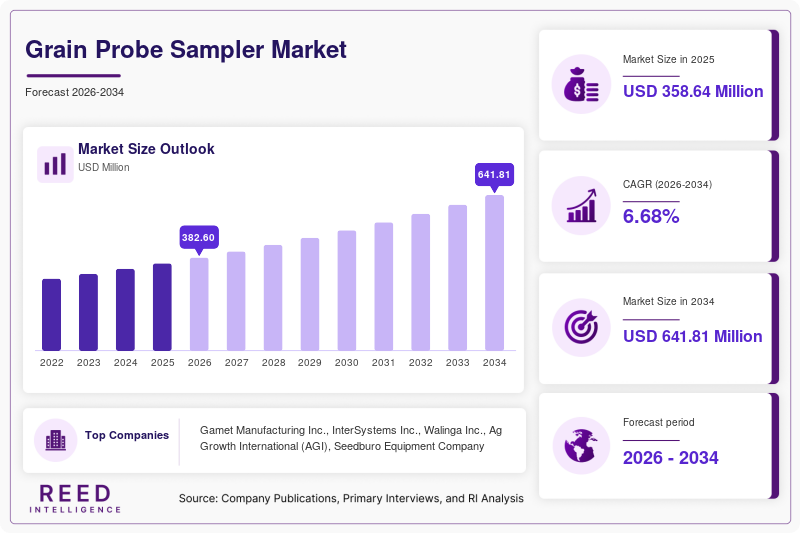
Grain Probe Sampler market size is projected at USD 382.6 million in 2026 and is expected to hit USD 641.8 million by 2034 with a CAGR of 6.68%. Rising emphasis on grain quality assessment, food safety compliance, and standardized sampling procedures is supporting market expansion across global agricultural supply chains. The report provides detailed evaluation of production volumes, technology adoption, market segmentation, and competitive landscape across major grain-producing regions.
The grain probe sampler market comprises equipment used for collecting representative grain samples from trucks, railcars, storage bins, and processing facilities for quality analysis. Global production exceeded 142,000 units in 2025, while grain quality inspection activities covered more than 3.6 billion metric tons of grain commodities annually. Grain elevators and storage facilities accounted for approximately 52% of equipment demand, while automated systems represented nearly 34% of total market value. Increasing grain trade volumes and quality certification requirements continue to strengthen Grain Probe Sampler market share.
Grain Probe Sampler Market Trends
Growing Adoption of Automated Sampling Technologies
Automation is becoming a key trend across grain handling and storage operations. In 2025, automatic grain probe sampler production exceeded 48,000 units, representing an annual growth rate of 9.8%. More than 37% of large-scale grain terminals adopted automated sampling systems to improve testing accuracy and reduce labor requirements. Integration with digital grain management systems continues to support Grain Probe Sampler market trend.
Increasing international grain trade and stricter food quality regulations are encouraging investment in advanced sampling equipment. Global grain exports exceeded 640 million metric tons in 2025, while quality inspection requirements expanded across more than 70 countries. Adoption of automated quality monitoring solutions increased by 11.4% year-over-year, reinforcing Grain Probe Sampler market trend.
Grain Probe Sampler Market Drivers
Rising Demand for Grain Quality Assurance and Food Safety
Global grain production exceeded 2.9 billion metric tons in 2025, creating a significant need for accurate quality assessment systems. More than 82% of commercial grain transactions require certified sampling and testing procedures. Grain contamination incidents declined by nearly 14% among facilities utilizing advanced sampling technologies. These factors continue to accelerate Grain Probe Sampler market growth.
Grain Probe Sampler Market Restraints
High Equipment Acquisition and Maintenance Costs
Automatic grain probe sampling systems can cost between USD 8,000 and USD 65,000 per installation depending on system complexity and automation level. Small grain storage operators account for approximately 46% of industry participants but often face budget limitations. Annual maintenance expenses ranging from 3% to 7% of equipment value may further limit adoption in cost-sensitive markets.
Grain Probe Sampler Market Opportunities
Expansion of Grain Storage and Logistics Infrastructure
Global grain storage capacity surpassed 1.9 billion metric tons in 2025, increasing by 5.6% compared to 2024. More than 420 new grain storage and handling projects were announced worldwide during the year. Investments exceeding USD 11 billion in grain logistics infrastructure are creating significant opportunities for Grain Probe Sampler market demand.
Challenges in Grain Probe Sampler Market
Lack of Standardization Across Emerging Markets
Sampling standards vary significantly between regions, creating operational challenges for equipment manufacturers and grain handlers. Nearly 28% of developing market facilities continue to rely on manual sampling methods. Inconsistent testing protocols and limited technical expertise affect sampling accuracy and equipment utilization rates, creating challenges for Grain Probe Sampler market development.
Grain Probe Sampler Market Segmentation
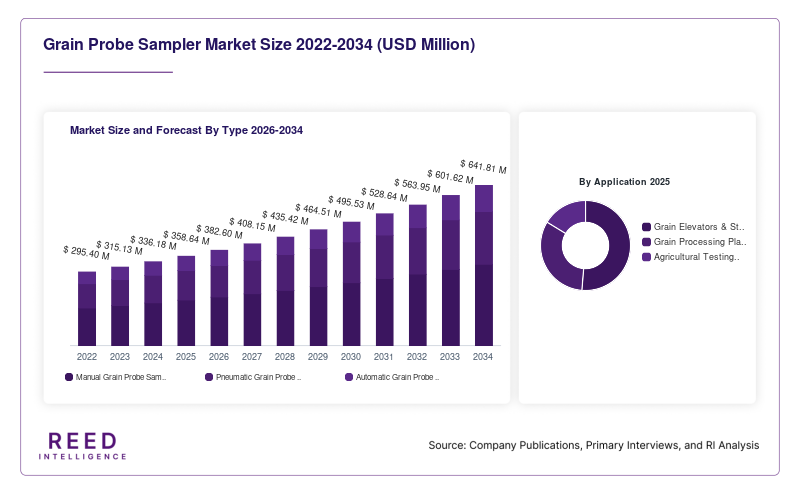
The market is segmented by type and application, with pneumatic and automatic systems gaining traction due to increasing automation requirements. Grain elevators and storage facilities remain the dominant application segment, accounting for more than half of global demand.
By Type
Manual grain probe samplers accounted for approximately 38% of total market revenue in 2025. Production exceeded 54,000 units globally. These systems are widely used by small storage facilities and agricultural cooperatives due to their low acquisition costs and operational simplicity.
Pneumatic grain probe samplers represented nearly 28% of market demand. Production surpassed 40,000 units during 2025. These systems improve sampling efficiency through vacuum-assisted collection and provide sampling depths exceeding 3 meters in bulk grain storage environments.
Automatic grain probe samplers held approximately 34% market share. Production exceeded 48,000 units in 2025. These systems offer programmable sampling patterns, automated sample transfer, and testing integration, reducing inspection time by up to 60% while improving consistency.
By Application
Grain elevators and storage facilities accounted for approximately 52% of total market consumption. More than 73,000 grain probe samplers were utilized across storage infrastructure globally in 2025. The segment benefits from increasing grain stock management requirements and regulatory quality standards.
Grain processing plants represented nearly 31% of market demand. Consumption exceeded 44,000 units in 2025. Sampling systems play a critical role in monitoring incoming raw materials, moisture content, contamination levels, and grain grading processes.
Agricultural testing laboratories accounted for approximately 17% of market volume. More than 24,000 units were utilized globally during 2025. Growing emphasis on certified grain analysis and export quality verification supports segment expansion.
Grain Probe Sampler Regional Market Outlook
North America Grain Probe Sampler Regional Market
North America accounted for approximately 34% of global revenue in 2025. The United States contributed nearly 81% of regional demand due to its extensive grain handling infrastructure. More than 48,000 units were installed across storage facilities and processing plants.
Europe Grain Probe Sampler Regional Market
Europe held approximately 26% market share. Germany, France, Ukraine, and Poland collectively accounted for over 63% of regional demand. Grain quality regulations and export-oriented grain production continue to support equipment adoption across the region.
Asia-Pacific Grain Probe Sampler Regional Market
Asia-Pacific represented nearly 28% of global demand. China accounted for 39% of regional consumption, followed by India at 24%. Expanding grain storage infrastructure and modernization of agricultural logistics support market growth throughout the region.
Latin America Grain Probe Sampler Regional Market
Latin America accounted for approximately 8% of market revenue. Brazil contributed nearly 54% of regional demand due to large-scale soybean and corn production. Investments in grain export infrastructure continue to support equipment adoption.
Middle East & Africa Grain Probe Sampler Regional Market
The region represented around 4% of global demand. South Africa, Saudi Arabia, and Egypt remain key markets due to growing grain storage investments and food security initiatives. Equipment demand increased by 6.7% during 2025.

Top players in Grain Probe Sampler Market
- Gamet Manufacturing Inc.
- InterSystems Inc.
- Walinga Inc.
- Ag Growth International (AGI)
- Seedburo Equipment Company
- TekPro Ltd.
- Gehaka
- Pfeuffer GmbH
- Cimbria A/S
- Schlagel Inc.
- Infratec Group
- Sukup Manufacturing Co.
- Caron Products & Services Inc.
- Farmcomp Oy
- Brock Grain Systems
Gamet Manufacturing Inc.
- Estimated market share ranges between 12% and 15%.
- Gamet Manufacturing is a recognized supplier of grain sampling and inspection equipment for commercial grain handling operations.
- The company offers manual, pneumatic, and automated grain probe systems designed for accurate and representative grain sampling.
- Strong relationships with grain elevators, cooperatives, and storage operators support widespread market penetration.
- Continuous product development and durable equipment designs contribute to its leadership position in the global market.
InterSystems Inc.
- Estimated market share ranges between 9% and 12%.
- InterSystems specializes in grain handling, storage, and quality assurance equipment serving agricultural supply chains worldwide.
- The company provides advanced grain probe samplers integrated with automated testing and grain management systems.
- Extensive distribution networks across North America and international markets strengthen its competitive position.
- Investments in automation and digital grain inspection technologies support long-term market expansion.
Recent Developments in Grain Probe Sampler Market
- 2025: InterSystems introduced upgraded automated grain sampling solutions with enhanced digital integration capabilities.
- 2025: AGI expanded grain quality management equipment offerings for large-scale storage facilities.
Grain Probe Sampler Market Segments
By Type
- Manual Grain Probe Samplers
- Pneumatic Grain Probe Samplers
- Automatic Grain Probe Samplers
By Application
- Grain Elevators & Storage Facilities
- Grain Processing Plants
- Agricultural Testing Laboratories
By Region
- North America
- Europe
- APAC
- Middle East and Africa
- LATAM