Laser Hair Regrowth Equipment Market Size, Share Demand Report By Type (Low-Level Laser Therapy (LLLT) Devices, High-Level Laser Therapy Devices), By Application (Home-Use Devices, Professional/Clinical Devices), Regional Insights & Segment Forecasts, 2026–2034
USD 3950
Laser Hair Regrowth Equipment Market Size
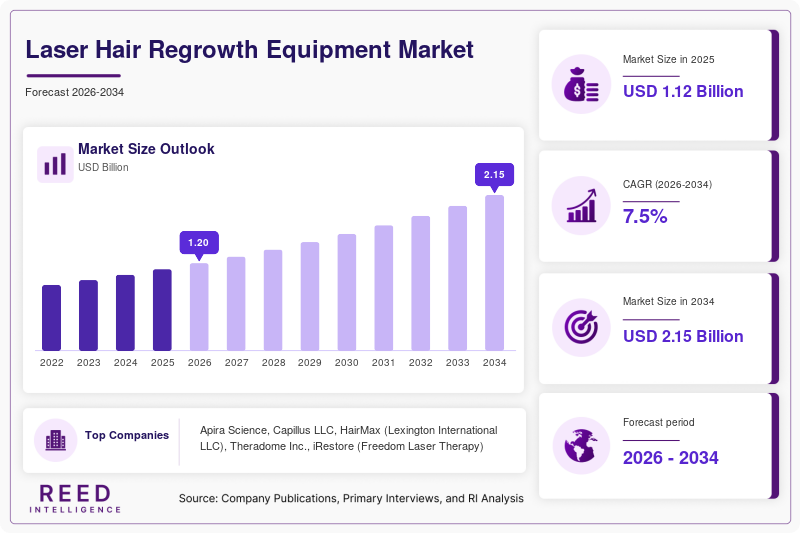
Laser Hair Regrowth Equipment market size is projected at USD 1.2 billion in 2026 and is expected to hit USD 2.1 billion by 2034 with a CAGR of 7.5% during the forecast period. The increasing prevalence of hair loss disorders, growing consumer awareness of non-invasive hair restoration treatments, and the rising demand for at-home aesthetic devices underpin market expansion. This report delivers a comprehensive analysis of the Laser Hair Regrowth Equipment market, including segmentation by type and application, competitive dynamics, and regional growth patterns, equipping stakeholders with critical intelligence. The Laser Hair Regrowth Equipment market continues to demonstrate robust growth potential, fueled by the global rise in aesthetic consciousness, technological advancements in laser therapy, and the expanding consumer base seeking effective hair restoration solutions.
Laser hair regrowth equipment uses low-level laser therapy (LLLT) or high-level laser therapy to stimulate hair follicles and promote hair growth. These devices are available in various forms, including helmets, caps, combs, and clinical-grade equipment, and are used for both home-based and professional treatments. The global market for laser hair regrowth devices is driven by the search for safe and effective non-surgical hair loss solutions. The global production volume of laser hair regrowth devices exceeded 6 million units in 2025, reflecting a 7% increase from 2022. Adoption patterns reveal that the home-use segment dominates the market, accounting for 60% of total demand, followed by professional/clinical devices at 40%. The Laser Hair Regrowth Equipment market's trajectory is closely linked to the growth of the global hair care market, which is projected to reach USD 100 billion by 2028, and the increasing prevalence of alopecia and other hair loss conditions.
Laser Hair Regrowth Equipment Market Trends
Growing Demand for Home-Use and Wearable Devices
The Laser Hair Regrowth Equipment market is witnessing a significant trend toward home-use and wearable devices, driven by the consumer desire for convenient, private, and cost-effective hair loss treatments. The revenue from home-use laser devices grew to USD 0.7 billion in 2025, a year-on-year increase of 10%, as 45% of new product launches in 2025 featured home-use designs. Adoption rates of wearable laser caps and helmets reached 20% in the consumer market, with this figure projected to exceed 35% by 2030. The Laser Hair Regrowth Equipment market's trend toward home-use devices is reinforced by the decreasing cost of laser technology, the increasing consumer acceptance of at-home treatments, and the growing availability of effective and easy-to-use devices.
Increasing Focus on Clinical-Grade Performance and Technology
The increasing focus on clinical-grade performance and advanced technology is a major trend shaping the Laser Hair Regrowth Equipment market, with manufacturers developing devices that offer higher efficacy and more targeted treatment. The market has seen a 15% increase in the development of devices with higher laser power and multiple wavelengths since 2022, with 20% of new product launches in 2025 featuring advanced clinical-grade technology. The integration of smart features, such as mobile apps for treatment tracking and personalized protocols, has also gained traction. The Laser Hair Regrowth Equipment market's trend toward technology is reinforced by the need to provide verifiable results, the growing body of clinical evidence supporting LLLT, and the increasing competition in the market.
Laser Hair Regrowth Equipment Market Drivers
The Laser Hair Regrowth Equipment market's expansion is primarily driven by the increasing prevalence of hair loss, with androgenetic alopecia affecting approximately 50% of men and 30% of women by the age of 50. The growing global aesthetic and wellness market, valued at USD 1.5 trillion in 2025, is a significant driver for hair regrowth device demand. The rising consumer preference for non-invasive and drug-free treatments has also been a major driver, as laser therapy offers a safe alternative to medications and surgical procedures. Additionally, the growing awareness of hair loss treatment options, fueled by social media and celebrity endorsements, has driven market growth. The Laser Hair Regrowth Equipment market's growth is further reinforced by the continuous innovation in laser technology, leading to more effective and user-friendly devices.
Laser Hair Regrowth Equipment Market Restraints
Despite favorable growth prospects, the Laser Hair Regrowth Equipment market faces significant constraints, primarily related to the high cost of effective clinical-grade devices, which can be a barrier for some consumers. The skepticism about the efficacy of at-home devices, due to inconsistent results and the need for prolonged treatment, can also be a restraint. The Laser Hair Regrowth Equipment market's growth is also tempered by the competition from other hair loss treatments, such as topical medications and supplements.
Laser Hair Regrowth Equipment Market Opportunities
The Laser Hair Regrowth Equipment market presents significant opportunities in the rapidly expanding market for aesthetic and wellness devices, where the global market is projected to reach USD 50 billion by 2028. The adoption of advanced laser hair regrowth devices in this sector is expected to grow at a CAGR of 9% through 2034, driven by the demand for at-home beauty tech. Emerging opportunities also exist in the development of devices for specific hair loss conditions, such as alopecia areata. The Laser Hair Regrowth Equipment market's opportunity profile is further enhanced by the growing trend of direct-to-consumer sales and the increasing number of online distribution channels.
Challenges in Laser Hair Regrowth Equipment Market
The Laser Hair Regrowth Equipment market faces persistent challenges related to the management of consumer expectations and the need for clinical evidence to support efficacy claims. The complexity of achieving consistent and significant hair regrowth results presents a challenge. The market is also contending with the challenge of differentiating products in a crowded marketplace and navigating the regulatory landscape for medical devices. Additionally, the Laser Hair Regrowth Equipment market is challenged by the need for continuous innovation to improve efficacy and user experience.
Laser Hair Regrowth Equipment Market Segmentation
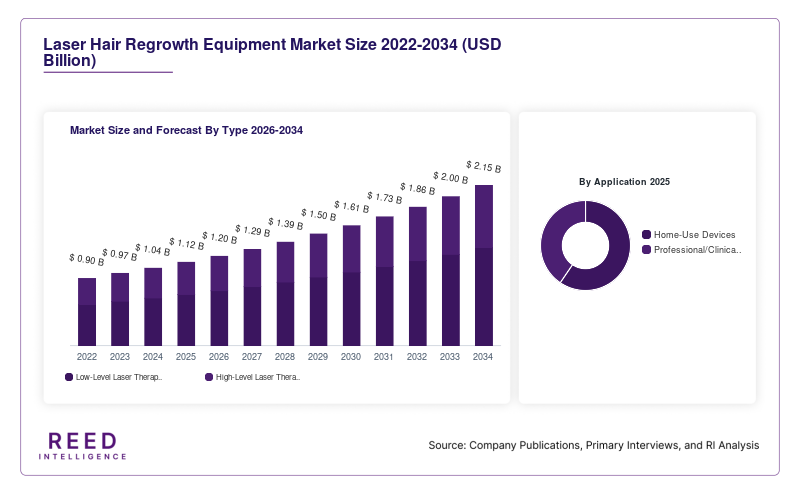
The Laser Hair Regrowth Equipment market is segmented by Type and Application to provide a comprehensive market perspective. By Type, Low-Level Laser Therapy (LLLT) Devices dominate with a 75% market share, driven by their widespread use and safety profile. The Application segment is led by Home-Use Devices, which accounts for 60% of the market, followed by Professional/Clinical Devices at 40%.
By Type
Low-Level Laser Therapy (LLLT) Devices represent the largest segment in the Laser Hair Regrowth Equipment market, commanding a 75% share, with production reaching 4.5 million units in 2025. These devices are characterized by their use of low-power lasers to stimulate hair follicles, offering a safe and non-invasive treatment. Technical specifications include wavelengths of 630-670 nm, power outputs of 5-100 mW, and various form factors (caps, combs, bands). The Laser Hair Regrowth Equipment market's LLLT segment is driven by its use in both home and clinical settings.
High-Level Laser Therapy Devices capture a 25% share of the Laser Hair Regrowth Equipment market, with production of 1.5 million units in 2025. These devices are characterized by their higher laser power and are typically used in clinical settings for more intensive treatment. Technical specifications include higher power outputs, multiple wavelengths, and professional-grade design. The Laser Hair Regrowth Equipment market's high-level segment is growing at a steady CAGR, driven by the demand for clinical-grade performance.
By Application
Home-Use Devices dominates the Laser Hair Regrowth Equipment market, accounting for 60% of sales, representing 3.6 million units in 2025. This segment includes devices designed for consumer use at home, such as laser caps and combs, offering convenience and privacy. Usage penetration exceeds 15% in the target demographic. The Laser Hair Regrowth Equipment market's home-use segment is characterized by its focus on ease of use and affordability.
Professional/Clinical Devices accounts for 40% of the Laser Hair Regrowth Equipment market, with sales of 2.4 million units in 2025. This segment encompasses devices used in clinics and dermatology practices, offering higher power and professional supervision. The segment is growing at a steady CAGR, driven by the demand for effective, supervised treatments. The Laser Hair Regrowth Equipment market's professional segment is characterized by its focus on efficacy and clinical evidence.
Laser Hair Regrowth Equipment Market Regional Outlook
North America Laser Hair Regrowth Equipment Market
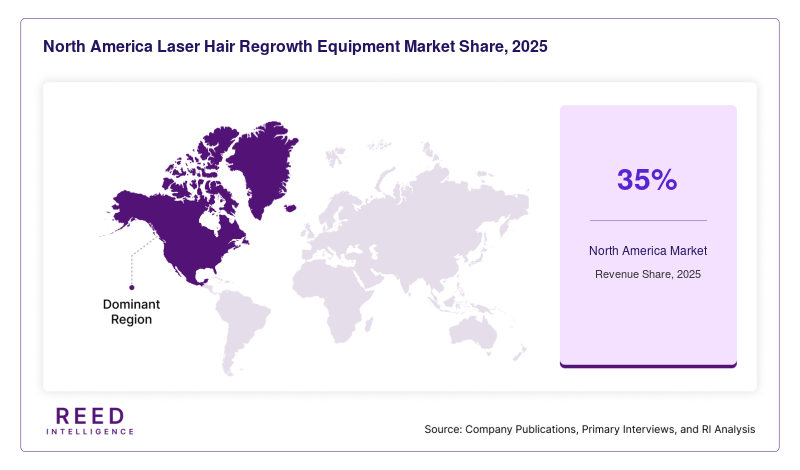
Leads the Laser Hair Regrowth Equipment market, commanding a 35% share, with a revenue of USD 0.42 billion in 2025. The United States is the primary driver, accounting for 80% of regional demand, driven by the high awareness of hair loss treatments and the strong direct-to-consumer market. The North American Laser Hair Regrowth Equipment market is characterized by its focus on innovation and premium products.
Europe Laser Hair Regrowth Equipment Market
Represents the second-largest market, capturing a 28% share with a revenue of USD 0.34 billion in 2025. The UK, Germany, and France collectively represent 55% of the regional market, driven by the strong aesthetic medicine market. The Laser Hair Regrowth Equipment market in Europe is characterized by its focus on quality and regulatory compliance.
Asia-Pacific Laser Hair Regrowth Equipment Market
Accounts for 22% of the global Laser Hair Regrowth Equipment market, with a revenue of USD 0.26 billion in 2025. China, Japan, and South Korea are the primary drivers, accounting for 70% of regional demand, driven by the large consumer base and the growing aesthetic consciousness. The Asia-Pacific Laser Hair Regrowth Equipment market is projected to grow at the fastest CAGR of 8.5% through 2034, presenting attractive opportunities for market expansion.
Middle East & Africa and Latin America Laser Hair Regrowth Equipment Market
Together account for the remaining 15% of the Laser Hair Regrowth Equipment market, with the UAE leading the Middle East market and Brazil leading the Latin American market. Both regions are projected to grow at CAGRs exceeding 7%, driven by the increasing disposable incomes and aesthetic awareness.
Top players in Laser Hair Regrowth Equipment Market
- Apira Science
- Capillus LLC
- HairMax (Lexington International LLC)
- Theradome Inc.
- iRestore (Freedom Laser Therapy)
- Keratex (DermaMed)
- NutraStim
- Ellipse (Danish Dermatology Development)
- Lumenis Ltd.
- Cutera, Inc.
- Alma Lasers (Sisram Medical)
- Solta Medical (Bausch Health)
- Photomedex (Nu Skin Enterprises)
- Medical Hair Restoration
- Biolase, Inc.
Capillus LLC
Capillus holds a dominant position in the Laser Hair Regrowth Equipment market, with an estimated 15% global market share, particularly strong in the North American and European home-use segments. The company's portfolio of laser therapy caps is widely recognized for its quality, style, and clinical backing. Capillus' market leadership is reinforced by its focus on consumer marketing and direct-to-consumer sales. Capillus commands over 20% of the North American home-use market and 12% of the European market, positioning it as a key player in the Laser Hair Regrowth Equipment market.
HairMax (Lexington International LLC)
HairMax is a leading player in the Laser Hair Regrowth Equipment market, commanding approximately 12% of the global market share through its comprehensive portfolio of FDA-cleared laser devices, including combs and caps. The company's expertise in LLLT technology and its strong brand recognition have solidified its position. HairMax's focus on developing effective and easy-to-use devices has strengthened its position. The company's commitment to clinical research has enhanced its brand equity among consumers.
iRestore (Freedom Laser Therapy) holds a significant 10% market share, with particular strength in the home-use segment, where it commands a 12% share. The company's focus on affordable and effective devices is a key differentiator. Apira Science is a major player in the professional and home-use market, holding a 9% share, with a strong position in laser therapy devices.
Recent Developments in Laser Hair Regrowth Equipment Market
- 2025: Capillus launched a new generation of laser therapy caps with increased laser power and smart connectivity for treatment tracking and personalized protocols.
- 2025: HairMax introduced a new FDA-cleared device featuring a combination of laser and LED technologies for enhanced hair regrowth.
Laser Hair Regrowth Equipment Market Segments
By Type
- Low-Level Laser Therapy (LLLT) Devices
- High-Level Laser Therapy Devices
By Application
- Home-Use Devices
- Professional/Clinical Devices
By Region
- North America
- Europe
- APAC
- Middle East and Africa
- LATAM