Passport Document Readers Market Size, Share Demand Report By Type (Desktop Passport Readers, Portable Passport Readers, Self-Service Passport Readers), By Application (Airports & Border Control, Hospitality & Tourism, Banking & Government Services) By Region & Segment Forecasts, 2026–2034
USD 3950
Passport Document Readers Market Size
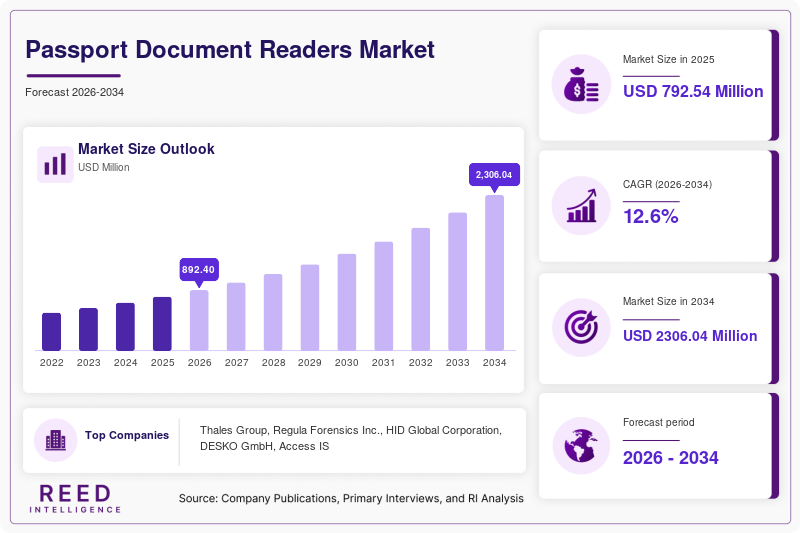
Passport Document Readers market size is projected at USD 892.4 million in 2026 and is expected to hit USD 2.31 billion by 2034 with a CAGR of 12.6%. The market is expanding due to increasing international travel volumes, growing investments in border security infrastructure, and rising deployment of automated identity verification systems. Governments, airports, financial institutions, and hospitality operators continue to invest in advanced document authentication technologies. Comprehensive segmentation analysis, technology evaluation, and competitive landscape assessment remain critical for strategic decision-making.
The passport document readers market includes devices and systems used for scanning, authenticating, and processing passports, visas, identity cards, and travel documents through OCR, RFID, NFC, and biometric verification technologies. Global production exceeded 5.8 million units in 2025, while deployment penetration surpassed 64% across international airports and border checkpoints. Airports and border control applications accounted for approximately 52% of installations, followed by hospitality and tourism at 28% and banking and government services at 20%. More than 1.6 billion travel documents were processed using automated readers during 2025, reinforcing the Passport Document Readers market.
Passport Document Readers Market Trends
Growing Adoption of Biometric and Automated Border Control Systems
The deployment of biometric-enabled document verification solutions is accelerating globally. More than 1,850 automated border control gates were installed during 2025, while biometric verification adoption exceeded 71% across major international airports. The integration of facial recognition, RFID chip authentication, and AI-based document validation increased by 24% year-over-year. These developments continue to shape Passport Document Readers market trends.
Manufacturers are introducing high-speed readers capable of processing documents in less than 3 seconds with authentication accuracy exceeding 99%. More than 46% of newly deployed systems support cloud-based identity management platforms and remote monitoring capabilities. Demand from hospitality providers increased by 18%, while banking sector deployments grew by 16%, further strengthening Passport Document Readers market trends.
Passport Document Readers Market Drivers
Rising International Travel and Border Security Investments
Global international tourist arrivals surpassed 1.4 billion travelers in 2025, while government spending on border security infrastructure exceeded USD 85 billion. More than 72% of international airports have implemented automated document verification systems, and airport modernization investments increased by 19% during the year. These factors continue to support Passport Document Readers market growth.
Passport Document Readers Market Restraints
High Deployment and Compliance Costs
Advanced passport document reader systems equipped with biometric authentication and RFID validation can cost between USD 2,000 and USD 25,000 per unit. Compliance with ICAO standards, cybersecurity regulations, and data privacy frameworks increases operational costs by 10%–15%. Approximately 34% of small facilities delay upgrades due to budget limitations, affecting Passport Document Readers market growth.
Passport Document Readers Market Opportunities
Expansion of Digital Identity and E-Government Programs
More than 125 countries have implemented e-passport programs, while digital identity initiatives cover over 4.8 billion citizens globally. Adoption of electronic travel authorization systems increased by 27% during 2025. Government agencies are increasingly integrating passport readers with national identity databases and biometric platforms, creating substantial opportunities within the Passport Document Readers market.
Challenges in Passport Document Readers Market
Data Security and Interoperability Concerns
The processing of sensitive personal information creates significant cybersecurity requirements. Nearly 31% of organizations identify interoperability challenges between legacy systems and modern identity verification platforms as a major concern. Cybersecurity spending related to border management systems increased by 18% during 2025, while compliance requirements expanded across multiple jurisdictions. These issues continue to affect Passport Document Readers market demand.
Passport Document Readers Market Segmentation
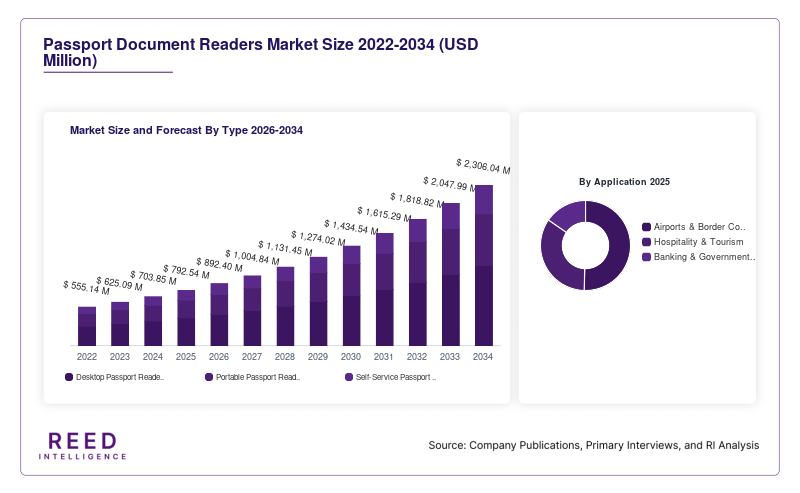
The market is segmented by type and application. Desktop passport readers account for approximately 43% of revenue, followed by self-service passport readers at 34% and portable passport readers at 23%. By application, airports and border control dominate with 52% share, followed by hospitality and tourism at 28% and banking and government services at 20%.
By Type
Desktop passport readers accounted for approximately 43% of market revenue in 2025. Global production exceeded 2.5 million units. These devices support OCR recognition, RFID chip reading, ultraviolet authentication, and barcode scanning functions. Their deployment remains high across immigration offices, airports, and government facilities.
Portable passport readers represented nearly 23% of total market revenue. Production exceeded 1.3 million units during 2025. These compact devices support wireless connectivity, battery-powered operation, and document verification accuracy above 98%. Their adoption increased significantly among law enforcement agencies and mobile verification teams.
Self-service passport readers held approximately 34% of the market. More than 2.0 million units were operational globally. These systems are integrated into e-gates, self-check-in kiosks, and automated border control stations, enabling document processing within 2–5 seconds and reducing passenger waiting times by up to 40%.
By Application
Airports and border control applications generated approximately 52% of total revenue. More than 3 million passport reader units were deployed globally across airports, seaports, and immigration checkpoints. Adoption penetration exceeded 78% among major international airports due to increasing passenger traffic and security requirements.
Hospitality and tourism applications accounted for nearly 28% of market demand. More than 1.6 million systems were installed across hotels, resorts, and travel facilities. Usage penetration exceeded 54% among international hotel chains, supporting faster guest registration and identity verification processes.
Banking and government services represented approximately 20% of market revenue. More than 1.2 million passport readers were utilized for customer onboarding, identity verification, and public administration processes. Adoption increased by 15% during 2025 as institutions strengthened compliance and fraud prevention measures.
Passport Document Readers Market Regional Outlook
North America Passport Document Readers Market
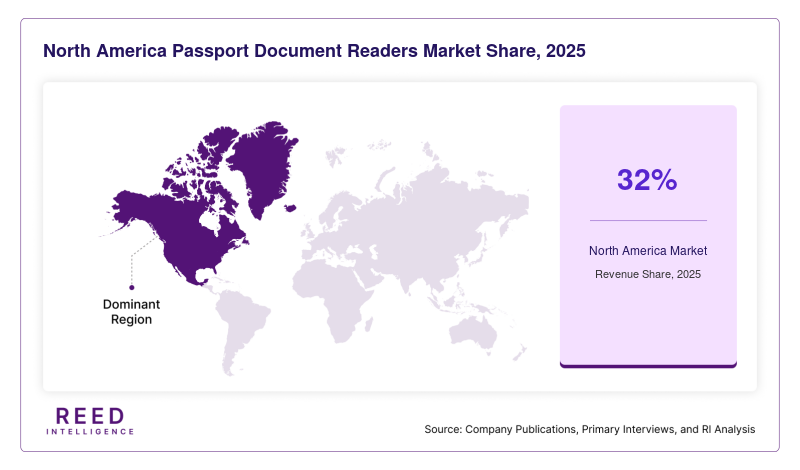
North America accounted for approximately 32% of global revenue in 2025. The United States contributed nearly 81% of regional demand, supported by advanced border security infrastructure and airport modernization projects. More than 1.8 million passport reader units were operational throughout the region.
Europe Passport Document Readers Market
Europe represented approximately 30% of the market. Germany, the United Kingdom, France, Italy, and Spain collectively contributed over 68% of regional demand. More than 1.7 million units were deployed across airports, government agencies, and hospitality facilities.
Asia-Pacific Passport Document Readers Market
Asia-Pacific held approximately 31% market share and remains the fastest-growing region. China contributed 38% of regional demand, followed by Japan at 17% and India at 15%. Regional deployments exceeded 1.9 million units due to increasing travel volumes and investments in smart border management.
Latin America Passport Document Readers Market
Latin America accounted for approximately 4% of global revenue. Brazil represented nearly 44% of regional demand, while Mexico contributed 29%. Tourism growth and digital identity initiatives continue to support market expansion.
Middle East & Africa Passport Document Readers Market
The Middle East & Africa region accounted for approximately 3% of total revenue. The UAE and Saudi Arabia collectively generated more than 58% of regional demand. Investments in smart airports, tourism infrastructure, and border modernization projects continue to drive adoption.
Top players in Passport Document Readers Market
- Thales Group
- Regula Forensics Inc.
- HID Global Corporation
- DESKO GmbH
- Access IS
- Gemalto N.V.
- Veridos GmbH
- IDEMIA Group
- Adaptive Recognition Inc.
- DILETTA ID Technology
- Grabba International Pty Ltd.
- ARH Inc.
- PrehKeyTec GmbH
- Sinosecu Technology Corporation
- Wintone Technology Co., Ltd.
Thales Group
- Estimated market share: 14%–16%.
- Maintains a strong position in digital identity, border management, and secure document authentication technologies.
- Supports numerous national e-passport and border security programs worldwide.
- Extensive expertise in biometric verification, RFID authentication, and automated border control systems.
- Strong presence across North America, Europe, Asia-Pacific, and the Middle East.
- Continuous investments in AI-driven identity verification solutions strengthen competitive positioning.
Regula Forensics Inc.
- Estimated market share: 10%–12%.
- Recognized provider of document authentication and forensic verification solutions.
- Offers a comprehensive portfolio of passport readers, identity verification systems, and forensic examination tools.
- Strong customer base across government agencies, airports, financial institutions, and law enforcement organizations.
- Advanced authentication technologies support high accuracy rates exceeding 99%.
- Continued innovation in portable and cloud-connected verification systems enhances market presence.
Recent Developments in Passport Document Readers Market
- 2026: Leading manufacturers introduced AI-powered passport readers with enhanced fraud detection and biometric verification capabilities.
- 2025: Multiple airports deployed next-generation self-service passport reader kiosks integrated with facial recognition systems.
- 2025: Government agencies expanded e-passport verification infrastructure across international border checkpoints.
Passport Document Readers Market Segments
By Type
- Desktop Passport Readers
- Portable Passport Readers
- Self-Service Passport Readers
By Application
- Airports & Border Control
- Hospitality & Tourism
- Banking & Government Services
By Region
- North America
- Europe
- APAC
- Middle East and Africa
- LATAM