Synthetic Sausage Casings Market Size, Share Demand Report By Type (Collagen Casings, Cellulose Casings, Plastic Casings), By Application (Fresh Sausages, Cooked Sausages, Cured Sausages), Regional Insights & Segment Forecasts, 2026–2034
USD 3950
Synthetic Sausage Casings Market Size
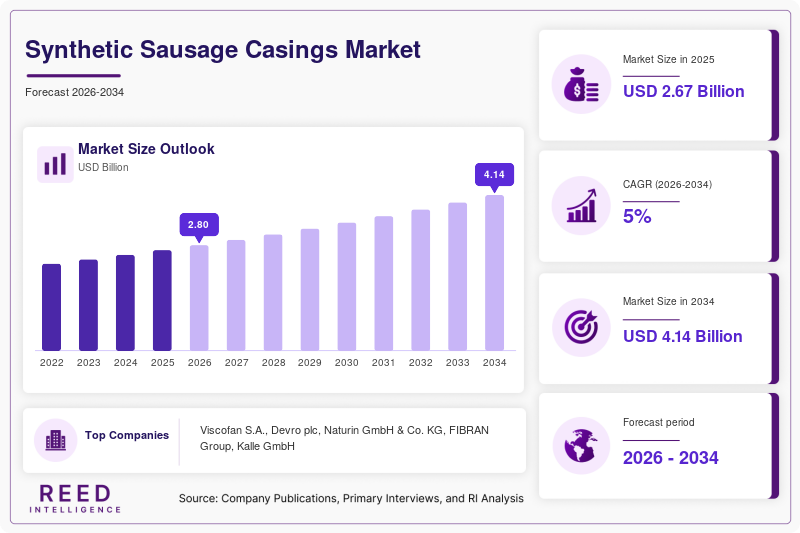
Synthetic Sausage Casings market size is projected at USD 2.8 billion in 2026 and is expected to hit USD 4.1 billion by 2034 with a CAGR of 5.0% during the forecast period. The increasing global demand for processed meat products, the rising popularity of sausages as a convenient and versatile food, and the growing preference for synthetic casings due to their cost-effectiveness and consistency underpin market expansion. This report delivers a comprehensive analysis of the Synthetic Sausage Casings market, including segmentation by type and application, competitive dynamics, and regional growth patterns, equipping stakeholders with critical intelligence. The Synthetic Sausage Casings market continues to demonstrate steady growth potential, fueled by the expansion of the global meat processing industry, the increasing urbanization and changing dietary habits, and the continuous innovation in casing materials and technology.
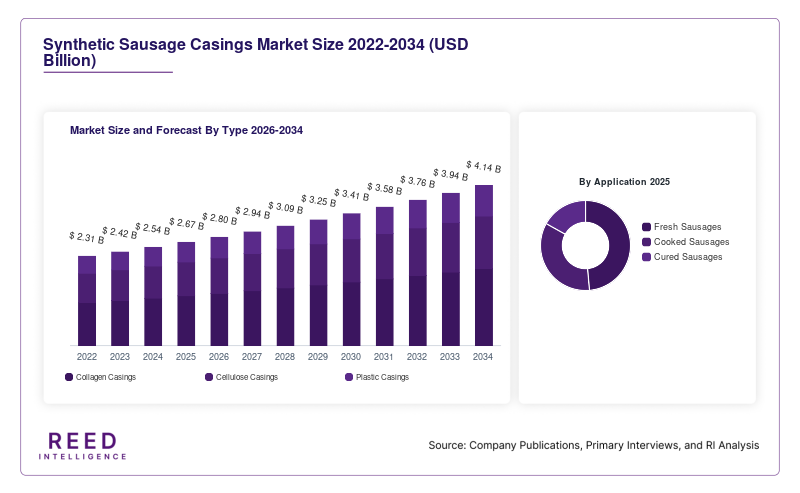
Synthetic sausage casings are man-made tubular casings used in the production of sausages. They are made from various materials, including collagen, cellulose, and plastics, and are designed to offer a uniform and consistent casing for processed meat products. They provide advantages such as uniform size, color, and texture, as well as extended shelf life and improved production efficiency. The global market for synthetic casings is driven by the needs of the modern meat processing industry. The global production volume of synthetic sausage casings exceeded 2.5 million metric tons in 2025, reflecting a 4.5% increase from 2022. Adoption patterns reveal that the collagen casing segment dominates the market, accounting for 45% of total demand, followed by cellulose casings at 30%, and plastic casings at 25%. The Synthetic Sausage Casings market's trajectory is closely linked to the growth of the global processed meat market, which is projected to reach USD 1.5 trillion by 2028, and the increasing consumer demand for convenient meat products.
Synthetic Sausage Casings Market Trends
Growing Demand for Edible and Collagen Casings
The Synthetic Sausage Casings market is witnessing a significant trend toward the use of edible and collagen casings, driven by consumer preference for natural and clean-label products. The revenue from collagen casings grew to USD 1.2 billion in 2025, a year-on-year increase of 5%, as 30% of new sausage product launches in 2025 featured collagen or edible casings. Adoption rates of collagen casings in the premium sausage segment reached 40%, with this figure projected to exceed 55% by 2030. The Synthetic Sausage Casings market's trend toward collagen is reinforced by the increasing consumer demand for natural ingredients, the development of improved collagen casing technology, and the growing popularity of specialty and artisanal sausages.
Increasing Focus on Sustainable and Biodegradable Materials
The increasing focus on sustainability and the use of biodegradable materials is a major trend shaping the Synthetic Sausage Casings market, driven by environmental concerns and consumer demand for eco-friendly packaging. The market has seen a 15% increase in the development of sustainable casing options since 2022, with 10% of new product launches in 2025 featuring biodegradable or compostable materials. The use of plant-based polymers and other bio-based materials has also gained traction. The Synthetic Sausage Casings market's trend toward sustainability is reinforced by the increasing regulatory pressure on plastic waste, the growing consumer awareness of environmental issues, and the continuous innovation in bio-based materials.
Synthetic Sausage Casings Market Drivers
The Synthetic Sausage Casings market's expansion is primarily driven by the increasing global demand for processed meat products, with the global meat consumption projected to increase by 15% by 2030. The growing popularity of convenience foods and ready-to-eat meat products has also been a major driver, as sausages are a versatile and easy-to-prepare option. The advantages of synthetic casings, such as cost-effectiveness, uniformity, and improved shelf life, have made them the preferred choice for large-scale producers. Additionally, the expansion of the food service and retail sectors has fueled demand for processed meat products. The Synthetic Sausage Casings market's growth is further reinforced by the continuous innovation in casing technology, leading to better performance and new applications.
Synthetic Sausage Casings Market Restraints
Despite favorable growth prospects, the Synthetic Sausage Casings market faces significant constraints, primarily related to the increasing consumer preference for natural and minimally processed foods, which can limit the growth of synthetic alternatives. The potential for health concerns related to certain casing materials can also be a restraint. The Synthetic Sausage Casings market's growth is also tempered by the competition from natural casings and the volatility of raw material prices.
Synthetic Sausage Casings Market Opportunities
The Synthetic Sausage Casings market presents significant opportunities in the rapidly expanding market for plant-based and alternative meat products, where the global market is projected to reach USD 30 billion by 2028. The adoption of specialized casings for plant-based sausages is expected to grow at a CAGR of 10% through 2034, driven by the need to replicate the texture and appearance of meat sausages. Emerging opportunities also exist in the development of casings with added functionalities, such as flavoring or antimicrobial properties. The Synthetic Sausage Casings market's opportunity profile is further enhanced by the growing trend of clean-label and natural products, creating demand for collagen and other edible casings.
Challenges in Synthetic Sausage Casings Market
The Synthetic Sausage Casings market faces persistent challenges related to the management of product quality and consistency, as manufacturing must ensure uniform strength and size. The complexity of developing casings that meet specific processing requirements and customer preferences presents a challenge. The market is also contending with the challenge of balancing cost with performance and sustainability. Additionally, the Synthetic Sausage Casings market is challenged by the need for continuous innovation to meet evolving consumer and regulatory demands.
Synthetic Sausage Casings Market Segmentation
The Synthetic Sausage Casings market is segmented by Type and Application to provide a comprehensive market perspective. By Type, Collagen Casings dominate with a 45% market share, driven by their use in premium sausages. The Application segment is led by Fresh Sausages, which accounts for 40% of the market, followed by Cooked Sausages at 35%, and Cured Sausages at 25%.
By Type
Collagen Casings represent the largest segment in the Synthetic Sausage Casings market, commanding a 45% share, with production reaching 1.13 million metric tons in 2025. These casings are characterized by their edible nature, natural appearance, and suitability for fresh and smoked sausages. Technical specifications include various diameters, thicknesses, and edible properties. The Synthetic Sausage Casings market's collagen segment is driven by its use in premium and fresh sausages.
Cellulose Casings capture a 30% share of the Synthetic Sausage Casings market, with production of 0.75 million metric tons in 2025. These casings are characterized by their uniformity, high strength, and peelability, making them ideal for cooked sausages. Technical specifications include uniform size, high peel strength, and suitability for high-speed production. The Synthetic Sausage Casings market's cellulose segment is driven by its use in hot dogs and other cooked sausages.
Plastic Casings represent the remaining 25% of the Synthetic Sausage Casings market, with production of 0.63 million metric tons in 2025. These casings are characterized by their barrier properties, impermeability, and suitability for cured and fermented sausages. Technical specifications include excellent barrier properties, durability, and suitability for long shelf life. The Synthetic Sausage Casings market's plastic segment is driven by its use in salami and other cured sausages.
By Application
Fresh Sausages dominates the Synthetic Sausage Casings market, accounting for 40% of sales, representing 1.0 million metric tons in 2025. This segment includes use in sausages that are consumed without cooking, where casings provide structural integrity. Usage penetration exceeds 70% in the fresh sausage sector. The Synthetic Sausage Casings market's fresh segment is characterized by its focus on natural appearance and tenderness.
Cooked Sausages accounts for 35% of the Synthetic Sausage Casings market, with a volume of 0.88 million metric tons in 2025. This segment encompasses use in sausages that are cooked during processing, where casings are often peeled before consumption. The segment is growing at a steady CAGR, driven by the demand for convenient ready-to-eat products. The Synthetic Sausage Casings market's cooked segment is characterized by its focus on uniformity and peelability.
Cured Sausages represents the remainder of the Synthetic Sausage Casings market, accounting for 25% of total sales, with 0.63 million metric tons in 2025. This segment includes use in fermented and dry-cured sausages, where casings provide protection and mold growth support. The segment is projected to grow at a steady CAGR through 2034. The Synthetic Sausage Casings market's cured segment is characterized by its focus on barrier properties and durability.
Synthetic Sausage Casings Market Regional Outlook
Europe Synthetic Sausage Casings Market
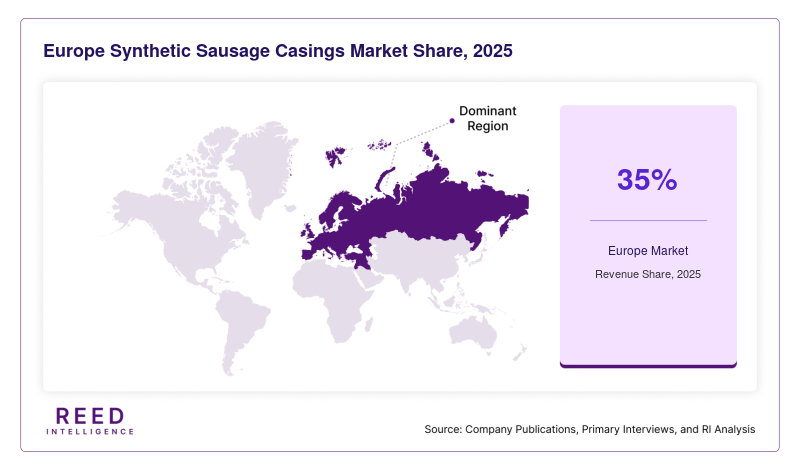
Leads the Synthetic Sausage Casings market, commanding a 35% share, with a revenue of USD 0.98 billion in 2025. Germany, Spain, and Italy are the primary drivers, accounting for 55% of regional demand, driven by the strong sausage-making tradition. The European Synthetic Sausage Casings market is characterized by its focus on quality and premium products.
North America Synthetic Sausage Casings Market
Represents the second-largest market, capturing a 28% share with a revenue of USD 0.78 billion in 2025. The United States dominates regional demand, accounting for 80% of consumption, driven by the large processed meat industry. The Synthetic Sausage Casings market in North America is characterized by its focus on innovation and efficiency.
Asia-Pacific Synthetic Sausage Casings Market
Accounts for 22% of the global Synthetic Sausage Casings market, with a revenue of USD 0.62 billion in 2025. China, Japan, and Australia are the primary drivers, accounting for 70% of regional demand, driven by the growing meat consumption and the expansion of the processed food sector. The Asia-Pacific Synthetic Sausage Casings market is projected to grow at the fastest CAGR of 6.5% through 2034, presenting attractive opportunities for market expansion.
Middle East & Africa and Latin America Synthetic Sausage Casings Market
Together account for the remaining 15% of the Synthetic Sausage Casings market, with South Africa leading the African market and Brazil leading the Latin American market. Both regions are projected to grow at CAGRs exceeding 5%, driven by the increasing urbanization and meat consumption.
Top players in Synthetic Sausage Casings Market
- Viscofan S.A.
- Devro plc
- Naturin GmbH & Co. KG
- FIBRAN Group
- Kalle GmbH
- Viskase Companies, Inc.
- Nippi Collagen Ltd.
- Mazzoni S.p.A.
- Selby Sausage Casings
- Overseas Casing Company
- Dunninghams Ltd.
- Combinatie Thomas B.V.
- Jintex Corporation Ltd.
- E. D. & F. Man Casings
- Rütgers Group
Viscofan S.A.
Viscofan holds a dominant position in the Synthetic Sausage Casings market, with an estimated 16% global market share, particularly strong in the European and North American segments. The company's portfolio of collagen, cellulose, and plastic casings is widely recognized for its quality and innovation. Viscofan's market leadership is reinforced by its significant R&D investment and its global manufacturing footprint. Viscofan commands over 20% of the European market and 14% of the North American market, positioning it as a key player in the Synthetic Sausage Casings market's premium segment.
Devro plc
Devro is a leading player in the Synthetic Sausage Casings market, commanding approximately 12% of the global market share through its comprehensive portfolio of collagen casings. The company's expertise in collagen technology and its strong presence in the global market have solidified its position. Devro's focus on developing high-quality and innovative collagen casings has strengthened its position. The company's commitment to sustainability has enhanced its brand equity among customers.
Naturin GmbH & Co. KG holds a significant 10% market share, with particular strength in the European market, where it commands a 12% share. The company's focus on natural and edible casings is a key differentiator. FIBRAN Group is a major player in the global casings market, holding a 9% share, with a strong position in the cellulose and plastic segments.
Recent Developments in Synthetic Sausage Casings Market
- 2025: Viscofan launched a new range of biodegradable casings made from plant-based materials, offering a sustainable alternative for the meat processing industry.
- 2025: Devro introduced a new collagen casing with improved strength and elasticity, designed for high-speed filling and processing.
Synthetic Sausage Casings Market Segments
By Type
- Collagen Casings
- Cellulose Casings
- Plastic Casings
By Application
- Fresh Sausages
- Cooked Sausages
- Cured Sausages
By Region
- North America
- Europe
- APAC
- Middle East and Africa
- LATAM