Industrial Food Slicers Market Size, Share & Trends Analysis Report By Product Type, By Food Type, By Application, By End User and By Region, Forecasts 2026–2034
USD 3950
Industrial Food Slicers Market Size
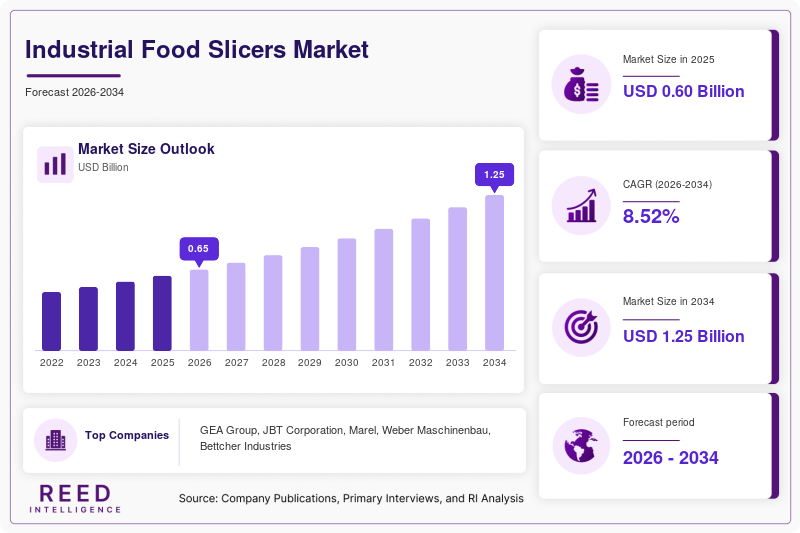
The global industrial food slicers market was valued at USD 0.60 billion in 2025 and is projected to grow from USD 0.65 billion in 2026 to USD 1.20 billion by 2034, registering a CAGR of 8.52% during the forecast period from 2026 to 2034.
Industrial food slicers are automated or semi-automated processing machines used to cut food products into consistent slices at commercial and industrial production volumes. They are used across meat processing, bakery, dairy, fruit and vegetable processing, prepared foods and other food manufacturing operations.
The market is benefiting from increasing food-processing automation, rising demand for packaged and ready-to-eat foods, greater emphasis on product consistency and improvements in food-processing equipment. Industrial slicers can improve throughput while reducing manual labor requirements and maintaining standardized product dimensions.
Industrial Food Slicers Market Drivers
Increasing Food Processing Automation
Food manufacturers are increasingly automating repetitive processing activities to improve productivity and consistency.
Industrial slicers can process large quantities of products with standardized thickness and dimensions, reducing dependence on manual slicing.
Growing Demand for Packaged Foods
Rising consumption of packaged meat, cheese, bread, prepared foods and other processed products is increasing demand for high-throughput food processing equipment.
Industrial slicing systems are commonly integrated into production lines supplying retail and food-service markets.
Need for Consistent Product Quality
Uniform slice thickness and shape are important for packaging, portion control and product presentation.
Automated slicers provide greater consistency than manual processing, supporting adoption among large food manufacturers.
Rising Labor Costs
Food processors in several markets face increasing labor costs and shortages of skilled production workers.
Automation provides manufacturers with an opportunity to improve productivity while reducing dependence on labor-intensive slicing operations.
Increasing Food-Safety Requirements
Food-processing companies are investing in equipment designed for improved sanitation and easier cleaning.
Modern industrial slicers increasingly incorporate hygienic designs, stainless-steel construction and components designed to minimize contamination risks.
Industrial Food Slicers Market Restraints
High Initial Investment
Industrial slicing systems require significant capital expenditure, particularly for automated and integrated production-line equipment.
The investment can be challenging for small and medium-sized food processors.
Maintenance and Operating Costs
Industrial slicers contain cutting mechanisms, motors, conveyors and control systems that require regular maintenance.
Blade replacement and equipment servicing can increase operating expenses.
Product-Specific Equipment Requirements
Different food products require different cutting mechanisms, blade configurations and machine settings.
Manufacturers processing diverse product categories may require multiple specialized machines.
Food Waste During Processing
Improper machine settings, blade wear or inconsistent product positioning can increase trimming and processing losses.
Food processors must optimize equipment settings to maintain yield while achieving the desired slice quality.
Industrial Food Slicers Market Opportunities
AI and Smart Automation
Integration of sensors, machine vision and advanced control systems can improve slicing accuracy and equipment monitoring.
Smart systems can identify product dimensions and adjust processing parameters automatically.
Growth of Ready-to-Eat Foods
Increasing consumption of prepared meals, packaged meats, sliced cheese and other convenience foods is creating opportunities for industrial slicing equipment.
Hygienic Equipment Design
Food manufacturers increasingly require equipment that can be cleaned quickly and thoroughly.
Manufacturers developing hygienic, easy-to-disassemble slicing systems can address growing food-safety requirements.
Expansion of Food Processing in Emerging Markets
Food-processing capacity is expanding across Asia-Pacific, Latin America and other emerging markets.
This creates opportunities for equipment manufacturers as processors modernize production facilities.
Integration with Packaging Lines
Automated slicers can be connected with weighing, portioning, conveying and packaging systems.
Integrated production lines can improve throughput and reduce manual handling.
Product Type Segment Analysis
By Product Type
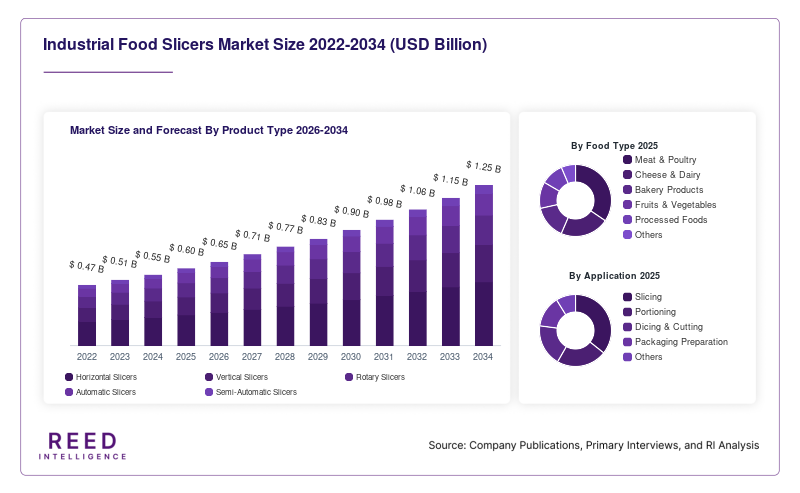
Automatic slicers accounted for approximately 43% of the industrial food slicers market in 2025, making them the largest product type segment. Their position is supported by the need for high production throughput, consistent slicing and reduced manual intervention across large food-processing facilities.
Rotary slicers accounted for approximately 19% and are projected to grow at approximately 9.4% CAGR, making them the fastest-growing major product segment. Their ability to support continuous processing and high-volume production is contributing to adoption.
Horizontal slicers represented approximately 18%, vertical slicers 12%, and semi-automatic slicers approximately 8%.
Food Type Segment Analysis
By Food Type
Meat and poultry accounted for approximately 39% of the market in 2025, making it the largest food-type segment. The large-scale processing of meat products and growing demand for standardized packaged portions support demand for industrial slicing equipment.
Processed foods accounted for approximately 15% and are projected to grow at approximately 9.1% CAGR, making them the fastest-growing major food-type segment. Expansion of ready-to-eat meals, convenience foods and packaged food products is supporting equipment demand.
Cheese and dairy represented approximately 24%, bakery products 13%, fruits and vegetables 6%, and other food types approximately 3%.
Application Segment Analysis
By Application
Slicing accounted for approximately 56% of the market in 2025, making it the largest application segment. Industrial slicers are primarily used to produce standardized portions for retail packaging, food service and further food processing.
Portioning accounted for approximately 17% and is projected to grow at approximately 9.0% CAGR, making it the fastest-growing major application segment. Increasing emphasis on standardized serving sizes, cost control and automated packaging is supporting demand.
Dicing and cutting represented approximately 14%, packaging preparation 9%, and other applications approximately 4%.
End-User Segment Analysis
By End User
Meat processing companies accounted for approximately 37% of the market in 2025, making them the largest end-user segment. High-volume processing requirements and increasing demand for packaged and portion-controlled meat products support investment in automated slicing equipment.
Food-service and catering companies accounted for approximately 13% and are projected to grow at approximately 9.2% CAGR, making them the fastest-growing major end-user segment. Demand for prepared ingredients, portion consistency and labor-efficient food preparation is supporting growth.
Dairy and cheese manufacturers represented approximately 24%, bakery and confectionery companies 15%, and other food manufacturers approximately 11%.
Industrial Food Slicers Market Regional Analysis
Europe Holds the Largest Share
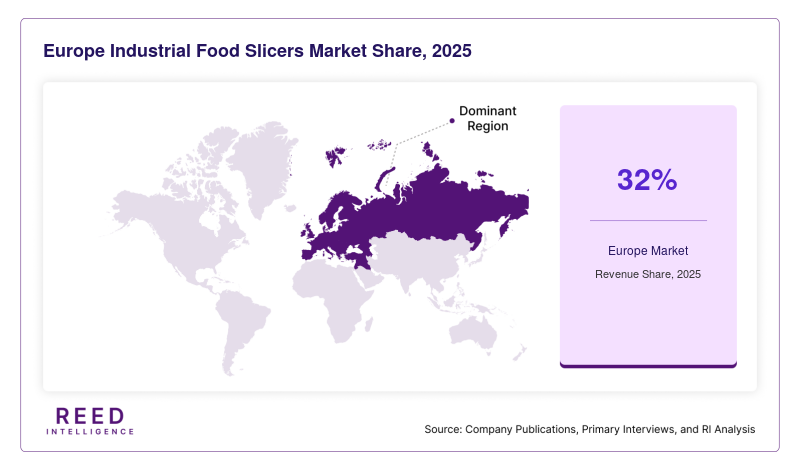
Europe accounted for approximately 32% of the global industrial food slicers market in 2025, making it the largest regional market. The region benefits from established food-processing industries, strong adoption of automation, mature packaged-food markets and stringent food-safety requirements.
Asia-Pacific accounted for approximately 29% and is projected to grow at approximately 10.1% CAGR, making it the fastest-growing major region. Expanding food-processing capacity, rising packaged-food consumption, industrialization and increasing investment in production automation are supporting regional growth.
North America Maintains Strong Demand
North America accounted for approximately 27% of the market in 2025 and is projected to grow at approximately 7.3% CAGR.
The region has established meat, dairy and prepared-food processing industries and continues to invest in automated processing and packaging equipment.
Latin America Shows Increasing Adoption
Latin America accounted for approximately 7% of the market in 2025 and is projected to grow at approximately 8.2% CAGR.
Expansion of food-processing facilities, increasing packaged-food consumption and modernization of production lines are supporting demand.
Middle East & Africa Represents an Emerging Market
Middle East & Africa accounted for approximately 5% of the market in 2025 and is projected to grow at approximately 8.0% CAGR.
Food-processing investments, population growth and increasing demand for packaged and convenience foods are creating opportunities for industrial slicing equipment.
Industrial Food Slicers Market Competitive Landscape
Competition in the industrial food slicers market is based on processing speed, slicing precision, product versatility, hygiene, automation, equipment reliability, energy efficiency, maintenance requirements and after-sales service.
Manufacturers are increasingly developing automated equipment that can be integrated into complete food-processing and packaging lines.
Top Companies
- GEA Group
- JBT Corporation
- Marel
- Weber Maschinenbau
- Bettcher Industries
- TREIF Maschinenbau
- Bizerba SE & Co. KG
- Urschel Laboratories
- Multivac Group
- Grasselli S.p.A.
Industrial Food Slicers Market Recent Developments
- Food manufacturers are increasingly adopting automated slicing equipment to improve throughput, consistency and labor productivity. Automated systems are particularly relevant for high-volume meat, cheese and prepared-food production.
- Equipment manufacturers are emphasizing hygienic construction, easy-clean surfaces and simplified machine disassembly. These features help food processors address sanitation and contamination-control requirements.
Industrial Food Slicers Market Segments
By Product Type
- Horizontal Slicers
- Vertical Slicers
- Rotary Slicers
- Automatic Slicers
- Semi-Automatic Slicers
By Food Type
- Meat & Poultry
- Cheese & Dairy
- Bakery Products
- Fruits & Vegetables
- Processed Foods
- Others
By Application
- Slicing
- Portioning
- Dicing & Cutting
- Packaging Preparation
- Others
By End User
- Meat Processing Companies
- Dairy & Cheese Manufacturers
- Bakery & Confectionery Companies
- Food-Service & Catering Companies
- Other Food Manufacturers
By Region
- North America
- Europe
- APAC
- Middle East and Africa
- LATAM