Internet Publishing Market Size, Share & Trends Analysis Report By Content Type (Digital News Publishing, Online Magazines & Journals, Digital Books & Publications, Blogs & Independent Publishing, Multimedia & Other Digital Publishing), By Revenue Model (Advertising, Subscription, Transactional & Licensing, Freemium & Other Models), By Content Format (Text-Based Content, Video Content, Audio Content, Interactive & Multimedia Content), By End User (Individual Consumers, Businesses, Educational &
USD 3950
Internet Publishing Market Size
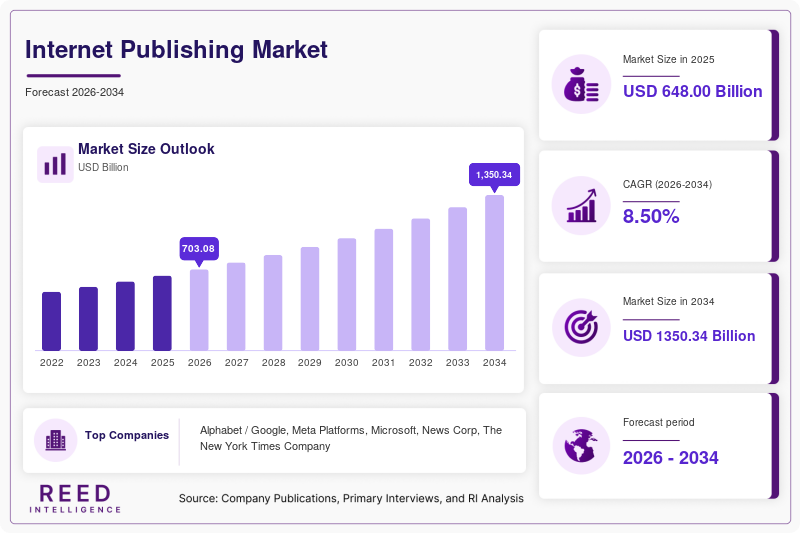
The internet publishing market was valued at USD 648.00 billion in 2025 and is projected to grow from USD 703.08 billion in 2026 to USD 1,342.50 billion by 2034, registering a CAGR of 8.50% during the forecast period from 2026 to 2034.
Internet publishing encompasses the creation, distribution, monetization and consumption of digitally delivered editorial, informational, educational, professional and entertainment content through websites, applications and other internet platforms. The market increasingly combines advertising-supported publishing with subscriptions, memberships, licensing, affiliate revenue and other digital monetization models.
The addressable audience continues to expand. The International Telecommunication Union estimates that 6 billion people, or 74% of the world's population, were online in 2025, compared with 5.8 billion in 2024. This enlarges the potential audience for publishers, although the remaining 2.2 billion people offline and persistent affordability and skills gaps limit the addressable audience in lower-connectivity markets.
Internet Publishing Market Drivers
Expanding Internet Connectivity Increases the Addressable Audience for Digital Publishers
The global online population reached 6 billion people in 2025, equivalent to 74% of the world's population, according to the ITU. Internet use increased from 71% of the global population in 2024 to 74% in 2025.
The market mechanism is an expansion of the potential audience that publishers can monetize through advertising, subscriptions, commerce referrals and licensing. Mobile broadband coverage is also approaching universal levels, while 5G accounted for more than one-third of mobile broadband subscriptions globally in 2025.
This particularly benefits mobile-first publishers and digital businesses operating in Asia-Pacific and other markets where additional users are moving online. However, connectivity growth is uneven: only 23% of people in low-income countries were online in 2025 compared with 94% in high-income countries. The commercial opportunity therefore depends not only on user growth but also on affordability, device access and digital skills.
Subscription Monetization Is Increasing the Revenue Potential of Premium Digital Content
Digital publishers are increasingly using recurring subscriptions and bundled products to monetize audiences directly rather than relying exclusively on advertising. The New York Times reported approximately 12.21 million digital-only subscribers at the end of 2025, with digital-only subscription revenue reaching approximately $1.43 billion, up 14.3% from 2024.
The mechanism is a shift from monetizing audience volume alone toward monetizing customer lifetime value. Publishers with differentiated journalism, specialist information, games, sports, lifestyle content or professional information can package multiple products into a single subscription.
The New York Times' experience also demonstrates the role of bundling: approximately 6.48 million of its digital-only subscribers were bundle and multiproduct subscribers at the end of 2025.
The counterbalance is subscription fatigue and consumers' willingness to limit the number of recurring digital services they pay for.
AI-Powered Discovery Is Reshaping Publisher Traffic, Content Production and Monetization
AI is changing the interface through which users discover online information. Google reported that AI Overviews were driving more than a 10% increase in Google usage for the types of queries in which the feature appeared in major markets such as the U.S. and India.
Google also reported that overall organic click volume from Search to websites remained relatively stable year over year and that it continued to send billions of clicks to websites daily. Publishers and industry groups, however, have challenged aspects of AI-generated search results, including Google's use of publisher content and the potential effects on traffic and revenue.
The resulting market mechanism is two-sided: AI can expand information discovery and create new distribution formats, while simultaneously changing the referral pathways through which publishers acquire audiences. Publishers are therefore increasingly incentivized to strengthen direct relationships, proprietary content and subscription products.
Internet Publishing Market Restraints
Dependence on Platform Distribution Creates Traffic and Monetization Uncertainty
Many internet publishers acquire audiences through search engines, social networks, recommendation systems and app ecosystems rather than exclusively through their own properties. Changes to ranking algorithms, recommendation systems or search interfaces can therefore alter traffic without changes to the publisher's underlying content.
Google's expansion of AI Overviews illustrates the structural change. The company says AI Search is generating more queries and continuing to send billions of clicks to the web, while independent publishers have argued that AI-generated answers can reduce visibility and referral opportunities.
The economic effect is that publishers with diversified direct traffic, subscriptions, memberships and first-party customer relationships are less dependent on any single acquisition channel. Smaller publishers with limited brand recognition may face greater volatility in audience acquisition.
Regulatory and Content-Compliance Requirements Increase Operating Complexity
Internet publishers increasingly operate under rules covering illegal content, user protection, transparency, data access and platform accountability. The European Union's Digital Services Act has applied to online platforms and search engines since February 2024, with additional obligations for very large platforms and search engines.
The European Commission also introduced guidelines in February 2026 relating to protection of professional media content on very large online platforms under the European Media Freedom Act.
The market mechanism is higher compliance expenditure, moderation requirements, legal review and changes to platform architecture. These costs can weigh more heavily on smaller publishers that lack dedicated compliance and legal teams. At the same time, clearer rules can improve transparency and create more predictable operating conditions for legitimate publishers.
Internet Publishing Market Opportunities
Direct-to-Consumer Publishing Creates Room for Higher-Value Subscription Models
The expansion of digital subscription businesses creates an opportunity for publishers to monetize specialized audiences rather than maximizing page views. The New York Times' 2025 results demonstrate this model: digital-only subscribers reached approximately 12.21 million, while digital subscription revenue increased 14.3% year over year.
The opportunity extends beyond general news into financial information, professional research, sports, education, specialist hobbies, consumer reviews and premium lifestyle content. Bundling can increase the amount of content available to each subscriber and reduce dependence on a single editorial product.
The constraint is the limited willingness of consumers and businesses to maintain numerous subscriptions. Publishers therefore need distinctive content, strong retention mechanisms and clear recurring value.
AI-Ready Content and Licensing Create New Monetization Channels
Generative AI is increasing demand for high-quality, structured and rights-cleared information. News Corp, for example, identifies licensing and partnership arrangements with large technology companies and AI-focused platforms as part of its digital strategy.
The commercial opportunity is to convert proprietary archives, structured information and premium editorial content into licensing relationships while maintaining direct consumer products.
The market is still developing because copyright, attribution, compensation and content-use rules remain contested. Publishers must therefore balance licensing opportunities with protection of their own distribution and subscription economics.
Content Type Analysis
By Content Type
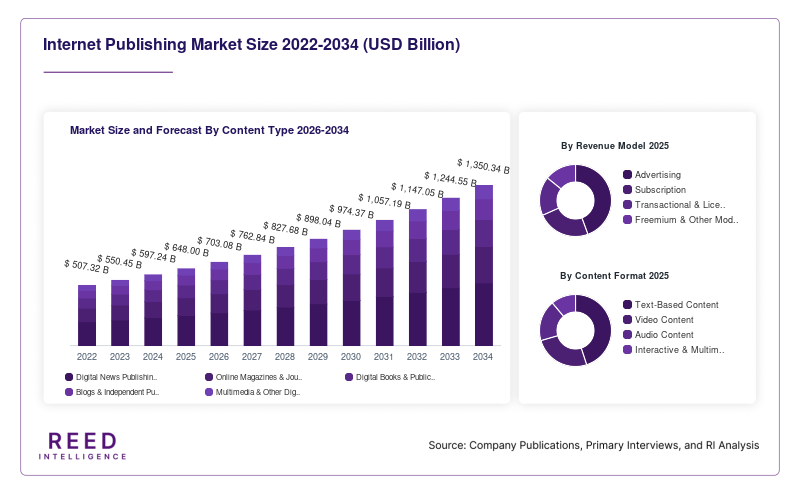
Digital News Publishing accounts for approximately 34% of the market in 2025. Its position reflects frequent consumption, large addressable audiences and multiple monetization mechanisms including advertising, subscriptions, memberships, sponsorships and licensing.
The segment is also undergoing a transition from open-access traffic acquisition toward direct audience relationships. The New York Times' digital-only subscription base reached approximately 12.21 million at the end of 2025, illustrating the ability of established publishers to convert recurring digital audiences into subscription revenue.
Multimedia & Other Digital Publishing accounts for approximately 18% and is projected to grow at approximately 10.60% CAGR, making it the fastest-growing content-type segment. Video, audio, interactive formats and mixed-media products allow publishers to distribute the same intellectual property across multiple consumption formats.
Online Magazines & Journals account for 21% and grow at approximately 7.80% CAGR, while Digital Books & Publications account for 15% and grow at approximately 7.20% CAGR. Blogs & Independent Publishing account for 12% and grow at approximately 8.40% CAGR.
Revenue Model Analysis
By Revenue Model
Advertising accounts for approximately 48% of the market in 2025. Digital advertising allows publishers to monetize audiences without requiring users to make direct payments, making it particularly relevant to high-volume content such as news, entertainment and open-access information.
Alphabet reported that YouTube's annual revenue surpassed $60 billion across advertising and subscriptions in 2025, illustrating the scale of digital content monetization through advertising-supported platforms. Meta also reported $196.18 billion in advertising revenue for 2025 across its Family of Apps and related activities.
Subscription accounts for approximately 29% and is projected to grow at approximately 10.30% CAGR, making it the fastest-growing revenue model. The expansion is supported by publishers converting loyal audiences into recurring customers.
Transactional & Licensing accounts for 13% and grows at approximately 8.90% CAGR, while Freemium & Other Models account for 10% and grow at approximately 7.30% CAGR.
Content Format Analysis
By Content Format
Text-Based Content accounts for approximately 42% of the market in 2025. Text remains central to digital news, professional information, online magazines, blogs, reference materials and digital books.
Search engines have historically provided a major discovery pathway for text-based information, although AI-generated search interfaces are changing how users interact with text content. Google reported that AI Overviews expanded to more than 200 countries and territories and more than 40 languages in 2025.
Interactive & Multimedia Content accounts for approximately 18% and is projected to grow at approximately 11.10% CAGR, making it the fastest-growing format. Interactive products can combine text, video, graphics, audio and user participation, creating opportunities for higher engagement and differentiated monetization.
Video Content accounts for 27% and grows at approximately 9.00% CAGR, while Audio Content accounts for 13% and grows at approximately 8.20% CAGR.
End-User Analysis
By End User
Individual Consumers account for approximately 63% of the market in 2025. Consumer publishing spans news, entertainment, lifestyle, sports, education, reviews, digital books and other information categories.
The segment's addressable base continues to expand as internet adoption increases. The ITU estimates that 6 billion people were online in 2025, although adoption varies substantially by income and geography.
Businesses account for approximately 22% and are projected to grow at approximately 9.70% CAGR, making them the fastest-growing end-user segment. Businesses increasingly purchase specialist information, professional publications, research and industry content where the information can support decision-making.
Educational & Research Institutions account for 10% and grow at approximately 8.30% CAGR, while Government & Nonprofit Organizations account for 5% and grow at approximately 6.90% CAGR.
Platform Analysis
By Platform
Websites account for approximately 47% of the market in 2025. Websites remain important because publishers can control branding, content presentation, advertising inventory, subscription infrastructure and first-party audience relationships.
The platform is particularly important for subscription publishers because direct web properties allow publishers to maintain billing and customer relationships without relying entirely on third-party distribution.
Mobile Applications account for approximately 27% and are projected to grow at approximately 10.20% CAGR, making them the fastest-growing platform segment. Mobile usage benefits publishers through push notifications, personalized feeds, offline access and continuous engagement.
Social & Content Platforms account for 18% and grow at approximately 8.70% CAGR, while Other Digital Platforms account for 8% and grow at approximately 6.90% CAGR.
Internet Publishing Market Regional Analysis
North America Holds the Largest Regional Share Through Mature Digital Monetization and Established Publishing Infrastructure
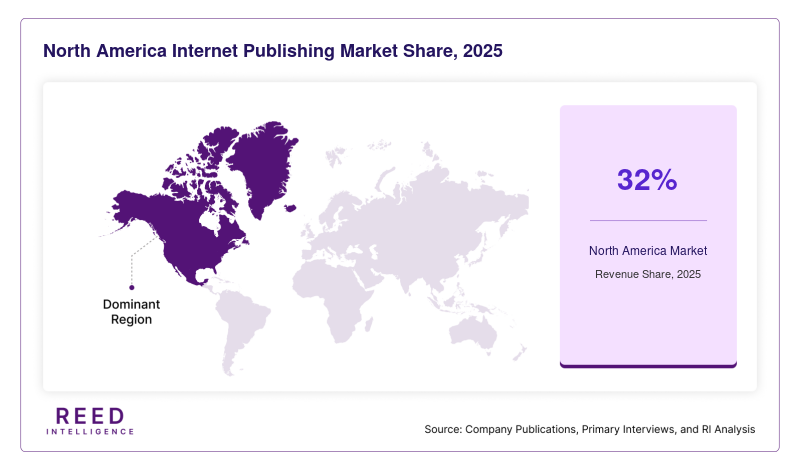
North America accounts for approximately 32% of the global internet publishing market in 2025 and is projected to grow at approximately 7.80% CAGR through 2034.
The region combines high internet penetration, mature digital advertising infrastructure, established subscription businesses and a large population accustomed to consuming content through websites, mobile applications and platforms. The ITU reports that internet use in the Americas was between 88% and 93% in 2025, placing the region among the world's most connected markets.
The U.S. represents the principal market within the region, with major publishers, technology platforms and advertising ecosystems operating at scale. Established publishers increasingly combine advertising, subscriptions, licensing, commerce and memberships.
The New York Times provides a clear example of subscription monetization. Its digital-only subscriber base reached approximately 12.21 million at the end of 2025, while digital-only subscription revenue increased 14.3% year over year.
Future growth is increasingly linked to AI-assisted publishing, multimedia content, subscription bundling and first-party audience relationships.
Constraints include intense competition for attention, platform dependency, advertising-market volatility and increasing content-production costs.
Europe Maintains a Strong Position Through High Connectivity and Developed Digital Publishing Ecosystems
Europe accounts for approximately 27% of the market in 2025 and is projected to grow at approximately 8.00% CAGR through 2034.
Europe's high internet penetration provides publishers with a large addressable digital audience. The ITU places European internet use among the highest regional levels globally, approaching the 95% universality target.
The region also has a mature newspaper, magazine, professional publishing and public-information ecosystem that is increasingly transitioning toward digital formats.
Regulation is an important differentiator. The Digital Services Act has applied broadly since February 2024, while very large platforms and search engines face additional obligations relating to transparency, content moderation and systemic risks.
In February 2026, the European Commission issued guidelines relating to protection of professional media content on very large online platforms under the European Media Freedom Act.
These developments increase compliance requirements but can also provide clearer operating rules for publishers.
Asia-Pacific Is the Fastest-Growing Region as Internet Adoption Continues to Expand Across Large Consumer Markets
Asia-Pacific accounts for approximately 25% of the market in 2025 and is projected to grow at approximately 10.20% CAGR through 2034, making it the fastest-growing region.
The principal mechanism is the continued expansion of the connected population. The ITU estimates that 77% of people in the Asia-Pacific region used the Internet in 2025, leaving considerable room for additional adoption compared with highly mature markets.
China, India, Japan, South Korea, Australia and Southeast Asian economies provide diverse publishing environments ranging from mass-market digital media to specialist professional information.
Mobile-first consumption is particularly important because publishers can reach new users through applications, social platforms, messaging ecosystems and mobile-optimized websites.
The region also provides opportunities for local-language publishing. As more users enter digital ecosystems, content demand can expand beyond English-language products toward regional languages and locally relevant information.
Constraints include uneven connectivity, regulatory fragmentation, monetization differences and significant competition from large technology platforms.
Middle East and Africa Represent an Expanding Market as Connectivity and Digital Content Consumption Increase
Middle East and Africa account for approximately 9% of the market in 2025 and are projected to grow at approximately 9.00% CAGR through 2034.
The region has substantial differences in digital maturity. The ITU reports that internet use in the Arab States reached approximately 70% in 2025, while Africa remained considerably lower, with just over one-third of individuals online according to the Global Connectivity Report.
This disparity creates two distinct market mechanisms. More mature markets can support subscription and premium publishing products, while markets with lower penetration offer longer-term audience expansion as infrastructure and affordability improve.
Mobile connectivity is particularly relevant because mobile broadband can provide access without requiring fixed-line infrastructure.
Constraints include affordability, digital skills, infrastructure quality and differences in regulatory environments across countries.
Latin America Develops Through High Digital Engagement and Increasing Mobile-Based Publishing
Latin America accounts for approximately 7% of the market in 2025 and is projected to grow at approximately 8.60% CAGR through 2034.
The region benefits from comparatively high internet adoption across major markets and strong mobile usage. The ITU places the Americas among the regions where internet use reached approximately 88%–93% in 2025.
Brazil and Mexico provide large consumer audiences, while Argentina, Colombia, Chile and other markets support regional publishing businesses and specialist digital content.
The growth mechanism is increasingly mobile-led: publishers can reach consumers through applications, mobile websites, video platforms and social distribution without requiring traditional print infrastructure.
Subscription affordability and advertising monetization remain important constraints, particularly where consumer purchasing power is lower or currency volatility affects digital-service pricing.
Internet Publishing Market Competitive Landscape
The internet publishing market is characterized by low barriers to digital content creation but high barriers to building large, trusted and monetizable audiences. Competition therefore occurs across content quality, brand recognition, distribution, audience engagement, advertising technology, subscriptions and proprietary data.
Large platform companies influence publisher economics because they control major discovery and advertising channels. Alphabet reported strong growth in Google Search and YouTube advertising during 2025, while YouTube's annual revenue across advertising and subscriptions surpassed $60 billion. Meta generated approximately $196.18 billion in advertising revenue in 2025, demonstrating the scale of platform-based audience monetization.
Traditional publishers are responding by building direct consumer relationships. The New York Times had approximately 12.21 million digital-only subscribers at the end of 2025 and increased digital-only subscription revenue 14.3% year over year.
Key Market Players
Internet Publishing Market Recent Developments
- September 2026 — A U.S. federal court ordered Google to modify aspects of its advertising-technology practices following an antitrust case. The judgment requires changes including separating Google's ad server from its AdX exchange. The development is relevant to internet publishing because publishers depend on advertising infrastructure to sell digital inventory. Google has indicated that it plans to appeal aspects of the ruling.
- February 2026 — The European Commission issued guidelines concerning protection of professional media content on very large online platforms. The guidelines relate to the European Media Freedom Act and include safeguards around the removal of professional journalistic content. The development increases the importance of platform-publisher relationships and content-governance practices in the European market.
Internet Publishing Market Segments
By Content Type
- Digital News Publishing
- Online Magazines & Journals
- Digital Books & Publications
- Blogs & Independent Publishing
- Multimedia & Other Digital Publishing
By Revenue Model
- Advertising
- Subscription
- Transactional & Licensing
- Freemium & Other Models
By Content Format
- Text-Based Content
- Video Content
- Audio Content
- Interactive & Multimedia Content
By End User
- Individual Consumers
- Businesses
- Educational & Research Institutions
- Government & Nonprofit Organizations
By Platform
- Websites
- Mobile Applications
- Social & Content Platforms
- Other Digital Platforms
By Region
- North America
- Europe
- APAC
- Middle East and Africa
- LATAM