Inventory Management System Market Size, Share & Trends Analysis Report By Component, By Deployment, By Organization Size, By Application and By Region, Forecasts 2026–2034
USD 3950
Inventory Management System Market Size
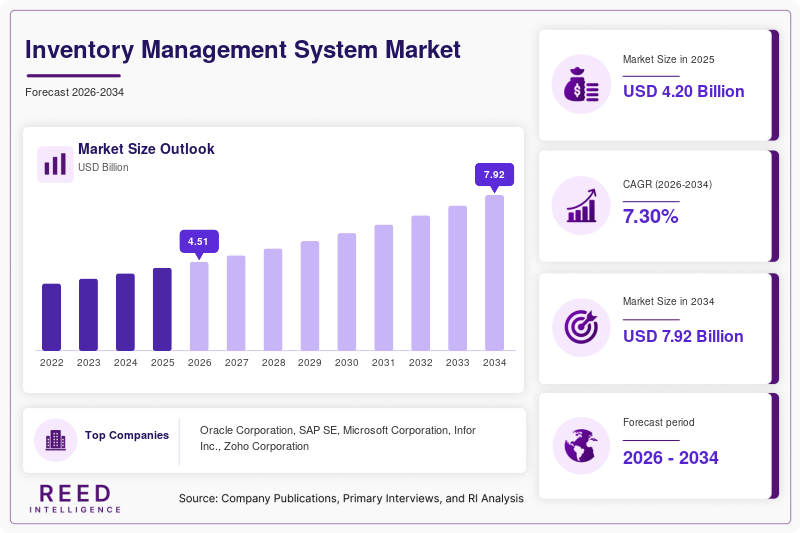
The global inventory management system market was valued at USD 4.20 billion in 2025 and is projected to grow from USD 4.50 billion in 2026 to USD 7.90 billion by 2034, registering a CAGR of 7.30% during the forecast period from 2026 to 2034.
Inventory management systems are software solutions designed to help businesses monitor, control and optimize inventory throughout procurement, storage, sales and distribution activities. These systems provide capabilities such as inventory tracking, stock-level monitoring, purchase management, warehouse coordination, order processing, barcode scanning, reporting and demand forecasting.
The market is being supported by the increasing complexity of supply chains, expansion of e-commerce, demand for real-time inventory visibility and growing adoption of cloud-based business software. Companies across retail, manufacturing, wholesale, healthcare, food and beverage and logistics are increasingly using digital inventory platforms to reduce stockouts, avoid excess inventory and improve operational efficiency.
Inventory Management System Market Drivers
Growing E-Commerce Operations
The expansion of e-commerce has increased the need for accurate and real-time inventory visibility across warehouses, fulfillment centers and sales channels.
Inventory management systems help businesses synchronize stock levels across multiple channels and improve order fulfillment.
Increasing Supply Chain Complexity
Businesses increasingly operate across multiple suppliers, warehouses, distribution centers and sales channels.
Inventory software enables centralized monitoring and coordination of stock across geographically distributed operations.
Demand for Real-Time Inventory Visibility
Businesses require accurate information about available inventory to make purchasing, production and sales decisions.
Cloud-based systems and connected inventory platforms can provide real-time or near-real-time visibility into stock movements.
Increasing Adoption of Cloud Software
Cloud deployment reduces the need for businesses to maintain extensive on-premise IT infrastructure.
Subscription-based software also allows smaller organizations to access inventory management capabilities without large upfront investments.
Need to Reduce Inventory Costs
Excess inventory ties up working capital, while stockouts can result in lost sales and customer dissatisfaction.
Inventory management systems help organizations establish reorder points, monitor stock levels and improve demand planning.
Inventory Management System Market Restraints
Implementation Costs
Although cloud-based solutions can reduce infrastructure requirements, businesses may still incur expenses for software configuration, integration, data migration and employee training.
These costs can discourage smaller organizations from adopting advanced systems.
Integration Challenges
Inventory platforms often need to integrate with ERP, accounting, e-commerce, POS and warehouse systems.
Compatibility issues and complex legacy infrastructure can increase implementation time and cost.
Data Quality Issues
Inventory systems depend on accurate product, stock and transaction data.
Incorrect data entry, duplicated records or inconsistent product information can reduce system effectiveness.
Cybersecurity and Data Privacy Concerns
Cloud-based inventory platforms store operational and commercial information that can be sensitive to businesses.
Organizations therefore require strong access controls, encryption and cybersecurity measures.
Inventory Management System Market Opportunities
AI-Based Inventory Forecasting
Artificial intelligence and machine learning can analyze historical sales, seasonal patterns and other variables to improve demand forecasting.
AI-enabled inventory systems can help businesses optimize reorder levels and reduce excess stock.
IoT-Enabled Inventory Tracking
IoT sensors, RFID and connected devices can provide automated visibility into inventory movement and storage conditions.
This creates opportunities for more accurate and automated inventory monitoring.
Growth of Omnichannel Retail
Retailers increasingly sell through physical stores, websites, marketplaces and mobile applications.
Inventory systems that synchronize stock across these channels can help businesses improve fulfillment and reduce inventory discrepancies.
Expansion of Small and Medium-Sized Businesses
SMEs are increasingly adopting affordable cloud-based software to digitize business processes.
Simplified implementation and subscription-based pricing are creating opportunities among smaller organizations.
Integration with Warehouse Automation
Inventory software can be integrated with automated storage systems, robotics, barcode scanners and warehouse management platforms.
This can improve inventory accuracy and operational productivity.
Component Segment Analysis
By Component
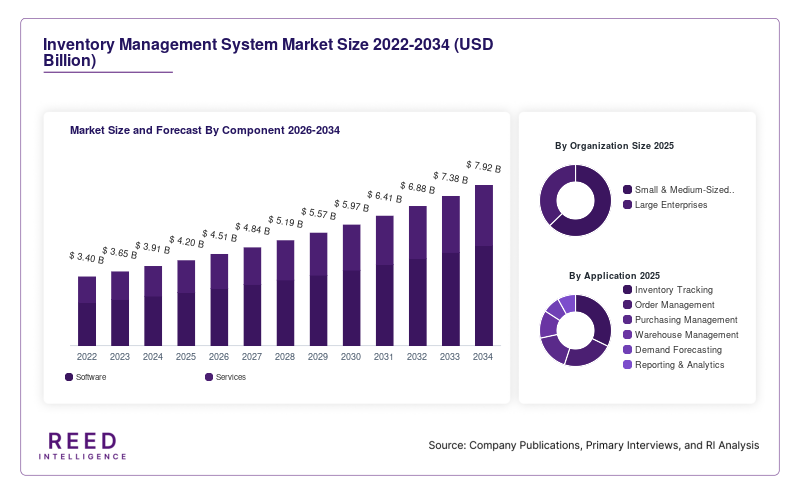
Software accounted for approximately 72% of the inventory management system market in 2025, making it the dominant component segment. Businesses increasingly require digital tools for stock tracking, purchasing, order management, forecasting and analytics.
Services accounted for approximately 28% and are projected to grow at approximately 8.1% CAGR, supported by demand for implementation, integration, customization, training and ongoing technical support.
Deployment Segment Analysis
By Deployment
Cloud-based inventory management systems accounted for approximately 67% of the market in 2025, making them the largest deployment segment. Their position is supported by lower infrastructure requirements, subscription-based pricing, remote accessibility and easier scalability.
Cloud-based deployment is projected to grow at approximately 8.5% CAGR, making it the fastest-growing deployment segment. Increasing adoption among SMEs and businesses operating multiple sales and warehouse locations is supporting expansion.
On-premise systems represented approximately 33% of the market.
Organization Size Segment Analysis
By Organization Size
Large enterprises accounted for approximately 61% of the market in 2025, reflecting their complex supply chains, larger inventories and greater requirements for integration with ERP, warehouse and enterprise systems.
Small and medium-sized enterprises accounted for approximately 39% and are projected to grow at approximately 8.5% CAGR, making them the faster-growing organization-size segment. Affordable cloud subscriptions and simplified implementation are increasing accessibility for smaller businesses.
Application Segment Analysis
By Application
Inventory tracking accounted for approximately 28% of the market in 2025, making it the largest application segment. Accurate monitoring of stock quantities, locations and movements is a fundamental requirement across industries.
Demand forecasting accounted for approximately 15% and is projected to grow at approximately 9.2% CAGR, making it the fastest-growing major application segment. Businesses are increasingly using predictive analytics and AI to improve purchasing decisions and reduce excess inventory.
Order management represented approximately 22%, purchasing management 14%, warehouse management 12%, and reporting and analytics approximately 9%.
End-User Segment Analysis
By End User
Retail and e-commerce accounted for approximately 31% of the market in 2025, making them the largest end-user segment. High transaction volumes, multiple sales channels and the need for real-time stock visibility are driving software adoption.
Healthcare accounted for approximately 9% and is projected to grow at approximately 8.4% CAGR, making it one of the fastest-growing major end-user segments. Increasing digitization of medical supply management and the need for accurate tracking of pharmaceutical and medical inventory are supporting demand.
Manufacturing represented approximately 27%, wholesale and distribution 18%, food and beverage 8%, automotive 7%, and other industries approximately 9%.
Inventory Management System Market Regional Analysis
North America Holds the Largest Share
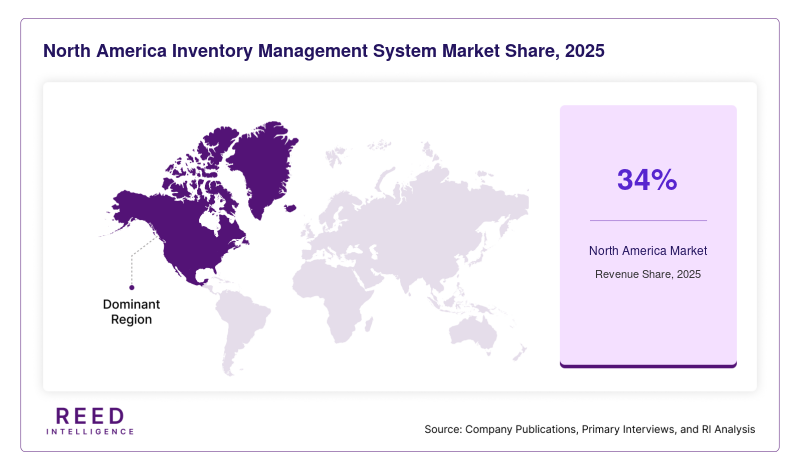
North America accounted for approximately 34% of the global inventory management system market in 2025, making it the largest regional market. The region benefits from high cloud-software adoption, mature e-commerce infrastructure, advanced supply chains and widespread business digitization.
Asia-Pacific accounted for approximately 29% and is projected to grow at approximately 9.1% CAGR, making it the fastest-growing major region. Expansion of e-commerce, manufacturing, logistics infrastructure and digital business platforms is increasing demand for inventory management systems.
Europe Maintains Strong Adoption
Europe accounted for approximately 25% of the market in 2025 and is projected to grow at approximately 6.7% CAGR.
The region benefits from established retail and manufacturing industries, increasing supply-chain digitization and growing adoption of cloud-based enterprise software.
Latin America Shows Increasing Digital Adoption
Latin America accounted for approximately 7% of the market in 2025 and is projected to grow at approximately 7.8% CAGR.
Growing e-commerce activity, modernization of retail operations and increasing SME adoption of cloud software are supporting market expansion.
Middle East & Africa Represents an Emerging Opportunity
Middle East & Africa accounted for approximately 5% of the market in 2025 and is projected to grow at approximately 7.6% CAGR.
Growth in e-commerce, logistics, retail modernization and digital transformation initiatives is creating opportunities for inventory management software providers.
Inventory Management System Market Competitive Landscape
Competition in the inventory management system market is based on functionality, ease of deployment, integration capabilities, scalability, automation, analytics, pricing, industry specialization, cybersecurity and customer support.
Software providers are increasingly incorporating AI-powered forecasting, real-time analytics, barcode and RFID capabilities, mobile applications and integrations with e-commerce and ERP platforms.
Key Market Players
- Oracle Corporation
- SAP SE
- Microsoft Corporation
- Infor Inc.
- Zoho Corporation
- Cin7
- Fishbowl
- NetSuite
- Lightspeed Commerce Inc.
- Odoo S.A.
Inventory Management System Market Recent Developments
- Inventory software providers are increasingly incorporating artificial intelligence and machine learning to analyze historical sales and identify demand patterns. AI-assisted forecasting can help businesses make more informed replenishment and purchasing decisions.
- Businesses are increasingly seeking real-time visibility across stores, warehouses and online sales channels. Cloud platforms, barcode scanning, RFID and connected systems are improving the speed and accuracy of inventory updates.
Inventory Management System Market Segments
By Component
- Software
- Services
By Deployment
A PHP Error was encountered
Severity: Notice
Message: Undefined offset: 1
Filename: reportpages/rd.php
Line Number: 400
Backtrace:
File: /var/www/html/application/views/frontend/reportpages/rd.php
Line: 400
Function: _error_handler
File: /var/www/html/application/controllers/FrontendReportController.php
Line: 420
Function: view
File: /var/www/html/index.php
Line: 315
Function: require_once
- Cloud-Based
- On-Premise
By Organization Size
- Small & Medium-Sized Enterprises
- Large Enterprises
By Application
- Inventory Tracking
- Order Management
- Purchasing Management
- Warehouse Management
- Demand Forecasting
- Reporting & Analytics
By End User
- Retail & E-Commerce
- Manufacturing
- Wholesale & Distribution
- Food & Beverage
- Healthcare
- Automotive
- Others
By Region
- North America
- Europe
- APAC
- Middle East and Africa
- LATAM