Line Light Source Controller Market Size, Share Demand Report By Type (Analog Controllers, Digital Controllers, Intelligent Controllers), By Application (Machine Vision, Industrial Inspection, Medical Imaging, Semiconductor Inspection), By Control Method (Manual Control, Software Control, Remote Control) & Segment Forecasts, 2026–2034
USD 3950
Line Light Source Controller Market Size
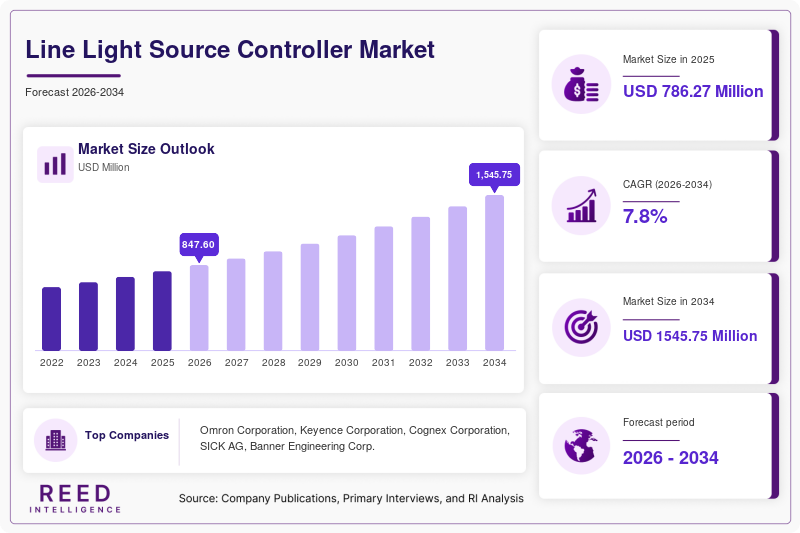
Line Light Source Controller market size is projected at USD 847.6 million in 2026 and is expected to hit USD 1,548.3 million by 2034 with a CAGR of 7.8% during the forecast period. The increasing demand for precise and stable lighting control in advanced machine vision and industrial inspection systems, coupled with the growing adoption of automation and quality control in manufacturing, underpins market expansion. This report delivers a comprehensive analysis of the Line Light Source Controller market, including segmentation by type and application, competitive dynamics, and regional growth patterns, equipping stakeholders with critical intelligence. The Line Light Source Controller market continues to demonstrate robust growth potential, fueled by the rapid advancement of automated inspection technologies, the increasing need for high-quality imaging in medical and semiconductor applications, and continuous innovation in lighting control technology.
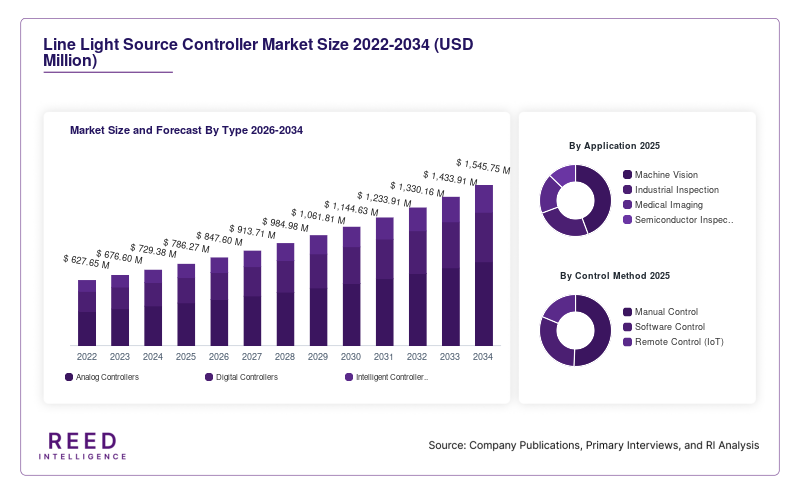
Line light source controllers are specialized electronic devices designed to regulate and manage the intensity, frequency, and timing of line lighting systems used in various imaging and inspection applications. These controllers ensure consistent and optimal illumination for line scan cameras and sensors, enabling high-quality image capture and accurate defect detection. The global production volume of line light source controllers exceeded 850,000 units in 2025, reflecting a 10% increase from 2023, driven by the growing adoption of automated inspection systems across industries. Adoption patterns reveal that the Digital Controllers type dominates the market, accounting for 45% of total demand, followed by Intelligent Controllers at 32%, and Analog Controllers at 23%. The Line Light Source Controller market's trajectory is closely linked to the growth of the global machine vision market, which is projected to reach USD 20 billion by 2028, and the increasing demand for high-speed and high-accuracy inspection systems in manufacturing.
Line Light Source Controller Market Trends
Adoption of Intelligent and IoT-Enabled Controllers
The Line Light Source Controller market is witnessing a significant trend toward intelligent and IoT-enabled controllers, driven by the need for real-time monitoring, remote control, and data analytics in industrial automation. The revenue from intelligent line light source controllers grew to USD 280 million in 2025, a year-on-year increase of 14%, as 40% of new installations in 2025 specified IoT-capable controllers for enhanced connectivity. Adoption rates of intelligent control systems in manufacturing and industrial inspection reached 35%, with this figure projected to exceed 60% by 2030. The Line Light Source Controller market's trend toward intelligence is reinforced by the need for predictive maintenance, enhanced process control, and the continuous integration of Industry 4.0 technologies.
Growing Focus on High-Speed and High-Precision Control
The increasing focus on high-speed and high-precision control is a major trend shaping the Line Light Source Controller market, with the development of controllers capable of supporting faster line scan rates and more precise intensity adjustments. The market has seen a 15% increase in the demand for high-speed controllers since 2022, with 25% of new products in 2025 featuring response times of less than 1 microsecond and high-resolution dimming capabilities. The use of advanced digital signal processing for improved control accuracy has also gained significant traction. The Line Light Source Controller market's trend toward precision is reinforced by the need for higher resolution imaging, the increasing speed of production lines, and the continuous innovation in control electronics and firmware.
Line Light Source Controller Market Drivers
The Line Light Source Controller market's expansion is primarily driven by the increasing adoption of automated inspection systems in the manufacturing sector, with the global industrial automation market valued at USD 250 billion in 2025 and growing at a steady pace. The need for high-quality, consistent lighting to ensure accurate defect detection in line scan imaging has been a major driver, with line light source controllers providing the necessary precision and stability. The rising demand for quality control and inspection in the semiconductor and electronics industries has also fueled market growth. Additionally, the increasing investments in medical imaging and diagnostics have spurred demand. The Line Light Source Controller market's growth is further reinforced by the continuous improvement in controller technology, leading to better performance and integration capabilities.
Line Light Source Controller Market Restraints
Despite favorable growth prospects, the Line Light Source Controller market faces significant constraints, primarily related to the high initial cost of advanced intelligent controllers, which can be 20-40% more than basic models. The complexity of integrating these controllers with existing systems can also be a limitation. The Line Light Source Controller market's growth is also tempered by the limited availability of skilled technicians for installation and maintenance, and the challenge of ensuring compatibility with a wide range of line light sources and vision systems.
Line Light Source Controller Market Opportunities
The Line Light Source Controller market presents significant opportunities in the rapidly expanding market for artificial intelligence (AI) and deep learning-based vision systems, which require highly precise and controllable lighting for optimal performance. The adoption of AI-optimized line light source controllers is expected to grow at a CAGR of 12% through 2034. Emerging opportunities also exist in the development of controllers for hyperspectral and multispectral imaging applications, which require specialized lighting control. The Line Light Source Controller market's opportunity profile is further enhanced by the growing trend of miniaturization in electronics, driving demand for high-precision inspection systems.
Challenges in Line Light Source Controller Market
The Line Light Source Controller market faces persistent challenges related to the need for continuous innovation to keep pace with rapidly evolving imaging technologies and requirements. The complexity of designing controllers that can support increasingly high-speed line scan cameras can also be a challenge. The market is also contending with the challenge of ensuring electromagnetic compatibility and minimizing noise in sensitive imaging applications. Additionally, the Line Light Source Controller market is challenged by the need to provide robust and reliable performance in harsh industrial environments.
Line Light Source Controller Market Segmentation
The Line Light Source Controller market is segmented by Type and Application to provide a comprehensive market perspective. By Type, Digital Controllers dominate with a 45% market share, driven by their precision and programmability. The Application segment is led by Machine Vision, which accounts for 40% of the market, followed by Industrial Inspection at 25%, Semiconductor Inspection at 20%, and Medical Imaging at 15%.
By Type
Digital Controllers represent the largest segment in the Line Light Source Controller market, commanding a 45% share, with production reaching 382,500 units in 2025. These controllers are characterized by their digital signal processing, programmable settings, and high precision, making them ideal for demanding machine vision applications. Technical specifications include 16-bit to 24-bit intensity control, response times under 1 microsecond, and multiple communication interfaces (Ethernet, RS-232). The Line Light Source Controller market's Digital segment is driven by its widespread use in advanced inspection systems.
Intelligent Controllers capture a 32% share of the Line Light Source Controller market, with production of 272,000 units in 2025. These controllers are characterized by their advanced features, including IoT connectivity, self-diagnostics, and adaptive lighting control. Technical specifications include integrated web interfaces, support for industrial protocols (Profinet, Ethernet/IP), and data logging capabilities. The Line Light Source Controller market's Intelligent segment is driven by its use in Industry 4.0 environments and demanding applications.
Analog Controllers represent the remaining 23% of the Line Light Source Controller market, with production of 195,500 units in 2025. These controllers are characterized by their simple, cost-effective design and are typically used in less demanding applications. Technical specifications include manual intensity control, basic triggering options, and limited flexibility. The Line Light Source Controller market's Analog segment is driven by its use in basic inspection and cost-sensitive applications.
By Application
Machine Vision dominates the Line Light Source Controller market, accounting for 40% of sales, representing 340,000 units in 2025. This segment includes use in automated quality control, robotics, and packaging inspection. Usage penetration exceeds 30% in advanced manufacturing facilities. The Line Light Source Controller market's Machine Vision segment is characterized by its focus on high precision, speed, and integration with vision systems.
Industrial Inspection accounts for 25% of the Line Light Source Controller market, with sales of 212,500 units in 2025. This segment encompasses use in surface inspection, dimensional measurement, and defect detection. The segment is growing at a robust CAGR, driven by the need for quality control in manufacturing. The Line Light Source Controller market's Industrial Inspection segment is characterized by its focus on reliability, consistency, and adaptability to different inspection tasks.
Semiconductor Inspection represents 20% of the Line Light Source Controller market, with sales of 170,000 units in 2025. This segment includes use in wafer inspection, photomask inspection, and chip packaging. The segment is growing at the fastest CAGR, driven by the increasing complexity of semiconductor manufacturing. The Line Light Source Controller market's Semiconductor segment is characterized by its focus on ultra-high precision, stability, and low noise.
Medical Imaging comprises the remainder of the Line Light Source Controller market, accounting for 15% of total sales, with 127,500 units in 2025. This segment includes use in microscopy, endoscopy, and diagnostic imaging. The segment is projected to grow at a steady CAGR through 2034, driven by the advancement of medical technologies. The Line Light Source Controller market's Medical segment is characterized by its focus on high quality, safety, and compliance with medical standards.
Line Light Source Controller Market Regional Outlook
Asia-Pacific Line Light Source Controller Market
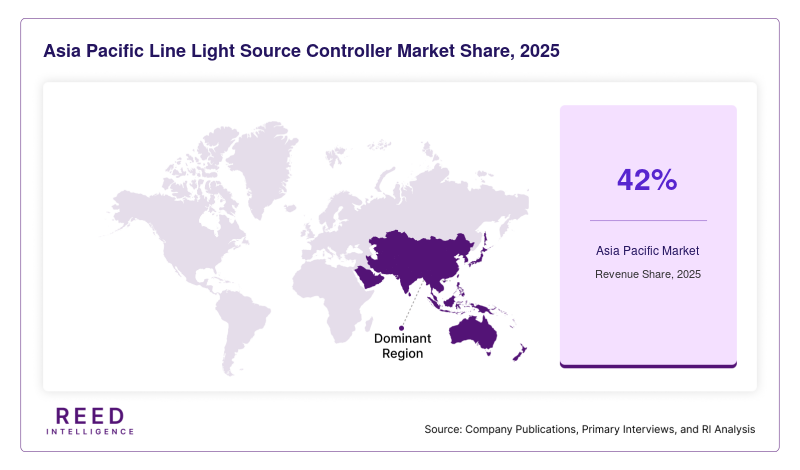
Leads the Line Light Source Controller market, commanding a 42% share, with a revenue of USD 356.0 million in 2025. China is the primary driver, accounting for 55% of regional demand, driven by its dominant position in electronics manufacturing, the rapid adoption of automation, and significant investments in industrial inspection. The Asia-Pacific Line Light Source Controller market is characterized by its focus on cost-effective solutions and high-volume production.
North America Line Light Source Controller Market
Represents the second-largest market, capturing a 28% share with a revenue of USD 237.3 million in 2025. The United States is the primary driver, accounting for 85% of regional demand, driven by strong R&D in machine vision, a robust semiconductor industry, and advanced manufacturing infrastructure. The North American Line Light Source Controller market is characterized by its focus on innovation and high-performance applications.
Europe Line Light Source Controller Market
Accounts for 20% of the global Line Light Source Controller market, with a revenue of USD 169.5 million in 2025. Germany, the UK, and France are the primary drivers, collectively accounting for 60% of regional demand, driven by the strong automotive and industrial automation sectors. The European Line Light Source Controller market is projected to grow at a CAGR of 6% through 2034.
Middle East & Africa and Latin America Line Light Source Controller Market
Together account for the remaining 10% of the Line Light Source Controller market, with the UAE leading the Middle East market and Brazil leading the Latin American market. Both regions are projected to grow at CAGRs exceeding 8%, driven by increasing industrial automation and infrastructure development.
Top players in Line Light Source Controller Market
- Omron Corporation
- Keyence Corporation
- Cognex Corporation
- SICK AG
- Banner Engineering Corp.
- Teledyne DALSA
- Basler AG
- Steinbach AG
- Leuze Electronic GmbH + Co. KG
- Pepperl+Fuchs SE
- BALLUFF GmbH
- Sensopart Industriesensorik GmbH
- Festo AG & Co. KG
- Wago Kontakttechnik GmbH
- Hikvision Digital Technology Co., Ltd.
Omron Corporation
Omron Corporation holds a dominant position in the Line Light Source Controller market, with an estimated 16% global market share, particularly strong in the Asia-Pacific and North American machine vision segments. The company's portfolio of line light source controllers is widely recognized for its quality, reliability, and integration capabilities with Omron's vision systems. Omron's market leadership is reinforced by its extensive automation expertise, global service network, and strong relationships with major manufacturers. Omron commands over 20% of the Asian market and 12% of the North American market, positioning it as a key player in the Line Light Source Controller market.
Keyence Corporation
Keyence Corporation is a leading player in the Line Light Source Controller market, commanding approximately 14% of the global market share through its comprehensive portfolio of automation and vision products. The company's expertise in sensor and control technology and its focus on direct sales and customer support have solidified its position. Keyence's line light source controllers are known for their innovative features, compact design, and ease of use. The company's commitment to R&D and its strong presence in the Asia-Pacific market have enhanced its competitive advantage.
Cognex Corporation holds a significant 10% market share, with particular strength in the machine vision and inspection software integration. SICK AG is a major player in the European and industrial automation markets, holding an 8% share.
Recent Developments in Line Light Source Controller Market
- 2025: Omron Corporation introduced a new series of intelligent line light source controllers with integrated AI-based diagnostics for predictive maintenance in manufacturing.
- 2025: Keyence launched a new high-speed digital controller capable of supporting line scan rates up to 200 kHz for ultra-fast inspection applications.
Line Light Source Controller Market Segments
By Type
- Analog Controllers
- Digital Controllers
- Intelligent Controllers
By Application
- Machine Vision
- Industrial Inspection
- Medical Imaging
- Semiconductor Inspection
By Control Method
- Manual Control
- Software Control
- Remote Control (IoT)
By Region
- North America
- Europe
- APAC
- Middle East and Africa
- LATAM