Machine Shop Services Market Size, Share & Trends Analysis Report By Service Type, By Machining Process, By End User and By Region, Forecasts 2026–2034
USD 3950
Machine Shop Services Market Size
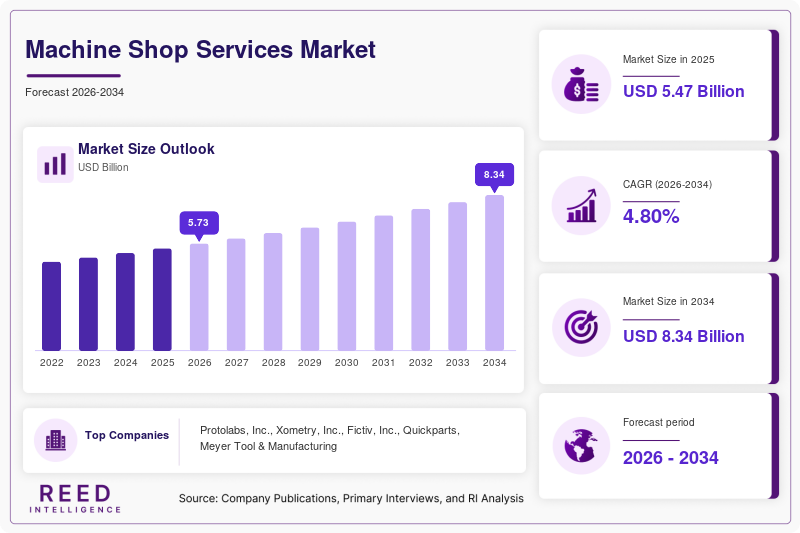
The global machine shop services market was valued at USD 5.47 billion in 2025 and is projected to grow from USD 5.74 billion in 2026 to USD 8.39 billion by 2034, registering a CAGR of 4.80% during the forecast period from 2026 to 2034.
Machine shop services encompass the precision manufacturing and machining of metal and other engineering materials into components, parts and assemblies according to specified dimensional and performance requirements. Services include CNC machining, turning, milling, grinding, drilling, fabrication, finishing, prototyping and other specialized machining operations.
The market is supported by continued demand for precision components across automotive, aerospace and defense, industrial machinery, medical devices, electronics, energy and other manufacturing industries. Increasing outsourcing of machining activities is also contributing to market growth as manufacturers seek to reduce capital expenditure, access specialized equipment and improve production flexibility.
Machine Shop Services Market Drivers
Growth in Precision Manufacturing
Modern industrial equipment increasingly requires components manufactured to tight dimensional tolerances.
The demand for precision parts across aerospace, medical devices, automotive and industrial machinery is supporting machine shop service providers.
Increasing Outsourcing of Machining Operations
Manufacturers increasingly outsource machining activities to specialized service providers to reduce equipment investment and access specialized technical expertise.
This trend allows original equipment manufacturers to concentrate on core design, assembly and product-development activities.
Expansion of CNC Machining
CNC equipment enables automated and highly repeatable manufacturing of complex components.
Increasing adoption of multi-axis CNC machines is supporting demand for advanced machining services.
Growth of Aerospace and Defense Manufacturing
Aerospace and defense components often require complex geometries, high precision and specialized materials.
Increasing aircraft production, maintenance and modernization activities are supporting demand for specialized machining services.
Rising Demand for Customized Components
Industrial customers increasingly require components designed around specific equipment and operational requirements.
Machine shops can manufacture low-volume and customized parts without requiring large-scale production facilities.
Machine Shop Services Market Restraints
High Equipment Investment
Modern CNC machines, multi-axis systems, robotics and advanced inspection equipment require significant capital investment.
This can create entry barriers for smaller machine shops.
Skilled Labor Shortages
Precision machining requires skilled operators, programmers, engineers and quality-control personnel.
A shortage of qualified workers can limit production capacity and increase labor costs.
Fluctuating Raw-Material Costs
Machine shops depend on materials such as steel, aluminum, titanium, copper and specialty alloys.
Price fluctuations can affect production costs and operating margins.
Competitive Pricing Pressure
The presence of numerous regional machine shops creates competitive pressure, particularly for standardized machining services.
Customers may compare suppliers based heavily on price, delivery time and production capacity.
Machine Shop Services Market Opportunities
Adoption of Advanced CNC Technology
Investment in five-axis machining, automated tool changing, robotics and digital production systems creates opportunities for service providers to improve productivity and handle more complex components.
Growth of Additive and Hybrid Manufacturing
Combining additive manufacturing with conventional machining can enable manufacturers to produce complex parts and subsequently achieve required dimensional accuracy through finishing operations.
Medical Device Manufacturing
Medical devices require highly precise components and specialized materials.
Increasing demand for implants, surgical instruments and medical equipment creates opportunities for precision machine shops.
Aerospace Component Outsourcing
Increasing outsourcing by aerospace manufacturers and suppliers is creating opportunities for specialized machine shops capable of meeting strict quality and traceability requirements.
Rapid Prototyping
Product developers increasingly require prototypes before full-scale production.
CNC machining provides a practical method for producing functional prototypes from engineering-grade materials.
Digital Manufacturing
Integration of CAD/CAM software, connected machines, automated inspection and production-monitoring systems can improve efficiency and provide customers with better visibility into manufacturing operations.
Service Type Segment Analysis
By Service Type
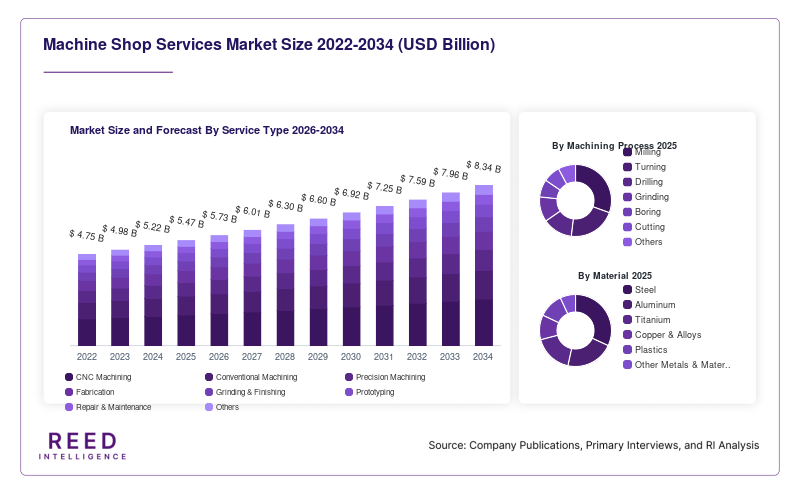
CNC machining accounted for approximately 42% of the machine shop services market in 2025, making it the largest service segment. Its ability to produce complex components with high repeatability and tight tolerances supports widespread adoption across industrial applications.
Precision machining accounted for approximately 19% and is projected to grow at approximately 6.1% CAGR, making it the fastest-growing major service segment. Increasing demand for high-accuracy components in aerospace, medical and advanced industrial applications is supporting growth.
Conventional machining represented approximately 16%, fabrication 10%, grinding and finishing 7%, prototyping 4%, repair and maintenance 2%.
Machining Process Segment Analysis
By Machining Process
Milling accounted for approximately 34% of the market in 2025, making it the largest machining-process segment. CNC milling is widely used to produce complex shapes, slots, holes, surfaces and three-dimensional components.
Grinding accounted for approximately 15% and is projected to grow at approximately 5.8% CAGR, making it the fastest-growing major process segment. Increasing requirements for surface finish, dimensional accuracy and tight tolerances are supporting demand.
Turning represented approximately 27%, drilling 12%, boring 7%, cutting 3%, and other processes approximately 2%.
Material Segment Analysis
By Material
Steel accounted for approximately 39% of the machine shop services market in 2025, making it the largest material segment. Steel's strength, availability and extensive use in industrial machinery and automotive components support its large machining demand.
Titanium accounted for approximately 8% and is projected to grow at approximately 7.0% CAGR, making it the fastest-growing major material segment. Increasing aerospace and medical applications are supporting demand for titanium machining.
Aluminum represented approximately 28%, copper and alloys 11%, plastics 8%, and other materials approximately 6%.
End-User Segment Analysis
By End User
Industrial machinery accounted for approximately 28% of the market in 2025, making it the largest end-user segment. Machine shops supply components, replacement parts and assemblies for industrial equipment across numerous manufacturing sectors.
Medical devices accounted for approximately 10% and are projected to grow at approximately 6.5% CAGR, making it the fastest-growing major end-user segment. Demand for precision surgical instruments, implants and medical equipment components is supporting growth.
Automotive represented approximately 24%, aerospace and defense 18%, energy 9%, electronics 6%, construction 3%, and other end users approximately 2%.
Machine Shop Services Market Regional Analysis
North America Holds the Largest Share
North America accounted for approximately 34% of the global machine shop services market in 2025, making it the largest regional market. The region benefits from established aerospace, automotive, defense, medical-device and industrial manufacturing industries.
Asia-Pacific accounted for approximately 35% and is projected to grow at approximately 6.0% CAGR, making it the fastest-growing major region. Expansion of manufacturing capacity, industrialization and automotive and electronics production is increasing demand for machining services.
Europe Maintains Strong Precision-Manufacturing Demand
Europe accounted for approximately 23% of the market in 2025 and is projected to grow at approximately 4.2% CAGR.
The region's automotive, aerospace, industrial machinery and medical-device sectors support continued demand for precision machining.
Latin America Shows Moderate Expansion
Latin America accounted for approximately 5% of the market in 2025 and is projected to grow at approximately 4.8% CAGR.
Automotive production, industrial development and manufacturing investment are supporting regional demand.
Middle East & Africa Represents an Emerging Market
Middle East & Africa accounted for approximately 3% of the market in 2025 and is projected to grow at approximately 4.5% CAGR.
Industrial diversification, energy-sector manufacturing and infrastructure development are creating opportunities for machine shop service providers.

Machine Shop Services Market Competitive Landscape
Competition in the machine shop services market is based on machining precision, production capacity, turnaround time, equipment capabilities, material expertise, quality certifications, customization, pricing and delivery reliability.
Large and specialized machine shops are investing in CNC equipment, automation, advanced inspection systems and digital manufacturing technologies to improve productivity and serve increasingly complex customer requirements.
Key Market Players
- Protolabs, Inc.
- Xometry, Inc.
- Fictiv, Inc.
- Quickparts
- Meyer Tool & Manufacturing
- Pioneer Service Inc.
- Ardel Engineering
- 3ERP
- Owens Industries
- eMachineShop
Machine Shop Services Market Recent Developments
- Machine shops are increasingly implementing automated CNC systems, robotic loading and unloading, and automated tool-management technologies. Automation can improve production consistency and reduce dependence on manual machine operation.
- Five-axis and other multi-axis machining technologies are gaining importance for complex aerospace, medical and industrial components. These systems can reduce setup requirements and improve the ability to manufacture intricate geometries.
Machine Shop Services Market Segments
By Service Type
- CNC Machining
- Conventional Machining
- Precision Machining
- Fabrication
- Grinding & Finishing
- Prototyping
- Repair & Maintenance
- Others
By Machining Process
- Milling
- Turning
- Drilling
- Grinding
- Boring
- Cutting
- Others
By Material
- Steel
- Aluminum
- Titanium
- Copper & Alloys
- Plastics
- Other Metals & Materials
By End User
- Automotive
- Aerospace & Defense
- Industrial Machinery
- Medical Devices
- Energy
- Electronics
- Construction
- Others
By Region
- North America
- Europe
- APAC
- Middle East and Africa
- LATAM