Medium Density Fiberboard (MDF) Market Size, Share & Trends Analysis Report By Product, By Type, By Application, By End User and By Region, Forecasts 2026–2034
USD 3950
Medium Density Fiberboard (MDF) Market Size
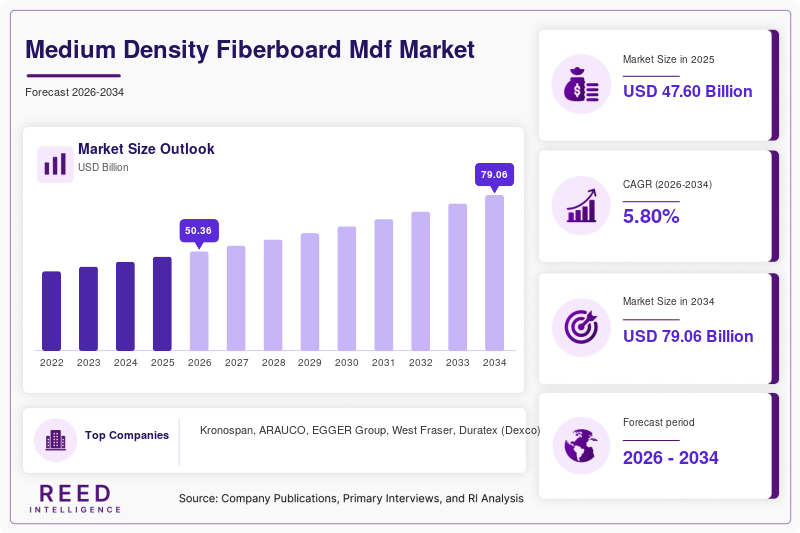
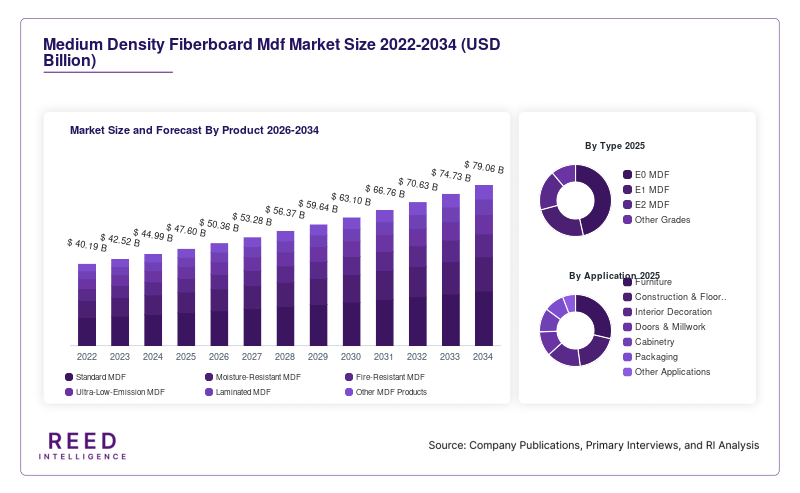
The global medium density fiberboard (MDF) market was valued at USD 47.60 billion in 2025 and is projected to grow from USD 50.56 billion in 2026 to USD 79.13 billion by 2034, registering a CAGR of 5.80% during the forecast period from 2026 to 2034. These market figures are consistent with the supplied market dataset and are also reported by Fortune Business Insights.
Medium Density Fiberboard (MDF) is an engineered wood product manufactured by refining wood fibers and combining them with resin or other binders under heat and pressure. Its uniform density, smooth surface, dimensional consistency and machinability make MDF suitable for furniture, cabinetry, doors, flooring, wall panels, interior decoration and construction applications.
The market is supported by growing furniture production, residential and commercial construction, remodeling activity and demand for cost-effective engineered wood products. MDF is particularly suitable for painted furniture and precision-machined components because its homogeneous structure allows detailed cutting, routing and finishing.
Medium Density Fiberboard (MDF) Market Drivers
Growing Furniture Manufacturing
Furniture remains one of the largest applications for MDF.
The material's smooth surface and consistent density make it suitable for cabinets, shelving, drawer fronts, doors, tables and ready-to-assemble furniture. Demand for modular and customized furniture is supporting MDF consumption.
Expansion of Residential Construction
Residential construction and renovation activities are generating demand for engineered wood panels used in cabinetry, flooring, doors, wall applications and interior fittings.
Growing urban housing activity in Asia-Pacific is particularly important to market development.
Demand for Cost-Effective Interior Materials
MDF offers manufacturers a relatively consistent and machinable substrate for interior products.
Its ability to accept paint, laminate, veneer and decorative finishes supports its use across different furniture and interior-design applications.
Growth of Modular Furniture
The expansion of modular kitchens, wardrobes, office furniture and ready-to-assemble products is increasing demand for precision-machined board materials.
MDF's uniform composition supports CNC routing and other automated manufacturing processes.
Increasing Adoption of Engineered Wood
Engineered wood products can provide manufacturers with alternatives to some solid-wood applications.
The availability of different MDF grades allows manufacturers to select products according to moisture resistance, fire performance, emissions and finishing requirements.
Medium Density Fiberboard (MDF) Market Restraints
Formaldehyde Emissions
Traditional MDF production can involve formaldehyde-containing resins.
Increasingly stringent emissions requirements are encouraging manufacturers to develop low-emission and formaldehyde-reduced products, which can increase manufacturing complexity and costs.
Volatility in Wood Fiber and Resin Costs
MDF production depends on wood fiber, resin, energy and transportation.
Changes in raw-material and energy costs can affect manufacturing margins and product prices.
Competition from Plywood and Particleboard
MDF competes with plywood, particleboard, oriented strand board and other engineered wood products.
Material selection varies according to strength, moisture resistance, price, appearance and intended application.
Moisture Sensitivity of Standard MDF
Standard MDF can experience swelling or degradation when exposed to excessive moisture.
This limitation has encouraged demand for moisture-resistant grades in kitchens, bathrooms and other high-humidity applications.
Medium Density Fiberboard (MDF) Market Opportunities
Low-Emission MDF
Increasing environmental and indoor-air-quality requirements are creating opportunities for no-added-formaldehyde and ultra-low-emission MDF products.
Premium low-emission products can serve furniture, healthcare, hospitality and residential applications.
Moisture-Resistant MDF
Moisture-resistant MDF can expand the material's use in kitchens, bathrooms, laundry areas and other environments where conventional MDF has limitations.
Fire-Resistant MDF
Fire-resistant grades provide opportunities in commercial construction, public buildings and applications where fire-performance specifications are important.
Recycled Wood-Content MDF
Manufacturers are increasingly exploring recycled wood fiber and circular production systems.
Recycled-content products can help address material-efficiency objectives while creating differentiated product lines.
Automated MDF Processing
Growing adoption of CNC machining, automated cutting and digital furniture manufacturing is increasing demand for boards with consistent density and surface quality.
Growth in Asia-Pacific Furniture Production
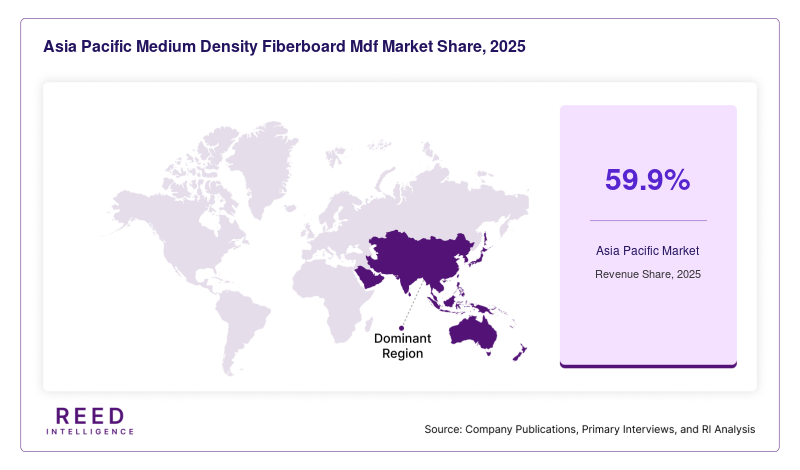
Asia-Pacific's large furniture manufacturing base and expanding construction activity provide substantial opportunities for MDF producers. The region accounted for approximately 59.9% of the global market in 2025 in the supplied market framework.
Product Segment Analysis
By Product
Standard MDF accounted for approximately 56% of the market in 2026, making it the largest product segment. Its broad application across furniture, cabinetry, construction and interior decoration supports its leading position. The supplied market framework also identifies standard MDF as the largest product category.
Moisture-resistant MDF is projected to be one of the faster-growing specialty product categories, supported by demand for kitchen cabinets, bathroom furniture, laundry-area applications and other environments requiring improved moisture performance.
Fire-resistant and low-emission MDF products are also gaining importance as building standards and indoor-air-quality requirements become more demanding.
Type Segment Analysis
By Type
E1 MDF accounted for approximately 75% of the market in 2025, according to industry estimates, making it the largest major emissions-grade segment. Its widespread use in furniture and interior applications is supported by requirements for controlled formaldehyde emissions.
Lower-emission and no-added-formaldehyde products are expected to see increasing adoption as manufacturers and customers respond to stricter indoor-air-quality requirements.
E2 and other grades continue to serve markets where different cost and performance requirements apply.
Application Segment Analysis
By Application
Furniture accounted for approximately 57% of the MDF Market in 2025, making it the largest application segment. MDF is widely used in cabinetry, drawer fronts, shelving, residential furniture and ready-to-assemble products because of its smooth surface and machining characteristics.
Interior decoration is among the faster-growing application areas, supported by demand for decorative wall panels, moldings, doors, architectural interiors and customized furnishings.
Construction and flooring, doors and millwork, cabinetry, packaging and other applications account for the remaining market demand.
End-User Segment Analysis
By End User
Residential applications accounted for approximately 66% of the market in 2025, making residential users the largest end-user segment. Demand is supported by home construction, renovation, kitchen and wardrobe installation, furniture replacement and interior decoration.
Commercial and institutional applications are also expanding, particularly in offices, hospitality, retail, healthcare and education projects where customized interior panels, cabinetry and millwork are required.
Medium Density Fiberboard (MDF) Market Regional Analysis
Asia-Pacific Holds the Largest Share
Asia-Pacific accounted for approximately 59.9% of the global MDF Market in 2025, making it the largest regional market. The region benefits from large furniture manufacturing industries, extensive construction activity and increasing adoption of engineered wood products.
China remains a major production and consumption center, while India and Southeast Asia are expanding furniture manufacturing and MDF capacity.
Asia-Pacific is also expected to remain one of the fastest-growing regional markets, supported by construction, urbanization and furniture production.
Europe Maintains Strong Demand for Premium MDF
Europe accounted for approximately 22.5% of the market in 2025, according to the supplied market framework.
European demand is supported by furniture manufacturing, interior renovation and increasing emphasis on low-emission, recyclable and sustainably sourced engineered wood products.
North America Shows Stable Demand
North America accounted for approximately 6.2% of the global market in 2025 in the supplied market framework.
Demand is supported by residential remodeling, cabinetry, furniture production, commercial interiors and construction activity.
Latin America Represents an Important Production Base
Latin America has an established engineered-wood industry, with Brazil representing an important production and consumption market.
Furniture manufacturing, construction and interior applications continue to support regional MDF demand.
Middle East & Africa Shows Emerging Opportunities
Construction, urban development, hospitality projects and expanding furniture manufacturing are creating additional opportunities for MDF products across the Middle East and Africa.
Medium Density Fiberboard (MDF) Market Competitive Landscape
Competition in the MDF market is based on production capacity, product quality, emissions performance, raw-material availability, pricing, energy efficiency, geographic reach, sustainability credentials and specialty-product capabilities.
Leading producers are investing in expanded manufacturing capacity, decorative products, low-emission grades, recycled-content boards and more efficient production technologies.
Key Market Players
- Kronospan
- ARAUCO
- EGGER Group
- West Fraser
- Duratex (Dexco)
- Kastamonu Entegre
- Swiss Krono Group
- Dongwha Enterprise
- Finsa
- Greenpanel Industries
Medium Density Fiberboard (MDF) Market Recent Developments
- Producers are investing in additional capacity to address growing furniture and construction demand, particularly in Asia and other cost-competitive manufacturing regions.
- Manufacturers are developing lower-emission and formaldehyde-reduced MDF products to meet increasingly stringent environmental and indoor-air-quality requirements.
Medium Density Fiberboard Mdf Market Segments
By Product
- Standard MDF
- Moisture-Resistant MDF
- Fire-Resistant MDF
- Ultra-Low-Emission MDF
- Laminated MDF
- Other MDF Products
By Type
- E0 MDF
- E1 MDF
- E2 MDF
- Other Grades
By Application
- Furniture
- Construction & Flooring
- Interior Decoration
- Doors & Millwork
- Cabinetry
- Packaging
- Other Applications
By End User
- Residential
- Commercial
- Industrial
- Institutional
By Region
- North America
- Europe
- APAC
- Middle East and Africa
- LATAM