Mesh App and Service Architecture Market Size, Share & Trends Analysis Report By Component (Software, Services), By Architecture Type (Microservices, APIs, Multiexperience Applications, Event-Driven Services), By Deployment Model (Cloud, On-Premises, Hybrid), By Enterprise Size (Large Enterprises, SMEs) and By Region (North America, Europe, Asia-Pacific, Middle East and Africa, Latin America) Forecasts, 2026–2034
USD 3950
Mesh App and Service Architecture Market Size
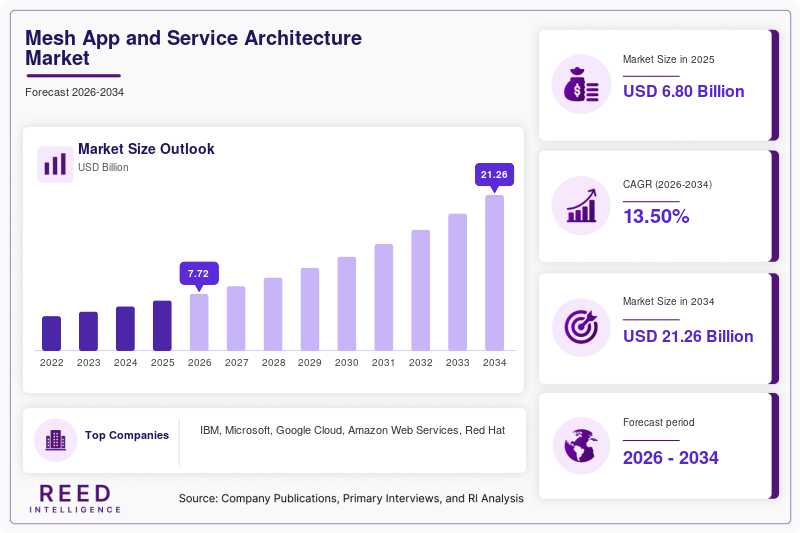
The mesh app and service architecture market was valued at USD 6.80 billion in 2025 and is projected to grow from USD 7.72 billion in 2026 to USD 21.40 billion by 2034, registering a CAGR of 13.50% during the forecast period from 2026 to 2034.
The Mesh App and Service Architecture (MASA) market is developing around the shift from monolithic applications toward interconnected applications, APIs, microservices and reusable services. Gartner describes MASA as an API-centric approach that supports agile, flexible and composable application architectures, while its 2025 architecture research emphasizes APIs, event mediation and services with different levels of granularity.
The commercial mechanism is tied to the increasing complexity of distributed applications. As applications are decomposed into independently managed services, organizations need infrastructure that can control service-to-service communication, apply security policies, manage traffic and provide observability without repeatedly embedding these functions into application code. Microsoft describes service mesh as an infrastructure layer that provides observability, traffic management and security for distributed applications.
Mesh App and Service Architecture Market Drivers
Cloud-Native Modernization Is Increasing the Need for Managed Service-to-Service Connectivity
The migration of enterprise applications toward microservices and cloud-native architectures creates a larger network of services that must communicate reliably. Gartner identifies service mesh as a technology for addressing cross-cutting connectivity concerns in microservices environments.
The market mechanism is straightforward: decomposing an application increases the number of service interactions, making traffic management, authentication, observability and failure handling more difficult to manage independently within each application. Service mesh moves these functions into an infrastructure layer.
This supports demand for service-mesh software, managed control planes, consulting and integration services. Large enterprises operating complex Kubernetes estates are particularly affected because multiple applications can share the same mesh infrastructure.
The counterbalance is operational complexity. Gartner also highlights the need to understand the benefits and complexities of service-mesh patterns before applying them to cloud-native architectures.
Sidecarless and Ambient Architectures Are Lowering the Operational Cost of Service Mesh Adoption
Traditional service meshes commonly deploy a proxy alongside application workloads. Ambient architectures change this model by using node-level components and waypoint proxies rather than requiring a sidecar for every workload. Solo's documentation describes ambient mesh as a sidecarless architecture using ztunnels for Layer 4 traffic and waypoint proxies for Layer 7 policies.
Istio's 1.29 release further advanced this architecture by making DNS capture and iptables reconciliation default in ambient mode and promoting multi-network, multicluster ambient support to beta.
The mechanism can reduce the operational burden associated with managing a proxy alongside every application workload. This potentially expands service-mesh adoption to organizations that previously viewed sidecar resource consumption and lifecycle management as barriers.
The limitation is ecosystem maturity. Microsoft’s current AKS Istio add-on documentation, for example, states that ambient mode is not yet supported in that add-on.
Managed Service Mesh Is Shifting Architecture Management Toward Platform Services
Managed service-mesh offerings are changing the economics of deployment by transferring portions of control-plane management, upgrades, scaling and security to cloud providers. Google Cloud states that its managed Cloud Service Mesh can manage the control plane and optionally the data plane, including upgrades, scaling and security.
The mechanism reduces the specialist infrastructure effort required to operate a mesh and makes the technology more accessible to enterprise platform teams that prefer managed services.
This is particularly relevant to organizations running Kubernetes across multiple applications and clusters. Managed offerings can also standardize policy enforcement and observability across workloads.
However, managed service mesh can increase dependence on a cloud provider's architecture, supported configurations and upgrade schedule. Organizations requiring portability may therefore continue to use open-source or independently managed implementations.
Mesh App and Service Architecture Market Restraints
Distributed Architecture Complexity Can Delay Service-Mesh Adoption
Service mesh introduces another infrastructure layer between applications and the underlying network. While that layer provides traffic management, security and observability, it also requires administrators to understand control planes, data planes, policies, proxies and routing behavior.
Google Cloud describes a service mesh as consisting of control-plane and data-plane components, while Red Hat documents the operational functions required to connect, secure and monitor microservices through its OpenShift Service Mesh.
The commercial consequence is additional engineering and operational requirements. Organizations with relatively simple applications may not obtain enough operational benefit to justify the added architecture.
Platform Fragmentation Increases Migration and Integration Costs
Service-mesh implementations increasingly span managed cloud products and open-source technologies. Azure's Istio add-on, Google Cloud Service Mesh and Red Hat OpenShift Service Mesh provide different managed approaches, while upstream Istio continues to evolve independently.
This creates integration considerations for enterprises operating across multiple clouds or Kubernetes environments.
AWS's planned discontinuation of AWS App Mesh support on September 30, 2026, with customers directed toward Amazon ECS Service Connect, also demonstrates how architectural product changes can create migration requirements for users.
Mesh App and Service Architecture Market Opportunities
Ambient Mesh Creates a Lower-Overhead Route Into Service-Mesh Adoption
Ambient architecture provides an opportunity to address one of the operational concerns associated with traditional sidecar-based meshes. Istio's 2026 releases have expanded ambient capabilities across security, DNS handling, telemetry and multicluster environments.
The commercial opportunity extends beyond core mesh software. Organizations adopting ambient architectures require migration services, observability, security policy management, platform engineering and multicluster integration.
The strongest opportunity is likely to emerge where organizations operate large Kubernetes environments containing many workloads, because reducing per-workload proxy management can become more meaningful as deployments scale.
Adoption may nevertheless remain gradual where existing sidecar implementations are stable or where cloud-provider integrations do not yet expose equivalent ambient capabilities.
AI and Composable Applications Increase Demand for Cross-Service Governance
Gartner's recent application-architecture research identifies AI as a major influence on application architecture and integration while emphasizing composable applications built from apps, APIs and services.
As applications incorporate AI services, external APIs, internal microservices and event-driven components, organizations need consistent methods for securing and observing interactions across these components.
The opportunity therefore extends MASA beyond conventional microservice networking toward governance for increasingly heterogeneous application environments.
The main constraint is that AI application architectures remain diverse. Some workloads may use direct API gateways, platform-native networking or application-level controls instead of a full service mesh.
Component Analysis
By Component
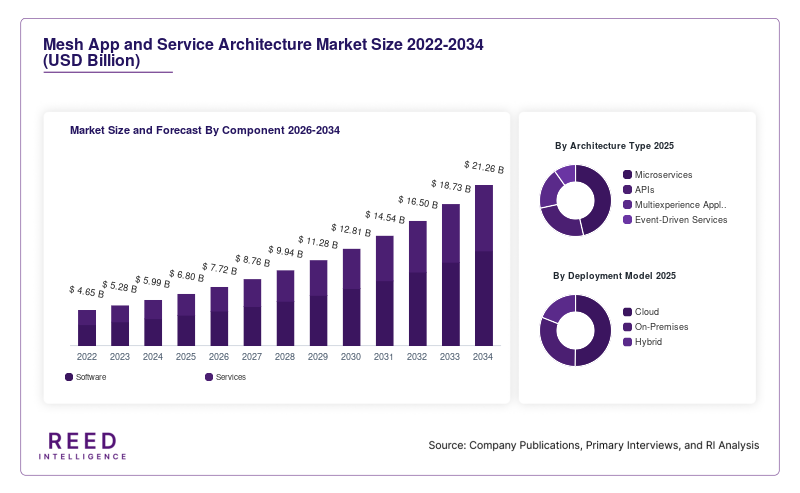
Software accounts for approximately 63% of the global MASA market in 2025. The software component includes service-mesh platforms, API management capabilities, application integration technologies, service discovery, traffic management and observability functions.
Its demand is connected to the recurring need to operate distributed applications rather than to one-time application development. Red Hat's service-mesh architecture, for example, provides discovery, load balancing, service-to-service authentication, failure recovery, metrics, monitoring and traffic-management functions.
Services account for approximately 37% of the 2025 market and are projected to grow at approximately 15.10% CAGR through 2034. Consulting, migration, integration, implementation and managed services become more important as organizations move from standalone microservices toward larger multicluster and hybrid architectures.
Architecture Type Analysis
By Architecture Type
Microservices account for approximately 42% of the global market in 2025. Their large share reflects the need to manage communication between independently deployed application components. Service meshes provide traffic management, security and observability without requiring these capabilities to be repeatedly implemented within application code.
Event-driven services represent approximately 18% of the market and are projected to record the fastest growth at approximately 15.80% CAGR through 2034. Event-driven architectures increase the number of asynchronous interactions between application components, creating requirements for reliable event routing, observability and governance.
APIs account for approximately 25% of the market and are projected to grow at approximately 13.70% CAGR, while multiexperience applications represent approximately 15% and are projected to grow at approximately 12.80% CAGR.
Deployment Model Analysis
By Deployment Model
Cloud deployment accounts for approximately 57% of the 2025 market. Cloud environments provide the infrastructure on which many microservice architectures operate and allow service-mesh functionality to be integrated with managed Kubernetes and cloud-native platforms.
Google Cloud's managed service mesh, for example, supports microservices across supported GKE environments and provides managed lifecycle capabilities.
Hybrid deployment accounts for approximately 27% of the market and is projected to grow at approximately 15.20% CAGR, making it the fastest-growing deployment model. Hybrid architectures allow enterprises to retain regulated, legacy or latency-sensitive workloads on private infrastructure while connecting them to cloud-based services.
On-premises deployment accounts for approximately 16% and is projected to grow at approximately 10.90% CAGR.
Enterprise Size Analysis
By Enterprise Size
Large enterprises account for approximately 72% of the market in 2025. Their larger application estates, multiple development teams and distributed infrastructure create stronger requirements for centralized traffic management, security policies and observability.
The requirement becomes more pronounced in multicluster environments. Istio's 2026 ambient development includes beta support for multicluster, multi-network deployments, illustrating the architectural requirements emerging as service environments expand.
SMEs represent approximately 28% of the market and are projected to grow at approximately 17.00% CAGR through 2034. Managed service-mesh offerings can reduce the specialist infrastructure skills required for deployment, potentially lowering the adoption barrier for smaller technology organizations.
Mesh App and Service Architecture Market Regional Analysis
North America Holds the Largest Regional Share Because Cloud-Native Infrastructure and Enterprise Software Ecosystems Are Highly Established
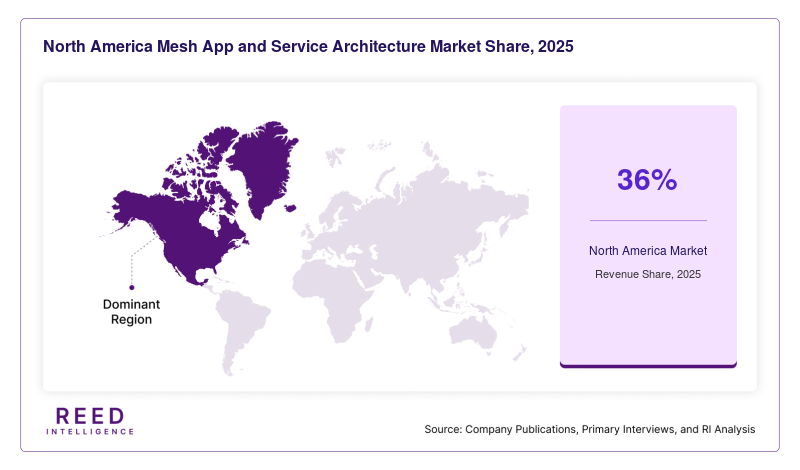
North America accounts for approximately 36% of the global MASA market in 2025 and is projected to grow at approximately 12.90% CAGR through 2034. The region benefits from established cloud infrastructure, enterprise software vendors, Kubernetes adoption and large technology development communities.
The region also has strong access to managed service-mesh platforms from major cloud providers. Google Cloud offers managed Cloud Service Mesh, while Microsoft provides an Istio-based service-mesh add-on for AKS.
Demand is concentrated around application modernization, API integration, microservices, cybersecurity and multicloud management. Enterprises increasingly need consistent service-to-service controls across large application portfolios.
The principal constraint is architectural complexity. Organizations with mature cloud-native environments may already operate multiple networking and observability layers, making the business case for another infrastructure layer dependent on measurable operational benefits.
Europe Maintains a Significant Market as Enterprise Modernization and Hybrid Architecture Adoption Expand
Europe accounts for approximately 27% of the market in 2025 and is projected to grow at approximately 12.70% CAGR through 2034. Demand is supported by enterprise modernization, cloud migration, API integration and the need to maintain security and governance across distributed applications.
Hybrid architectures are particularly relevant where organizations operate combinations of private infrastructure, public cloud and legacy enterprise systems. Service-mesh technology can provide a consistent policy and traffic-management layer across portions of these environments.
Red Hat's OpenShift Service Mesh provides a relevant enterprise implementation, with capabilities covering service discovery, authentication, monitoring, access control and traffic management.
European adoption can nevertheless vary by industry because regulatory requirements, data-location considerations and established enterprise infrastructure can affect cloud and application-modernization strategies.
Asia-Pacific Represents the Fastest-Growing Regional Market as Cloud-Native Application Development Expands
Asia-Pacific accounts for approximately 22% of the market in 2025 and is projected to grow at approximately 15.70% CAGR through 2034, making it the fastest-growing region. The growth mechanism is linked to expanding cloud adoption, digital application development, mobile services and modernization of enterprise IT environments.
The region contains a large base of organizations developing digital services around APIs, microservices and cloud platforms. As these environments become more distributed, requirements for traffic management, observability and service-level security become more important.
Managed offerings can reduce deployment barriers because enterprises do not necessarily need to operate every control-plane component themselves. Google Cloud's managed model illustrates this approach by handling control-plane lifecycle activities such as upgrades and scaling.
The principal constraints include differences in cloud adoption across countries, varying technology maturity and shortages of specialized platform-engineering skills.
Middle East and Africa Represent a Smaller Market With Cloud Modernization Creating New MASA Adoption Paths
Middle East and Africa account for approximately 8% of the global market in 2025 and are projected to grow at approximately 13.90% CAGR through 2034. Demand is linked to cloud migration, digital government initiatives, financial technology, telecommunications and modernization of enterprise applications.
Service-mesh adoption can become relevant as organizations move from monolithic applications toward distributed architectures. The technology provides centralized capabilities for authentication, traffic management and observability across microservices.
The region's development is likely to remain concentrated in major technology and business centers where cloud infrastructure and Kubernetes expertise are more established.
Constraints include limited specialist skills, infrastructure differences between countries and the cost of implementing sophisticated distributed-application management platforms.
Latin America Develops Through Cloud Adoption and Modernization of Customer-Facing Applications
Latin America accounts for approximately 7% of the market in 2025 and is projected to grow at approximately 13.60% CAGR through 2034. Cloud-based application development and digital customer services provide a pathway for organizations to move toward modular application architectures.
MASA technologies become relevant when applications require multiple APIs, backend services and independently scalable components. This is particularly applicable to financial services, telecommunications, commerce and digitally delivered consumer services.
Managed service-mesh platforms can reduce infrastructure-management requirements, while open-source technologies such as Istio provide another route for organizations with internal platform-engineering capabilities.
The principal limitations include uneven cloud maturity, technology budgets and the availability of engineers experienced in Kubernetes, service mesh and distributed application operations.
Mesh App and Service Architecture Market Competitive Landscape
The competitive environment is centered on open-source ecosystem participation, managed service delivery, Kubernetes integration, application modernization and security capabilities.
Istio remains a major technology foundation for enterprise service mesh. Its 2026 releases have expanded ambient capabilities, multicluster support, security controls and operational automation.
Red Hat has incorporated Istio into OpenShift Service Mesh and moved its product architecture closer to upstream Istio. OpenShift Service Mesh 3.1 introduced a newer architecture based on the community Sail operator, while version 3.2 added general availability for Istio ambient mode.
Key Market Players
- IBM
- Microsoft
- Google Cloud
- Amazon Web Services
- Red Hat
- Solo.io
- Tetrate
- Kong
- F5
- Buoyant
Mesh App and Service Architecture Market Recent Developments
- June 2026 – AWS confirmed the September 30, 2026 end of support for AWS App Mesh. AWS states that after this date customers will no longer have access to the App Mesh console or resources and directs users toward Amazon ECS Service Connect. The development creates a migration requirement for existing users and shifts part of AWS's service-mesh strategy toward its native service-connectivity offering.
- July 2026 – Istio 1.30.3 improved ambient-mode scalability. The release introduced more targeted XDS pushes for workload and service-address changes, limiting updates to affected waypoints instead of broadly pushing changes to all waypoints and proxies. This can reduce unnecessary control-plane work in larger ambient deployments.
Mesh App and Service Architecture Market Segments
By Component
- Software
- Services
By Architecture Type
- Microservices
- APIs
- Multiexperience Applications
- Event-Driven Services
By Deployment Model
- Cloud
- On-Premises
- Hybrid
By Enterprise Size
- Large Enterprises
- SMEs
By Region
- North America
- Europe
- APAC
- Middle East and Africa
- LATAM