Mining Explosives Market Size, Share & Trends Analysis Report By Type (Ammonium Nitrate Explosives, Emulsion Explosives and ANFO), By Application (Coal Mining, Metal Mining and Quarrying & Non-Metal Mining) and By Region (North America, Europe, Asia-Pacific, Latin America, Middle East & Africa) Forecasts, 2026–2034
USD 3950
Mining Explosives Market Size
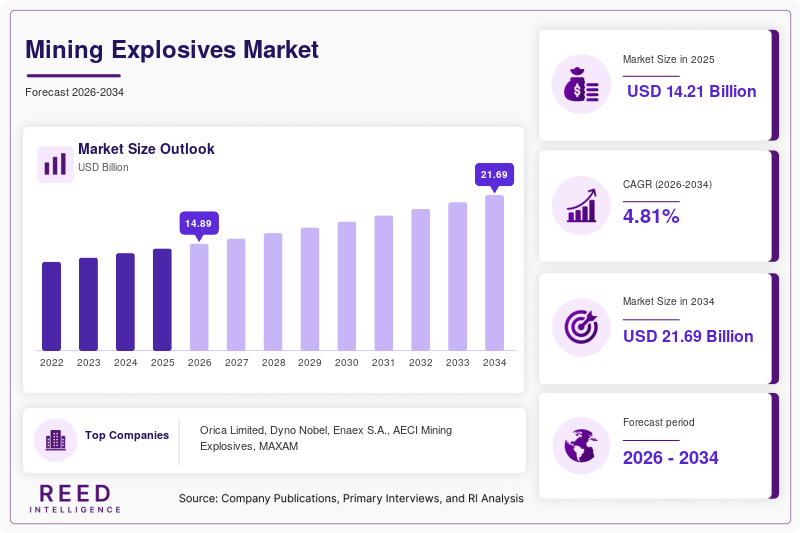
The global mining explosives market was valued at USD 14.21 billion in 2025 and is projected to grow from USD 14.90 billion in 2026 to USD 21.69 billion by 2034, registering a CAGR of 4.81% during the forecast period from 2026 to 2034. These market figures are consistent with the published 2026–2034 market outlook.
Mining explosives are industrial blasting products used to fragment rock, ore and overburden during surface and underground mining and quarrying operations. Major product categories include ammonium nitrate-based explosives, ANFO and emulsion explosives.
Demand is closely linked to mineral production, mine development, quarrying activity, ore hardness, stripping requirements and the increasing need for controlled fragmentation. The expansion of copper, gold, iron ore, coal and critical-mineral extraction is supporting consumption of blasting products.
Mining Explosives Market Drivers
Rising Mining and Mineral Extraction Activity
Growing demand for metals and minerals is increasing investment in new mines, mine expansions and deeper extraction operations.
Mining explosives remain essential consumables for breaking hard rock and overburden, directly connecting market demand with mining production volumes.
Expansion of Metal Mining
Copper, gold, iron ore and other metals are experiencing increased exploration and development activity.
The expansion of metal mining operations is creating demand for bulk explosives and advanced initiation systems capable of delivering controlled fragmentation across large-scale operations.
Growth in Quarrying and Construction Aggregates
Infrastructure development and urbanization require substantial volumes of crushed stone, limestone and other aggregates.
Quarrying operations therefore represent an important source of explosives demand, particularly for surface blasting.
Increasing Adoption of Advanced Blasting Technologies
Mining companies are increasingly adopting electronic detonators, programmable timing systems, bulk-emulsion delivery and digital blast-design technologies.
Electronic initiation systems accounted for 39.38% of the initiation-system segment in 2025, according to Mordor Intelligence, reflecting increasing emphasis on timing precision and blast optimization.
Mining Explosives Market Restraints
Strict Explosives Regulations
Mining explosives are subject to extensive controls covering manufacturing, transportation, storage, handling and use.
Requirements concerning ammonium nitrate and explosive precursors can increase compliance costs and lengthen procurement processes.
Safety and Environmental Concerns
Blasting operations can generate ground vibration, airblast, flyrock, dust and noise.
Mining operators increasingly need blasting products and initiation technologies that enable tighter control of these effects, particularly when mines and quarries operate close to populated areas.
Volatility in Raw Material and Energy Costs
Explosive manufacturing depends on chemical feedstocks, energy and specialized manufacturing infrastructure.
Changes in input costs can affect product pricing and operating margins across the value chain.
Skilled Labor and Logistics Constraints
Mining explosives require specialized transportation, storage and trained personnel.
Logistics challenges can be particularly significant for remote mining operations where long-distance transportation and regulatory requirements increase delivery complexity.
Mining Explosives Market Opportunities
Growing Demand for Emulsion Explosives
Emulsion explosives offer performance advantages in wet or challenging ground conditions and are increasingly used in large-scale mining operations.
The global emulsion explosive market is projected to grow from approximately USD 3.2 billion in 2026 to USD 5.3 billion by 2036, reflecting continued expansion of this product category.
Digital Blast Optimization
Digital blast-design and monitoring technologies are creating opportunities for suppliers to combine explosives with software, sensors, analytics and specialized blasting services.
These solutions can help mining operators optimize fragmentation and manage blast outcomes more consistently.
Expansion of Critical-Mineral Mining
The energy transition is increasing attention toward minerals such as copper and other materials required for electrification, renewable energy and advanced manufacturing.
New exploration and mine-development projects can create additional demand for blasting products.
Mining Development in Emerging Regions
Africa, the Middle East, Latin America and parts of Asia-Pacific are attracting mining investment for metals, minerals and infrastructure aggregates.
This creates opportunities for explosives manufacturers with localized production, distribution and technical-service capabilities.
Type Segment Analysis
Ammonium Nitrate Explosives Hold a Significant Share
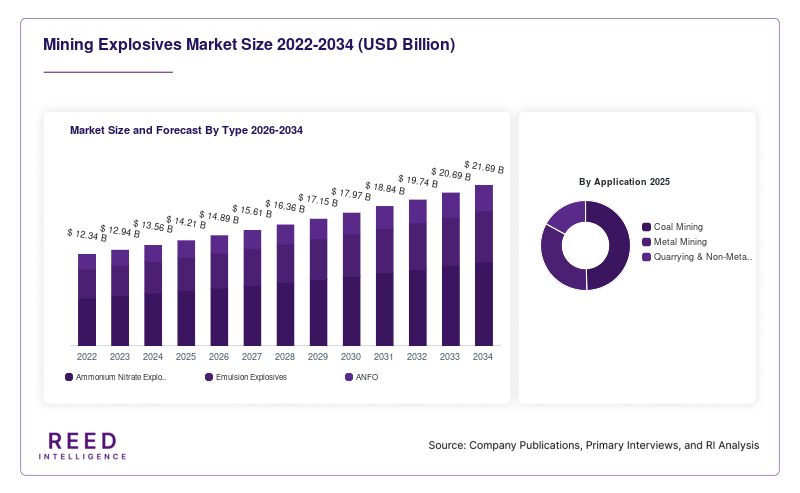
Ammonium nitrate explosives accounted for approximately 38% of the market in 2025, making them one of the leading product categories. Their broad application across coal mining, metal mining, quarrying and non-metal mining supports demand.
Ammonium nitrate-based products remain important because of their established industrial use and suitability for large-scale blasting operations.
Emulsion explosives accounted for approximately 34% and are projected to grow at approximately 5.4% CAGR, making them the fastest-growing major type segment. Demand is supported by their use in wet ground conditions and large-scale mining operations.
ANFO accounted for approximately 28% and is projected to grow at approximately 4.5% CAGR. Its relatively low cost and widespread use in dry-hole surface mining applications continue to support adoption.
Application Segment Analysis
Coal Mining Holds the Largest Share
Coal mining accounted for approximately 42% of the mining explosives market in 2025, making it the largest application segment. Explosives are used extensively in surface coal mining to remove overburden and expose coal seams.
Quarrying & non-metal mining accounted for approximately 24% and is projected to grow at approximately 5.2% CAGR, making it the fastest-growing major application segment. Infrastructure development and aggregate consumption are supporting quarrying activity.
Metal mining represented approximately 34% of the market and is projected to grow at approximately 4.9% CAGR, supported by continued extraction of copper, gold, iron ore and other minerals.
Mining Explosives Market Regional Analysis
Asia-Pacific Holds the Largest Share
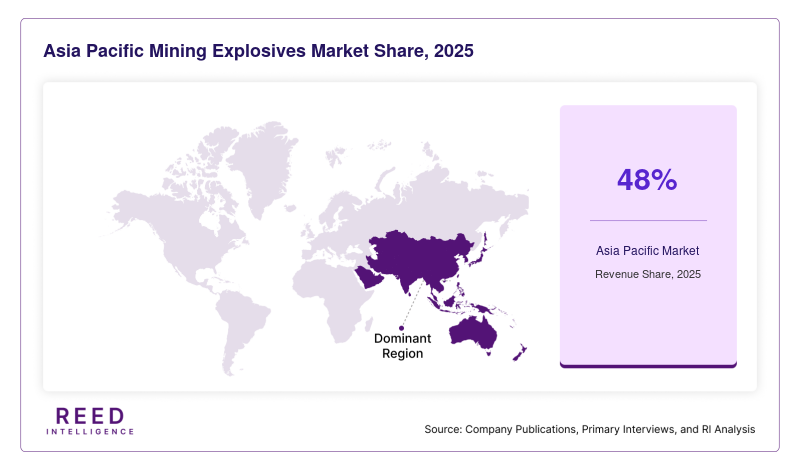
Asia-Pacific accounted for approximately 48% of the global mining explosives market in 2025, making it the dominant regional market. The region benefits from extensive mining activity, particularly coal and metal extraction, alongside substantial quarrying requirements. Mordor Intelligence similarly estimates Asia-Pacific's 2025 share at 48.21%.
China, India, Australia and other regional mining markets provide substantial demand for blasting products.
Middle East & Africa accounted for approximately 12% of the market and is projected to grow at approximately 5.4% CAGR, making it the fastest-growing major region. Mining development in Africa and increased investment in the Middle East are supporting regional demand.
North America Maintains a Strong Market
North America accounted for approximately 16% of the market in 2025 and is projected to grow at approximately 4.3% CAGR.
Demand is supported by metal mining, quarrying and construction aggregates. The region is also seeing investment in domestic explosives supply and distribution infrastructure.
Europe Shows Steady Demand
Europe accounted for approximately 11% of the market in 2025 and is projected to grow at approximately 3.7% CAGR.
The market is supported by quarrying, construction aggregates and selected metal-mining activities, although stringent environmental and blasting regulations influence product and technology selection.
Latin America Benefits From Mining Investment
Latin America accounted for approximately 13% of the market in 2025 and is projected to grow at approximately 4.9% CAGR.
The region's major copper, gold, iron ore and other mineral-producing countries provide sustained demand for blasting products.
Mining Explosives Market Competitive Landscape
Competition in the mining explosives market is based on product performance, safety, reliability, manufacturing capacity, supply-chain security, technical blasting expertise, digital technologies, regulatory compliance and customer service.
The market includes global explosives companies as well as regional manufacturers and specialized blasting-service providers.
Key Market Players
- Orica Limited
- Dyno Nobel
- Enaex S.A.
- AECI Mining Explosives
- MAXAM
- Solar Industries India Limited
- BME
- Austin Powder
- Sasol Limited
- Hanwha Corporation
Mining Explosives Market Recent Developments
- In May 2026, Orica announced an agreement to acquire Nelson Brothers' explosives business in North America. Orica said the transaction would increase its exposure to the U.S. quarries and construction sectors and provide additional direct channels to market.
- In May 2026, Dyno Nobel reported that its explosives business delivered 1H26 underlying EBIT of AUD 224 million, up 28% year over year. The company attributed the performance to strong operating results across its explosives businesses and continued execution of its transformation program.
Mining Explosives Market Segments
By Type
- Ammonium Nitrate Explosives
- Emulsion Explosives
- ANFO
By Application
- Coal Mining
- Metal Mining
- Quarrying & Non-Metal Mining
By Region
- North America
- Europe
- APAC
- Middle East and Africa
- LATAM