Mobile Messaging Services Market Size, Share & Trends Analysis Report By Service Type (SMS, MMS, Rich Communication Services (RCS), Over-the-Top (OTT) Messaging), By Application (Business Messaging, Personal Messaging, Customer Support & Engagement, Authentication & Notifications), By Deployment (Cloud-Based, On-Premises), By Enterprise Size (Large Enterprises, SMEs) and By Region (North America, Europe, Asia-Pacific, Latin America, Middle East & Africa) Forecasts, 2026–2034
USD 3950
Mobile Messaging Services Market Size
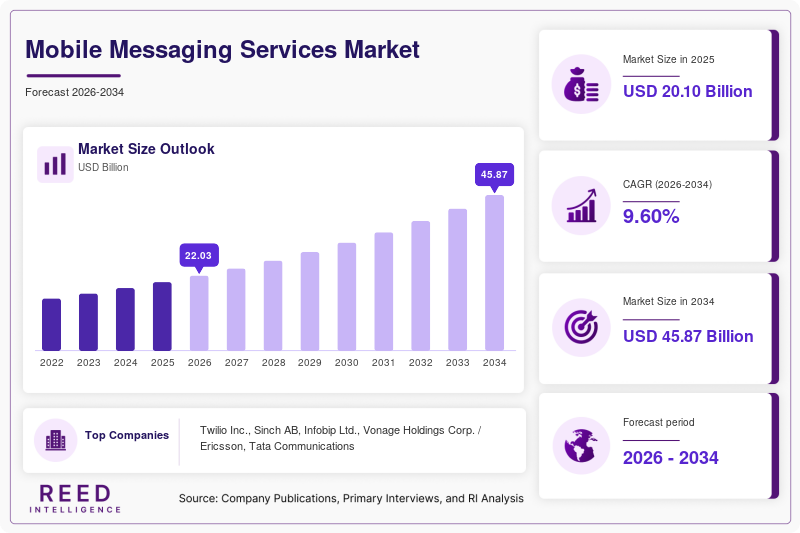
The global mobile messaging services market was valued at USD 20.10 billion in 2025 and is projected to grow from USD 22.03 billion in 2026 to USD 45.90 billion by 2034, registering a CAGR of 9.60% during the forecast period from 2026 to 2034.
Mobile messaging services are shifting from conventional person-to-person SMS toward a broader communications ecosystem covering SMS, MMS, RCS, OTT messaging, application programming interfaces (APIs), business messaging and automated conversational communication. SMS remains important because of its broad device and network reach, while RCS and OTT channels are adding richer media, interactive functions and two-way customer engagement. Sinch's 2025 annual report describes its messaging business as covering SMS, RCS, MMS and application-based channels such as WhatsApp, with transaction fees generated from individual messaging services.
The transition toward richer messaging is particularly visible in RCS. Apple introduced RCS support with iOS 18 in 2024, extending the technology beyond the Android ecosystem. The GSMA subsequently incorporated stronger end-to-end encryption specifications into the RCS standard, and cross-platform encrypted RCS began rolling out for supported Android and iPhone users in 2026.
Mobile Messaging Services Market Drivers
RCS Is Converting Traditional Text Messaging Into an Interactive Business Channel
RCS is changing the economics of mobile messaging by adding rich media, verified sender information, buttons, carousels, suggested actions and other functions to the native messaging environment. The GSMA describes RCS as an evolution of SMS that supports group chat, file transfers, read receipts and richer interactions, while its Universal Profile provides a common technical framework for operators, device manufacturers and service providers.
The commercial mechanism is the expansion of what a message can accomplish. A business can move from sending a simple delivery notification to offering tracking, support, product information or an action directly inside the conversation. This reduces the number of steps between receiving a message and completing a transaction.
Apple's adoption materially expanded the addressable device base, while Infobip reported a fivefold increase in global RCS traffic on its platform following Apple's iOS 18 support and a 14-fold increase in North America during 2024.
The constraint is uneven carrier availability and the continuing requirement for fallback to SMS where RCS is unsupported.
Enterprise Messaging Is Becoming Embedded in Operational Workflows
Businesses increasingly use messaging as part of their existing software infrastructure rather than treating it as an independent communications activity. Twilio's 2025 filing identifies account notifications, marketing, mass alerts, order confirmations, sales support and customer care as messaging use cases, while APIs allow these communications to be embedded into enterprise applications.
This creates recurring demand because messaging becomes connected to events such as a login attempt, payment, shipment, appointment, reservation or customer-service interaction. Each event can generate a communication without requiring an employee to manually initiate it.
Sinch similarly states that customers integrate its communications platform into their own digital infrastructure through APIs, using SMS, MMS, RCS, WhatsApp, voice and email.
The strongest commercial effect is therefore likely in industries with high transaction frequency, including financial services, retail, logistics, travel, healthcare and telecommunications. The limitation is that enterprise buyers increasingly expect a single platform to manage multiple channels, raising the technology and integration requirements for providers.
AI Is Increasing the Role of Messaging in Conversational Customer Engagement
AI is changing messaging from a notification channel into an interactive customer-service interface. Sinch reported in its 2025 annual report that businesses are moving from static notifications toward dynamic, AI-enabled conversational engagement, while continuing to emphasize security, compliance and fraud controls.
The market mechanism is an increase in the number of customer interactions that can be completed within messaging. AI assistants can answer questions, collect information, provide status updates and route complex requests to human agents. RCS further strengthens this model by supporting richer content and interactive actions inside the messaging environment.
Infobip's 2026 messaging analysis, based on 628 billion mobile interactions in 2025, describes a shift toward omnichannel and AI-supported customer communication.
The counterbalance is operational risk. AI-generated responses require monitoring, and businesses must prevent inaccurate information, unauthorized actions, privacy violations and fraudulent activity from being transmitted through automated messaging.
Mobile Messaging Services Market Restraints
Spam and Fraud Controls Increase the Cost of Delivering Commercial Messages
The growth of business messaging has also increased the need for stronger spam and fraud controls. The U.S. Federal Communications Commission has strengthened requirements around illegal robotexts and directed providers to block certain messages following enforcement notifications. Its 2024 proceeding also reaffirmed consent requirements for solicited robotexts.
The economic mechanism is straightforward: messaging providers must invest in sender authentication, traffic monitoring, filtering, identity management and compliance infrastructure. These controls can increase operating costs and complicate message delivery for businesses using large-scale campaigns.
The effect is particularly relevant to A2P messaging providers, financial institutions, retailers and other organizations sending high volumes of transactional or promotional messages.
The same infrastructure can nevertheless support premium services. Verified sender identities, fraud detection and secure delivery can differentiate enterprise-grade messaging from low-cost bulk messaging.
OTT Messaging Platforms Increase Competitive Pressure on Operator Messaging
Consumers increasingly communicate through dedicated messaging applications, creating competition for traditional SMS and operator-led services. WhatsApp, for example, reported more than two billion daily users in 2025 and highlighted the growing use of business messaging for tasks such as bookings, delivery updates and utility payments.
This affects the market because businesses increasingly require access to several channels rather than relying exclusively on SMS. Messaging providers must therefore support OTT channels alongside SMS and RCS, increasing integration requirements.
The constraint is less a complete replacement of SMS than a fragmentation of messaging traffic. Enterprises need routing, identity, analytics, compliance and fallback capabilities across multiple platforms, creating additional technology and pricing complexity.
Mobile Messaging Services Market Opportunities
Omnichannel Messaging Platforms Can Consolidate Fragmented Communication Channels
A significant opportunity lies in platforms that allow businesses to manage SMS, RCS, WhatsApp and other messaging channels through one API and workflow layer. Sinch and Twilio both describe multi-channel communication architectures that connect businesses to customers through multiple messaging technologies.
The commercial problem is fragmentation. Enterprises operating across countries may need different carriers, messaging applications, sender requirements and fallback mechanisms. A unified platform can abstract these technical differences and automatically select an appropriate channel.
This is particularly relevant for multinational retailers, banks, airlines, logistics companies and digital platforms.
The main adoption barrier is integration complexity and the need to maintain reliable delivery across networks and jurisdictions. Providers must also maintain compliance with local messaging rules and carrier policies.
RCS-Based Conversational Commerce Creates New Revenue Opportunities
RCS provides a mechanism for businesses to move marketing, customer service and transactions into the messaging interface. The GSMA identifies business messaging applications including customer engagement, bookings, interactive notifications, conversational commerce and customer care.
The opportunity is strongest where a transaction can be completed through a short sequence of messages, such as product inquiries, appointment confirmations, travel updates, delivery tracking or payment-related interactions.
Infobip's 2025 data showed substantial RCS expansion after Apple enabled the technology on iPhones, while the company subsequently reported more than 10 billion RCS business messages delivered through its platform.
Adoption could nevertheless be constrained by carrier coverage, regional differences, message pricing and consumer preferences for established OTT applications.
Service Type Analysis
By Service Type
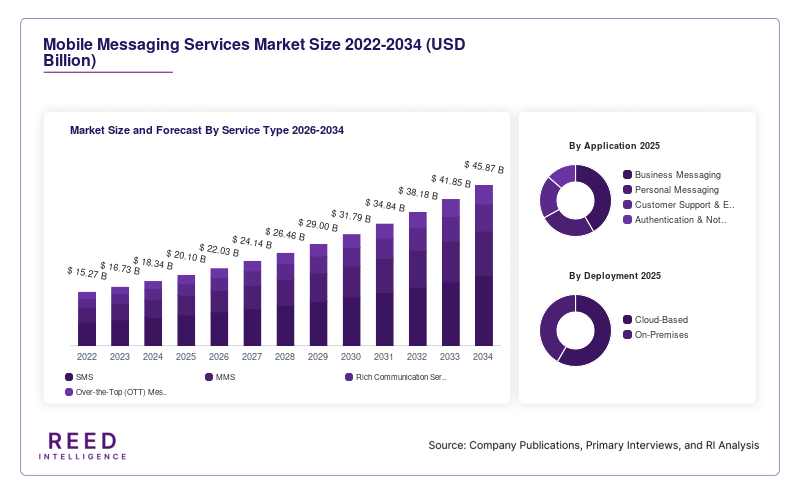
SMS accounted for approximately 46% of the service-type segment in 2025. Its position is supported by broad handset and network compatibility and its continuing role in authentication, alerts, appointment reminders, delivery notifications and other communications where reliable reach is more important than rich media.
Enterprise communication providers continue to support SMS alongside newer technologies. Sinch identifies SMS as part of its core messaging portfolio, while Twilio supports SMS together with MMS, RCS and OTT messaging through its programmable messaging infrastructure.
The recurring nature of transactional messages gives SMS a stable demand base even as richer channels expand.
However, its limited interactivity creates a structural disadvantage for marketing and conversational applications. This creates room for RCS and OTT messaging to capture incremental business communication.
RCS accounted for approximately 14% of the service-type segment in 2025 and is projected to grow at approximately 18.4% CAGR through 2034. The major change is the transition from an Android-focused technology toward cross-platform support.
GSMA reported that RCS reached iPhone users through iOS 18 in 2024, while Google reported that more than one billion RCS messages were being sent each day in the U.S. by May 2025.
The subsequent rollout of cross-platform RCS encryption in 2026 strengthens the technology's security proposition.
MMS represented approximately 7% of the segment in 2025 and is projected to grow at approximately 3.8% CAGR, while OTT Messaging represented approximately 33% and is projected to grow at approximately 8.6% CAGR through 2034.
Application Analysis
By Application
Business Messaging accounted for approximately 39% of the application segment in 2025. Demand is supported by authentication, marketing, order notifications, customer support, appointment reminders and transaction updates.
Twilio identifies these applications directly within its programmable messaging portfolio, while Sinch describes business messaging as part of a broader digital customer-communications platform.
The key economic characteristic is repeat usage. Once messaging is integrated into an enterprise workflow, communication volume is linked to the number of transactions or customer events rather than discretionary media spending.
Customer Support & Engagement accounted for approximately 24% of the application segment in 2025 and is projected to grow at approximately 11.8% CAGR through 2034.
The segment is benefiting from conversational messaging, chatbots and AI-assisted interactions. GSMA identifies customer care and AI-enabled business messaging as important RCS use cases, while Sinch describes a shift toward dynamic, AI-powered conversational engagement.
Authentication & Notifications represented approximately 22% and is projected to grow at approximately 8.2% CAGR, while Personal Messaging accounted for approximately 15% and is projected to grow at approximately 6.1% CAGR.
Deployment Analysis
By Deployment
Cloud-Based deployment accounted for approximately 72% of the deployment segment in 2025. Cloud delivery allows enterprises to access messaging APIs without building carrier connectivity, messaging infrastructure and routing systems internally.
Sinch states that customers generally embed its communications platform into their digital infrastructure through APIs, while Twilio provides programmable messaging infrastructure for global communication use cases.
The model is particularly suited to enterprises seeking rapid integration and access to multiple messaging channels.
On-Premises deployment accounted for approximately 28% of the segment in 2025 and is projected to grow at approximately 5.9% CAGR through 2034. Demand remains connected to organizations with strict internal infrastructure, security or regulatory requirements, although cloud APIs increasingly provide enterprise-grade security and compliance capabilities.
Enterprise Size Analysis
By Enterprise Size
Large enterprises accounted for approximately 68% of the enterprise-size segment in 2025. Their messaging requirements are supported by high customer volumes, international operations and extensive transactional workflows.
Banks, airlines, retailers, telecommunications companies and digital platforms can generate messaging events across authentication, purchasing, customer service and logistics, making API-based messaging infrastructure operationally important.
SMEs accounted for approximately 32% of the enterprise-size segment in 2025 and are projected to grow at approximately 11.0% CAGR through 2034. Cloud-based APIs and managed messaging platforms reduce the need for SMEs to develop carrier connectivity or messaging infrastructure internally.
The opportunity is strongest among digitally native businesses that use messaging as a primary customer-engagement channel. The main constraint is lower messaging volume per customer and greater sensitivity to communication costs.
Mobile Messaging Services Market Regional Analysis
North America Represents the Largest Regional Market
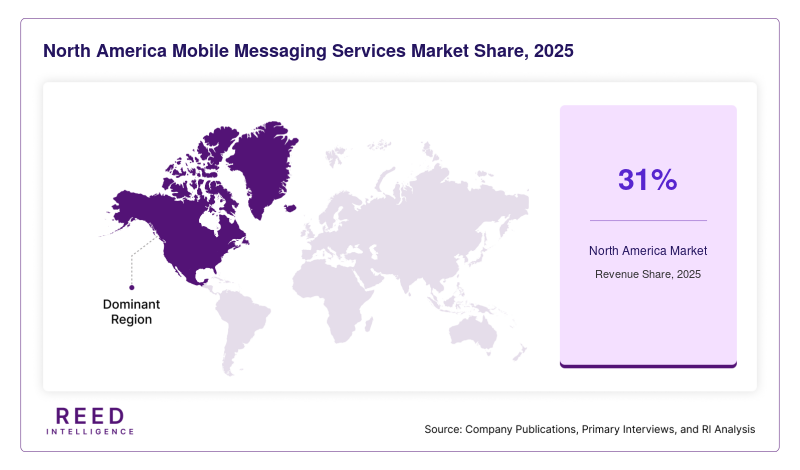
North America accounted for approximately 31% of global revenue in 2025. The region benefits from mature mobile infrastructure, high enterprise software adoption and early deployment of RCS and CPaaS technologies.
Google reported that U.S. RCS traffic had surpassed one billion messages per day by May 2025. Infobip also reported a 14-fold increase in North American RCS traffic on its platform during 2024 following Apple's RCS adoption.
The region's market mechanism is therefore a combination of established SMS demand and rapid migration toward richer enterprise messaging. Banks, retailers, technology companies, logistics providers and telecommunications operators are important users.
The United States represents the principal market, while Canada contributes through its mature mobile and enterprise-communications ecosystem.
North America's high level of 5G adoption also supports richer mobile communication. GSMA reported that 5G represented about 60% of mobile connections in both the U.S. and Canada in 2024.
The principal constraints are messaging fraud, regulatory requirements, high competition among CPaaS providers and the fragmentation between operator messaging and OTT platforms.
Asia-Pacific Is the Fastest-Growing Regional Market
Asia-Pacific accounted for approximately 29% of global revenue in 2025 and is projected to grow at approximately 11.8% CAGR through 2034. The region combines large mobile-user populations with expanding 5G infrastructure and rapidly developing digital commerce.
Infobip reported a 51% increase in messaging activity in APAC in its 2025 messaging analysis and identified APAC as one of the strongest regions for messaging expansion.
The regional mechanism is the convergence of mobile-first consumer behavior, digital payments, e-commerce and business communication. India, China, Japan, South Korea, Australia and Southeast Asian markets provide different but substantial use cases.
GSMA's 2025 Asia-Pacific analysis also showed significant differences in mobile technology adoption between developed and developing markets, meaning messaging providers need to support multiple generations of network technology.
The main constraint is fragmentation across languages, regulations, operators, messaging applications and payment systems. Providers often require local partnerships and country-specific compliance capabilities.
Europe Maintains a Mature Mobile Messaging Ecosystem
Europe accounted for approximately 22% of global revenue in 2025 and is projected to grow at approximately 8.1% CAGR through 2034. The region has a highly developed mobile-internet ecosystem and widespread 4G and 5G connectivity.
GSMA reported that nearly half a billion people across Europe were connected to mobile internet and that 5G represented 30% of mobile connections at the end of 2024.
Messaging demand is supported by banking, retail, transportation, travel and customer-service applications. RCS provides an additional mechanism for businesses to deliver richer interactions through the native messaging environment.
The United Kingdom, Germany, France, Italy and Spain represent important country-level markets.
The region's regulatory environment creates both opportunity and constraint. Strong requirements around data protection, consumer consent and digital services increase compliance requirements but also raise the importance of trusted messaging infrastructure.
Latin America Is Expanding Through Mobile-First Customer Engagement
Latin America accounted for approximately 11% of global revenue in 2025 and is projected to grow at approximately 9.8% CAGR through 2034. Mobile-first consumer behavior, digital commerce and financial-service digitization support business messaging demand.
Brazil and Mexico represent major markets, while Argentina, Colombia and Chile provide additional demand opportunities.
The commercial mechanism is particularly strong in financial services, retail, delivery, authentication and customer support, where messaging can reach consumers without requiring a separate enterprise application.
Infobip reported a 20% increase in messaging interactions across Latin America in its 2025 analysis, illustrating continued expansion of mobile business communication.
Currency volatility, varying carrier economics and differences in digital infrastructure can constrain enterprise messaging investment.
Middle East & Africa Represent an Emerging Messaging Market
Middle East & Africa accounted for approximately 7% of global revenue in 2025 and is projected to grow at approximately 8.9% CAGR through 2034. Adoption is concentrated in markets with strong mobile penetration, expanding digital payments and growing enterprise digitization.
The United Arab Emirates, Saudi Arabia and South Africa are important markets for business messaging, while other African economies offer opportunities as mobile internet and digital services expand.
GSMA's regional data shows substantial differences in mobile internet adoption between markets, creating a multi-speed environment for messaging providers.
The opportunity is strongest where messaging can substitute for more expensive or less accessible customer-service infrastructure. Constraints include connectivity gaps, fragmented markets, regulatory differences and lower enterprise technology spending in some countries.
Mobile Messaging Services Market Competitive Landscape
The competitive environment is shifting from traditional SMS aggregators toward CPaaS providers, telecom operators, RCS technology providers, OTT messaging platforms and enterprise software companies. The main competitive variables are network reach, message delivery reliability, carrier relationships, API quality, channel breadth, pricing, fraud prevention, analytics and the ability to provide fallback between RCS, SMS and OTT channels.
Twilio operates a programmable messaging platform supporting SMS, MMS, RCS and OTT channels including WhatsApp and Facebook Messenger. Its competitive position is connected to API integration and the ability to incorporate messaging into enterprise workflows.
Sinch combines SMS, MMS, RCS and application-based messaging with broader customer-communications capabilities. Its 2025 strategy emphasized enterprise expansion, RCS, email, partner ecosystems and AI-enabled capabilities.
Key Market Players
- Twilio Inc.
- Sinch AB
- Infobip Ltd.
- Vonage Holdings Corp. / Ericsson
- Tata Communications
- Route Mobile Limited
- MessageBird
- Bandwidth Inc.
- Telnyx
- CM.com
- Kaleyra
- LINK Mobility
- Meta Platforms
- Apple
Mobile Messaging Services Market Recent Developments
- Apple introduced RCS support with iOS 18 in September 2024, creating a major cross-platform expansion for the messaging standard. The GSMA described the release as a significant milestone because RCS had previously been concentrated primarily within the Android ecosystem. The development matters because businesses can increasingly use RCS as a standardized rich-messaging channel across both major smartphone ecosystems. It also increased the commercial incentive for operators, CPaaS providers and enterprises to develop RCS capabilities.
- Infobip's 2025 Messaging Trends analysis, based on more than 530 billion interactions in 2024, found that global RCS traffic increased fivefold following Apple's adoption, with North American traffic increasing 14-fold. The development indicates that handset-level support can materially change the addressable market for a messaging protocol. For CPaaS providers, it creates demand for RCS provisioning, verified sender management, analytics and fallback infrastructure.
Mobile Messaging Services Market Segments
By Service Type
- SMS
- MMS
- Rich Communication Services (RCS)
- Over-the-Top (OTT) Messaging
By Application
- Business Messaging
- Personal Messaging
- Customer Support & Engagement
- Authentication & Notifications
By Deployment
- Cloud-Based
- On-Premises
By Enterprise Size
- Large Enterprises
- Small & Medium Enterprises (SMEs)
By Region
- North America
- Europe
- APAC
- Middle East and Africa
- LATAM