Nursery Planters and Pots Market Size, Share & Trends Analysis Report By Material, By Product Type, By Application, By End User and By Region, Forecasts 2026–2034
USD 3950
Nursery Planters and Pots Market Size
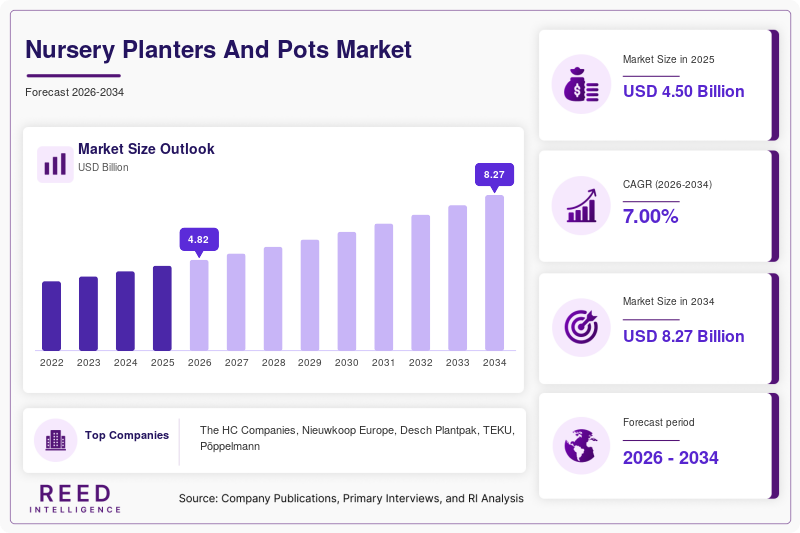
The global nursery planters and pots market was valued at USD 4.50 billion in 2025 and is projected to grow from USD 4.82 billion in 2026 to USD 8.30 billion by 2034, registering a CAGR of 7.00% during the forecast period from 2026 to 2034.
Nursery planters and pots are containers used for propagating, growing, transporting and displaying plants in nurseries, garden centers, landscaping projects and residential gardening applications. Products range from conventional plastic nursery pots to biodegradable containers, ceramic pots, fabric grow bags and specialized propagation containers.
The market is supported by increasing urban gardening, landscaping activity, commercial nursery production and consumer interest in indoor and outdoor plants. Expansion of horticulture and ornamental plant production is also generating recurring demand for containers used during cultivation and distribution.
Nursery Planters and Pots Market Drivers
Growing Urban Gardening
Increasing urbanization is encouraging consumers to grow plants in balconies, terraces, rooftops and compact residential spaces.
This is increasing demand for small and medium-sized planters suitable for ornamental plants, herbs, vegetables and indoor greenery.
Expansion of Commercial Nurseries
Commercial nurseries require large volumes of pots and containers for propagation, cultivation and transportation.
Growth in ornamental plants, landscaping plants and horticultural production is therefore supporting recurring demand.
Rising Landscaping Activity
Residential and commercial landscaping projects increasingly incorporate ornamental plants, shrubs and trees.
The growing use of container-grown plants is supporting demand for nursery pots and larger planters.
Increasing Interest in Indoor Plants
Houseplants have become an important category within consumer gardening.
Demand for decorative and functional planters is increasing as consumers use plants as part of residential and commercial interior design.
Growth of E-Commerce Plant Sales
Online plant sales are expanding access to nursery-grown plants.
Nursery pots and containers are important for transporting plants safely, creating demand for durable and lightweight products.
Nursery Planters and Pots Market Restraints
Environmental Concerns Related to Plastic Pots
Conventional nursery pots are frequently manufactured from plastic materials.
Concerns regarding plastic waste and disposal can encourage consumers and growers to seek alternative products.
Fluctuating Raw-Material Prices
Plastic, resin, metal and other materials used in manufacturing planters are subject to raw-material price fluctuations.
Higher input costs can affect manufacturer margins and product prices.
Breakage and Transportation Costs
Certain products, particularly ceramic and other fragile planters, can incur breakage during handling and transportation.
This can increase logistics costs and reduce profitability.
Seasonal Demand
Nursery and gardening activity is influenced by planting seasons and regional weather patterns.
Seasonality can create fluctuations in demand and inventory requirements.
Nursery Planters and Pots Market Opportunities
Biodegradable Nursery Pots
Increasing concern about plastic waste is creating opportunities for pots manufactured from biodegradable or compostable materials.
These products can appeal to nurseries and growers seeking more sustainable cultivation systems.
Recycled Plastic Planters
Manufacturers are increasingly incorporating recycled plastics into nursery containers.
Recycled-content products can reduce dependence on virgin resin while retaining the durability required for commercial applications.
Smart and Self-Watering Planters
Self-watering and technologically enhanced containers can help consumers manage irrigation more efficiently.
These products create opportunities in premium residential and indoor gardening segments.
Growth of Vertical Gardening
Vertical gardens allow plants to be cultivated in limited spaces.
Increasing adoption of vertical gardening is creating demand for lightweight containers designed for wall-mounted and modular systems.
Premium Decorative Planters
Growing interest in interior landscaping and decorative plants is creating opportunities for premium planters with distinctive designs, textures and finishes.
Material Segment Analysis
By Material
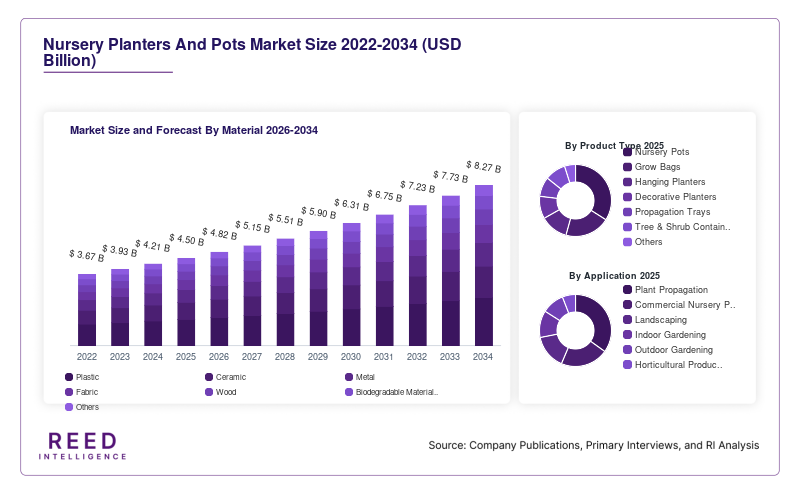
Plastic accounted for approximately 48% of the nursery planters and pots market in 2025, making it the largest material segment. Its position is supported by low cost, lightweight construction, durability, availability in multiple sizes and suitability for commercial nursery operations.
Biodegradable materials accounted for approximately 9% and are projected to grow at approximately 11.2% CAGR, making them the fastest-growing major material segment. Increasing environmental awareness and efforts to reduce conventional plastic waste are supporting adoption.
Ceramic represented approximately 19%, metal 9%, fabric 8%, wood 4%, and other materials approximately 3%.
Product Type Segment Analysis
By Product Type
Nursery pots accounted for approximately 42% of the market in 2025, making them the largest product-type segment. Their widespread use in plant propagation, cultivation and transportation supports strong demand from commercial growers and nurseries.
Grow bags accounted for approximately 18% and are projected to grow at approximately 9.4% CAGR, making them the fastest-growing major product category. Their lightweight construction, drainage characteristics and suitability for space-efficient cultivation are supporting adoption.
Decorative planters represented approximately 17%, propagation trays 10%, tree and shrub containers 8%, hanging planters 3%, and other products approximately 2%.
Application Segment Analysis
By Application
Commercial nursery production accounted for approximately 36% of the market in 2025, making it the largest application segment. Commercial growers require substantial quantities of containers throughout plant propagation and cultivation cycles.
Indoor gardening accounted for approximately 18% and is projected to grow at approximately 9.0% CAGR, making it the fastest-growing major application segment. Increasing consumer interest in houseplants, decorative greenery and compact gardening is supporting growth.
Landscaping represented approximately 21%, outdoor gardening 15%, plant propagation 6%, and horticultural production approximately 4%.
End-User Segment Analysis
By End User
Commercial nurseries accounted for approximately 38% of the market in 2025, making them the largest end-user segment. Nurseries require containers across propagation, cultivation, inventory management and plant distribution.
Residential consumers accounted for approximately 22% and are projected to grow at approximately 9.1% CAGR, making them the fastest-growing major end-user segment. Rising home gardening, indoor plants and balcony gardening are contributing to demand.
Garden centers represented approximately 16%, landscaping companies 13%, professional growers 8%, and other users approximately 3%.
Nursery Planters and Pots Market Regional Analysis
Asia-Pacific Holds the Largest Share
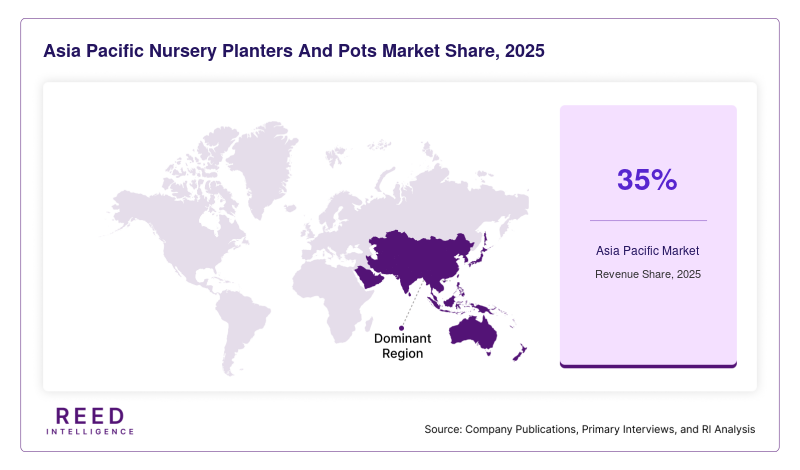
Asia-Pacific accounted for approximately 35% of the global nursery planters and pots market in 2025, making it the largest regional market. The region benefits from a large horticulture industry, extensive nursery production, expanding urban populations and growing gardening activity.
Asia-Pacific is also projected to grow at approximately 8.1% CAGR, supported by expanding commercial horticulture, landscaping and consumer gardening.
North America Maintains Strong Consumer Demand
North America accounted for approximately 27% of the market in 2025 and is projected to grow at approximately 6.6% CAGR.
The region benefits from established garden-center networks, commercial nurseries, landscaping activity and strong consumer interest in indoor and outdoor gardening.
Europe Shows Strong Sustainability Demand
Europe accounted for approximately 24% of the market in 2025 and is projected to grow at approximately 6.3% CAGR.
Environmental awareness, horticultural production and demand for sustainable gardening products are supporting the market.
Latin America Shows Expanding Horticultural Activity
Latin America accounted for approximately 8% of the market in 2025 and is projected to grow at approximately 6.8% CAGR.
Growth in commercial horticulture, landscaping and ornamental plant production is supporting demand.
Middle East & Africa Represents an Emerging Market
Middle East & Africa accounted for approximately 6% of the market in 2025 and is projected to grow at approximately 6.5% CAGR.
Urban landscaping, controlled horticulture and investment in green spaces are creating opportunities for nursery containers and planters.
Nursery Planters and Pots Market Competitive Landscape
Competition in the nursery planters and pots market is based on material quality, durability, product design, drainage performance, sustainability, pricing, customization, product range and distribution capabilities.
Manufacturers are expanding recycled and biodegradable product offerings while developing lightweight containers and decorative designs for residential and commercial applications.
Key Market Players
- The HC Companies
- Nieuwkoop Europe
- Desch Plantpak
- TEKU
- Pöppelmann
- Summit Plastic Company
- Nursery Supplies, Inc.
- Landmark Plastic Corporation
- Scheurich
- Elho
Nursery Planters and Pots Market Recent Developments
- Manufacturers are increasing the use of recycled plastics, biodegradable materials and other sustainable inputs in nursery pots and planters. The shift is being supported by growing environmental concerns surrounding conventional plastic containers.
- Self-watering designs are gaining attention among residential consumers and indoor gardeners. These products can simplify plant care and help manage irrigation, particularly for consumers with limited gardening experience.
Nursery Planters And Pots Market Segments
By Material
- Plastic
- Ceramic
- Metal
- Fabric
- Wood
- Biodegradable Materials
- Others
By Product Type
- Nursery Pots
- Grow Bags
- Hanging Planters
- Decorative Planters
- Propagation Trays
- Tree & Shrub Containers
- Others
By Application
- Plant Propagation
- Commercial Nursery Production
- Landscaping
- Indoor Gardening
- Outdoor Gardening
- Horticultural Production
By End User
- Commercial Nurseries
- Garden Centers
- Landscaping Companies
- Professional Growers
- Residential Consumers
- Others
By Region
- North America
- Europe
- APAC
- Middle East and Africa
- LATAM