Sliding Vane Air Motor Market Size, Share & Trends Analysis Report By Type (Reversible Air Motors, Non-Reversible Air Motors), By Power Output (Below 1 HP, 1–5 HP, Above 5 HP), By Application (Industrial Machinery, Material Handling, Automotive, Food & Beverage, Chemical & Pharmaceutical, Other Applications), By Distribution Channel (Direct Sales, Distributors & Dealers, Online Channels) and By Region (North America, Europe, Asia-Pacific, Middle East and Africa, Latin America) Forecasts, 2026–20
USD 3950
Sliding Vane Air Motor Market Size
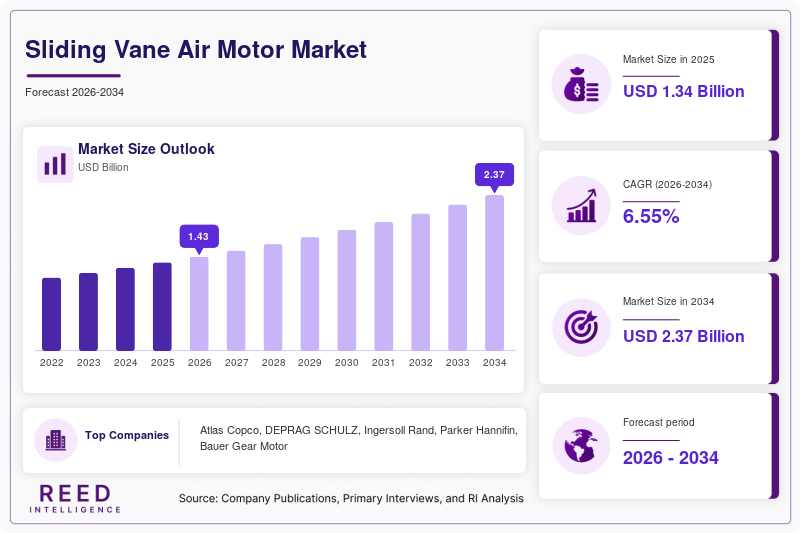
The sliding vane air motor market was valued at USD 1.34 billion in 2025 and is estimated to reach USD 1.43 billion in 2026. The market is projected to reach USD 2.23 billion by 2034, registering a 6.55% CAGR during 2026–2034.
The sliding vane air motor market is tied to industrial applications where pneumatic power provides advantages in environments requiring compact equipment, variable speed and resistance to electrical hazards. Sliding vane motors convert compressed air into rotary motion and are used in equipment such as mixers, conveyors, pumps, hoists, winches and material-handling systems.
Demand is influenced by the expansion and modernization of industrial production, particularly where pneumatic systems are already integrated into machinery. The broader industrial automation market is also increasing the use of pneumatic and electro-pneumatic systems, although the choice between an air motor and an electric motor depends on operating conditions, torque requirements, available infrastructure and total operating cost.
Sliding Vane Air Motor Market Drivers
Expansion of Pneumatic Automation Increases Demand for Compact Rotary Actuation
Industrial automation continues to increase the use of pneumatic systems for movement, clamping, positioning and material handling. The International Federation of Robotics reports continued investment in industrial automation globally, increasing the installed base of automated production equipment.
Sliding vane air motors benefit where rotary motion is required within pneumatic machinery. Their compact configuration and ability to provide variable operating speeds can make them suitable for machinery exposed to demanding operating conditions.
The mechanism is strongest when an existing plant already has compressed-air infrastructure, because integrating a pneumatic motor avoids introducing a separate electrical drive architecture. However, compressed-air generation costs can limit adoption where energy efficiency is the primary purchasing criterion.
Material-Handling Equipment Creates Recurring Demand for Pneumatic Drives
Material-handling systems require motors capable of driving hoists, winches, conveyors and other equipment under variable loads. Pneumatic motors can be useful in applications requiring controlled speed and operation in environments where electric motors may present installation or operational limitations.
This creates demand for sliding vane designs among equipment manufacturers and industrial users. Replacement demand also provides recurring sales because motors are components within larger mechanical systems.
Process Industries Require Drive Systems Compatible with Demanding Operating Environments
Chemical processing, food and beverage production and other process industries use machinery that can operate around moisture, combustible materials, dust or chemical exposure. Pneumatic motors can offer an alternative to electrically powered rotary equipment in selected applications.
The market mechanism is therefore linked to application-specific operating requirements rather than pneumatic technology alone. Where compressed air is already available and environmental conditions favor pneumatic equipment, sliding vane motors can reduce certain electrical-system requirements.
The counterbalance is that modern electric motors increasingly offer high efficiency, variable-speed control and specialized environmental protection, creating competition in applications where electrical drives can satisfy operating requirements.
Sliding Vane Air Motor Market Restraints
Compressed-Air Energy Costs Can Reduce the Economic Advantage
Compressed-air systems incur energy losses during compression, distribution and end use. The U.S. Department of Energy identifies compressed-air systems as an area where leakage, inappropriate use and system inefficiencies can materially increase operating costs.
For sliding vane air motors, this creates an economic trade-off: the motor itself may be compact and operationally flexible, but the total system cost includes the electricity required to generate compressed air.
Consequently, facilities evaluating new equipment may compare the complete lifecycle cost of pneumatic and electric drives rather than the motor purchase price alone.
Electric Motor Technology Increases Substitution Pressure
Electric motors continue to benefit from improvements in efficiency, electronic controls and variable-speed drives. The U.S. Department of Energy's motor-efficiency programs emphasize the potential energy savings associated with efficient motor systems and appropriate motor selection.
This creates substitution pressure for air motors in applications where electrical infrastructure is readily available. Sliding vane motors therefore retain stronger relevance where pneumatic characteristics—such as compactness, controllability or suitability for particular operating environments—provide a practical advantage.
Sliding Vane Air Motor Market Opportunities
Explosion-Sensitive Industrial Environments Create Application-Specific Demand
Some industrial environments require equipment designed to minimize ignition risks associated with electrical systems. Pneumatic motors can provide an alternative drive technology in appropriately designed applications.
The commercial opportunity is concentrated in chemical processing, petroleum-related operations, mining and other industrial environments where hazardous-area equipment requirements influence motor selection. The opportunity depends on compliance with applicable equipment and workplace-safety standards, meaning certification and application engineering can be as important as motor performance.
Retrofit Demand Can Extend the Addressable Market
A large installed base of pneumatic machinery creates replacement demand as motors wear, equipment is refurbished or production lines are modified. Retrofit projects can be commercially attractive because replacing a motor does not necessarily require a complete machinery redesign.
Manufacturers that offer interchangeable mounting configurations, application-specific torque characteristics and replacement support can address this demand more effectively. However, retrofit activity depends on industrial maintenance budgets and production schedules.
Sliding Vane Air Motor Market Type Segment Analysis
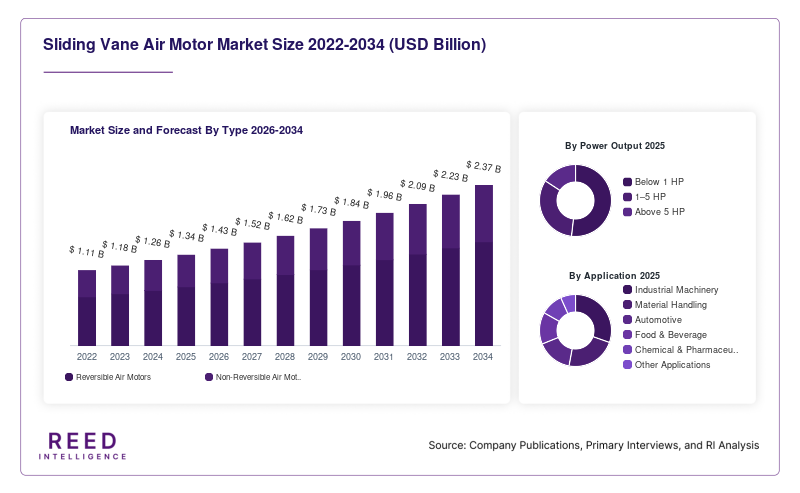
Reversible Air Motors are internally modeled as the largest type segment, accounting for approximately 58% of the 2025 market, equivalent to USD 777.20 million. Their ability to operate in both rotational directions makes them suitable for equipment requiring forward and reverse movement, including winches, material-handling systems and machinery requiring directional control.
The segment is modeled to reach approximately USD 1.34 billion by 2034, representing about 60% share, with a modeled 6.85% CAGR.
Their commercial advantage comes from application flexibility rather than simply higher motor output. Reversible designs can reduce the need for separate drive arrangements where machinery requires bidirectional operation. Demand is therefore supported by industrial automation and equipment modernization.
The main risk is substitution by electric servo and variable-frequency drive systems that can provide sophisticated directional and speed control where electrical infrastructure is available.
Non-Reversible Air Motors represent approximately 42% of the 2025 market, equivalent to USD 562.80 million. Their simpler operating configuration makes them appropriate for applications requiring rotation in a single direction.
The segment is modeled to reach approximately USD 890 million by 2034, corresponding to about 40% market share and a modeled 5.21% CAGR.
Demand is supported by machinery where bidirectional operation is unnecessary and system simplicity is more important than directional flexibility. The segment can remain relevant in pumps, mixers, grinders and other continuous-duty applications.
Its slower modeled growth reflects the narrower application range and greater availability of electric alternatives for straightforward rotary-drive requirements.
Sliding Vane Air Motor Market Power Output Analysis
Below 1 HP motors account for approximately 25% of 2025 market revenue, equivalent to USD 335 million. Demand is concentrated in compact equipment and applications requiring relatively low rotational power.
The 1–5 HP category represents approximately 48% of the 2025 market, or USD 643.20 million. Its broad applicability across industrial machinery and material-handling equipment supports its larger internal allocation.
Above 5 HP motors account for approximately 27% of the 2025 market, equivalent to USD 361.80 million. Demand is concentrated in heavier-duty industrial equipment where pneumatic power can provide operational advantages.
Sliding Vane Air Motor Market Application Analysis
Industrial machinery represents approximately 31% of the 2025 market, equivalent to USD 415.40 million. The segment benefits from the use of pneumatic rotary drives in manufacturing and processing equipment.
Material handling accounts for approximately 21%, or USD 281.40 million, of the 2025 market. Hoists, winches and conveyor-related equipment create demand where controlled pneumatic rotation is advantageous.
Automotive applications represent approximately 17% of the 2025 market, equivalent to USD 227.80 million. Automotive production uses pneumatic equipment extensively for assembly, fastening and material-handling operations.
Food and beverage contributes approximately 12%, or USD 160.80 million, to the 2025 market. Pneumatic equipment can be relevant in processing environments where equipment design and cleanliness requirements influence drive selection.
Chemical and pharmaceutical applications account for approximately 10% of 2025 revenue, equivalent to USD 134 million. Demand is influenced by equipment requirements in controlled and potentially hazardous processing environments.
Other applications represent approximately 9% of the 2025 market, equivalent to USD 120.60 million. These include specialized machinery and industrial applications where pneumatic rotary power offers an application-specific advantage.
Sliding Vane Air Motor Market Regional Analysis
North America Represents an Established Market Supported by Industrial Automation and Replacement Demand
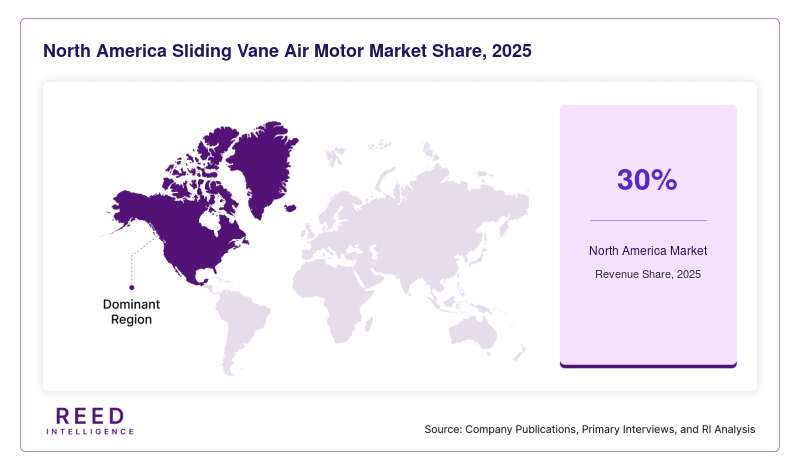
North America represents approximately 30% of global revenue in 2025, equivalent to USD 402 million. Its share is modeled at 29% by 2034, with market value reaching approximately USD 646.70 million and a modeled 5.45% CAGR.
The region has a large installed base of industrial machinery and pneumatic systems. U.S. Department of Energy resources also emphasize energy efficiency and optimization of compressed-air and motor systems, influencing purchasing decisions toward lifecycle performance.
The market mechanism is therefore split between new automation equipment and replacement of installed pneumatic components. Automotive, manufacturing, food processing and material handling remain relevant customer industries.
The principal constraint is substitution by efficient electric motors and the operating cost associated with compressed-air generation.
Europe Maintains Demand Through Industrial Automation and Specialized Machinery
Europe represents approximately 27% of the 2025 market, equivalent to USD 361.80 million. Its share is modeled at 26% by 2034, with market value reaching approximately USD 579.80 million and a modeled 5.39% CAGR.
European industrial customers place significant emphasis on energy efficiency, machine safety and equipment performance. These factors influence motor selection and create demand for pneumatic systems in applications where their operating characteristics justify compressed-air consumption.
Germany, Italy, France and other industrial economies provide an important equipment-manufacturing base. Demand is supported by machinery modernization and replacement cycles.
Energy costs remain a counterbalance because compressed-air systems can have higher operating costs than appropriately selected electric drives.
Asia-Pacific Represents the Fastest-Growing Regional Market as Industrial Capacity and Automation Expand
Asia-Pacific accounts for approximately 28% of 2025 revenue, or USD 375.20 million. Its share is internally modeled to reach 31% by 2034, with market value reaching approximately USD 691.30 million and a modeled 7.02% CAGR.
Industrial expansion across manufacturing, automotive, electronics, food processing and material handling provides a broad customer base. The region's large manufacturing sector also creates recurring demand for machinery components and replacement equipment.
China, Japan, South Korea and India represent important industrial markets, although adoption patterns differ substantially by industry and plant maturity.
The principal growth mechanism is the expansion and modernization of automated production equipment. Energy consumption and competition from electric drive systems remain important constraints.
Middle East and Africa Shows Demand Concentrated in Specialized Industrial Applications
Middle East and Africa represents approximately 8% of the 2025 market, equivalent to USD 107.20 million. Its share is modeled at 8% by 2034, with market value reaching approximately USD 178.40 million and a modeled 5.82% CAGR.
Demand is concentrated in oil and gas, chemical processing, mining, industrial manufacturing and material-handling applications. Pneumatic motors can be relevant where environmental conditions or equipment requirements favor non-electric drive solutions.
The region's commercial opportunity is therefore concentrated rather than broad-based. Investment cycles in industrial infrastructure can materially affect demand.
Latin America Represents a Developing Market Linked to Industrial Equipment Investment
Latin America accounts for approximately 7% of the 2025 market, equivalent to USD 93.80 million. Its share is modeled at 6% by 2034, with market value reaching approximately USD 133.80 million and a modeled 4.03% CAGR.
Brazil and Mexico provide important industrial demand through automotive, food processing, manufacturing and other industrial sectors. Replacement demand from existing pneumatic machinery also supports the market.
Economic volatility and fluctuations in industrial investment can constrain equipment purchases, while competition from electric motors limits pneumatic adoption where compressed-air infrastructure is not already established.
Sliding Vane Air Motor Market Competitive Landscape
Competition in the sliding vane air motor market is based on motor performance, operating range, product reliability, application engineering, distribution reach and compatibility with existing pneumatic systems. Established pneumatic-equipment manufacturers compete by offering broad product portfolios covering different torque, speed and mounting requirements.
Atlas Copco competes through its broad industrial-compressor and pneumatic-equipment ecosystem, allowing it to address customers already operating compressed-air infrastructure.
Deprag focuses on pneumatic motors and industrial drive technology, giving it specialized positioning in applications requiring engineered pneumatic solutions.
Key Market Players
- Atlas Copco
- DEPRAG SCHULZ
- Ingersoll Rand
- Parker Hannifin
- Bauer Gear Motor
- GAST Manufacturing
- Deublin
- Globe Airmotor
- Pneumax
- Mann+Hummel
Sliding Vane Air Motor Market Recent Developments
- Industrial automation investment continues to increase the installed base of automated machinery globally. The International Federation of Robotics has reported continued robot deployment across manufacturing, particularly in automotive and electronics. For sliding vane air motors, the implication is indirect: greater automation expands the machinery base in which pneumatic actuation and rotary motion can be incorporated. However, the benefit depends on whether individual machine builders select pneumatic or electric drives.
- The U.S. Department of Energy continues to emphasize compressed-air system optimization, including leak reduction, appropriate system sizing and efficient operation. This development affects air-motor purchasing because users increasingly evaluate pneumatic equipment through total system energy consumption. Manufacturers therefore face greater pressure to improve air consumption and operating efficiency rather than competing solely on mechanical specifications.
Sliding Vane Air Motor Market Segments
By Type
- Reversible Air Motors
- Non-Reversible Air Motors
By Power Output
- Below 1 HP
- 1–5 HP
- Above 5 HP
By Application
- Industrial Machinery
- Material Handling
- Automotive
- Food & Beverage
- Chemical & Pharmaceutical
- Other Applications
By Distribution Channel
- Direct Sales
- Distributors & Dealers
- Online Channels
By Region
- North America
- Europe
- APAC
- Middle East and Africa
- LATAM