Tungsten Market Size, Share & Trends Analysis Report By Product Type (Tungsten Carbide, Tungsten Metal, Tungsten Alloys, Tungsten Chemicals), By Application (Metalworking, Mining & Construction, Aerospace & Defense, Electronics & Electrical, Automotive, Others) and By Region (North America, Europe, Asia-Pacific, Latin America, Middle East & Africa) Forecasts, 2026–2034
USD 3950
Tungsten Market Size
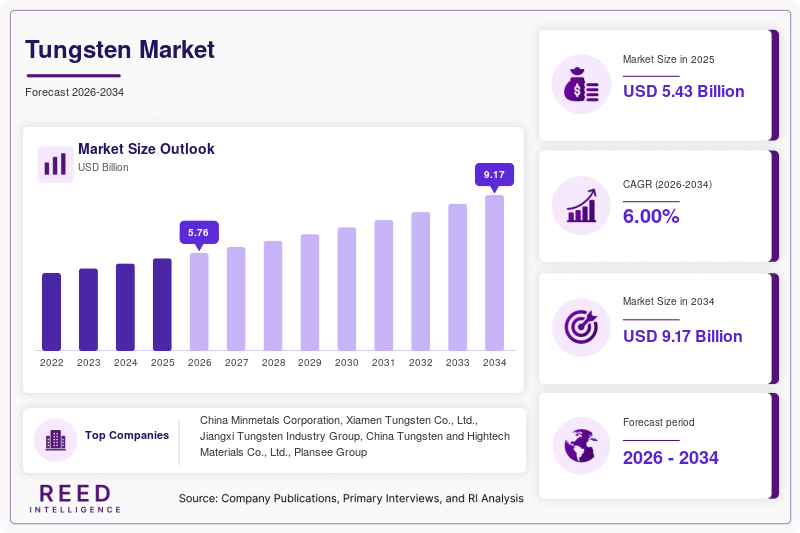
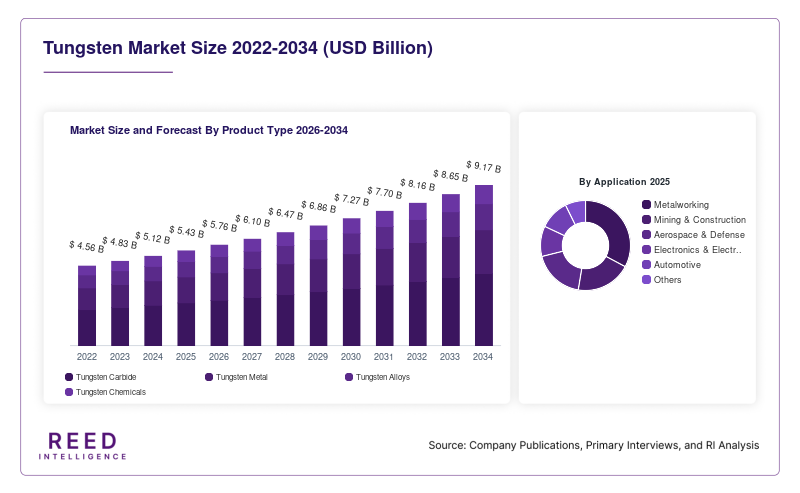
The global tungsten market was valued at USD 5.43 billion in 2025 and is projected to grow from USD 5.78 billion in 2026 to USD 9.17 billion by 2034, registering a CAGR of 6.00% during the forecast period from 2026 to 2034.
Tungsten demand is closely tied to applications where hardness, density, wear resistance and high-temperature performance cannot easily be achieved with conventional metals. The largest consumption base is concentrated in tungsten carbide and other hardmetal products used for cutting, drilling, mining and wear-resistant components. The U.S. Geological Survey identifies cemented carbides as the largest use of tungsten, with applications spanning metalworking, mining and construction.
Supply concentration is a defining feature of the market. China accounted for an estimated 82% of global mined tungsten production in 2024, according to USGS data, leaving downstream manufacturers in North America and Europe exposed to changes in Chinese supply and export policy. The supply structure became more strategically significant in February 2025 when China introduced export controls covering specified tungsten-related materials and technologies.
Tungsten Market Drivers
Concentration of Tungsten Supply Is Increasing the Value of Secure Non-Chinese Sources
The tungsten supply chain is highly concentrated, with China producing approximately 82% of mined tungsten in 2024. The concentration matters because tungsten is difficult to substitute in several high-performance applications, particularly cemented carbide tooling and specialized alloys. China introduced export controls on specified tungsten products and technologies in February 2025, requiring exporters to obtain licenses for covered items. This creates a direct mechanism for higher demand for recycling, long-term offtake agreements and alternative production outside China. Plansee has responded by combining scrap collection, recycling technologies and mine offtake agreements to secure supply. The counterbalance is that new mines and processing facilities require substantial investment and long development periods.
Cemented Carbide Consumption Links Tungsten Demand to Industrial Tooling
Tungsten carbide remains the principal industrial pathway for tungsten consumption because its hardness and wear resistance support cutting, drilling and machining applications. USGS estimates that around 60% of U.S. tungsten consumption was used in cemented carbide parts in 2024, primarily for construction, metalworking, mining and oil and gas drilling. Globally, Sandvik reported solid demand for tungsten powder during 2025, supported by supply limitations and higher tungsten prices, while strong demand was also recorded for cutting tools in aerospace and defense. This links tungsten consumption to manufacturing activity, mining equipment replacement and infrastructure investment. A slowdown in industrial production, particularly in general engineering, can therefore moderate demand.
Recycling Is Becoming a Strategic Supply Source
Recycling is moving from a sustainability initiative toward a supply-security mechanism because used carbide tools contain recoverable tungsten. Sandvik's 2025 sustainability reporting states that its tungsten carbide powder Bergla is made from 100% recycled tungsten raw material, while its carbide-tool recycling programs were expanded across additional markets. Plansee reported that recycled material accounted for 92% of its tungsten input in fiscal 2025/26, supported by scrap collection, recycling technologies and long-term mine agreements. This can reduce dependence on newly mined material and improve raw-material security for manufacturers. However, collection networks, processing capacity and the availability of recoverable carbide scrap determine how quickly recycling can offset primary-material requirements.
Tungsten Market Restraints
High Supply Concentration Creates Procurement and Price Exposure
The concentration of primary tungsten production creates a structural procurement risk for downstream manufacturers. China produced approximately 67,000 metric tons of tungsten content in 2024 against world production of approximately 81,000 metric tons, according to USGS data. Export controls introduced in 2025 add another layer of uncertainty for international buyers of covered tungsten materials. Manufacturers outside China can respond through inventories, recycling and alternative suppliers, but these measures can increase procurement costs. The constraint is particularly relevant to companies whose production depends on consistent tungsten carbide powder or other processed tungsten inputs.
Limited Substitutability Restricts Material Flexibility
Tungsten can be substituted in selected applications, but alternatives often involve performance or cost trade-offs. USGS identifies molybdenum carbide, niobium carbide, titanium carbide, ceramics, cermets and tool steels as potential substitutes for cemented tungsten carbide in some applications. However, the availability of substitutes does not eliminate tungsten requirements across high-wear and high-temperature applications. As a result, manufacturers may optimize tungsten consumption or redesign components rather than fully replace the material. This limits the ability of downstream users to respond rapidly to supply disruptions through material substitution alone.
Tungsten Market Opportunities
Secondary Tungsten Supply Can Reduce Exposure to Primary-Mining Constraints
The expansion of closed-loop carbide recycling creates an opportunity for manufacturers to secure part of their tungsten requirements independently of newly mined supply. Sandvik has expanded customer recycling programs for used carbide tools and uses recycled tungsten to manufacture new carbide powder. Plansee similarly combines recycling with long-term mine agreements as part of its raw-material strategy. The commercial opportunity extends across tooling manufacturers, mining-equipment suppliers and metalworking customers because used inserts, drill bits and other carbide components represent recoverable feedstock. Adoption depends on collection economics, regional recycling infrastructure and the ability to maintain material quality during recovery.
New Non-Chinese Mining Projects Can Diversify the Supply Base
Supply concentration is creating a commercial rationale for developing tungsten resources outside China. A 2025 USGS assessment of three tungsten deposits in Uzbekistan concluded that the deposits could be economically viable under 2024 market conditions; if developed, they could increase global tungsten output by approximately 2.7% and potentially make Uzbekistan the third-largest producer. Similar diversification efforts are relevant to Australia, Europe and other resource regions. New projects can supply manufacturers seeking geographic diversification, but financing, permitting, infrastructure and processing capability remain important barriers.
Product Type Analysis
By Product Type
Tungsten Carbide accounted for approximately 61% of the global market in 2025. Its position reflects extensive use in cutting tools, drilling equipment and wear-resistant components. USGS identifies cemented carbides as the largest application of tungsten, covering metalworking, mining and construction equipment. The material combines tungsten's hardness with carbide-based performance characteristics, allowing tooling to withstand high mechanical loads and abrasive operating conditions. Demand therefore follows machining activity, mining production and industrial equipment replacement. Sandvik's 2025 reporting showed solid demand for tungsten powder alongside strong cutting-tool demand in aerospace and defense. The main risk to the segment is the development of alternative hard materials and efforts by manufacturers to reduce tungsten intensity through tool design and improved recycling.
Tungsten Metal Is the Fastest-Growing Product Type as Supply-Security Applications Expand
Tungsten Metal represented approximately 17% of the market in 2025 and is projected to expand at about 7.2% CAGR through 2034. Its growth is associated with applications requiring high density, high melting temperature and resistance to extreme operating conditions. USGS identifies tungsten metal products in electrical, electronic, heating, welding and specialized high-temperature applications, while tungsten heavy alloys are used in high-density and defense-related applications. Strategic supply concerns are also encouraging investment in processing and recycling capabilities. Plansee has emphasized tungsten's role in electronics, medical technology and other high-tech applications while expanding its efforts to secure raw-material supply. The segment remains sensitive to material prices and the availability of specialized processing capacity.
Other product-type growth: Tungsten Alloys are projected to expand at approximately 5.8% CAGR, while Tungsten Chemicals are projected to grow at approximately 4.9% CAGR through 2034.
Application Analysis
By Application
Metalworking accounted for approximately 31% of the global market in 2025. Tungsten carbide tools are used extensively for machining hard materials, where wear resistance directly affects tool life and manufacturing productivity. USGS identifies metalworking as one of the principal end uses for cemented tungsten carbide. Demand is therefore connected to machining volumes, production of industrial components and investment in manufacturing equipment. Aerospace manufacturing provides an additional high-value demand base because difficult-to-machine alloys require advanced cutting tools. Sandvik reported strong underlying cutting-tool demand from aerospace during 2025.
Aerospace & Defense is the fastest-growing major application, representing approximately 15% of the market in 2025 and expanding at about 7.5% CAGR through 2034. Tungsten's combination of density, temperature resistance and wear performance supports specialized aerospace, defense and high-temperature applications. USGS includes jet-engine and ammunition applications among the uses of tungsten identified in its critical-mineral materials. Rising attention to secure supplies can additionally encourage stockpiling and non-Chinese sourcing.
Other application growth: Mining & Construction is projected to grow at approximately 6.2% CAGR, Electronics & Electrical at 5.9%, Automotive at 5.3%, and Others at approximately 4.7% CAGR through 2034.
Tungsten Market Regional Analysis
Asia-Pacific Tungsten Market
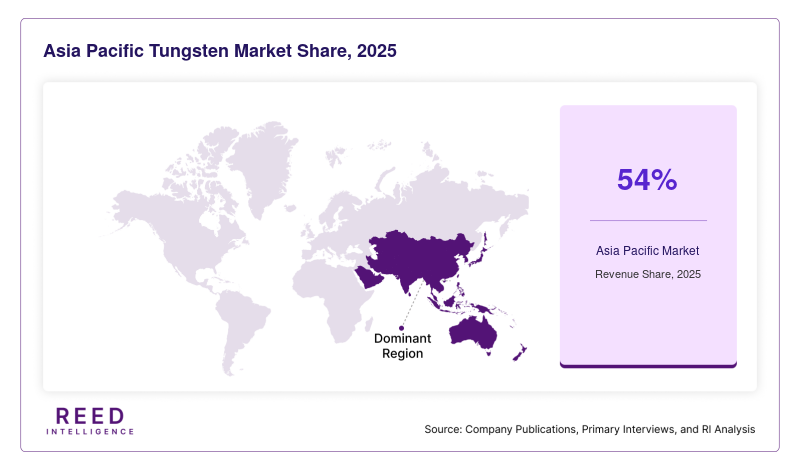
Asia-Pacific accounted for approximately 54% of the global market in 2025 and is the fastest-growing region at about 6.8% CAGR through 2034. China's dominant production position is the primary structural feature of the regional market: USGS estimates that China accounted for approximately 82% of global mined tungsten production in 2024. The region also contains major downstream manufacturing capacity, particularly across metalworking, mining equipment, electronics and industrial tooling.
China's February 2025 export-control decision covering specified tungsten-related products and technologies has increased the importance of regional supply management. For international manufacturers, this can encourage inventory building, supplier diversification and increased recycling. Within Asia-Pacific, China remains the central production and processing hub, while Japan, South Korea and other industrial economies contribute demand from advanced manufacturing and electronics.
The region's future growth mechanism is therefore a combination of industrial production, domestic tooling demand, electronics manufacturing and strategic tungsten processing. Constraints include supply concentration, export-policy uncertainty and the possibility of weaker industrial activity in mature manufacturing economies.
North America Tungsten Market
North America represented approximately 18% of the global market in 2025 and is projected to grow at about 5.6% CAGR through 2034. The regional market is characterized by substantial downstream consumption despite limited domestic mine production. USGS reports that tungsten has not been commercially mined in the United States since 2015, while U.S. consumption is heavily concentrated in cemented carbide applications.
This creates demand for imported material as well as recycling and alternative supply arrangements. The strategic importance of tungsten is reinforced by its inclusion on the U.S. critical-minerals list. Aerospace, defense, energy, oil and gas drilling, construction and precision manufacturing provide important downstream demand.
North American manufacturers are consequently increasing attention to secondary supply. Sandvik's recycling programs and Kennametal's carbide-recycling activities illustrate the commercial role of recovered material. The primary constraints are import dependence, limited domestic mining and the capital required to establish alternative processing capacity.
Europe Tungsten Market
Europe accounted for approximately 17% of the global market in 2025 and is expected to grow at about 5.5% CAGR through 2034. Tungsten has strategic importance within the European raw-material framework because the EU classifies it as both a strategic and critical raw material. The Critical Raw Materials Act establishes objectives for strengthening European extraction, processing and recycling capabilities.
The European market has a strong downstream base in machine tools, automotive manufacturing, aerospace, medical technology and industrial equipment. This makes reliable tungsten access important even when primary mining occurs elsewhere. Plansee has made supply security a long-term strategic priority and combines recycling, mine offtake agreements and processing capabilities to support its tungsten business.
The future growth mechanism is increasingly linked to circular supply chains and high-value manufacturing rather than rapid expansion of primary consumption. European constraints include energy costs, regulatory requirements, limited domestic mining and dependence on imported primary material.
Latin America Tungsten Market
Latin America represented approximately 7% of the global market in 2025 and is projected to grow at about 5.1% CAGR through 2034. Demand is connected primarily to mining, construction, metalworking and industrial equipment, while the region also has tungsten-bearing mineral resources. Mining activity creates a two-sided market effect: tungsten-containing drilling and cutting equipment supports local demand, while mining development can create opportunities for tungsten production.
The region's growth depends on investment in mineral processing, infrastructure and industrial manufacturing. Brazil and Bolivia are particularly relevant to the tungsten supply chain, with USGS reporting tungsten mine production in both countries. However, the commercial opportunity is constrained by project financing, processing infrastructure, commodity-price volatility and competition from established producers.
Middle East & Africa Tungsten Market
Middle East & Africa accounted for approximately 4% of the global market in 2025 and is projected to expand at about 5.0% CAGR through 2034. Demand is concentrated in mining, oil and gas, construction and industrial equipment, where tungsten carbide tools provide wear resistance in demanding operating environments. Africa also contributes to primary tungsten supply, with Rwanda among the countries reported by USGS as a tungsten producer.
The market's commercial opportunity is strongest where mining activity and industrial processing develop simultaneously. Greater investment in mineral-resource development could increase regional tungsten output while expanding consumption of drilling and cutting tools. Supply-chain infrastructure, processing capacity, financing and geopolitical conditions remain constraints. The region therefore has greater potential as a source of incremental primary supply and industrial demand than as a mature downstream tungsten-processing center.
Tungsten Market Competitive Landscape
Competition is increasingly organized around raw-material security, recycling, tungsten processing, carbide technology, tooling performance and geographic supply reliability.
Plansee's strategy illustrates how vertical integration is becoming a competitive differentiator. The company combines scrap collection, tungsten recycling and long-term mine offtake agreements; it reported a 92% tungsten recycling rate in fiscal 2025/26.
Sandvik is similarly integrating recycling into its carbide-tool business. Its 2025 reporting describes buyback programs for used cemented-carbide inserts, drill bits and rock tools and identifies its Bergla tungsten carbide powder as being produced from 100% recycled tungsten raw material.
Key Market Players
- China Minmetals Corporation
- Xiamen Tungsten Co., Ltd.
- Jiangxi Tungsten Industry Group
- China Tungsten and Hightech Materials Co., Ltd.
- Plansee Group
- Sandvik AB
- Kennametal Inc.
- Wolfram Bergbau und Hütten AG
- Japan New Metals Co., Ltd.
- Global Tungsten & Powders Corp.
Tungsten Market Recent Developments
- Sandvik expanded its recycling activities for used carbide tools and continued digitalized customer recycling programs in additional markets during 2025. The company also reported solid demand for tungsten powder, supported by global supply limitations and higher tungsten prices. The development strengthens the role of secondary tungsten as a strategic input rather than simply an environmental initiative.
- Plansee reported a 92% tungsten recycling rate for fiscal 2025/26, while describing tight raw-material supply and significantly higher prices. The company combines scrap collection, proprietary recycling technologies and long-term mine offtake agreements to secure tungsten. This demonstrates how vertical integration and recycling are being used to manage supply risk.
Tungsten Market Segments
By Product Type
- Tungsten Carbide
- Tungsten Metal
- Tungsten Alloys
- Tungsten Chemicals
By Application
- Metalworking
- Mining & Construction
- Aerospace & Defense
- Electronics & Electrical
- Automotive
- Others
By Region
- North America
- Europe
- APAC
- Middle East and Africa
- LATAM