Ultracentrifuge Market Size, Share & Trends Analysis Report By Product Type, By Application, By End User and By Region, Forecasts 2026–2034
USD 3950
Ultracentrifuge Market Size
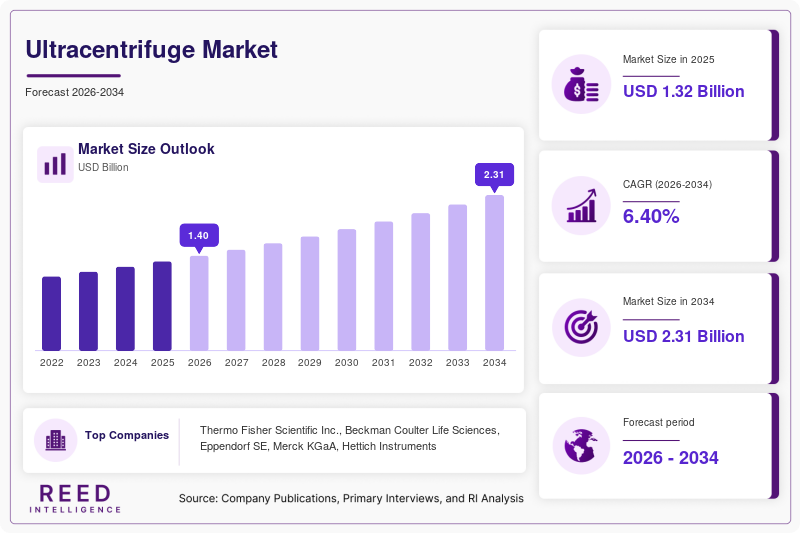
The global ultracentrifuge market was valued at USD 1.32 billion in 2025 and is projected to grow from USD 1.41 billion in 2026 to USD 2.35 billion by 2034, registering a CAGR of 6.40% during the forecast period from 2026 to 2034.
Ultracentrifuges are high-speed laboratory instruments used to separate, purify and characterize biological and chemical materials according to density, size and molecular weight. They are widely used in molecular biology, biochemistry, pharmaceutical research, genomics, proteomics and biotechnology.
The market is supported by increasing biomedical research activity, growing pharmaceutical and biotechnology development, expansion of molecular diagnostics and rising demand for advanced laboratory equipment. Ultracentrifugation is particularly valuable for applications involving viruses, proteins, nucleic acids, organelles, nanoparticles and other subcellular structures.
Ultracentrifuge Market Drivers
Expansion of Biotechnology Research
Growth in biotechnology research is increasing demand for laboratory equipment capable of separating and purifying complex biological materials.
Ultracentrifuges are used in areas such as molecular biology, cell biology, genomics and proteomics.
Increasing Pharmaceutical R&D
Pharmaceutical companies use ultracentrifugation in drug discovery, biologics development, vaccine research and characterization of biological materials.
Increasing investment in pharmaceutical research is supporting demand for specialized laboratory equipment.
Growth of Vaccine and Biologics Development
Vaccines, antibodies, viral vectors and other biologics require advanced research and purification techniques.
Ultracentrifugation can be used in the isolation and characterization of biological particles, supporting applications throughout the development process.
Expansion of Genomics and Proteomics
Genomics and proteomics research increasingly relies on sophisticated sample preparation and separation techniques.
Ultracentrifuges provide high-speed separation capabilities for biological components used in these research workflows.
Increasing Academic and Research Funding
Universities, research institutes and government laboratories continue investing in advanced scientific infrastructure.
Expansion of laboratory capacity creates opportunities for suppliers of ultracentrifuges and associated equipment.
Ultracentrifuge Market Restraints
High Equipment Cost
Ultracentrifuges are sophisticated laboratory instruments that require precision engineering, specialized rotors and advanced control systems.
Their relatively high acquisition cost can limit adoption among smaller laboratories.
High Maintenance Requirements
High-speed rotating systems require regular inspection and maintenance to ensure safe operation.
Rotor maintenance and replacement can also increase the overall cost of ownership.
Requirement for Skilled Operators
Operating ultracentrifuges safely and effectively requires trained laboratory personnel.
Complex experimental protocols and rotor selection requirements can create barriers for inexperienced users.
Availability of Alternative Separation Technologies
Other separation methods, including chromatography, filtration and conventional centrifugation, can address some applications.
Laboratories therefore select ultracentrifugation based on the required separation performance and experimental objectives.
Ultracentrifuge Market Opportunities
Growth of Biopharmaceuticals
Increasing development of antibodies, vaccines, recombinant proteins and other biologics is creating opportunities for advanced laboratory separation equipment.
Expansion of Molecular Biology Research
Increasing research into proteins, nucleic acids, organelles and viruses is supporting demand for high-speed centrifugation systems.
Automated Laboratory Workflows
Laboratories are increasingly adopting automation to improve reproducibility and productivity.
Automated rotor recognition, programmable protocols and advanced monitoring can improve the usability of ultracentrifuge systems.
Nanoparticle Research
Ultracentrifugation can be used to characterize and separate nanoparticles and other advanced materials.
Growing research into nanomedicine, drug-delivery systems and engineered nanoparticles creates additional applications.
Emerging Research Markets
Expansion of pharmaceutical and biotechnology research in Asia-Pacific, Latin America and other emerging markets is creating opportunities for ultracentrifuge manufacturers.
Product Type Segment Analysis
By Product Type
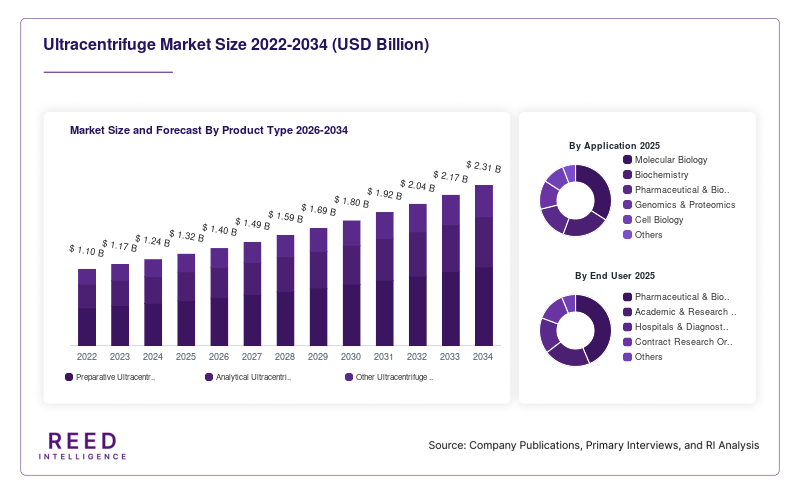
Preparative ultracentrifuges accounted for approximately 61% of the ultracentrifuge market in 2025, making them the dominant product type. Their extensive use in the separation and purification of biological materials supports demand across pharmaceutical, biotechnology and academic research laboratories.
Analytical ultracentrifuges accounted for approximately 27% and are projected to grow at approximately 7.3% CAGR, making them the fastest-growing major product segment. Increasing demand for quantitative characterization of proteins, macromolecules and biological particles is supporting adoption.
Other ultracentrifuge systems represented approximately 12% of the market.
Application Segment Analysis
By Application
Molecular biology accounted for approximately 29% of the market in 2025, making it the largest application segment. Ultracentrifugation is widely used for separating nucleic acids, proteins, viruses and cellular components in molecular biology workflows.
Genomics & proteomics accounted for approximately 18% and are projected to grow at approximately 8.0% CAGR, making them the fastest-growing major application segment. Increasing research into genes, proteins and molecular interactions is supporting demand for advanced separation and characterization techniques.
Pharmaceutical and biotechnology research represented approximately 25%, biochemistry 16%, cell biology 8%, and other applications approximately 4%.
End-User Segment Analysis
By End User
Pharmaceutical and biotechnology companies accounted for approximately 38% of the market in 2025, making them the largest end-user segment. Increasing investment in drug discovery, biologics, vaccines and molecular research supports their demand for advanced centrifugation equipment.
Contract research organizations accounted for approximately 14% and are projected to grow at approximately 8.1% CAGR, making them the fastest-growing major end-user segment. Increasing outsourcing of pharmaceutical and biotechnology research is supporting demand for advanced laboratory capabilities among CROs.
Academic and research institutions represented approximately 34%, hospitals and diagnostic laboratories 9%, and other end users approximately 5%.
Ultracentrifuge Market Regional Analysis
North America Holds the Largest Share
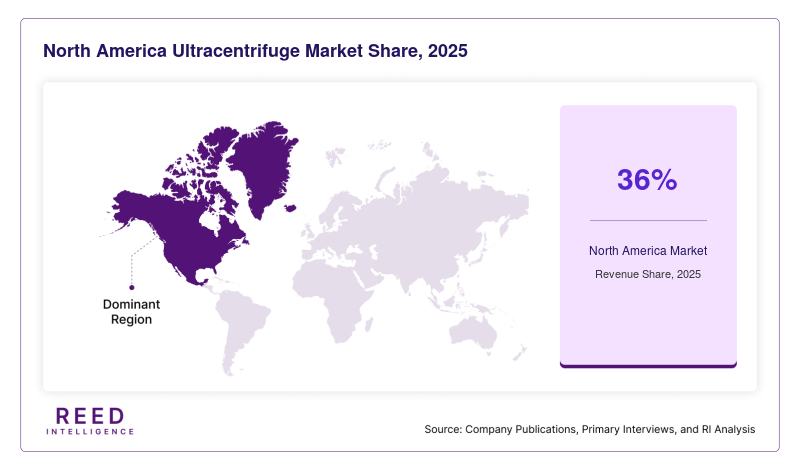
North America accounted for approximately 36% of the global ultracentrifuge market in 2025, making it the largest regional market. The region benefits from extensive pharmaceutical and biotechnology R&D, advanced research infrastructure, major academic institutions and high laboratory-equipment spending.
Asia-Pacific accounted for approximately 29% and is projected to grow at approximately 8.0% CAGR, making it the fastest-growing major region. Expanding pharmaceutical manufacturing, biotechnology research, academic laboratory infrastructure and healthcare investment are supporting regional growth.
Europe Maintains Strong Research Activity
Europe accounted for approximately 25% of the market in 2025 and is projected to grow at approximately 5.5% CAGR.
The region has established pharmaceutical and biotechnology industries, strong academic research networks and substantial investment in life-science research.
Latin America Shows Emerging Growth
Latin America accounted for approximately 6% of the market in 2025 and is projected to grow at approximately 6.0% CAGR.
Growing healthcare research capabilities and increasing pharmaceutical and biotechnology investment are supporting adoption.
Middle East & Africa Represents an Emerging Opportunity
Middle East & Africa accounted for approximately 4% of the market in 2025 and is projected to grow at approximately 6.3% CAGR.
Healthcare infrastructure development, research investments and expansion of laboratory capabilities are supporting gradual market growth.
Ultracentrifuge Market Competitive Landscape
Competition in the ultracentrifuge market is based on centrifugation speed, rotor capacity, sample handling, analytical accuracy, automation, safety features, reliability, service support and application flexibility.
Leading manufacturers are focusing on improved control systems, advanced rotors, automation and laboratory workflow integration.
Key Market Players
- Thermo Fisher Scientific Inc.
- Beckman Coulter Life Sciences
- Eppendorf SE
- Merck KGaA
- Hettich Instruments
- Kubota Corporation
- Hitachi High-Tech Corporation
- Tomy Digital Biology Co., Ltd.
- Labnet International
- Sigma Laborzentrifugen GmbH
Ultracentrifuge Market Recent Developments
- Manufacturers are developing ultracentrifuges with improved speed control, rotor designs and monitoring capabilities. These developments are intended to improve separation performance, reproducibility and operational safety.
- Laboratories are increasingly seeking automated workflows to improve consistency and reduce manual intervention. Programmable protocols, automated monitoring and enhanced user interfaces are being incorporated into modern centrifugation systems.
Ultracentrifuge Market Segments
By Product Type
- Preparative Ultracentrifuges
- Analytical Ultracentrifuges
- Other Ultracentrifuge Systems
By Application
- Molecular Biology
- Biochemistry
- Pharmaceutical & Biotechnology Research
- Genomics & Proteomics
- Cell Biology
- Others
By End User
- Pharmaceutical & Biotechnology Companies
- Academic & Research Institutions
- Hospitals & Diagnostic Laboratories
- Contract Research Organizations
- Others
A PHP Error was encountered
Severity: Notice
Message: Undefined offset: 3
Filename: reportpages/rd.php
Line Number: 400
Backtrace:
File: /var/www/html/application/views/frontend/reportpages/rd.php
Line: 400
Function: _error_handler
File: /var/www/html/application/controllers/FrontendReportController.php
Line: 420
Function: view
File: /var/www/html/index.php
Line: 315
Function: require_once
By Region
- North America
- Europe
- APAC
- Middle East and Africa
- LATAM