Women Nutrition Market Size, Share & Trends Analysis Report By Product Type (Vitamins & Minerals, Protein & Functional Nutrition, Herbal & Botanical Supplements, Specialty Supplements, Prenatal & Postnatal Nutrition), By Life Stage (Adolescent Women, Women of Reproductive Age, Pregnant & Lactating Women, Perimenopausal Women, Postmenopausal Women), By Form (Tablets & Capsules, Gummies, Powders, Softgels, Ready-to-Drink), By Distribution Channel (Pharmacies & Drugstores, Supermarkets & Hypermarke
USD 3950
Women Nutrition Market Size
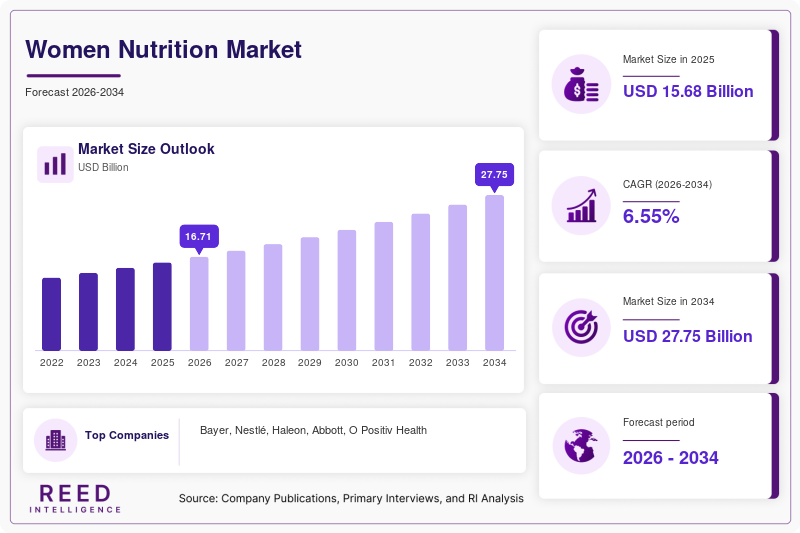
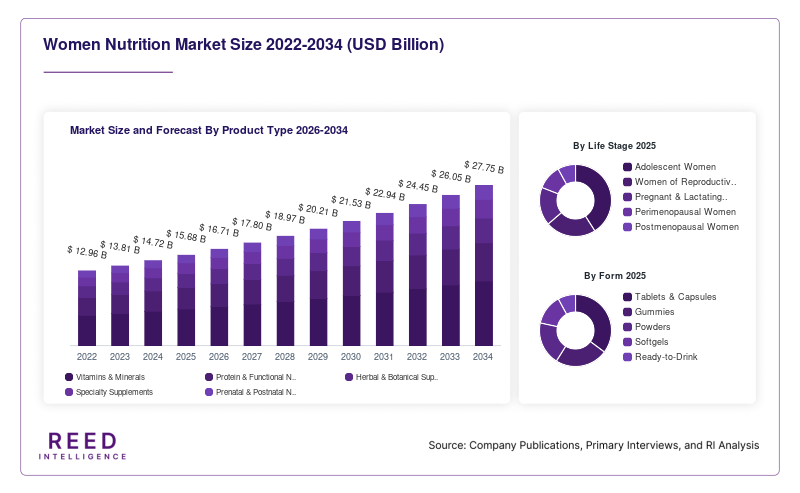
The women nutrition market was valued at USD 15.68 billion in 2025 and is projected to grow from USD 16.70 billion in 2026 to USD 27.75 billion by 2034, registering a CAGR of 6.55% during the forecast period from 2026 to 2034.
Women nutrition is increasingly shifting from broad multivitamin consumption toward products designed around specific physiological stages and nutritional requirements. The demand base spans everyday micronutrient supplementation, reproductive health, pregnancy, postpartum recovery, bone health, healthy aging and nutrition products addressing changing dietary requirements across the female life course.
Micronutrient gaps remain an important underlying demand mechanism. WHO reports that 33% of women of reproductive age have anemia, while its nutrition guidance identifies iron, folate, vitamin A and zinc among important micronutrients for women.
Women Nutrition Market Drivers
Persistent Micronutrient Gaps Sustain Demand for Women-Specific Nutrition
Micronutrient deficiency provides a direct mechanism for recurring demand in the women nutrition market. WHO states that 33% of women of reproductive age have anemia, while its broader nutrition guidance notes that more than two-thirds of non-pregnant women of reproductive age are deficient in at least one key micronutrient.
Iron is particularly important because menstruation increases the risk of iron deficiency among women of reproductive age. WHO recommends iron and folic acid supplementation strategies for menstruating women in appropriate settings and identifies iron deficiency as a major contributor to anemia.
The commercial mechanism is recurring demand for multivitamins, iron, folate and other micronutrient products. The strongest effect is concentrated among women of reproductive age and populations with documented nutritional gaps. However, adherence, gastrointestinal side effects and the preference for food-based nutrition can constrain supplement consumption.
Pregnancy and Maternal Nutrition Create Structured, Life-Stage-Specific Demand
Pregnancy creates a defined period in which nutritional requirements change, supporting demand for prenatal vitamins, iron, folic acid, DHA and broader maternal-nutrition products. WHO recommends iron and folic acid supplementation during pregnancy, while its antenatal-care guidance places nutritional counseling and supplementation within routine maternal care.
This creates a relatively predictable commercial cycle extending from preconception through pregnancy and postpartum. Nestlé's Materna portfolio demonstrates how suppliers are expanding from conventional prenatal products into staged solutions covering fertility, pregnancy and post-birth recovery.
The opportunity extends to DHA, multivitamins, protein and other nutritional products. Bayer likewise maintains life-stage-oriented prenatal nutrition through its Elevit portfolio.
The counterbalance is that prenatal supplementation is influenced by healthcare-provider recommendations, individual nutritional status and affordability rather than discretionary consumption alone.
Growing Attention to Menopause Expands the Market Beyond Reproductive Nutrition
The market is expanding from pregnancy and reproductive health into perimenopause and postmenopause. The National Institute on Aging notes that after menopause women become more vulnerable to conditions including osteoporosis and recommends adequate calcium and vitamin D alongside a healthy diet and physical activity.
This creates demand for products positioned around bone health, protein, vitamin D, calcium and broader healthy-aging needs. Haleon's 2025 Health Inclusivity Index also highlighted the nutritional challenges associated with menopause and perimenopause, including the importance of nutrients such as calcium, vitamin D, protein and B vitamins.
Commercial suppliers are responding with dedicated formulations. Bayer entered the UK menopause-support category with CanesMeno in 2025, while Doctor's Best introduced a women's collection containing a menopause-support product in 2024.
The limitation is that nutritional products cannot substitute for medical treatment where symptoms or health conditions require clinical management.
Women Nutrition Market Restraints
Supplement Adherence and Tolerability Limit Conversion of Nutritional Need Into Sustained Consumption
Nutritional need does not automatically translate into consistent supplement use. WHO identifies low coverage, insufficient distribution and adherence problems, including side effects such as constipation, dark stools and metallic taste, as barriers to iron supplementation among women of reproductive age.
The commercial implication is that brands must compete not only on nutrient composition but also on convenience, dosage, taste and tolerability. Gummies, powders and simplified daily routines are therefore increasingly relevant.
However, format innovation does not eliminate the need for appropriate nutrient dosing. Consumers may also switch between products or rely on dietary sources, reducing repeat purchases for individual supplement categories.
Regulatory and Scientific Scrutiny Limits Aggressive Health Claims
Women-focused nutrition products frequently address sensitive areas such as fertility, hormonal balance, menopause, weight management and reproductive health. These categories require careful distinction between nutritional support and medical claims.
Bayer, for example, explicitly states that supplements should complement healthy eating and that consumers should avoid unnecessary high doses and follow product labeling or professional advice.
The constraint affects product development, advertising and consumer communication. Companies need credible ingredient evidence and compliant claims while avoiding positioning that implies treatment of disease.
This can increase formulation, substantiation and regulatory costs, particularly for products marketed around complex hormonal or reproductive-health outcomes.
Women Nutrition Market Opportunities
Life-Stage-Specific Nutrition Can Increase Product Relevance and Repeat Purchasing
Women have different nutritional considerations across adolescence, reproductive years, pregnancy, postpartum, perimenopause and postmenopause. This creates an opportunity for companies to move from generic women's multivitamins toward products addressing specific stages.
Nestlé's Materna expansion illustrates this approach, with products covering preconception, pregnancy and post-birth recovery. Bayer similarly positions its women's health portfolio around different life stages.
The commercial mechanism is portfolio expansion: one consumer can potentially transition between products as nutritional needs change rather than remaining with a single generic formulation.
The limitation is that life-stage segmentation can increase SKU complexity and requires stronger evidence that formulations meaningfully address the nutritional requirements of the targeted group.
Midlife and Menopause Nutrition Remains a Developing Product Category
Menopause creates an identifiable nutritional need around healthy aging, bone health and dietary quality. NIA recommends adequate calcium and vitamin D during and after menopause, while broader evidence highlights changing nutritional requirements during this stage.
This creates room for targeted multivitamins, mineral formulations, protein products and combination supplements. Recent launches from Bayer, Doctor's Best, Midi Health and other brands demonstrate increasing commercial activity around midlife women's nutrition.
The main adoption barrier is evidence quality. Consumers and healthcare professionals may distinguish between products supported by established nutritional requirements and products making broader claims about hormones or symptoms.
Product Type Analysis
By Product Type
Vitamins & Minerals Represent the Largest Product Segment Because Micronutrient Requirements Create the Broadest Addressable Customer Base
Vitamins & Minerals account for approximately 38% of the global women nutrition market in 2025. Their broad application across everyday wellness, reproductive years, pregnancy and healthy aging supports recurring demand. WHO identifies iron, folate, vitamin A and zinc among key micronutrients relevant to women, while specific supplementation recommendations support established use cases for iron and folic acid.
Prenatal & Postnatal Nutrition accounts for approximately 23% and is projected to grow at approximately 7.40% CAGR, making it the fastest-growing product segment. Its growth mechanism is the expansion of products covering the full maternal journey rather than pregnancy alone. Nestlé's staged Materna portfolio illustrates this shift.
Protein & Functional Nutrition represents approximately 16% and is projected to grow at approximately 6.80% CAGR, supported by healthy-aging and active-lifestyle applications.
Herbal & Botanical Supplements account for approximately 13% and grow at approximately 6.20% CAGR, while Specialty Supplements account for approximately 10% and grow at approximately 6.70% CAGR, benefiting from targeted products addressing specific women's health concerns.
Life Stage Analysis
By Life Stage
Women of Reproductive Age account for approximately 34% of the market in 2025. This group has recurring nutritional requirements associated with menstruation, reproductive health and preparation for pregnancy. WHO identifies women of reproductive age as a population with substantial micronutrient needs and recommends iron and folic acid interventions in appropriate settings.
Perimenopausal Women account for approximately 18% and are projected to grow at approximately 8.10% CAGR, making this the fastest-growing life-stage segment. The mechanism is increasing attention to nutrition during the menopausal transition, when dietary and health priorities change.
Pregnant & Lactating Women account for approximately 25% and grow at approximately 7.10% CAGR, supported by structured prenatal and postnatal nutritional requirements.
Postmenopausal Women represent approximately 16% and grow at approximately 6.90% CAGR, with demand linked to healthy aging, bone health and broader dietary support. Adolescent Women account for approximately 7% and grow at approximately 6.40% CAGR, particularly around micronutrient requirements.
Form Analysis
By Form
Tablets & Capsules account for approximately 45% of the market in 2025. Their position reflects established consumer familiarity, broad formulation flexibility and widespread use in multivitamins, minerals and prenatal products.
Gummies account for approximately 25% and are projected to grow at approximately 8.20% CAGR, making them the fastest-growing form. Recent launches illustrate manufacturers' emphasis on more convenient and consumer-friendly formats. Bayer introduced a new Women's Multi Gummy formulation in 2026, while Doctor's Best expanded its women's product portfolio in 2025.
Powders account for approximately 13% and grow at approximately 7.20% CAGR, supported by products designed for functional nutrition and hormone-related wellness.
Softgels represent approximately 11% and grow at approximately 5.90% CAGR, while Ready-to-Drink products account for approximately 6% and grow at approximately 6.50% CAGR.
Distribution Channel Analysis
By Distribution Channel
Pharmacies & Drugstores account for approximately 37% of the market in 2025. Consumers use these channels for vitamins, prenatal products and other health-oriented supplements where product trust and accessibility influence purchase decisions.
Online Channels account for approximately 29% and are projected to grow at approximately 9.00% CAGR, making them the fastest-growing distribution channel. Online channels allow brands to provide detailed product information, subscriptions and targeted product assortments.
Recent expansion demonstrates the importance of omnichannel distribution. O Positiv expanded into CVS in 2025 and subsequently launched nationwide at Walmart, while Ritual expanded its women's supplement presence through Walmart.
Supermarkets & Hypermarkets account for approximately 24% and grow at approximately 5.80% CAGR, while Specialty Stores represent approximately 10% and grow at approximately 6.10% CAGR.
Women Nutrition Market Regional Analysis
North America Holds the Largest Regional Share Through Mature Supplement Consumption and Expanding Life-Stage Product Portfolios
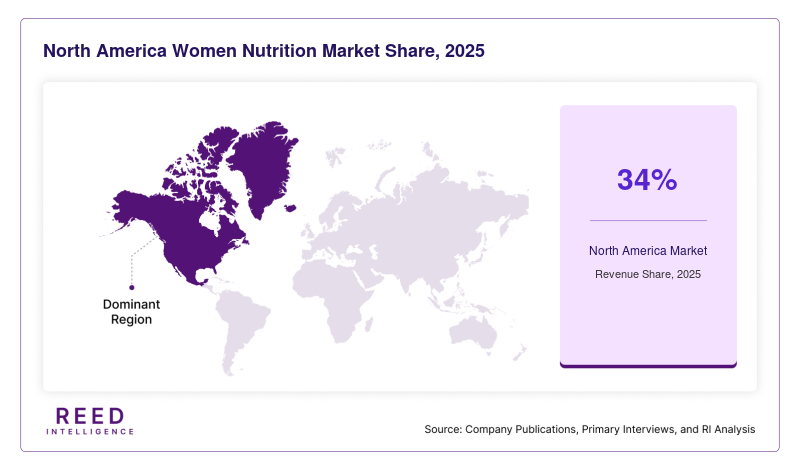
North America accounts for approximately 34% of the global women nutrition market in 2025 and is projected to grow at approximately 5.90% CAGR through 2034.
The region has a mature dietary-supplement ecosystem with established multivitamin, prenatal, menopause and functional-nutrition categories. Product development increasingly focuses on specific women's needs rather than generic supplementation.
Recent commercial activity supports this transition. O Positiv expanded into CVS and Walmart during 2025, extending distribution of products addressing hormonal, vaginal, digestive, urinary, menstrual and menopausal health.
The U.S. remains the principal regional demand center, with Canada contributing to the established consumer-health market.
The region's future growth mechanism is increasingly connected to personalization, life-stage segmentation, convenient formats and direct-to-consumer-to-retail expansion.
The principal constraints are regulatory scrutiny of health claims, consumer skepticism toward poorly substantiated products and competition among a large number of supplement brands.
Europe Maintains a Significant Market Through Established Nutrition Awareness and Increasing Focus on Women's Life Stages
Europe accounts for approximately 27% of the market in 2025 and is projected to grow at approximately 6.20% CAGR through 2034.
European demand is supported by prenatal nutrition, micronutrient supplementation, healthy aging and growing commercial attention to menopause.
Bayer entered the UK menopause category in 2025 with CanesMeno, combining educational resources with a dedicated product range. The launch illustrates the movement toward integrated education and product solutions for women's specific life stages.
The region also has a substantial maternal-health infrastructure, making prenatal and postnatal nutrition important segments. Product differentiation increasingly relies on evidence, formulation transparency and targeted nutritional positioning.
Germany, the United Kingdom, France and Italy represent important markets.
Constraints include varying regulatory environments, differences in permitted health claims and price sensitivity across individual European markets.
Asia-Pacific Is the Fastest-Growing Region as Nutritional Gaps and Expanding Consumer Health Markets Create Multiple Demand Channels
Asia-Pacific accounts for approximately 25% of the global market in 2025 and is projected to grow at approximately 8.00% CAGR through 2034, making it the fastest-growing region.
The region combines a large female population with substantial differences in nutritional status, healthcare access and supplement penetration. WHO identifies women of reproductive age as an important population for anemia prevention and micronutrient interventions.
India, China, Japan, Australia and South Korea represent important demand centers, while Southeast Asian markets offer additional opportunities as modern retail and digital commerce expand.
Bayer's nutrition initiatives demonstrate the importance of maternal micronutrient access in the region. In Indonesia, multiple micronutrient supplementation was adopted as the national standard for antenatal care in October 2024, according to Bayer's 2025 case study.
The main constraints are affordability, uneven healthcare access, varying regulatory standards and differences in consumer awareness.
Middle East and Africa Develop Through Maternal Nutrition and Micronutrient-Access Programs
Middle East and Africa account for approximately 8% of the market in 2025 and are projected to grow at approximately 6.80% CAGR through 2034.
Maternal and reproductive nutrition represent important demand mechanisms because micronutrient deficiencies remain a significant public-health concern in several markets. WHO identifies anemia among women of reproductive age as a major nutrition issue and supports iron and folic acid supplementation strategies.
Commercial demand spans prenatal vitamins, iron and folic acid, multivitamins and products designed around general nutritional adequacy.
Bayer reported reaching millions of underserved people through its Nutrient Gap Initiative and multiple micronutrient supplementation programs, illustrating the role of partnerships in extending access to women's nutrition.
The main constraints are affordability, distribution infrastructure and differences in healthcare access across countries.
Latin America Represents a Developing Market Supported by Consumer Health and Maternal Nutrition Demand
Latin America accounts for approximately 6% of the global market in 2025 and is projected to grow at approximately 6.50% CAGR through 2034.
Demand is concentrated around multivitamins, prenatal nutrition, minerals and products supporting healthy aging.
Brazil and Mexico represent major regional markets, while broader adoption of modern retail and online purchasing can expand consumer access to specialized products.
The growth mechanism is the combination of increasing health awareness and greater product availability through pharmacies, supermarkets and digital channels.
However, economic volatility, purchasing-power differences and fragmented distribution can limit premium-product adoption.
Women Nutrition Market Competitive Landscape
Competition in the women nutrition market is increasingly centered on life-stage specialization, formulation science, convenient delivery formats, retail distribution and consumer trust.
Large consumer-health companies such as Bayer, Nestlé and Haleon benefit from established brands, healthcare relationships and broad distribution networks. Bayer's women's nutrition activities include prenatal nutrition through Elevit and broader life-stage-oriented consumer-health products. Nestlé has expanded Materna from conventional maternal nutrition into staged products covering preconception, pregnancy and post-birth recovery.
Specialized women's-health companies are competing through narrower product positioning. O Positiv, for example, has expanded its portfolio across menstrual, hormonal, vaginal, digestive and menopause-related needs while increasing retail distribution.
Key Market Players
Women Nutrition Market Recent Developments
- July 2026 – Bayer introduced a new One A Day Women's Multi Gummy formulation with 1,000 mcg of biotin. The new product combines women's daily multivitamin nutrition with hair, skin and nail positioning, illustrating continued movement toward multifunctional formats.
- December 2025 – Nestlé expanded Materna with products covering healthy pregnancy and post-birth recovery. The staged portfolio extends its maternal-nutrition proposition beyond a single prenatal product and creates opportunities to retain consumers across multiple phases of motherhood.
Women Nutrition Market Segments
By Product Type
- Vitamins & Minerals
- Protein & Functional Nutrition
- Herbal & Botanical Supplements
- Specialty Supplements
- Prenatal & Postnatal Nutrition
By Life Stage
- Adolescent Women
- Women of Reproductive Age
- Pregnant & Lactating Women
- Perimenopausal Women
- Postmenopausal Women
By Form
- Tablets & Capsules
- Gummies
- Powders
- Softgels
- Ready-to-Drink
By Distribution Channel
- Pharmacies & Drugstores
- Supermarkets & Hypermarkets
- Online Channels
- Specialty Stores
By Region
- North America
- Europe
- APAC
- Middle East and Africa
- LATAM