Beef Fat Market Pricing, Production, Consumption & Trade Analysis
Introduction
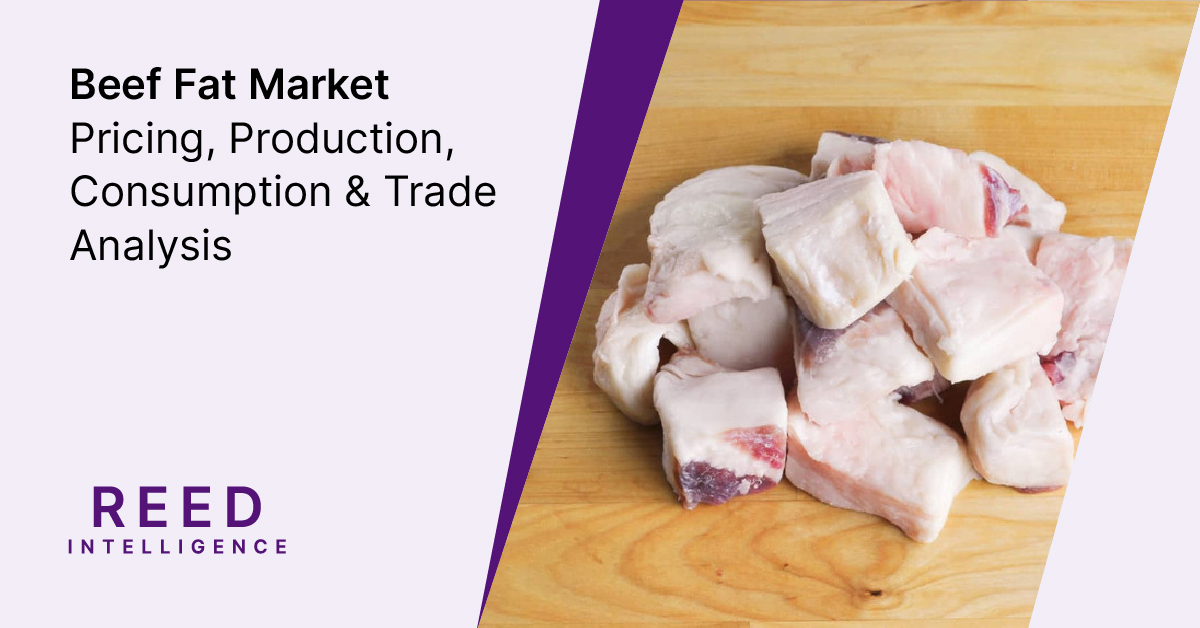
The Beef Fat Market plays a critical role in multiple industrial sectors, including food processing, biodiesel production, oleochemicals, and animal feed. Beef fat, commonly processed into tallow, is a high-demand by-product of the global meat industry with versatile applications across both developed and emerging economies.
Global beef fat output is estimated at 3.5–4.2 million metric tons annually, driven primarily by large-scale meat processing industries. In parallel, average industrial pricing for refined beef tallow ranges between USD 650–1,250 per metric ton, depending on purity, region, and end-use application. Rising demand from biofuel production and cosmetics manufacturing continues to reshape global trade flows.
Pricing Analysis in the Beef Fat Market
Beef fat pricing is highly sensitive to livestock supply, rendering capacity, energy costs, and demand from downstream industries such as biodiesel and food processing.
Key pricing indicators include:
-
Industrial-grade beef tallow prices range between USD 650–1,250 per metric ton
-
Food-grade refined beef fat commands a premium of USD 1,100–1,600 per metric ton
-
Low-grade animal feed fat is priced lower, typically around USD 500–800 per metric ton
Price volatility is influenced by cattle slaughter rates, which can fluctuate by 4–7% annually depending on feed availability and climatic conditions. Additionally, energy-intensive rendering processes account for nearly 18–22% of total production cost, directly impacting final pricing.
In biodiesel markets, beef fat competes with vegetable oils, but its cost advantage of approximately 10–15% lower input cost per ton of fuel output strengthens demand during periods of vegetable oil price inflation.
Production Analysis of Beef Fat
Beef fat production is closely tied to global beef slaughter volumes and meat processing efficiency. Major producing regions include North America, South America, Europe, and parts of Asia-Pacific.
Key production metrics:
-
Global beef fat output: 3.5–4.2 million metric tons per year
-
United States contributes approximately 1.2–1.5 million metric tons annually
-
Brazil produces around 0.8–1.0 million metric tons
-
Europe accounts for nearly 0.7–0.9 million metric tons
Rendering efficiency plays a crucial role in yield optimization. Modern rendering facilities achieve fat recovery rates of up to 85–90% from raw animal by-products, significantly improving production efficiency.
Industrial expansion in emerging economies has increased processing capacity by nearly 12–18% over the last five years, driven by rising meat consumption and export-oriented livestock industries.
Additionally, approximately 60–65% of total beef fat output is converted into tallow, while the remaining fraction is used in low-grade feed applications or industrial waste recovery systems.
Consumption Analysis of Beef Fat Market
Consumption of beef fat is distributed across multiple industrial sectors, with biodiesel production emerging as the fastest-growing application segment.
Key consumption insights:
-
Biodiesel production accounts for 40–45% of total beef fat consumption
-
Food industry usage represents 25–30%
-
Animal feed applications account for 15–18%
-
Oleochemical and industrial uses consume the remaining 10–15%
Global biodiesel consumption derived from animal fats has increased steadily, with usage volumes exceeding 1.5 million metric tons annually.
In food processing, beef fat is widely used in bakery shortening, frying oils, and flavor enhancement products. Per capita consumption in high-meat-consuming countries ranges between 2.5–4.0 kg annually, while industrial demand in developing economies remains significantly lower at around 0.8–1.5 kg per capita.
The cosmetic and personal care industry also utilizes refined beef tallow in soaps and moisturizers, with demand growing at approximately 6–9% annually in volume terms, driven by rising interest in natural ingredients.
Import & Export Analysis
Global trade of beef fat is shaped by regional production surpluses and industrial demand centers.
Key trade indicators:
-
Global beef fat trade volume exceeds 2.2–2.8 million metric tons annually
-
Exporting countries supply nearly 55–60% of total production to international markets
-
The United States exports around 0.6–0.8 million metric tons annually
-
Brazil exports approximately 0.5–0.7 million metric tons
-
Europe collectively exports close to 0.4–0.6 million metric tons
On the import side, Asia-Pacific and the Middle East are major consumers:
-
China imports nearly 0.7–0.9 million metric tons annually, primarily for biodiesel and industrial applications
-
India imports approximately 0.3–0.4 million metric tons, largely for oleochemical processing
-
Middle Eastern countries collectively import around 0.2–0.3 million metric tons
The total global trade value of beef fat is estimated at USD 2.5–3.2 billion annually, reflecting strong industrial dependence and price-linked volatility.
Trade flows are highly responsive to energy market conditions, particularly crude oil prices, which influence biodiesel blending economics.
Supply Chain Analysis
The beef fat supply chain is multi-layered, beginning at livestock farming and extending to industrial processing and end-use manufacturing.
1. Livestock Production
Cattle farming is the primary upstream source. Feed costs represent nearly 60–65% of total livestock production expenses, directly influencing slaughter rates and fat availability.
2. Slaughtering & Meat Processing
Beef fat is collected during slaughtering operations, where by-products account for 25–35% of total carcass weight. Efficient meat processors maximize fat recovery during this stage.
3. Rendering Industry
Rendering plants convert raw fat into usable tallow. Energy consumption in rendering accounts for 18–22% of operational costs, making energy efficiency a key competitive factor.
4. Refining & Processing
Refined beef fat is processed into food-grade, feed-grade, or industrial-grade outputs. Refining improves purity levels to over 99% in high-grade applications.
5. Distribution & End Use
Final products are distributed to biodiesel plants, food manufacturers, cosmetics companies, and chemical industries. Logistics costs contribute approximately 8–12% of final product pricing, especially in cross-border trade.
Conclusion
The Beef Fat Market demonstrates strong industrial integration across energy, food, and chemical sectors. With global production exceeding 3.5–4.2 million metric tons annually and trade volumes nearing 2.8 million metric tons, the market remains structurally important for multiple value chains.
Pricing remains volatile within the USD 650–1,250 per metric ton range, influenced by livestock cycles, energy costs, and competing vegetable oil markets. Consumption patterns are increasingly dominated by biodiesel demand, accounting for nearly half of total utilization, while food and industrial applications maintain steady demand.
Trade flows valued at over USD 2.5 billion annually highlight the strategic importance of beef fat in global commodity markets. Meanwhile, supply chain efficiency improvements and rising rendering capacity continue to enhance production output across major regions.
Overall, the Beef Fat Market is shaped by a dynamic balance of agricultural supply, industrial demand, and energy market linkages, making it a critical segment in the global fats and oils ecosystem.
Subscribe To our latest insights
200,000 users registered since January 2015
We’ve created the product that will help your startup to look even better
.png)